Jump to ratings and reviews
Rate this book

Strong Female Character

Rate this book
A summary of my book:

1. I'm diagnosed with autism 20 years after telling a doctor I had it.

2. My terrible Catholic childhood.

3. My friendship with an elderly man who runs the corner shop and is definitely not trying to groom me. I get groomed.

4. Homelessness.

5. Stripping.

6. More stripping but with more nervous breakdowns.

7. I hate everyone at uni and live with a psycho etc.

8. REDACTED as too spicy.

9. After everyone tells me I don't look autistic, I try to cure my autism and get addicted to Xanax.

10. REDACTED as too embarrassing.

288 pages, Hardcover

First published February 14, 2023

1735 people are currently reading
71091 people want to read

About the author

Fern Brady

1 book651 followers

Ratings & Reviews

What do you think?
Rate this book

Friends & Following

Create a free account to discover what your friends think of this book!

Community Reviews

5 stars
21,843 (53%)
4 stars
14,301 (35%)
3 stars
3,557 (8%)
2 stars
600 (1%)
1 star
174 (<1%)
Displaying 1 - 30 of 4,656 reviews
Profile Image for Josie Waller.
40 reviews7 followers
February 19, 2023
If you are going to read it, absolutely get the audiobook!
Profile Image for Lotte.
631 reviews1,132 followers
May 7, 2023
loved so so much about this, didn't love the internalised fatphobia (that fern clearly hasn't worked through yet) as much: there were quite a few derogatory descriptions of people's weights and looks in general that she then didn't properly reflect on (and that I guess were supposed to be funny??). this is basically my only reason for knocking one star off because it really bothered me after a while. apart from that it truly is a fantastic memoir!
Profile Image for Baba.
4,067 reviews1,511 followers
March 9, 2024
Without a doubt a world-class read, and the Goodreads blurb is spot on: "This is a book about how being a woman gets in the way of people's expectation of what autism should look like and, equally, how being autistic gets in the way of people's expectations of what a woman should look like."
A very personal and seemingly extraordinarily honest memoir of Fern's childhood, youth and adulthood as an undiagnosed autistic woman and how it did (and didn't) impact on her life. The beauty and appeal of this book is its frankness and Fern's ability to be so self aware in hindsight that the book is very much more informative and mind expanding and very far from some emotive sob-story.

Podcaster, comedienne and TV personality Fern is a truly amazing woman who has achieved so much primarily through hard-work and commitment; she managed to live some sort of life in her undiagnosed condition, although I honestly cant say if she would have achieved as much if she had been diagnosed, but that's a question for another place. Easily the best UK memoir I have ever read and a huge must-read recommendation from me to you. All the stars, 10 out of 12, Five star read.

2024 read
Profile Image for Brady Lockerby.
247 reviews117k followers
Read
April 27, 2025
by now, you all probably know what i’m going to say!
loved this on audio + just give all of the praise to anyone willing to share their life and story with us
Profile Image for Anya Smith.
298 reviews152 followers
February 13, 2023
4.5* (rounded up). An absolutely fantastic memoir - the experiences of autistic women are much needed, and as an autistic woman myself, I found Fern Brady's experiences to be incredibly relatable and refreshing. This is a memoir I will hold close to my heart for a long time to come-
Profile Image for Cecily.
1,320 reviews5,327 followers
September 22, 2024
Autism has become a hot topic in recent years. Diagnoses have increased massively, the possible link to vaccines was raised and debunked (but persists), possible “treatments” are fiercely debated, Asperger’s has been deprecated as a label, and awareness has grown of how symptoms in girls and women usually differ from the more familiar male tropes (it’s the intensity of obsession that’s significant, not that they’re inherently niche). That’s reflected in the popularity of fictional protagonists who seem to be “on the spectrum”, even if it’s not explicitly stated.

Like many allistic (non-autistic) neurotypicals, I know a variety of autistic people. I have also watched documentaries by Temple Grandin, read a fair bit about autism, and think I have thought I had some understanding of how it can present and feel. This book opened my eyes far wider, especially about autistic women. Brady has a knack for explaining things in an authoritative (with footnotes to research articles) and relatable way, without ever talking down to the reader.

Parts of it are shocking, parts are funny, some of it is both. All of it is informative and compelling: I read it in a single day.

If you’ve ever started school midway through the school year or been the new person at work and felt lost - it’s that feeling. Except you never just pick up on stuff or fall in line eventually; it’s a constant sense that everyone is in a WhatsApp group you don’t know about.


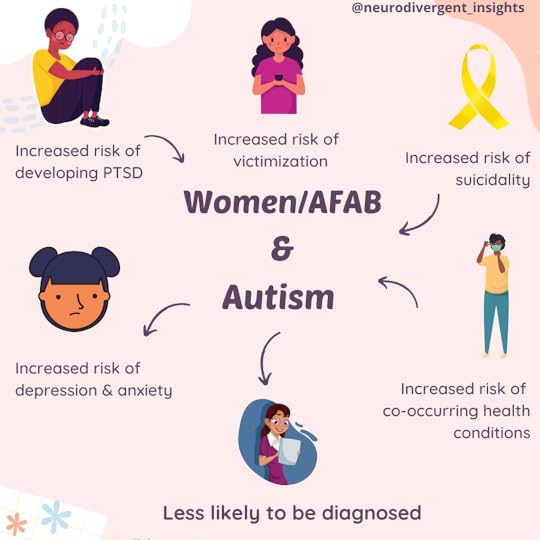
Image: Increased risks for women and AFAB with autism: victimisation, PTSD, suicidality, depression, anxiety, and co-occurring health conditions, BUT less likely to be diagnosed than men/AMAB (Source)

Memoir

Fern Brady is a standup comedian from a working class Roman Catholic family in a small town between Glasgow and Edinburgh. I first encountered her in Series 14 of Taskmaster, in 2022. This book was published in 2023, when she was in her mid-thirties.

As a child, she was clever, bored, solitary (her best friend was a tree), and deemed bad and difficult. She first attempted suicide aged eight. At a teen mental health unit, she was told she couldn’t be autistic because she made eye contact and had a boyfriend. She eventually escaped to university:
I didn't have to kill myself for now.
But she didn’t fit in there either (social class became another axis of difference), though she did eventually graduate.

She abused medication and weed, self-harmed, got into debt, had episodes of homeless sofa-surfing, lots of casual sex with men and women, at least one very abusive relationship, and worked as a stripper. She describes stripping as another type of masking, and somewhat positive: routine, rules, bouncers to evict anyone problematic, it’s hard to get sacked, and the misogyny was visible and clear.

She was eventually diagnosed as autistic during Covid lockdown, and discusses some of the conditions and circumstances that are more common in autistic people, such as OCD, depression, PTSD, eating disorders, ADHD, and alexithymia (limited ability to recognise and describe emotions).


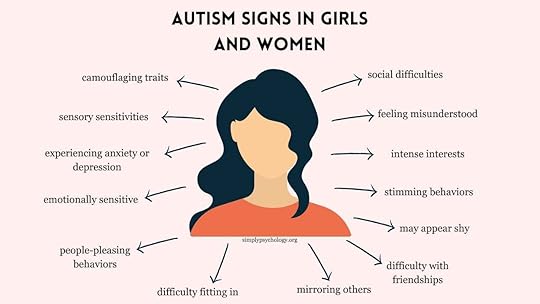
Image: Autism signs in women: camouflaging, sensory sensitivities, anxiety or depression, emotionally sensitive, people-pleasing, difficulty fitting in, mirroring others, difficulties with friendships, appears shy, stimming, intense interests, feeling misunderstood, and social difficulties (Source)

Meltdowns

Trying to stop a meltdown feels similar to trying to hold your breath.
Brady says this is not discussed enough, and I agree. I had no idea that meltdowns (literally smashing up her home) were an issue for high-functioning adults, let alone those, like Brady, with a successful career, a supportive partner, and with a diagnosis that finally makes sense of her place in the world. She likens them to explosive diarrhoea: she can usually postpone them until she gets home, or away from people, but not always.

Meltdowns are a consequence of ignoring sensory over-stimulation; they’re not about anger or being manipulative. Hitting herself over the head is:
Akin to someone slapping an analogue telly that’s on the blink.

She says arresting people having meltdowns (including children, and she cites specific cases) is like saying epilepsy is demonic.

There are also shutdowns, which are less dramatic, and just look like sulking.

Family

Brady sees her parents as driven by over-protective instincts, and a strong desire to avoid family shame. At 14, she didn’t know how to catch a bus, and shocked her mother, first by buying tampons, and later by taking the initiative to access contraception. Nevertheless, her mother nurtured her puzzling passion for books, theatre club, piano lessons, and obscure foreign languages.

In a very telling passage, she compares memories of being a flower girl at a wedding. As the family tell it, she was wearing a pretty dress, then “for no reason”, she had a meltdown (screaming and tearing her dress), “exactly like the child from The Omen”, and was taken outside and slapped. Despite being given some Chewits (candy), she wouldn’t pose for photos.
My recollection of it is this: a group of people stopped me from playing and put me in an itchy lace dress that felt like fire ants crawling all over my skin. They then braided my hair so tightly my entire scalp felt like it was being clamped in a vice. I ran out to the garden… to try to get rid of the unbearable feeling… Someone beat me and dragged me back inside, tightly re-braiding my hair… I’d venture a guess that no one who has just experienced a meltdown is up for doing a photo shoot, with or without Chewits.


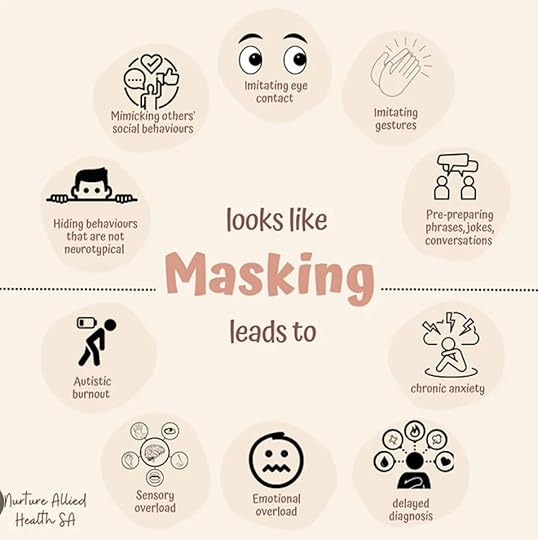
Image: Masking tactics (hiding autistic behaviours, mimicking others' social behaviours including eye contact and gestures, and pre-preparing phrases, jokes and conversations) and possible consequences (burnout, sensory overload, emotional overload, chronic anxiety, delayed diagnosis) (Source)

Quotes

• “People would impose their friendship on me” - and often, take advantage of her credulity.

• “Every attempt to fit in resulted in me being more weird and more isolated from normal people.”

• “If you could be fluent in a foreign language then surely you could become fluent in social skills.” Or so she thought, as she searched online for tips, which she then applied over-specifically.

• “I tried and failed to be the best at masking.”
“All I felt was the suffocating horror that I was failing at being clever.”

• “Autistic women speak out of turn a lot… [with] direct honesty… [and] an almost childlike sense of injustice.”

• “Honesty is powerful but it’s not something that comes easily to allistic people because they’re so driven to fit in with others that they prize collective values over truth.” She explains it’s probably why autistic people often fail to get parole: they don’t express false regret.

• “Autistic people often require much lower doses of antidepressants than non-autistic people do. Her [Temple Grandin’s] argument is that our nervous systems are so sensitive that we need less of everything - alcohol, recreational drugs, caffeine - for it to have an impact.”

• “I believe there’s a significant number of autistic women who have sex freely because we’ve little regard for gender norms or complex social hierarchies (for example, promiscuity carries a heavy social cost as a woman) and it’s sensorily enjoyable.”

• “The dropout rate for autistic [university] students is ten times higher than for non-autistic students and it’s thought that’s because most students tend to help each other by ‘crowdsourcing’ information from their peers”, like where the lecture theatre is and how to work the washing machine.”

• “Defining yourself as the girlfriend of someone impressive was easier than working out who you were… especially if you’re a weird woman.”

• “If you’re prepared to be thin you will be rewarded with money and status… in short supply for most autistic women.”

• “I frequently had the sense that a madwoman was driving the car of my life while I sat in the back seat observing.”

Autism in fiction

In contrast to Brady’s “own voices” memoir, here are some novels that seem to have a main character who is on the spectrum, and whose authors are not, as far as I know, autistic. This is a very unscientific list, but I spot a pattern:

• Bonnie Garmus’ Lessons in Chemistry, 2022 (woman). See my 2* review HERE.

• Catherine Lacey’s Pew, 2020 (adult of ambiguous gender). See my 5* review HERE.

• Ottessa Moshfegh’s My Year of Rest and Relaxation, 2018 (woman). See my 2* review HERE.

• Gail Honeyman’s Eleanor Oliphant Is Completely Fine, 2017 (woman).

• Sayaka Murata’s Convenience Store Woman, 2016 (woman).

• Becky Chambers’ A Closed and Common Orbit, 2016 (AI woman). See my 4* review HERE.

• David Mitchell’s Slade House, 2015 (boy). See my 3* review HERE.

• Jonas Karlsson’s Room, 2014 (man). See my 4* review HERE.

• Graeme Simsion’s The Rosie Project, 2013 (man).

• Rief Larsen’s Selected Works of TS Spivet, 2009 (boy). See my 4* review HERE.

• Maggie O'Farrell’s The Vanishing Act of Esme Lennox, 2006 (girl/woman). See my 4* review HERE.

• Mark Haddon’s The Curious Incident of the Dog in the Night-time, 2003 (boy). See my 5* review HERE.

• Yōko Agawa’s The Housekeeper and the Professor, 2003 (boy). See my 3* review HERE.

• Doris Lessing’s The Fifth Child, 1988 (boy). See my 4* review HERE.

• Iris Murdoch’s A Word Child, 1975 (man). See my 4* review HERE.

• Herman Melville’s Bartleby the Scrivener, 1853 (man). See my 5* review HERE.

• Nikolai Gogol's The Overcoat, 1842 (man). See my 5* review HERE.
Profile Image for Darren.
183 reviews85 followers
February 19, 2025
One of the best autobiographies I've ever read. I knew Fern mainly from a few panel shows she was on and also taskmaster. So I knew before reading this a little bit about her due to the fact that she has talked a lot about her autism diagnosis.

I wasn't expecting her to have gone through so much in her 30 odd years. She's goes into great detail about her autism, her sex life, her mental breakdown, self mutilation, being physically attacked by an ex partner. She also mentions terrible things that have happened to her in a matter of fact way as if she's simply describing buying milk.

I can see that the book might be triggering for some people. I loved how self deprecating she is and how completely unfiltered she is. She's just brutally honest about everything

A phenomenal book and one that has made me an ultimate Fern fan

Highly recommended
Profile Image for Jennie Tay.
86 reviews2 followers
December 12, 2023
I wish I’d left my worldview of Fern Brady as it was instead of reading this book. None of her story threw me. She went through some truly complicated shit while dealing with undiagnosed autism, something that our world does not yet understand (and worse, isn’t exactly trying to get more information about) and I feel so much for her. It’s amazing the situation she climbed her way out of and I commend her for being where she is today. But this book suggests that she’s a mean spirited person. The number of insults in this book directed at people she didn’t even interact with was wild. And after reading, I’m concerned that she would go ‘well I’m autistic, I say what I think’ despite multiple portions of the book calling others out for their bullying. The bullied becomes the bully and I’m not here for it. I think she has a lot of trauma she hasn’t dealt with and I really wish her luck on her journey dealing with that.
Profile Image for Lisa Vegan.
2,911 reviews1,314 followers
September 8, 2023
I’m not sure I was supposed to be laughing most of the way through this book but she is funny, even when writing about serious things. It did get deep/dark though and I didn’t laugh the whole way through but I did smile a lot and she does tell her story in an entertaining way and most often in an amusing manner.

“I’m aware that this process was called the Liverpool Care Pathway by the NHS but for reasons outlined elsewhere in the book, I don’t do well with obfuscating language. I think if we called it ‘starving and dehydrating someone to death’ a lot more of us would become pro-euthanasia overnight.”

“I realized that those people who say money isn’t everything are liars.”

I figured that she would be a great stand-up comic. I looked online and watched part of a few videos of her routines and I do think she is funny. Great writing and delivery & timing.

This memoir? I loved it. I found it hilarious. I found her perspicacious honesty funny and touching too. I greatly appreciate how the author explains (at least her) autism incredibly well and that I think readers will come away with an understanding of people with autism and the behaviors they might have. I’d like to put this book into the hands of most readers, particularly doctors, therapists, teachers and others It’s a must read for parents of people diagnosed with autism and I think it will help people with autism, those diagnosed with the condition and those not yet diagnosed. I also love how she takes a good hard look at society and is a feminist.

I simultaneously read the Kindle e-book edition and the Libby audiobook edition. I love her Scottish accent. With a memoir I’ll listen (in addition to reading the words on the page or screen) only if the author is the narrator and she is for this book.
Profile Image for &#x1f336; peppersocks &#x1f9e6;.
1,522 reviews24 followers
February 22, 2023
Reflections and lessons learned:
“The public perception of autistics is so heavily based on the stereotype of men who love trains or science that many women miss out on diagnosis and thought of as studious instead…”

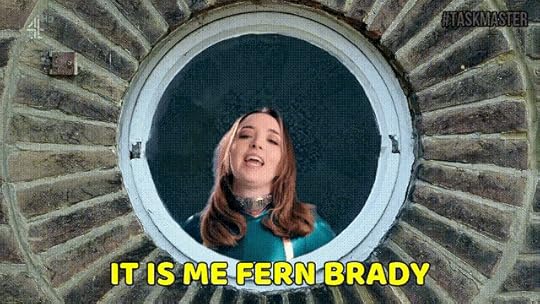
I only knew a bit about Fern Brady, and had bits of that altered whilst watching Taskmaster (singing: mefernbrady, mefernbrady!), but this was much more personal and to be honest, harrowing than I expected it to be. I feel that I learned a lot from this on multiple different areas - some which I needed to learn more about (identifiable first hand experience characteristics of being neurodivergent, Protestant upbringing) and some that are brutal and I’d rather have avoided, but are still parts of life that some experience. Brave in an unexpected way without seemingly looking for anything from the audience apart from understanding
Profile Image for Katya.
78 reviews3 followers
January 26, 2025
This book pulls no punches. Fern Brady's childhood and early adulthood as an undiagnosed autistic woman reads like a hurricane of trauma. She makes it clear that she's not out of the storm, having to unpack years of masking and battle societal pressures to be neurotypical, but the fact that she's written this book is so important.

I think it achieves her intention of bringing awareness to a disability that is still not properly understood, especially when it manifests in women and girls – and it achieves it without sugarcoating or shying away from traumatic or devastating experiences. It's her matter-of-fact way of writing and observing the world that shows how difficult and frustrating it is to be in a society that never says what it means, or means what it says. Especially as she, as a woman, has a view of herself, her body, her sexuality, her talent and worth, in a way that society can't quite infiltrate. It's enviable. But it just goes to show how women bend themselves into all sorts of shapes just to fit in; I can't imagine what it's like being autistic under all that existing pressure.

I found the book really readable, although I often struggled to find the flow of it. I was aware that there was (to use the damned phrase) "a journey of discovery" going on, but sometimes the narrative jumped about and I wasn't quite sure what order events occurred, and it felt more like a list of events than anything else. But I really liked her (often brutal) honesty and observation. Definitely worth a read if you want to learn more about what it's like to live (and hide your life) as an autistic woman – but buckle in. It's a rollercoaster.

[Thanks to Octopus Books for sending me a proof!]
Profile Image for leah.
518 reviews3,374 followers
March 3, 2024
an expectedly funny but also vulnerable and honest depiction of neurodiversity and the struggle of diagnosis for women with autism.
Profile Image for skeptic .
330 reviews4 followers
January 10, 2024
Brady attacks women a lot. Thankfully it's usually just nasty words about how they are fat or ugly but I absolutely lost all respect for this author the moment she angrily smashes a bottle on a woman's head and then essentially claims that undiagnosed autism made her do it.

I am ok with a self centered narrator. I also do not need women to be traditonally likeable or whatever. But I also knew it was probably a bad sign that she claimed the term "pickme" was specifically harming autistic women (read: just her) and the way she speaks/acts towards/uses women while trying to prove her bisexuality is gross and at best, disrespectful. (IWhy is my boyfriend mad that i cheated with a woman who thought i was single? Doesn't he know that women dont really count ?) She seems genuinely uninterested in ever treating other people better??? And when her mean-spirited behavior results in losing access to people, she is quick to chalk it up to autism. I was actually surprised that she had a boyfriend who was able to endure super abusive behavior and she either doesn't care or realize that she talks about him like an emotional support animal she hardly likes being around?

I wanted something redeeming about the author....but I didn't find anything more complex or interesting than internalized misogyny. Her 'insights' were always just justifications for being mean to other women and it seemed pretty clear that the author would not be looking further into THAT at all.
Profile Image for Silvia Almeida.
37 reviews8 followers
April 5, 2023
The system fails autistic women every single day. It always goes like ‘we should all be inclusive’ or ‘it is so okay that you are autistic’, but then condeming the specific behaviors that are autistic traits. This kind of hypocricy leaves autistic individuals in constant danger and suffering, in constant need of hiding behind a mask.

Everyone who thinks autism has a look and mostly thinks of Sheldon Copper when being told ‘I’m autistic’, this book is for you! It is also for the entire world because Fern is brilliant at explaining autism in late-diagnosed women with perfect terminology and letting her story speak for itself.

It discusses masking, and why women tend to be late-diagnosed while feeling like an alien their whole lives. It discusses patriarchy, homelessness, and what being a stripper means as an autistic woman. It describes what it means to hide your authentic self to fit in, and end up being severaly ill and burnt out.

I shed many tears reading this book as it made me feel so seen, and I will forever be recommending it.
Profile Image for Betsy Robinson.
Author 11 books1,228 followers
July 8, 2023
Part of autistic survival is learning to unpick social dynamics. I liked that in a strip club men’s contempt of you was out in the open. In the outside world, misogyny was always hovering in your peripheral vision, meaning you could never quite trust your instincts. In a strip club, groups of men are in a safe space where they’re encouraged to play up to hypermasculine ideas—and because they believe no one in power is watching them they project all their shame and irregular feelings about women onto the strippers, who they believe exist in a vacuum and won’t ever speak out about their behavior or, say, write about it in a tell-all memoir. (180-181)
International comedian sensation Fern Brady (who I’d never heard of until actor Bob Odenkirk recommended this memoir on Twitter) has written an educative memoir about learning in adulthood that she is autistic.

There was much I resonated with, even though I’m not autistic (I learned that unequivocally). I never have any problem intuiting what is going on in social situations or trusting my instincts, but oh how I resonate with Brady’s hard-won conclusions—as in the case of the above quote.

Chapter 13 is a description of what causes a meltdown and a blow-by-blow of an autistic person’s brain experience that anybody who wants to know about autism should read, and it should be a requirement for law enforcement officers who so often are called upon to deal with people going through something they have no understanding of. I give this chapter a standing ovation and wish somebody would base a course on it that would be widely offered. I knew nothing about most of this and I feel as if will affect me for the rest of my life.

And the final chapter 14 is perfect. Fern Brady is simply brilliant.

There is humor in Strong Female Character, but overall this is not a terribly funny book. Brady’s life is exhausting. But she’s smart, writes well, and has a much-needed story to tell.
Profile Image for Rosamund Taylor.
Author 2 books200 followers
April 4, 2023
I'm usually wary of books written by anyone with a degree of fame, because they're so often about how great all the famous people they know are, and how exciting it is to be on TV. But Fern Brady's book is nothing like that: it is a furious, intelligent and gripping description of growing up as an undiagnosed autistic in working-class Scotland. She barely touched on her work as a comedian. Brady always felt that people didn't like her, including her own family. Things that seemed normal or intuitive to others were completely alien to her, and she was constantly distressed. During her teenage years, life became more and more unbearable, and she found herself in a psychiatric unit, and went through periods of homelessness and domestic abuse. Fiercely intelligent, she secured a place in Edinburgh university, and worked as a stripper to pay for accommodation and food, as she juggled essays and unpaid internships at newspapers.

Brady examines what it's like to be autistic in an uncaring world, and her writing is completely unsentimental: she shows the disadvantages of living with a different neurotype, and the ways people are damaged and cast aside by the wider system. Brady writes in a pared-back vernacular, using words like "'cause" and "dunno", which sometimes seem at odds with the careful research behind her work, and the series of footnotes and works she cites, but which also makes the narrative very accessible and readable. I really admired the book's furious honestly -- its refusal to offer comfort or false hope, and Brady's demand that we see autistic people as having agency and inalienable human rights. As an autistic person, although it's very bleak, I found it comforting to see this experiences written about with such clarity and honesty. I would highly recommend it to other autistic people, as well as anyone interested in reading a compelling memoir.
Profile Image for Haley Jean.
381 reviews4,066 followers
January 8, 2025
“It's very painful to start loving someone when holding on to the idea of hating them keeps you safe.”
4⭐️ a fantastically blunt memoir from an autistic woman who received a later diagnosis but showed clear symptoms her entire life.
i laughed (A LOT). i learned so much. i even cried a little! i hope fern writes more!
if you have an autistic loved one: READ THIS!

just a few of my favorite quotes:
“It's uncomfortable that this isn't all good or all bad or a happy ending or a sad ending, but just a mess that everyone muddled through. It's very painful to start loving someone when holding on to the idea of hating them keeps you safe.”

“I was continually over-identifying with fiction to try and find a template for myself and my story.”

“I wasn't sure how they'd got mental illness conflated with me having done something wrong but there didn't seem to be any chance of reasoning with them now.”

“Arguably, men made me hate men; stripping just let me see them at their most men-ish.”

“Reading about why stripping is appealing to some autistic women, my pragmatic views made sense: of course I enjoyed a job that was highly tolerant of weirdos, almost impossible to get sacked from, had none of the fluorescent lighting that made most offices or supermarket jobs overwhelming, involved the same routine night after night and the same dumb conversations with no tricky social cues to read.”

“Their question implied that stripping had clouded my judgement and made me a grizzled hag gazing angrily into the middle distance rather than giving me perfect clarity over the fact that the world hates women.”

“How were you supposed to know not to mention necrophilia at Christmas dinner?!”

Profile Image for C.L. Taylor.
Author 26 books3,436 followers
May 31, 2023
Without doubt the best memoir I've listened to this year. Whether you're autistic, or you're not, I guarantee that Fern will entertain, astonish and educate you. You'll laugh, you'll cringe, you'll feel desperately sorry for her, and you'll applaud her bravery. One hell of a listen. Buy it now.
21 reviews
June 20, 2023
I first became aware of Fern Brady when she was on Taskmaster, and though I did not find her entertaining on the show, I was hopeful with this book to learn more about her. Unfortunately, I found this book to be much like her comedy on the show -- I couldn’t wait for it to be over.

Like many other reviewers have stated, the writing really lacks structure, but perhaps this was done to show how she processes and conveys information in general. She does talk in this book as if she is some authority on autism because of her diagnosis, making generalizations about autism as if they are fact because she exhibits the behavior. Speaking of behavior, it does appear as though she at times treats people poorly under the guise of her diagnosis.

As Fern Brady likes to say, “I’m soooo tired…,” so I’m going to end this review.
Profile Image for mae.
98 reviews14 followers
Read
August 13, 2024
I don't know what to say that won't make me feel really overly vulnerable. this book made me feel less broken and generally just a bit more accepting of myself and my reality. Lol
Profile Image for Polly.
7 reviews1 follower
July 12, 2023
Bit (a lot) fatphobic and demeaning towards people Fern deems to be stupid
Profile Image for Anna.
1,077 reviews832 followers
November 26, 2023
DNF 71% Didn’t enjoy the writing nor found it particularly funny. She includes second-hand anecdotes purely for shock value, like the one about the guy with Down’s syndrome at the strip club. Also, the way she describes people’s appearance and makes generalisations about autism grated on me. Not a 1-star, because I think the author is being her genuine mean-spirited self, with no apologies left or right, so hats off to that! I’m just not obliged to like it.
Profile Image for Lola Keeley.
Author 12 books418 followers
May 3, 2023
Honest, searingly personal, and I've just never understood autism as well as I do after reading these pages. What a brave and wonderful book to put out in the world.
Profile Image for Julia.
475 reviews17 followers
October 31, 2023
DNF @60% though I skimmed through to the end. I have lots of thoughts but most are best left unsaid, but can I resist?! I came to this book via autism-in-adult-women channels and had no idea who Fern Brady was; if I'd realized she was a well known comic, I would've passed (books by famous personalities aren't my cup of tea in general and this one is probably best appreciated by her fans). Here's my conclusion as someone who is probably autistic (aka "self-diagnosed" in autism communities' terms) and who knows more than a handful of adult women (and men) in various stages of formal and informal diagnosis by mental health professionals...: Fern Brady is an asshole, and autistic. She seems to be getting to grips with one of these conditions, while seemingly being oblivious to the other. She blames her asshole behavior entirely on autism while failing to do a bare minimum of self-reflection or accepting any accountability, which a lot of reviews alluded to via such euphemisms as "she has not processed her trauma". There's no doubt she's had a difficult childhood, but she is not the only one, and most of us don't go around physically attacking people we barely know resulting in stitches being needed, with zero remorse. Or repeatedly cheat on our partners, or skip out on owed rent, or just generally deliberately act like assholes.

At about one third of the way through I started having a feeling that something wasn't adding up in her story and that feeling only intensified as I went on. Was she lying? I felt like I was being lied to, but I didn't feel like she was lying. Was she exaggerating? Maybe? I could relate to the things she spoke of, but at a less extreme level, with far less drama. Switching to the audiobook for a bit I didn't get the sense of her embellishing the stories but that "something's off" feeling remained. After giving it some thought, I believe I've figured it out. Fern isn't lying, and probably is not deliberately exaggerating but the whole lack of reflection thing (see above re "unprocessed trauma") is making it seem that way, but I think what I'm picking up on are the things she's omitting from her stories. Things that would explain why certain people in her life behaved a certain way towards her for no apparent reason. I'd love to hear her mother's or her partners' perspective on certain events, for example.

Anyway. Two stars for bringing some attention to autism in adult women (though whether it's a net positive or a net negative given the kind of attention, the jury is still out). I hope Fern continues getting help because, honestly, she has bigger problems than autism.

Trigger warnings for pretty much everything you can think of, including extreme levels of smugness.
Profile Image for Sarah.
7 reviews1 follower
August 16, 2023
Lost a star due to her constant negative comments about people’s appearance, even those mentioned once and fat-phobia. I preferred when she told her own story of her life rather than constantly saying ‘autistic people do x y z’ which implies (after the 30th time it’s been said) that people’s experience with autism is a monolith rather than a hugely varied experience.
Profile Image for Melanie.
560 reviews276 followers
August 21, 2023
Related to much in terms of upbringing as an undiagnosed autistic girl and the violence and abuse we often experience.

I liked reading it but also hated reading it. I have it two stars but it might also be 4 stars. Truth is: I don’t know how to feel. Felt very close to home and also very alien. Triggered me also no end. It will take a while to come down from this.
Profile Image for Lizzy.
964 reviews1 follower
May 19, 2024
I think it’s an important book and hearing more about the experiences of autistic women is important. However, Fern Brady comes across as bullying and needlessly cruel to others, perhaps as a defensive mechanism, while constantly criticizing others for cruelty and bullying behavior. She’s undoubtedly had a rough, stressful life, and earlier diagnosis would’ve helped. I appreciated her candor. But she seems to lack self-awareness about some areas. Her fatphobia and derogatory remarks on people (often women’s) appearances, while going on feminist rants about other topics seems particularly egregious. She doesn’t seem to really come to terms with her own disordered eating, focusing on it only from an autistic angle. Very much seems to understand feminism as a “let me do what I want” way, and not offering that graciousness to women who think differently than her. She seems to see everything as Autism vs Neurotypical, assuming everyone else is “Neurotypical,” while seeming to ignore evidence others may be having their own mental illness issues. There’s a lot of the modern perspective of mental illness being a defining part of an identity and conflating it with personality. A need to label everything in terms of a diagnosis (one that is an arbitrary social construct in its own way) and the idea that a specific diagnosis is needed to really solve one’s issues. Instead of realizing you can be autistic and have other things going on, that also need addressing. There are definitely some good points and perspectives, but a lot of this feels very disorganized. Maybe intentional, to mirror her way of thinking. But I don’t know, maybe this would’ve been better in a few years, with more perspective and growth and wisdom. I feel many celebrities write memoirs really young, and their books feel underbaked. Definitely worth reading for her unique perspectives and experiences, but ultimately it felt like she was trying to be like “hey I did this all because I was autistic and everyone sucked for not helping me!” Like there’s insufficient support for autistic women now, imagine how overwhelming it would be to be a Scottish Catholic family decades ago trying to handle this degree of mental illness when the doctors and schools aren’t recognizing it. There’s no standard way to be mentally ill, and it felt like she cherry-picked data and stories to feel better about her own choices. I feel like many of the things she describe are not true for many autistic women, although are presented as if Autistic Women are a monolith. Not that she needs to include it, but it might have been helpful to better present ways people can support her and other women with autism, and what sorts of accommodations might be helpful.

Also, many of the ways she presents sexuality seem unkind or overly limited to her own perspective. Judging women for being virgin losers or assuming they’re too scared to admit to being bisexual or otherwise judging other women for sexuality differing from her own seems like a reactionary swing to the opposite side of the hyper-conservative Catholic upbringing she had. It’s confusing reading about her sex work, because a lot of it does seem exploitative of her autism, but it also in some ways is freeing. Maybe both are true. Women are allowed to find sex work objectifying, or not wish to explore queer relationships, or want to have kids and marry, or find having 4 sexual partners in week a bit much, etc. Judging other women for not having as much sex as her and then being hypocritically mad at them for judging her for having so much sex and being a stripper. Another unfortunate book touted as feminist that seems to over-rely on the outdated Virgin Whore Crone archetypes of womanhood. Women are ugly and old and disgusting or pathetic virgins who are afraid of sex because of patriarchy or very sexual and comfortable with their bodies. Doesn’t feel like there’s much room for nuance here, or for accepting of others’ views of their own womanhood. If only it was easier to decenter men and sex and patriarchy. It feels like Fern is unaware of how much she has internalized society’s standards, despite portraying herself as a life-long alien outsider, and maybe should re-evaluate some of her own biases.
Profile Image for Liralen.
3,338 reviews275 followers
May 31, 2023
You might know Fern Brady as a comedian—I know of her from the show Taskmaster, where contestants complete ridiculous tasks and then have a good laugh about them. But Strong Female Character isn't about comedy; it's about Brady's experience growing up while viewing the world through undiagnosed autism.

It has to be said: celebrity memoirs are almost always at their best when the writer is writing about something other than their work (think Jennette McCurdy, Evanna Lynch, Allison Moorer). But it also has to be said: Brady is funny from start to finish here, despite the often wildly stressful material of the book. She pulls no punches, delivering an incisive criticism of the way society treats those who are "different", and of the limited view of autism held by many medical professionals. (Told by one doctor that she couldn't possibly be autistic because she'd had boyfriends, she notes that the diagnostic criteria for autism are based on eight-year-old boys in Vienna in the 1930s, and that it's not surprising that none of them would have had boyfriends.)

The ending is a bit condensed, I think because there's an extent to which this is all still something she's figuring out—she talks a lot about what she has learned about what autism means for her, and what things contribute to overload, and what things help her reset, but this is very much a book she wouldn't have been able to write—or articulate—even five years ago, and I expect that in a few more years she'll have more insights. That's not a bad thing in this case, and I'm just going to hang out over here hoping that Strong Female Character does well enough that somewhere down the line Brady will write another book, because whether it's a follow-up memoir or something else entirely I expect it'll be fascinating and hilarious.

I don't really listen to audiobooks, but I bet the audio version of this is fantastic. At the very least, if you've seen Brady perform, you'll be able to read this with her in your head throughout. Highly recommend.

Thanks to the author and publisher for providing a review copy through NetGalley.
Profile Image for Barb.
3 reviews
January 27, 2024
I appreciate Fern's honesty, and that she's been through a lot in her life.

However, not knowing anything about her outside of her own description of herself, I'm getting the impression of an awful human being who constantly complains and has no issue using people until they no longer serve their purpose. I cannot recall a single positive thing throughout the entire book, everything is so negative! The way she describes other people and puts them down for the way they look, especially women, is simply mind-boggling. There's zero accountability throughout the book, apparently it's fine to physically attack people and blame it on autism. Also, the focus on the author's sexual experiences was a bit concerning to me.

Fern seems very angry with life and I think she has a lot of work ahead of herself before she realises that life is tough on everyone and we all spend most of the time pretending to be something we aren't. I'm not saying it's okay but she seems to be stuck on the idea that if you're an 'allistic' person, you live life on easy mode, which simply isn't true.

I'm glad the book exists as it certainly sparks up some much-needed conversations about the topic but otherwise can't say I've enjoyed it at all, which sucks because I was quite excited to read this one.
Profile Image for Ray.
698 reviews152 followers
October 1, 2025
What a book. I would give this six stars if I could. Read in a single day, a rare event for me nowadays.

Fern Brady is a Scottish comedian, currently living in exile in London. The starting point for the book is an autism diagnosis as an adult, which is then used to explore and explain events in her life. And what a life, though only in her thirties Fern has packed a lot in - the book takes us to mental health units, strip clubs, domestic abuse, drugs and alcohol, Edinburgh University and lands with Fern finding her feet as a successful comic.

The autism means that Fern does not really fit in anywhere, or more accurately means that she cannot follow societies hidden rules and etiquette. Time and time again an inability to understand peoples mannerisms or motives and her own literalness and lack of flexibility causes problems and pain.

The uplifting part is that after the diagnosis Fern takes time to analyse and learn about how her mind and the minds of others work and finds an accommodation with the world.

A poignant and important book. You should read it.
Displaying 1 - 30 of 4,656 reviews

Can't find what you're looking for?

Get help and learn more about the design.