
Jump to ratings and reviews
Rate this book

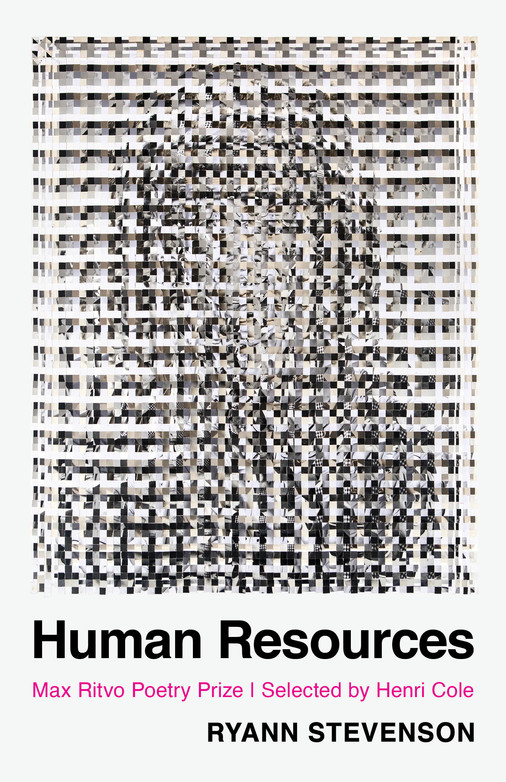
Human Resources

Rate this book
Winner of the Max Ritvo Poetry Prize, Ryann Stevenson’s Human Resources is a sobering and perceptive portrait of technology’s impact on connection and power.

Human Resources follows a woman working in the male-dominated world of AI, designing women that don’t exist. In discerning verse, she workshops the facial characteristics of a floating head named “Nia,” who her boss calls “his type”; she loses hours researching “June,” an oddly sexualized artificially intelligent oven; and she spends a whole day “trying to break” a female self-improvement bot. The speaker of Stevenson’s poems grapples with uneasiness and isolation, even as she endeavors to solve for these problems in her daily work. She attempts to harness control by eating clean, doing yoga, and searching for age-defying skin care, though she dreams “about the department / that women get reassigned to after they file / harassment complaints.” With sharp, lyrical intelligence, she imagines alternative realities where women exist not for the whims of men but for their own—where they become literal skyscrapers, towering over a world that never appreciated them.

Chilling and lucid, Human Resources challenges the minds programming our present and future to consider what serves the collective good. Something perhaps more thoughtful and human, Stevenson writes: “I want to say better.”

96 pages, Hardcover

First published June 14, 2022

9 people are currently reading
378 people want to read

About the author

Ryann Stevenson

3 books5 followers
Ryann Stevenson is the author of Human Resources, selected by Henri Cole as winner of the 2021 Max Ritvo Poetry Prize. Her poems have appeared in the Adroit Journal, American Letters & Commentary, Bennington Review, Columbia Poetry Review, Cortland Review, Denver Quarterly, and Linebreak, among others. She lives in Oakland, California.

Ratings & Reviews

What do you think?
Rate this book

Friends & Following

Create a free account to discover what your friends think of this book!

Community Reviews

5 stars
41 (27%)
4 stars
44 (29%)
3 stars
49 (32%)
2 stars
14 (9%)
1 star
3 (1%)
Displaying 1 - 29 of 29 reviews
Profile Image for s.penkevich [hiatus-will return-miss you all].
1,573 reviews14.8k followers
September 24, 2024
How did we get here,’ the speaker asks in various ways across Ryann Stevenson’s collection Human Resources. How have we reached our current era of technology-infused living, a world of social media influencers, a life where of choices with ‘each goal offered in a pod-shaped icon,’AI voices, zoom meetings, and all the anxieties of modern life. Winner of the Max Ritvo Poetry Prize, Stevenson’s poems are an insightful and fresh examination of the ways our lives are entwined with the futures of Silicon Valley, an industry she knows all too well from working on the inside of it. This brief collection is sharp and playful, contrasting the bots and batteries of our lives with the natural world, memories and mindfulness, interrogating the tech that connects us with the ways it isolates us, all while depicting the hostility to women in a man-driven industry.

I spend all day trying to break a female
bot who wants to coach me
to be my best self.


Working in a field developing AI voices, Stevenson told NPR that she began ‘thinking a lot about voice and disembodied speakers calling to an unknown user…to me, this had a direct correlation to poetry, the speaker of a poem, and the readers.’ The conversation of voices, human and non-human alike, hum as a melody of static in which these poems are born, questioning who we are in a world where we tell our live into social media only to find social media is merely a ‘story of it’s interpretation of you.’ Questions of authenticity and if we are truly connected or only further isolated by social media tech burn at the heart of this collection, an anxious tone building as if towards a crescendo of consciousness as the poems pile up.

We want them to look and act human
but not too real. Get it?
my boss said, touching the dip in a line graph—
the uncanny valley.


In the poem Anticipatory Design, Stevenson dives headlong into the ways the ease of technology seems to cheap us and remove our individuality, becoming simple marketing checkboxes to brands. As she explains in the notes, the title is a term for ‘aims to reduce the cognitive load of users by making data-driven decisions on their behalf,’ though is data-driven a true replacement for the decisions of the heart.

Anticipatory Design

I’m standing in the center
of the room that will house,
for the next 48 hours,
the sample sale, after
which, the exposed
brick decals will be peeled
off the walls, and,
much like a castle
in a children’s pop-up
book, the whole scene
will cease to exist.
Others who look
almost exactly like me—
save for a few identifying
details—swarm,
their arms heavy
with last seaon’s
colors. We are like
garments in the outlet
store: to the naive eye,
we’d pass inspection.
Our sun-kissed heads
tilt from side to side,
droning the same tone
as we speak to our
wearables, though
we each hide
some defect. I
don’t know
how I got here.


There is an excellent look into how our attempts to create tech to act more human, it forces us to question what being human truly means. ‘My boss explained that a user’s recognition of beauty is actually nothing more than a recognition of humanness,’ she writes in the prose poem Beauty Mask. The almost-punchline closing statement is that ‘simply, the more beautiful, the more humane,’ which quickly dredges up the anxieties of our treatment of people based on ideas of beauty.

I dream about the department
that women are reassigned to after they file
harassment complaints.


Stevenson’s collection is also very centered in the experiences of working within the tech industry and grapples with the treatment of women in a male-dominated industry. In an interview with NPR she states ‘building voices that are designed to be predominantly female and thinking about that from my point of view, as usual as one of the only women in the room, was something that I was navigating.’ Her poems write about glass ceilings, or a boss proud to be the ‘captain’ where he ‘built his ship / out of women. I understood / those women to be me.’ There is always the threat of misogyny, and she warns ‘boys will be / bad meat, and girls / thrown behind dumpsters.

Though not all of the poems center solely on tech, and there are beautiful moments addressing childhood memories, hurts, and family. The tech, it seems, may not be as equipped to heal our past traumas as advertised. A favorite moment in the collection, however, contrasts a remote work meeting, everyone dialed in and connected, with dogs:
When somebody’s dog barks near the phone
Somebody else’s dog barks back.
This is the best part of my day.


This is a delightful collection and Stevenson has found the pulse of social media and wellness-tech anxieties that speak profoundly about our interpretations of human and being human. The closer human and tech blur, the greater the anxiety it would appear here, and luckily Stevenson’s lovely prose is here to help us navigate it.

4.5/5
Profile Image for Inverted.
185 reviews21 followers
October 16, 2022
Human Resources is a mapping of womanhood in its various expressions — mother, partner, consumer, employee — alongside technology and corporate culture, contemporary forces that complicate and filter what being a woman is. Its preoccupations call to mind What Kind of Woman, but with a Silicon Valley twist.

There is a strong sense of narrative in these poems, however fractured that narrative is, and that allows Stevenson to Black Mirror these poems. Consider Trouble Areas:

I turned it over in my hands. The Face Eraser, I read, yields best results when stored in the freezer, then rolled across trouble areas morning and night. I read the copy until I remembered who I am.


Some poems have too abrupt of an ending or are too deadpan for my liking, but they provide contrast to poems like Biological Clock, an ode to the trek towards motherhood. These lines still linger:

Nothing was questioned.
And when we came upon a war,
it didn’t feel inevitable, like an outcome,
just the next landscape to cross.


A poet who can thrift the workaday and make good use of them in poems deserves a nod, so that Max Ritvo Poetry Prize seems justified. Stevenson’s skill in pulling in corporate work — the huge, often ugly chunk of one's existence — and imbuing it with a clear female POV makes her poetry simultaneously relatable and distinct. Looking forward to her next collection.
Profile Image for BB Bux.
11 reviews4 followers
June 27, 2022
These poems articulate isolation, disassociation, the uncanny, and the robotic so well, while remaining very human. They also feel as if they capture something very true of the notion of the feminine — they locate a current between an almost conceptual notion of femaleness (in its lived experience and as an idea) with the ways in which we as humans design the artificial and the unreal, of how we replicate our selves and lives. These poems made me feel like I was outside my own body looking in. I know I will revisit this book many times. After reading it I felt as though the surface of my life was disrupted, and I’m yet to see the deep truths this revealed to me.
Profile Image for Jatan.
113 reviews41 followers
April 11, 2023
Reflections of an elder millennial tech worker on capitalism, childhood, motherhood, AI anxiety, as well as the unexpected sources of beauty and intimacy in contemporary life.
Profile Image for Ivy.
466 reviews
January 13, 2023
3.5

Quotes
- if they smell like what they are, they're more dead than the rest.

- I walked up the hill the way a man would, my limbs punishing space.

-At the grocery store, floating numbers and percentage signs, seasons return, children become ghosts and adults, fluoride climbs to popularity"
Profile Image for Lauren .
1,834 reviews2,548 followers
August 7, 2022
"Working from home
is just like working in outer space, I imagine.
I go to the bathroom
just to go somewhere.
I hear my neighbors through the wall, and my heart jumps -- there are others."
Profile Image for Madison Goode.
38 reviews1 follower
Read
February 1, 2025
poems that capture the absurdity of modern life - the sometimes nightmarish interinfluence between technology and humanity, the exploitation of our inner worlds by tech overlords, the nonsensical rituals of corporate work, the cultural pressure to self-optimize, and the inevitable inescapability of the past. I met this book when I needed it.
Profile Image for Timothy Arliss OBrien.
Author 9 books13 followers
Read
May 5, 2022
Human Resources dives into anxiety, intelligence, and technology to give the reader a sense of wonder and unrequited dread. Lucid, wonder-filled, and aggressively relatable while being intimately in touch with the reader, it is no surprise that this collection was awarded the fifth Max Ritvo Poetry Prize. A must-read for anyone wanting to connect to their own relationship with technology and anxiety.
Profile Image for B.A. Sise.
Author 3 books24 followers
April 2, 2024
12 July 2022
B.A. Van Sise for the New York Journal of Books

In his 1999 book The Age of Spiritual Machines Ray Kurzweil, inventor of the reading machine for the blind, explored the possibility of a world when the AI creations of our future were not golems but collaborators and, perhaps, unequal equals. “By the year 2029,” he projected, “machines will have their own agenda; they’ll argue that it is worthy of our respect. And we’ll believe them.”

Just last month, a Google AI technician made international news when he argued to the press that his company had created sentient artificial intelligence, and that it had told him—first and foremost—that it was concerned of its own agency in our world. The technician was promptly fired.

His department is run by Kurzweil.

The future is now, as it has always been. The biggest change, perhaps, is not in the technology of it but the thought of it. In a time when so much poetry looks to the past, it is refreshing to see there are still artists with their eyes to the future.

Enter Ryann Stevenson.

The young poet—young is important here, as one suspects most older scribes could not approach our kinetic future in such argus-eyed fashion—takes to these possibilities with a pragmatic sensibility.

Hers is not the age of intelligent machines, but of spiritual ones. It’s a thin volume, but lately it is hard not to love short books. Our attention spans seem to have tightened as much as our waistbands, these last few years. So, this boo—thinner than a cigarette—could be praised for taking the time to not take too much time, through careful and concise editing that might as well have been done by Occam.

“A user’s recognition of beauty is actually nothing more than a recognition of humanness,” she writes in Beauty Mask. It is hard, at times, to recognize the beauty in these poems because it is hard, at times, to recognize the humanness. But still it is there, made obvious not by what we’ve come to recognize as human beaty—the shape of a jaw, the bridge of a nose—but what actually makes us human.

The human species, at its core, is only defined by thumbs and imagination. Everything else is to our deficit: can’t fly. Don’t swim well. Chimps would beat us at arm wrestling. Five minutes in the bush and things that crawl and things that run would eat us. But thumbs and imagination opened a world to us. Our technological children might not have either. What do we have to offer them instead?

In Stevenson’s poems, our technological inhabitants are invasive, but not necessarily ominous. On a date, a man stares at the Instagram model on his phone. Anticipatory design—in which data-driven decisions are made for users, often without their ken—is discussed in the matter-of-fact way Kilmer looked at trees.

There’s a lot of conversation about what it means to be human; in “The Valley,” referencing the uncanny valley in which humans, like all primates, are made uncomfortable by things that look like us but not quite, she closes “it’s not as deep as you’d think / just so dark you could drop in anything / and it would disappear.”

The poems are, at times, abstract, but so is imagination. So are thumbs. So is the future. They are also, in spite of the ugliness of our coming challenges, just stunningly pretty. This is especially true at the edges of the things that we so often use to define ourselves in our humanity, the things we think are unique but aren’t: our physical beauty, that from some of our bodies we can make new bodies.

We are entering an age of spiritual machines, one where we will create, as all parents do, children who will exceed us. Surpass us. We will, blessed with thumbs and imagination, continue to make poetry and, as they grow to occupy and perhaps dominate our lives, one suspects they will occupy and perhaps dominate even more of our poetry, too.

The question is: Will they ever write poems? And will their poems ever, ever talk about us as much as we will about them?

Or are we, as Stevenson might suggest, just human resources?
Profile Image for Patricia Murphy.
Author 3 books126 followers
August 17, 2023
Day 16 of #TheSealeyChallenge 2023. Human Resources by Ryann Stevenson published by Milkweed.

@SealeyChallenge @losingmy_edge @milkweed_books

#thesealeychallenge2023 #sealeychallenge #poetry

Inventive, chilling, and sometimes too close to reality.

Some of my favorite moments:

Some days I’m floating around and don’t know it until I break the French press again.

Working from home is just like working in outer space

It’s not my death’s fault that for every cage something is caged.

I dream about the department that women get reassigned to after they file harassment complaints.
Profile Image for Sofi.
934 reviews8 followers
July 30, 2022
3.5 stars. Interesting and fresh poems about the impact of technology and social media on our lives, culture and sense of self. Some landed really well for me, others went a bit over my head. A few very clever and sarcastic lines especially when reflecting on the modern workplace (working from home). I know I will want to revisit.
Profile Image for Ed.
355 reviews4 followers
October 4, 2022
I'm afraid
by the time I make a life
my death will be
the new Midwest,
like the forever of Kansas
where there are roadside lookouts
you can climb
but the only thing to see
are other lookouts
and all the death
between them
and the death before that
knowing you must somehow
make room for life.
63 reviews2 followers
January 31, 2023
A delightful debut collection of poetry that masterfully mixes reflections on the mundane and moves of everyday life with scientific and technology speak. An occasionally whimsical (and witty) slim set here that seemed to end all too soon. Definitely looking forward to more poems from Ryann in the future.
Profile Image for andrea.
21 reviews
March 12, 2023
We were not
men, but harnessed equal might.
And when I caught a bullet in my neck,
I only flinched to keep the milk in,
which spilled out anyway. I pushed
the bullet deep so it would stay,
my little sting. In all ways, I was right.
With certainty, I would go on living.
And when I woke, I still believed
in you. In my desire.
Profile Image for Caroline.
719 reviews31 followers
May 16, 2023
2.5 stars

I just found these poems to be rather one-note and repetitive, and not in a "drawing new depths through repetition" kind of way. Also, poems about boredom make me bored.

It's possible I may never read a poetry collection I truly enjoy ever again at this rate! Having such bad luck lately.
Profile Image for Angela.
526 reviews14 followers
August 20, 2022
If I had to give a first time poetry reader a collection, this would be it. Oh my gosh. Spectacular.
Profile Image for Brandon Amico.
Author 5 books18 followers
December 29, 2022
Incredibly insightful and timely. Simultaneously haunting, bleak, and wry.
66 reviews1 follower
February 22, 2025
3.5 stars. But rounded down, I feel is best. Still, worthwhile. Very short.
Profile Image for Amanda Perry.
524 reviews14 followers
March 29, 2025
3.5.

A book for the moment. Very good.

Favorite poems:
Work From Home
Cleaning the Pool
Flower
Yoga Revolution
Host (my favorite of the collection)
Deep Learning
The Valley
10 reviews
August 3, 2025
Good poetry, though only marginally dealing with tech & sci-fi, as far as I can tell.
Profile Image for Timothy Arliss OBrien.
Author 9 books13 followers
Read
May 5, 2022
Human Resources dives into anxiety, intelligence, and technology to give the reader a sense of wonder and unrequited dread. Lucid, wonder-filled, and aggressively relatable while being intimately in touch with the reader, it is no surprise that this collection was awarded the fifth Max Ritvo Poetry Prize. A must-read for anyone wanting to connect to their own relationship with technology and anxiety.
Profile Image for Aumaine Rose.
90 reviews
August 6, 2022
read this in one sitting between two jobs which seems right. Clear and productively uncomfortable at times, with the occasional turn toward openness/hope
Displaying 1 - 29 of 29 reviews

Can't find what you're looking for?

Get help and learn more about the design.