What do you think?
Rate this book


260 pages, Paperback
First published January 1, 1931


'The Cape Cod Mystery' was a pleasant surprise. Published in 1931, it's an American Golden Age Mystery that couldn't be more different from its English Detective Club contemporaries. I read it because it was selected as a side-read by the GoodReads Appointment With Agatha group and I has no idea what to expect.
'The Cape Cod Mystery' launched a series of books featuring amateur sleuth Asey Mayo, a Cape Cod native who, after travelling the world as a Merchant Seaman, now works for the powerful Porter family. Asey is dragged into his first case when his millionaire boss is arrested for the murder of a well-known and much-detested novelist. Asey has one weekend to find the real killer and stop his boss from becoming so entangled with the legal system that even his great wealth might not be enough to set him free.
The book got off to an exhaustingly fast start with dialogue so brisk and brittle it made 'The Gilmore Girls' look slow and naturalistic. To me, everything sounded brash until I hooked into the taken-for-granted privilege of the characters and realised that their chatter was all performative - the 1930s equivalent of cool.
Surprisingly, the pace increased about a quarter of the way through, when I first met Asey Mayo. Wow, what a whirlwind he was. And what a wonderfully refreshing contrast he was to Poirot or Wimsy. And how quintessentially late 19th Century Yankee he was. A man of broad experience, slim education, high intelligence and low cunning. He comes across as all practicality and common sense and no pretensions at all but he uses his 'I'm just a plain-speaking Cape Cod fisherman using my common sense to muddle through' personal as a weapon to ambush, beguile, and bully his way to the truth.
Part of what makes the story work is that it is told not through the eyes of Asey Mayo but through the eyes of Miss Wtsby, a well-respected Bostonian woman of means in her fifties. She has all the education and social graces that Asey lacks. She's also connected to just about everyone of importance in the plot. She is calm, rational, open-minded and prone to gentle humour. She makes an excellent foil for the folksy man-of-the-people amateur detective.
It took me a while to work out the social status of Miss Witsby and her niece. This made me realise that when I read Sayers or Christie, I'm always aware of the social class that the people come from and that sets my expectations of them. With the Cape Code summer people, I found myself class-blind. It was like suddenly losing my sense of smell. I couldn't figure out the class Miss Witsby came from or where the young people fit in the social strata. I finally figured out they must be from money because, when the maid had the evening off and the women had a 'pick up supper' they helped themselves to food, ate and then stacked the plates and left them for the maid to clean. Who does that? Four people at table and they make no effort to clean up after themselves and they treat that as normal. Nothing says money like taking that kind of thing for granted.
Asey and Miss Witsby work at a frenetic pace to track down what turns out to be at least half a dozen people who had both the motive and opportunity to kill the deservedly detested novelist. The investigation was heavier on humour than method but they got the job done.
To me, it felt that the author was setting out to debunk more traditional murder mystery stories by showing that diligently following clues was much less helpful than being able to read people and know when and why they were lying.
The humour mostly worked, although it was occasionally a little heavy-handed, especially when the Sheriff was involved, but it was always entertaining.
By the end of the book, I was beginning to find Asey a little wearing - there's only so much folk-wisdom I can enjoy - then the author came up with an ending that was clever and touching (and a little improbable) which put Asey in a much better light.
This was a high-energy piece of entertainment that rollicked along with more pace than grace but which made me smile and kept me interested.
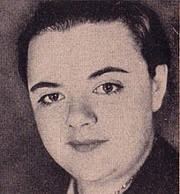
Phoebe Atwood Taylor was born in Boston, Massachusetts. Her parents were natives of Cape Cod and descended from Pilgrims. She graduated from Barnard College in New York City in 1930, and returned to Boston. She married a surgeon also named Taylor and lived in the Boston suburbs of Newton Highlands and Weston. The couple also had a summer home in Wellfleet on Cape Cod. Boston and Cape Cod served as the locales for many of her mystery novels.
She published under her own name as well as under the pen names Freeman Dana and Alice Tilton. Her first novel, The Cape Cod Mystery (1931), introduced Asey Mayo, the "Codfish Sherlock," a handyman and amateur sleuth who appeared in 24 novels. These novels were full of humor and the local culture of Cape Cod in the 1930s and 1940s.
Another series featured Leonidas Witherall, a teacher, and author of detective novels.
”It was all about a man— no; about a girl who loved a man who was married to a girl— I think this is straight— who loved a man who loved the first mentioned girl. It confused me to such an extent that I left off on page forty. It was a little nasty, too. I am not convinced that his characters bear any resemblance to human beings, though I am given to understand that he takes his stories from life.”
“He was, I thought, a little oily. I tried to make out why. It might have been the chorus-boy perfection of his too-well-cut flannels and blue coat, or possibly his highly manicured fingers. My father always warned me about men with manicured hands. Such a man, he said, was never a gentleman by birth but by accident.
”Asey was the kind of man everybody expects to find on Cape Cod and never does. He was by my reckoning about sixty years old, because I am fifty, and I knew he had been “voting age,” as they say in the town, when I was a girl visiting my relatives. No one seeing him for the first time could tell whether he was thirty-five or seventy. His long lean face was so tanned from exposure that the lines and wrinkles did not show. His mouth was wide, with a humorous twist about the corners, and his deep-set blue eyes twinkled disconcertingly.
He usually walked with his shoulders hunched and his head thrust forward. As he moved his worn corduroy trousers and flannel shirt flopped as though anxious to catch up with the rest of his spare frame. An old broad-brimmed Stetson set at an angle on his head gave him a strangely rakish look. He almost invariably chewed tobacco, and that habit coupled with his trick of pronouncing no more syllables of a word than were absolutely necessary, made him quite unintelligible to those who didn’t know him.
Although he called himself a mechanic, he had taken a turn at nearly every trade. As steward, cook or ordinary seaman he had sailed over the seven seas in every type of ship. He had made his first voyage on one of the last of the old clipper ships, and before he had settled down in the town he had been mate of a tramp steamer. Under Bill’s grandfather he had built carriages; under Bill’s father he had learned about automobiles. I doubt if he had ever had more than a fleeting glimpse of the inside of a school-room, but his knowledge of the world and its inhabitants was vastly superior to that of the average man.
The town cast a critical eye upon him because he belonged to no church and rarely attended any service outside of the Christmas Eve celebration, when he went and lustily sang hymns. He was neither a Mason, a Bison nor an Elk.”
“I told Miss Prue the other day that all folks was like other folks in one little thing or ’nother, an’ usually if they was alike in that one little thing they was like them in other ways too.”
“Yup. Well, if I was a feller as understood that, I’d use it. If I understood about finger-prints an’ microscopes an’ things like, I’d use ’em up too. But I don’t. Like the kid in the piece he wrote about two apples an’ a piece of pie,—I ain’t ’temptin’ any flights of fancy but just’s the things that’s in me. A handful of common sense an’ a little imagination is worth all them notions anyways.”