This Deluxe Hardcover collects Marvel's most mischievous melodrama, as featured in Entertainment Weekly's Must List! Whether she's going to school or hanging out with her friends at the Coffee Bean, Mary Jane Watson is always the center of attention. But what no one knows is that this gorgeous redhead's exuberant personality is a shell designed to make her forget about life's harsh realities. From her social life to her undying interest in becoming an actress to her crush on that costumed crime-fighter who swings along the New York City rooftops, it's clear Mary Jane just wants to escape. Join MJ, Harry Osborn, Liz Allen, Flash Thompson and Harry's nerdy friend, Peter Parker, as they experience the thrilling highs and the crushing lows of high-school existence in this electric teen drama!
Collecting: Mary Jane 1-4, Mary Jane: Homecoming 1-4, Spider-Man Loves Mary Jane 1-5
After writing indie comics (such as the ensemble teen-drama The Waiting Place) for six years, Sean got his big break writing an issue of The Incredible Hulk for Marvel Comics in 2001. Since then, Sean has written hundreds of comics for Marvel, DC Comics and other publishers, including notable runs on Sentinel, Inhumans, Mystique, Marvel Adventures Spider-Man, Gravity, Spider-Man Loves Mary Jane, Birds of Prey and Teen Titans.
Best known for delivering introspective, character-driven work, Sean also wrote several weeks of the Funky Winkerbean syndicated comic strip, much of which has been reprinted in the celebrated collection, Lisa's story: the other shoe.
In 2005, Sean won the Eisner Award for Talent Deserving of Wider Recognition.
Sean continues to write comic books; he also writes for the videogame and animation industries.
I am extremely charmed by this collection, which recasts Mary-Jane as the protagonist of the story. This is a graphic novel that is 50% high school drama (think Archie), and 50% Mary-Jane's low-key obsession with dating Spider-man. In this story, MJ isn't Peter's childhood friend or neighbor: she becomes friends with him after an event in her friend group leaves her lonely. But she's weirdly obsessed with dating Spider-man anyway, even though her best friend (rightfully) tells her that's crazy. I suppose it's a way to set up the eventual , but it felt like the writer just needed to keep reminding us that yes, this was a Spider-man comic. Honestly, I could have done with less Spider-man altogether. I liked the high school friend group story.
Crazily enough, all of these seem to be out of print! I put a used book alert on this edition when I was at Powell's in 2015, and the first copy came through in summer 2017. At this rate, I'll be reading volume 2 in two years. Wish me luck.
While retelling and refurnishing stories has a long and even ancient history, the current motivation seems largely motivated by a need to keep our common story properties fresh (and therefore marketable). In the classical era, refurbishing old tales was essential and taught as part of the progymnasmata. The best storytellers were expected not to develop new stories but instead to work with the classics of the era. So people grew accustomed to reinventing the legends and telling the stories from different perspectives, from different points in time, featuring different characters, and to different ends. A breadth of methods were explored and necessity mothered invention in very confined circumstances.
[She’s talking about Gwen Stacy ಠ_ಠ]
Today, it’s a little bit different. We have the option to build any story we like. We can invent until our brains fall out. And some of us do. But wholesale invention isn’t always safe. Audiences might not “get” a new and exciting work. And readers are already comfortable with several fistfuls of already existing stories. Revisiting these proven tales is one of the safest ways to market a new story. Hence Disney’s entire animated catalogue. Hence the spate of cinematic adaptations that go back to the dawn of the moving picture. Hence our current subject.
Spider-Man is almost a dead property. Or he should be. He’s had monthly adventures (or better) for more than fifty years now. He never strays far from status quo. His story has been told over and over and over again—enough so that any Spider-Man reader from any era can safely describe everything one really needs to know about the character to jump-start a new reader into the concept. Radio-active spider bite. Uncle Ben. Great power, greater responsibility. Sad sack normal dude. Tons of bad luck. Popular with the ladies. Sticks to walls, super strength, and webshooters. Complicated relationship with the public. Everything else is gravy. We’ve been there and done that. If not in comics, then in cartoons or films.
So really, what’s a publisher to do? Spider-Man is an essential Marvel product, but there’s got to be some way to breathe life into his carcass. Sure, you can give him a new, adventurous writer/artist battery, but that’s only catering to a small segment of his potential audience—the people who are already reading his books, generally. So they throw in some of the old favourites. Spider-Man crossovers with other pop characters! Spider-Man in the future (totally a legit move since Frank Miller turned Bruce Wayne into an old man with a bad heart)! Or, and this was kind of genius, you make him into a barely appearing support character in a normally supporting character’s book. And that is where the magic happens. Unfortunately, since it barely lasted twenty-eight issues, it apparently wasn’t as popular as it deserved to be.
I’m guessing that Marvel was trying to market Mary Jane (and later, Spider-Man Loves Mary Jane) to a young female demographic. I’m not sure if they ever succeeded in that goal or if the book only sold well to then-thirty-year-old males such as myself. In any case, the recipe was right: Sean McKeever, fresh off Dawson-Creeky indie rom-dram The Waiting Place, would write it; Takeshi Miyazawa, one of the most vibrant young manga-inspired artists working in US comics would draw the heck out of the thing; Christina Strain would do some amazingly fun things on colours; and it would star a young Mary Jane Watson in a pretty much non-superhero book concerned with highschool drama and celebrity worship. I could imagine a teen or pre-teen girl digging that. But what did I know? I was a thirty-year-old dude on the downhill end of a waning relationship and I dug it. Maybe it was aimed at adult men after all?
[Oh Snap, Mary Jane! Time to step up your game!]
Spider-Man Loves Mary Jane absolutely sparkles. It’s the most fun I’d had on a Spider-Man book in ages. Maybe ever.[1] Spider-Man Loves Mary Jane isn’t concerned with just how depressing Peter Parker’s life is (which is, of course, the overwhelmingly resilient vibe I get from my accumulated contact with the original series), partially because it isn’t really even about Spider-Man. At least not at first.
Mary Jane Watson is a popular girl. She’s good-looking, fun, buoyant, and has a fair amount of cross-over appeal in her school—making nice with kids from multiple walks of life. She’s the lynchpin fourth to a trio of popular friends: wealthy flirt, Harry Osborn; quarterback of the varsity football squad, Flash Thompson; and Liz Allen, head cheerleader and Flash’s verbally abusive girlfriend. Mary Jane’s got a good good life, but nothing’s perfect. Her friends want her to hook up with Harry because they’re basically made for each other, but she’s actually incapable of generating any real romantic interest because her heart belongs to a celebrity that she doesn’t even know: Spider-Man.
For much of the narrative, the hero occupies only the small dark corners of Mary Jane’s story. He’s not the main character, after all; just the MacGuffin. This is really and truly Mary Jane’s story—at least for the first several arcs, after which Peter Parker’s romantic drama begins insinuating itself into the narrative and we start getting more scenes with no Mary Jane. But that’s all pretty late-in-game for the book’s lifespan and one’s never sure if that creeps in as the book gradually distracts from its raison d’etre or if the shift was editorially mandated.[2]
Spider-Man Loves Mary Jane is foremost the story of a young woman who cannot interact with reality in any kind of healthy way, hiding her existential dissonance from friends and acquaintances by a mask of effervescence. Even to her closest friend, the one who sees the cracks, she demurs, pretending that her fears, insecurities, and obsessions are perfectly within normal parameters. It’s a balancing act that constantly threatens to overwhelm her, and minor breakdowns pepper the script from start to finish.
One of the early geniuses of the book is that McKeever writes Spider-Man as the problem rather than the solution.[3] If Mary Jane ever succeeds in her quest to win Spider-Man’s love and affection, she will have lost her soul (so to speak). And Peter (a.k.a. Spider-Man), who titularly loves her, does not help her. He encourages her fracture from reality by making the fantasy more realistic. Beyond just flirting with Mary Jane while in costume, Peter at one point even takes Mary jane on a Spider-date. Peter’s more concerned with his own needs than he is with Mary Jane’s—because he’s got his own issues with reality and his own problems with coping in the social circuit.
[You guys are both blackholes of existential angst and you don’t even know it.]
This is part of the joy of McKeever’s version of the highschool Spider-verse: it plays as standard teen drama, but every last character is a psychological mess for their own discrete reasons. Which makes sense when you consider his prior work, The Waiting Place, which features the exact same kind of character complexity. I mentioned earlier that this incarnation of the Spider-Man mythos is perhaps the one I enjoy the most, the one that’s the most fun. Though a series of characters each with their own social disaffections doesn’t necessarily sound very buoyant at first, it’s the combination of these characters’ unique social disabilities that make them such a charming collection of personalities.
Takeshi Miyazawa, for his part, makes these dour-ish[4] kinds of interactions sparkly. His drawings of teens have always held a certain verve and energy that very few artists in the superhero field seem able to muster or imagine. He’s great with expression and posture, but more than most Marvel artists Miyazawa seems to get clothing—and gives his characters a wide range of teen-ish fashion choices. His figures always seem believable and lively. I’m actively broken-hearted that we don’t get to see more of his work.
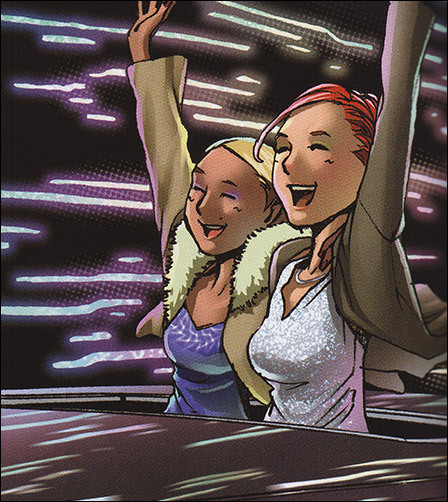
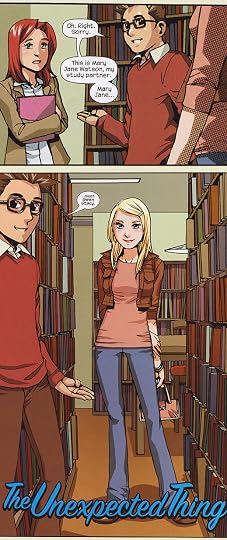
Another contributor who turns the book into something more than just a second-tier effort on one of Marvel’s little side books is Christina Strain, the colourist. Beyond just using a lot of screentones to texture the art, Strain does pretty phenomenal work translating Miyzawa’s teens into something actually resemblant of the real world. More than merely providing a variety of colours on their fashion, Strain gives the kids’ clothing patterns, graphics, and embroidery. It’s an understated effect but it goes yards toward establishing them as real people. Here’s a sample of just three of the hundreds of examples in these volumes.
And if there’s any question of Miyazawa’s command over the book, everything kind of falls apart when he’s not at the artistic helm. Early in the fourth arc he takes a break during a flashback chapter to be covered by Valentine de Landro, and the book falters substantially in those two chapters. Later, Miyazawa ultimately bids farewell to the book entirely (save for remaining on covers), handing the reins over to David Hahn, and again the book loses substantial steam. And it’s not that Hahn is in any way a bad artist. He’s pretty great actually and I loved his work on Private Beach. Hahn successfully draws a despondent Firestar, a frustrated Flash Thompson, a wily Felicia Hardy, whatever. He does just fine. The only problem is that he’s following the firestorm of Miyazawa’s tenure on the book and he’d have to do something downright incredible to not be second best here.[5]
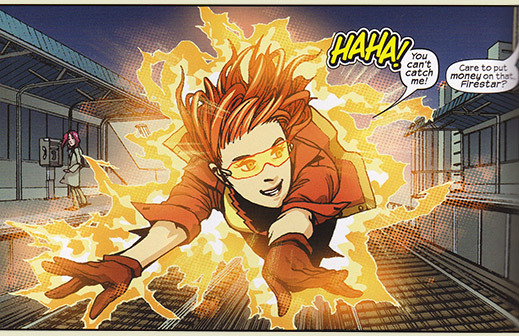
[Hey, look! An occasional superhero!]
And unfortunately, David Hahn never had the chance to make the book his own. Spider-Man Loves Mary Jane folded with the close of the sixth act. I don’t know whether McKeever had hoped to end it here exactly (as there are a couple unresolved bits), but he does a fair enough job. Nobody really gets over their problems; and Mary Jane, while somewhat bottoming out, doesn’t seem to have had the ultimate kind of revelation that we can trust will keep her from the kind of disassociation that makes her celebrity fantasies at the book’s start possible. McKeever leaves the toys in place for a future writer[6], so it’s no surprise I guess that Marvel revamped the series a year after it folded, headed by Strangers in Paradise creator Terry Moore.[7]
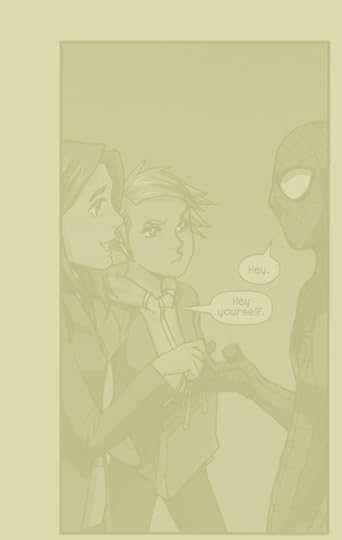
[Miyazawa draws the four friends hanging at the coffee shop.]
[The same quartet under David Hahn’s pen.]
As time goes by, it’s going to be increasingly difficult to get ahold of this series from the mid-Aughts, so if you’re interested, get on your ball! I really do pretty highly recommend it for fans of the admixture of superheroing and romantic drama. It’s lovely and lively and a testament to the fact that these old stories aren’t entirely impossible to re-envigourate—if only creators can fashion something new and fancy from the wasted old bones of canon material. _______
Footnotes 1) I’ve read the original series up through Gwen Stacy’s exit, picked up again with the introduction of the Hobgoblin in the John Romita Junior days, exited again with the introduction of Carnage, picked up some of John Byrne’s run and some Tangled Web, and hopped on again for volume 2 of Amazing Spider-Man (written by Howard Mackie and then by Michael J. Straczynsky) before exiting for good and forever after the “Sins Past” arc—because why on earth would anyone stay after that? There were some good stories in there (like “Kraven’s Last Hunt” and the Aunt May Figures It Out episode), but none were particularly fun.
2) It’s easy to suspect the latter, as the book goes from being simply titled Mary Jane to shoehorning in Parker even above the heroine with Spider-Man Loves Mary Jane. The title shift always grated on me a bit, 1) for making Spider-Man the headliner of another character’s story, but also 2) for insisting that Spider-Man loves Mary Jane rather than vice versa, stripping the book of any real tension, since no matter who Peter’s dating, you are told explicitly by the title that he loves Mary Jane. Simultaneously, her love of Spider-Man is never at stake because the entire book is predicated on her obsession for the hero.
3) Or at least a very visible symptom of the problem.
4) Sort of not a fair description since McKeever gives the kids a good deposit of lively, humourous dialogue to fill in the crevasses of angst, woe, and social disability.
5) Actually, the only Marvel/DC artist I can think of who could have been a suitable replacement for Miyazawa is Stuart Immonen in his Nextwave/Never As Bad As You Think phase. It would have been different but would have also been distinct enough to reinvent the book while retaining some of Miyazawa’s stylistic energy. Expanding beyond Marvel/DC artists, the only other artist I could see succeeding is Yoshitoki Oima (creator of A Silent Voice). She’d probably even be a more solid choice than Immonen, really.
6) Which is exactly the kind of thing that pushed me to abandon Marvel/DC books about eight years ago. If all stories have to circle back to the beginning, then they really aren’t much stories at all, just narrative tricks—and seeing the same trick played over and again for years upon years just gets plain dulling.
7) The revamp, unfortunately, has essentially no relation to the prior series. Characters behave in wildly different manner and are now first-day sophomores in highschool rather than the juniors or seniors they were previously. The second series may or may not be fine—I haven’t been able to give it a fair shot due to my investment in McKeever and Miyazawa’s vision for the story.
I already knew I was going to like this series of Marvel graphic novels, simply because I love the relationship between Peter Parker and Mary Jane Watson. I've read plenty of comics and other graphic novels involving this particular couple, and loved all of them. In this run of graphic novels, Peter and MJ are in high school, and figuring out who they are, not only in terms of themselves, but to each other, as well. MJ wants to date Spider-Man, which her friend Liz says is crazy. MJ persists, and does get that elusive date with the wall-crawler. Unfortunately, it comes at the expense of dating Peter Parker, her best friend and tutor. There are the usual awkward high school moments, made all the more so because you know that when Flash Thompson is picking on Peter, Peter could easily throw him across the room using his spider-enhanced super strength. But Peter chooses to take the high road, and allows himself to get picked on. He is very sweet to MJ, and I want them to get together NOW, but alas, high school romance is what it is. We all know things won't resolve that quickly, especially when Gwen Stacy shows up. Good writing and nice illustrations abound, and I just really enjoy the storyline. I'm currently reading Volume two now.
Spider-Man Loves Mary Jane is a really cute series; I really enjoyed it more than I expected to. I thought this was going to be a really sappy teen romance soap opera, and yes, it has it's drama but the characters actually have dimension which is something I didn't expect. Most writing for teens tends to be really saturated but McKeever did a great job giving the characters depth. Flash Thompson and Liz Allen could have easily been written off in stereotypes and become the least appealing characters in the group but they're not. Flash is still a bully to Peter, but he's not just some dumb jock, he's a loyal friend. Liz Allen is bossy and really mean to Flash, her personality can come off really harsh and a turnoff to readers but she's Mary Jane's best friend and no amount of crazy jealousy keeps Liz from being there when it counts. I think anyone can related to any one of these characters which is the appeal to the series. Seeing how we're taken into this journey through MJ's perspective, she's a likeable lead character without being annoying or a "Mary Sue" which keeps me engaged. Then there's Spider-man which we can all agree that Peter Parker has always been the more interesting part of this hero's life. Ending this volume with the introduction of Gwen Stacy was a perfect fit; I'm excited for what Volume 2 brings.
When I first saw the fluffy cover portraying Mary Jane and Spider-Man as high schoolers, I cynically thought Marvel was trying way too hard to appeal to girls and quite literally scrunched my nose at it. But borrowing from a library means reading stuff you aren’t sure you’d enjoy, so I gave it a shot and discovered a charming comic that I would re-read over Ultimate Spider-man any day of the week. The relationships and problems portrayed are as complex as real-life ones and have real emotional depth. Despite being popular at school and a favorite among comics fans, Mary Jane personally strikes me as a private person/character and this story is a rare look into Mary Jane’s anxious but hopeful inner life.
This was really cute, it’s an all ages book that focuses on Mary Jane’s time in high school. It was a lot of fun seeing all the Spider-Man characters back in high school. It’s very manga inspired with the art style which I liked.
This got better as it went on, at the beginning it was very Spidey-lite with him swooping in here and there for a few panels and then there were only a few passing references to Peter.
The first half basically focused on MJ and Harry and their friends Flash and Liz. some love triangles and misunderstanding all coming to a head at the Homecoming dance. This was interesting but not really what I signed up for. It was more Mean Girls than Marvel.
I was a little annoyed by how literally every guy in this high school is in love with Bella Swan Mary Jane and apparently even the girls at this school worship her. Why? I'm not exactly sure, and the author doesn't really show us. Still, there was a fantastic scene between best friends MJ and Liz that very accurately summed up the love and hate feelings that go on between female friends. It struck a cord with me and helped me connect with the characters.
However, the second half is where this book got really interesting. There was much more Spider-man and the relationship between MJ and Peter finally started to pick up steam.
Overall, a great comic for younger readers and a much better characterization of Mary Jane when compared to the train wreck that is Kristin Dunst.
Bought this out of curiosity more than anything else. I wanted to see how a Spider-Man story told from the point of view of his ordinary would-be girlfriend would fare - in this case, it's Mary-Jane Watson's story. And it's by a male writer, in 2006.
As it turns out, 'Spider-Man Loves Mary-Jane, Volume 1' is a sweet, understated and quite charming high school drama comic that happens to be set in the world and city of Spidey. It's about Mary-Jane and the growing relationships she has with her group of friends - Liz Allen the cheerleader, Flash Thompson (that is such a jock character name, isn't it?) the quarterback, and Harry Osborn the rich boy. Oh, and Peter Parker will slowly but surely get involved in her life as well. He's a bit sneaky like that.
Starting out as best friends from childhood, towards homecoming, things between MJ and co become very complicated. Heartbreaking, even. So many feelings clashing and then changing. It truly is like the worst aspects of the cursed transitional period into adulthood that is high school.
If I were an insecure teenage boy, I'd call this 'Friendzone: the comic'.
Amid all the love and friendship drama, kind and caring popular girl Mary-Jane goes job-hunting, and tutors her friends (with PG-rated benefits). She also wishes to avoid a depressing domestic existence.
What makes MJ happiest of all: She has a big crush on Spider-Man.
The web-slinger in the red and blue PJ's is her fantasy guy - her literal hero; many times she seems to get in the way whenever he is fighting crime. Yep, even when she's the leading lady, Mary-Jane Watson is still pretty much a damsel in distress. But at least here she's assertive, determined, and knows what she wants and will get it. And what she wants more than anything is for Spidey to be her homecoming prom date. Or her regular date, whichever.
But will that seemingly-impossible dream come true? And if it does, will the fantasy live up to the reality? Will the mystery of the masked hero lose its allure for her, a changeable teen?
Like I said, there is a lot of high school teen drama happening in 'Spider-Man Loves Mary-Jane'. There are connecting story and character threads in each issue, whilst being completely different from the previous one. Some characters you start out liking can turn into dicks - like the selfish, insecure Harry, and the bully Flash, and especially the jealous secret mean girl Lindsay - and some you start out disliking but suddenly end up really liking; Liz, who despite leaning towards the obnoxious and overbearing, is the only person who remains a loyal and supportive friend to poor Mary-Jane.
Female friendships in comics = excellent.
Though since this is an early-to-mid-2000's high school story, there are a few instances of unchecked slut-shaming and girl-on-girl hating. But 'Spider-Man Loves Mary-Jane' manages to avoid some high school drama cliches by having the characters actually talk to each other about their problems and feelings, and calling one another out on occasion. It does happen, thank whatever-you-believe-in.
In a way, it is realistic, or as realistic as I'd expect it to be. Teenagers are selfish, ungrateful and superficial; on differing levels. So while there ended up being some annoying parts in the comic, near the end, I could deal with it. 'Spider-Man Loves Mary-Jane' is, ahem, dealistic. Not so idealistic.
The idea of a teen crush on a superhero is deconstructed, if in a simple way that's accessible to children and young adults (because this is YA marketing for comic books, as was intended). Mary-Jane Watson is pretty and a sweetheart, but not a pushover. She's not a total saint, either. She's the kind of girl most teenage girls - myself included, way back - would want to be like: popular but not mean, and who won't sell her soul for the price of popularity in the survivalist hell that is high school.
MJ is not that popular, however, as she gets picked on a lot and jealous girls will delight in making her suffer. On top of that, she has low self-esteem and confidence issues, due to a home life she tells no one about (which is hardly touched upon at this stage).
Mary-Jane is stronger than she thinks she is, and is able to rise above it all. Mary Sue, my foot.
She doesn't even need Spider-Man for her character growth; only as a wake-up call of sorts. The nice, attractive redhead is an aspiring actress, and she may at a snail's pace be developing feelings for her nerdy tutor and friend Peter Parker, who along with every other guy in school is clearly smitten with her, and who keeps disappearing whenever there's criminal trouble...
The slightly-manga-style aesthetic artwork is gorgeous, too. Can't forget about that. It's colourful and nicely done, managing not to feel gimmicky for its time.
'Spider-Man Loves Mary-Jane, Volume 1' - Recommended. It is less about superheroics - though those action moments are gleeful and fun when they arrive, since they contain the quippy Spidey fighting ridiculous costumed supervillains - and more about high school characters. Never mind; they are good characters the reader will grow to care about, but not all are decent and caring. Girls are its target demographic, and despite its romantic melodrama angle, I don't feel insulted by it.
It's a product of its time, sure, but it's cute and well-written. It was a mid-2000's experiment from Marvel Comics in attracting new audiences, and I give it high marks for having effort put into it, in terms of art, character, and slice-of-life/superhero world storytelling.
It might be lovely to have a friend like MJ. Or complex. Or dangerous, depending on what continuity/timeline this path takes.
Cute. Not as endearing as Terry Moore's run, but a pretty good stage-setting. Honestly, I was hoping for a little more Peter in the first portion, but it was important to introduce MJ and the gang as people in their own rights, and the story did that. Probably not the sort of thing I'd've looked at if it weren't for the fact that the characters had a history, but I enjoyed it.
Mary Jane Watson is a popular girl in Midtown High School. She's laid back, fun-loving, and easy to talk to. She hangs out at the coffee shop with her best friend Liz, Liz's boyfriend Flash Thompson (the quarterback of the school's team), and old friend Harry Osborn. They have a typical high school life, full of drama about relationships. Mary Jane is infatuated with Spider-Man with whom she has occasional run-ins. Liz wants MJ to date Harry, so they can go on double dates and she'll have someone to go to the Homecoming Dance. MJ agrees but is still smitten with another guy and she feels uncomfortable with Harry paying for everything. She tries out a bunch of jobs, though none quite work out. Neither does dating Harry, which introduces all sorts of complications.
This book isn't a superhero story; it's a high school melodrama. As such, it works quite well. Mary Jane is charming as the central character. Spider-Man and Peter Parker are mostly absent for the first half to two-thirds of the story, making the title misleading. The action is all in the shifting personal relationships of the main characters. They are refreshingly true to their original versions in earlier comics (where they were minor characters). The bad sides of Harry and Flash are present but not dominant. They are well-rounded characters. If anything, Peter Parker gets short shrift in the story, so if a reader is expecting a lot of Spider-Man and his fights with bad guys, this will be a disappointing read.
I was not disappointed. This was a fun and light read. Just don't expect action and a lot of Spider-Man.
*Note: As I produce comic book work, I intend to add one a week to this collection. i've failed that many times. Right now, in the midst of packing to move everything, I'm trying to quickly eat through graphic novels/manga to give away before I leave.*
Why doesn't marvel resurrect their old romance line if they are attempting to create 'Love' comic books? Current creators could learn how to write and draw such stories, which this book clearly shows an inability to do.
The greatest problem with this is a complaint prevalent by today's society of most media ten years or older: It hasn't aged well. This book is so keenly crafted in Valley-Girl-ese that it's already getting outdated five years later.
Is there no editor to smack the writer int he back of the head and point out that product needs to last decades, not hours?
Thee problem of Valley-Girl-ese is that the snippets of verbiage craters the momentum of story telling. This one drags and drags and drags. 1/3rd could be eliminated and have a tighter and better focused tale.
Another issue is that all of the characters are drawn in a different style, but written as if the average Marvel comics reader will know who is who. Peter Parker, particularly has little likeness to the Peter Parker drawn over the past 60 years.
There's also the poor plotting. Even without the endless prattle, this is a ho-hum, standard soap opera with little of interest. Especially for $7.99!
Bottom line: i don't recommend this book. 2 out of ten points.
I really think Marvel needs to start investing in teen and middle grades readers again. Generally, just want more cute slice of life super hero fare. The versatility of Spider-man is that his stories span a variety of genres. I think Takeshi's manga style art fits the tone of the series. Peter is more of a background character than Spider-man here. Not going to spoil it but MJ and Flash have a heart to heart that's very cute and wholesome. Glad Midtown's resident jock gets to be more than a one-note bully. Harry Osborn's hairstyle makes him look a lot like Ultimate Peter Parker. Interesting that Miyaza drew this and Runaways around the sane time period.
This was a very captivating read!! I have always loved Spider-man and I love how they do the universe this go around. You can definitely tell that they had written this with millennials like myself in mind, especially when they talk about “The OC” of all things at some point LOL. Can’t wait for Volume 2.
I loved and hated this book bro. Ok so I loved how the plot was insane and I literally couldn’t stop reading it I finished in like a day. But i will say some of the characters are annoying. AND I HATE SOME OF THE DESCISIONS THEY MADE OT WAS SO STUPID. Like Mary Jane what the heck. But it was entertaining and cool art so slay I guess
I love this whole comic, everything about it! It's a spider-man comic that's not really about spider-man, but about the high-school drama around him. That could have been done badly, but it's fantastic and I'm really invested in the characters. And it's cute!
That this was written by a man is very evident in the storytelling. Mary Jane has no characterization except that she's considered perfect by other characters and is attractive. This Spider-Man was ADORBS THOUGH.
Wish this was better since concept was fun - shoujo anime style with MJ, Peter, and Flash all in high school together - but it had no depth and felt like nothing happened (which I guess happens quite often in shoujo but…)
My ten year old loves Spidey. She's also a redhead so she naturally loves Mary Jane. We read this collection together and she absolutely loved it....therefore I absolutely loved it. :)