
Jump to ratings and reviews
Rate this book

The Resilient Society

Rate this book
People in a resilient society are able to bounce back from shocks, such as pandemics and economic crises. The Resilient Society, by Princeton University economist Markus Brunnermeier, describes how individuals, institutions, and nations can successfully navigate a dynamic, globalized economy filled with unknown risks. Lacking resilience, societies, families, and individuals can reach tipping points from which they cannot recover. Written for business leaders, economists, policymakers, and politically interested citizens, the book argues that the concept of resilience can be a compass for developing a social contract that benefits all people. The author applies his macroeconomic insights to public health, innovation, public debt overhang, inflation, inequality, climate change, and challenges to the global order. 


The Resilient Society was awarded the prestigious German Business Book Prize in 2021.


"Markus Brunnermeier has written a landmark book on resilience. It is an indispensable guide to what we must learn from the pandemic, and how to do better next time." - Angus Deaton, 2015 Nobel laureate in economics


"In this book, Markus Brunnermeier thinks big about the long-term future, in light of the lessons we have learned from recent transforming events, such as the Covid-19 pandemic and the digital revolution. His book is a significant read for anyone taking a leadership role in the coming years. An excellent reading to an intro economics course." - Robert Shiller, 2013 Nobel laureate in economics


"Markus Brunnermeier provides a new framework for understanding resilience in finance and in the political economy. He argues that we need to adopt a wider vision of how economies work. Lucid, clear, and engaging, the book should be required reading for any economist or policymaker seeking a new way of imagining the craft of economics." - Gillian Tett, Financial Times, chair of the editorial board and editor-at-large


"Markus Brunnermeier, one of the leading economists of this generation, shows us how we can address crises more effectively in the future. His book will be an invaluable resource for scholars and practitioners looking to build a more resilient, just, and productive society." - Raj Chetty, William A. Ackman Professor at Harvard University and the director of Opportunity Insights

380 pages, Kindle Edition

Published August 23, 2021

48 people are currently reading
344 people want to read

About the author

Markus Brunnermeier

5 books13 followers

Ratings & Reviews

What do you think?
Rate this book

Friends & Following

Create a free account to discover what your friends think of this book!

Community Reviews

5 stars
15 (24%)
4 stars
15 (24%)
3 stars
17 (27%)
2 stars
10 (16%)
1 star
5 (8%)
Displaying 1 - 11 of 11 reviews
Profile Image for BOOKSTHATSTAY.
105 reviews39 followers
May 11, 2022
" People in a resilient society are able to bounce back from shocks, such as pandemics and economic crises. Lacking resilience, societies, families, and individuals can reach tipping points from which they cannot recover." - Markus K. Brunnermeier

This book has done an excellent job of presenting the concept and principles of resilience in a structured way. It has started a conversation on the need & importance of resilience in a global society.

It is definitely a thought-provoking read that has brought forward a new approach of "just in case" in contrast to the one that has been followed to date by the production systems, i.e. "just in time" principle. The new approach would ensure a speedy recovery after a shock.

The author has emphasized how resilience is different from risk and is an essential component of sustainability. He has argued that rather than avoiding risks or blocking shocks, we should focus on enhancing resilience in order to deal with shocks, like the recent pandemic.

Using some great examples, case studies from around the world, and excerpts from poems & prose, the author has explained the different ways in which resilience can be induced, ensured with the help of policies, and implemented to its full potential!

This book is a must-read for all the business leaders, economists, policymakers, and politically interested citizens! It has an entire blueprint required for the reconstruction of societies and economies that the pandemic has hit. It is definitely a super interesting read with so much to offer to everyone!
Profile Image for Jason Furman.
1,411 reviews1,666 followers
December 5, 2021
An impressive tour of everything from the response to COVID to macro issues (monetary and fiscal policy), macro finance, inequality, climate change, globalization and more. Markus Brunnermeir uses "resilience" as the overarching concept (as in a reed that blows in the wind but is fine after the hurricane), in contrast to robustness (the oak that is strong but can get knocked down) or risk reduction (which he worries inhibits the risk taking needed for growth). Brunnermeir is in part marveling at some of the resilience that the global economies showed in the wake of COVID and speculating about what it teaches us about resilience in normal times. I found myself in agreement with almost everything he argued.
Profile Image for Orestis.
122 reviews43 followers
April 28, 2022
Το βιβλιο αναδεικνηει την σημασια που εχει να χτισουμε μια κοινωνια βιοσημη. Το πιο ενδιαφερον για μενα ειναι η αντίθεση ανθεκτικότητας (η ικανότητα αναπήδησης μετα απο μια δυσμενη συνθηκη) και στιβαρότητας (η ικανότητα αντίστασης στους κραδασμούς). Μια κοινωνία πρέπει να είναι ικανή να ανακάμψει. Πώς αναπτύσσεται αυτό; Θα μπορούσε να γίνει με ένα ισχυρό κοινωνικό συμβόλαιο ή μέσα από μια σειρά μικρών κλυδωνισμων, οπου οι σωφρονες επιχειρησεις μπορουν να αναπτύξουν ανθεκτικότητα.

Οι μακροπρόθεσμοι παράγοντες μπορούν να βελτιώσουν ή να υπονομεύσουν την ανθεκτικότητα. Οι αδύναμες χρηματοπιστωτικές αγορές, το υψηλό δημόσιο χρέος, η αστάθεια του πληθωρισμού ή η ανισότητα, αποτελούν όλες πιθανές προκλήσεις. Τα παγκόσμια προβλήματα περιλαμβάνουν τις αλυσίδες εφοδιασμού, την αδύναμη οικονομία και διακυβέρνηση σε ορισμένες αναδυόμενες οικονομίες, οι αποτυχίες του παγκόσμιου συντονισμού, για παράδειγμα με τα εμβόλια Covid. Το κόστος της οικοδόμησης ανθεκτικότητας δεν θα πρέπει να θεωρηθεί ότι έρχεται εις βάρος της μακροπρόθεσμης ανάπτυξης, διότι επιτρέπει στην κοινωνία να αναλάβει μεγαλύτερο κίνδυνο.

Εξετάζοντας τη σημασία του κοινωνικού συμβολαίου και τον τρόπο με τον οποίο οι εξωτερικές επιπτώσεις επηρεάζουν τα αποτελέσματα, ο Covid παράγει πολλά παραδείγματα καλων και λιγότερο καλων πρακτικων. Οι εξωτερικές παγίδες (παιδιά που χάνουν το σχολείο ή πάσχουν από προβλήματα υγείας λόγω ανεργίας των γονέων) προσδιορίζονται ως εκείνες από τις οποίες είναι δύσκολο να ανακάμψουν.

Ο Brunnermeier υποστηρίζει επίσης ότι οι ποικιλομορφες κοινωνίες είναι πιο ανθεκτικές – επειδή υπάρχουν μια σειρά απαντήσεων σε κάθε κρίση. Μια ανθεκτική κοινωνία υποστηρίζει τους ανέργους να ανακάμψουν – όχι να παραμείνουν άνεργοι. Ισχυροί κοινωνικοί κανόνες, κυβερνήσεις ικανές για ανθεκτικότητα, επιβολή και αγορές προτείνονται ως πιθανοί τρόποι εφαρμογής του κοινωνικού συμβολαίου. Ωστόσο, οι υπερβολικά ισχυροί κοινωνικοί κανόνες ενδέχεται να μειώσουν την ποικιλομορφία και οι αγορές μπορούν να ανατρέψουν και να μειώσουν την ανθεκτικότητα. Η πανδημία covid έδειξε τη σημασία της ταχείας προσαρμογής στον τρόπο με τον οποίο οι κυβερνήσεις συνεργάστηκαν με τον ιδιωτικό τομέα για να επιταχύνουν την ανάπτυξη εμβολίων.

Ένα σημαντικό επιχείρημα γίνεται για τις εκ των προτέρων και εκ των υστέρων κοινωνικές συμβάσεις. Η σύμβαση πρέπει να ειναι responsive(διαδραστικό;), πράγμα που σημαίνει ότι οι κυβερνήσεις πρέπει να είναι σε θέση να ξεφύγουν από ορισμένες υποσχέσεις, αλλά εξακολουθούν να είναι αξιόπιστες. Αυτό μπορεί να επιτευχθεί μόνο εάν υπάρχουν ισχυροή θεσμοί δικαιοσύνης που εφαρμόζονται κατά την άσκηση αυτής της ευελιξίας.

Στη συνέχεια, ο Brunnermeier αναλύει λεπτομερέστερα την περίπτωση του Covid, εξετάζοντας το φάσμα των κυβερνητικών απαντήσεων και των μακροπρόθεσμων επιπτώσεων και αλλαγών. Αυτά τα κεφάλαια φαίνονται λιγότερο επιτυχημένα – αν μη τι άλλο, καθώς όταν γράφτηκαν το 2021 ήμασταν μόνο στα μισά αυτής της ιστορίας.

Αυτό σημαίνει ότι τα ακόλουθα κεφάλαια (σχετικά με τις "ουλές"(scarring), τη συμπεριφορά των κεντρικών τραπεζών και τη δημοσιονομική πολιτική) που παρατηρούνται σε μεγάλο βαθμό μέσα από τον φακό του Covid, φαίνονται επίσης προσωρινά. Ίσως αυτό να είναι αναπόφευκτο. Οι δυνητικοί κίνδυνοι που επισημαίνονται από τις κεντρικές τράπεζες που ενεργούν ως διαπραγματευτές και αγοραστές περιουσιακών στοιχείων κατά τη διάρκεια της κρίσης δεν έχουν ακόμη εξελιχθεί. Ωστόσο, βλέπουμε τώρα έναν από τους κινδύνους που αναφέρθηκαν να έρχεται να περάσει - ότι η ανάκαμψη του Covid θα πυροδοτήσει τον πληθωρισμό. Και οι μακροπρόθεσμες ουλές στους νέους, και συνεπώς στην ανισότητα στο μέλλον, θα μπορούσαν να αποδειχθούν αποδυνάμωση της ανθεκτικότητας.

Τα επόμενα κεφάλαια εξετάζουν μια σειρά παγκόσμιων οικονομικών πτυχών. Αυτές περιλαμβάνουν τις δυσκολίες και τους κινδύνους που περιβάλλουν το χρέος των αναδυόμενων αγορών και τα ζητήματα που εγείρονται από την ταχέως αυξανόμενη δύναμη της Κίνας στο παγκόσμιο οικονομικό σύστημα.

Τέλος, υπάρχουν ορισμένες παρατηρήσεις σχετικά με τη δυσκολία ανάπτυξης αξιόπιστων και επιτυχημένων πολιτικών για την αντιμετώπιση της κλιματικής αλλαγής. Ειδικότερα, αυτό επαναλαμβάνει το προηγούμενο σημείο σχετικά με την ένταση μεταξύ μιας σαφούς εκ των προτέρων πορείας πολιτικής και της αναπόφευκτης εκ των υστέρων ανάγκης για ευελιξία καθώς μαθαίνουμε για την αλλαγή συμπεριφοράς και την ανάπτυξη τεχνολογιών.

Τίθενται ορισμένα δελεαστικά ερωτήματα: πόσος οικονομικός κίνδυνος είναι πολύτιμος και πόσο υπερβολικός; Θα πρέπει τα SDRs να χρησιμοποιηθούν για τη στήριξη αναδυόμενων και αναπτυσσόμενων αγορών σε περιόδους κρίσης; Αλλά είναι δύσκολο να αντλήσουμε πολιτικές απαντήσεις ή προτάσεις.

Σε ένα τελικό κεφάλαιο, ο Brunnermeier συζητά τις νέες προκλήσεις για την ανθεκτικότητα που αναδύονται, όπως από την ασφάλεια στον κυβερνοχώρο, τα γενετικά σχεδιασμένα όπλα ή τις μελλοντικές πανδημίες. Τονίζει τη σημασία της ατομικής ανθεκτικότητας, καθώς και της κοινωνικής και θεσμικής. Το βασικό μήνυμα είναι ότι οι κοινωνίες πρέπει να είναι πιο προορατικές στη διασφάλιση της ανθεκτικότητάς τους, σε όλα τα επίπεδα, συμπεριλαμβανομένου του παγκόσμιου. Δυστυχώς, την άνοιξη του 2022, η παγκόσμια ανθεκτικότητα αισθάνεται τρομακτικά εύθραυστη.
85 reviews75 followers
February 13, 2022
This is a collection of loosely related chapters on current political topics such as pandemic response and macroeconomics. I haven't read the whole book. But since each chapter is designed to stand alone, I feel comfortable reviewing a subset of the book.

They're more readable than the comparable Wikipedia pages, but less rigorous.

Pandemic Response
Brunnermeier devotes a medium-sized part of the book to summarizing the response to COVID-19. He mostly repeats ideas that have been prominently discussed in the news media, without adding much insight. E.g.:
There are two ways to incentivize vaccine development.

He's referring to patents, and to government guarantees.

Only two ways? Really?

If he had paid more attention to the economist he mentions in the next paragraph, he'd have noticed two different proposals to use prizes as incentives.

With a bit more imagination, he could even have noticed the standard textbook advice of letting drug companies charge as much as the market will bear. To have any hope of political feasibility, that would need to be combined with significant subsidies for some buyers.

My guess is the best incentive would be prizes, given in proportion to the estimated number of lives saved.

A related peculiarity involves the speed of vaccine deployment. The 1957 flu pandemic was not very memorable in the U.S., probably because 40 million vaccine doses were deployed within about 6 months of getting virus samples. Whereas in 2020, the news media mostly called Trump a liar for hoping to achieve roughly half that speed. [ETA: apparently the 1957 vaccine was a modified version of an existing vaccine, so it's harder to compare than I realized. Still, it likely tells us a good deal about how quickly production can be ramped up. And it's clear that our leaders didn't aim for fast approval. ]


The slow response in 2020 seems to involve something like Eroom's Law impairing our resilience. Yet Brunnermeier implies (vaguely enough to avoid any clearly false statement) that COVID vaccines were produced with unprecedented speed. Why do people such as Brunnermeier seem oblivious to this outrageous decrease in resilience? I don't have a full answer. I suggest reading Where Is My Flying Car? for some hints.

Inflation
I'll now focus on inflation, since I've studied that topic a good deal. Brunnermeir used to advise the Fed, so he's based his writing on this topic more on academic literature than on the news media.

He claims that "persistent stimulus" after the 2008 crisis failed to increase inflation much. He ignores the economists who show evidence of tight monetary policy. Brunnermeir implies that if the Fed fails to meet its target, we should conclude it was impotent.

Brunnermeir says that a large Fed balance sheet creates some sort of default risk. Yet two paragraphs later, he makes a cryptic comment which could be interpreted as agreeing with Scott Sumner's response: the risk is an illusion, and that illusion could be dispelled by a simple accounting change. The resilience of Fed policy is rather dependent on the Fed knowing whether this risk is real. Brunnermeir mostly sounds like he'd prefer that the Fed worry about the illusion.

Here's one of the rare cases where he's willing to make something resembling a forecast:
In the short term, the outlook appears at this time to be deflationary, but other long-run forces could contribute to a potential whipsaw pattern in the future.
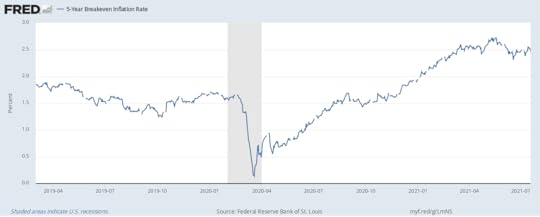

He knew that markets were predicting that inflation would be slightly above the Fed's target, since he includes this graph:
TIPS spread

That's the 5 year forecast; the market forecasts for shorter-term inflation were higher.

The graph indicates that he finished writing the chapter in July 2021, at which time inflation was a bit over 5%. Inflation for 2021 ended up to be more than 7% - the highest in about 40 years. In other words, he picked one of the least appropriate times of the past few decades to express concern about deflation.

In sum, Brunnermeir exemplifies the kind of "expert" who encourages the Fed to avoid resilient policies, with this pattern:
* promoting misleading summaries of when the Fed engaged in stimulus.
* excusing Fed failures as the result of impotence (I expect the Venezuela central bank could show them how to avoid that impotence).
* implying that concern about PR risks from a large balance sheet justify subpar stimulus.
* making inflation forecasts that look like attempts to fight the previous war, rather than keeping up with the latest evidence.

Interest Rates
Brunnermeir provides a good three page summary of why interest rates are currently low. My main complaint here is that 2 of his 3 references here are to his YouTube channel. His impressive guest list suggests that it's one of the best YouTube channels, but the videos provide less evidence than do the best academic papers. Yet I can't fault him very much, since for the claim I find most valuable, the only good reference I know of was published later than this book.

Conclusion
You may have noticed that I didn't mention Brunnermeir's advice about how to increase resilience. It's easy to read large parts of the book without noticing anything of relevance to that topic, other than generic platitudes about the benefits of being competent.

I see that Taleb has written a book that appears to say a good deal about resilience. I was hoping to find a better author than Taleb to cover this topic. The Resilient Society has made me pessimistic about finding such an author.
Profile Image for Sean.
4 reviews
July 12, 2022
Wanted to like this book, but if you know anything about economics it is a waste of time. Very bog-standard neokeynesian policy recommendations, and the analysis is facile/underdeveloped. It also reads as if written as a textbook for college freshmen. Not worth the time.
Profile Image for Apurva Barve.
20 reviews2 followers
May 12, 2022
The book is quite a tough read for people who have no background in economics or don't
own any general knowledge about the working of policies, bonds, or things that are related
to economics, still, it has been successful in organising the content to be at the simplest
level. But still, as a whole, considering that every person is familiar with the situations
currently in the globe, the book provides an exact and deep analysis of what the country has
been or what the world has been like before the pandemic, and what are the after-effects of
the COVID pandemic; leading to certain situations which we never imagined. The book has
provided a detailed analysis of what a person or a younger generation should do or how
businessmen or future policymakers should consider framing policies by thinking about the
aftershocks that a country or a system would face if something like this hits us again. The
book has brilliantly discussed about the government, the markets, the society and the
changes in the climate, the situations and the behaviour of the people that affects the
worldwide condition regarding anything that has been related to economics. On a personal
level, it is highly appreciated how the author has included detailed graphs of certain
situations which can be easily pictograph and explained in a simple manner. The book is
divided into four parts, sections in certain situations wherein the author goes on talking about
the various phases that we have faced or the society as a whole has faced, and how we
recovered; moreover how we should be ready for something like this in the future. The
author has been successful in including things like interest rates, bonds, the climate
condition, the society wherein the developing nations are hit, underdeveloped nations which
come under the trap of losing many things in form of aid, and the countries which are
developed eyeing for another opportunity for revenue generation. Having said that, the book
also mentions a list of events regarding the COVID- 19 pandemic and its different phases or
forms according to regions. It also states the information regarding the lockdowns,
communication and by far its most detailed analysis and explanation one could have in a
book. In general, the book covers all the aspects of the society that a 3rd person would like
to read, in order to get an idea of the situation and get ready for future events if any.
Mentioning the change that the book discusses how the ecosystem of work for the world has
changed, the author has done commendable work in mentioning the positives as well as the
negatives. A particular thing which I was personally looking for in this book was the growth,
the dip and the shock for an individual ( if we are considering a person, part of society as
discussed) I felt that there was an absence of particular individual side thinking that the book
could have explained up at easily but considering that we are talking about the society as a
whole it could be ignored without any issues. To summarise what values the book gives us is
the fact that it provides a base framework for the situations that we may face in the future
and provides a clear understanding on what we should be ready for in case an economic
shaking disaster like this occurs again in the future. For people who are trying to understand
the working of economies and managing such situations for business, a book that provides
long-term assistance or a long-term map for unprecedented or unpredicted events like this
"The Resilient Society" is a book to go for. To conclude I would say, the book is a perfect
compilation of the articles, and thoughts processed and beautifully explained for every
person who wants to get an idea of the situation of how the pandemic takes place, it jitters
the globe. The book is a great example of how we have tackled such situations, and how we
as a resilient society can be ready for the upcoming challenges, which are not in sight.
Profile Image for billyskye.
275 reviews35 followers
October 9, 2024
Something of a talk shop fever dream. I can picture it now. A modern-styled conference room. Crisp business wear. The logo of some major defense contractor plastered on every backdrop and notepad in sight. Speakers will affect an earnest and pensive tone as they feed each other bland morsels of conventional wisdom for roughly 45min. Next will follow a brief period for the attendees to ask questions that were lab engineered exclusively to showcase their own mastery of the jargon and set up an intro with some hunted panelist once the formalities break. We’ll all eat shitty catered sandwiches and swap business cards before calling it a day. Livin’ the American dream, baby.

I was curious to check in on how the academic conversation surrounding the topic of ‘resilience’ had advanced over the past decade since a publication I worked for put out a special issue on the subject. Sad to say I didn’t find much here that left an impression. The author has aggregated some intriguing policy proposals, but everything is structured so chaotically that it’s difficult to follow any particular train of thought to a satisfying destination. Instead, the reader is asked to wade through a logorrhea of innocuous talking points and waterlogged explanations. Between all this and an overreliance on sourcing from the author’s own youtube channel, one can’t escape the impression that this was a rush job stitched together by way of a tenuous theme in order to capitalize on the post-pandemic scramble for scholarly takes. A shame. My bookshelf is a graveyard of forgotten texts about the ‘Arab Awakening’ and the GWOT published well before the events had settled into any measure of cogency. Resist the temptations of a cardboard name tent and those cold deli sides. Take your shot at immortality.
Profile Image for Claudia.
335 reviews34 followers
April 21, 2022
This is an interesting book. I liked it. Its overarching theme is resilience and it goes some way to explain in economic terms how to develop resilience in a society, whether it is advantageous to do so and how to go about it. I liked that it goes beyond pandemic management to look into the role of communication and community cohesion. If you are a beginner this book might be for you. But I don’t think it brings novelty to more seasoned readers. Still a solid 3. 5 stars from me for its great explanation of economic concepts.
Profile Image for Andreas.
139 reviews8 followers
March 19, 2022
After having read 10%, I just didn't have the feeling that this book would offer many new insights. The importance of resilience is self-evident, and no one will deny that it involves trade-offs with efficiency.
Profile Image for Ietrio.
6,949 reviews24 followers
January 9, 2022
A State bureaucrat who pleads for more power to the State bureaucrats, in the spirit of not letting a good crisis go to waste.
338 reviews11 followers
June 12, 2023
The first 100 pages were good but the middle part about macroeconomic impacts seemed like a look at the pandemic rather than any broader ideas about resilience.

I'm not sure if I have just been unlucky of late or whether this is a genuine trend, but I don't really like when a book tells me it's going to do something and then doesn't.
Displaying 1 - 11 of 11 reviews

Can't find what you're looking for?

Get help and learn more about the design.