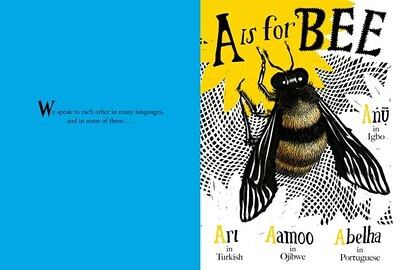
What letter does the word bee start with? If you said "B" you're right – in English! But in many, many languages, it actually starts with A. Bee is Anu in Igbo. Ari in Azerbaijani. Aamoo in Ojibwe.
And Abelha in Portuguese.
Come and explore the gorgeous variations in the ways we talk about familiar things, unified and illuminated through Ellen Heck's eye-catching, graphic scratchboard details and hidden letterforms.
What a lovely idea! An alphabet book where you have the usual alphabet book animals, but they're all assigned to different letters... because, for example, in Portuguese the word for bee, abelha, actually does start with a A! If you want your bright seven year old to become a linguist, you could definitely find a worse starting point.
I'm not sure how to rate this one. It's visually appealing and I like the concept of explaining languages to children. However, I feel like it can't quite decide on the target audience. The typical tots for whom most alphabet books are written may find it confusing since they are still learning to read their own language yet I don't see most older children wanting to read an alphabet book. The book proper is only the illustration of the animal and the names for it in various languages, yet it misses a pronunciation guide (you can get it online) and maps showing where these languages are spoken so it's frustrating with the lack of context. And, I really admire the research that went into the book but the rich back matter is quite scholarly in tone and, again, I don't see it being for most kids in the picture book crowd but more for parents and educators.
A is van Bij. Echt waar! In het Turks is het woord voor Bij namelijk ‘Arl’. En dan begint Bij dus echt met een A.
De meeste lezers zullen bij het lezen van deze speelse titel al even blijven hangen bij dit mooie boek, en als het bladeren dan eenmaal is begonnen opent zich een unieke wereld voor de lezer. Of beter gezegd; een uniek ABC.
"Een creatief en wondermooi boek dat ik maar al te graag als tip wil meegeven aan scholen en iedereen die met kinderen werkt. Nederlands is voor veel kinderen niet de eerste taal en hoe mooi zou het zijn als dit boek een ingang zou kunnen zijn om iemands moedertaal op zo’n natuurlijke manier ter sprake te laten komen. Én te vieren."
A Is for Bee: An Alphabet Book in Translation presents the typical animal alphabet book - except, "A," not "B" is for "bee." Why? Because around the world, in many languages, the black and yellow striped creature that flies and buzzes is called "anu" (Igbo), "ari" (Azerbaijani), "aamoo" (Ojibwe), and "abelha" (Portuguese).
In short, A Is for Bee: An Alphabet Book in Translation introduces familiar animals by assigning each animal a letter based on how it's pronounced in 65 other languages, including well known ones like Spanish, Chinese, and French, as well as much less known ones such as Chichewa, Balinese, and Zulu.
The book is accompanied by bright and colorful illustrations that are recognizable but not a generally seen art form (scratchboard panels). These add a lot to the text because it encourages readers to look for similarities and inconsistencies (either from themselves, each other, or their perceptions) in the illustrations as well as the differences between languages.
I was surprised by how similar some of the Anglicized (or more accurately, Romanized) words from diverse locations and language origins looked or were pronounced (more on pronunciation in a bit). For instance, using the words provided for "bee," the Igbo "anu" and the Ojibwe "aamoo" look similar despite the first being an east African language and the second being an Algonquin-based language in the northern US and Canada. That's fascinating to me.
Another thing that surprised me was that some cultures have the words for certain animals in their language in the first place. How, for instance, would the Maori people of New Zealand have needed a word for "giraffe," an African mammal they historically (and most likely even today to a large extent) would not be coming into contact with, or at least enough to have a word for it in their own language, rather than using a loan word?
I was disappointed at first that there wasn't a pronunciation guide, but after reading the author's note, I think I understand why. Because A Is for Bee: An Alphabet Book in Translation, and because not all letters make the same sounds in all languages (nor do all languages use the same characters for their alphabet), a pronunciation guide would only go so far in helping children (or adults) to pronounce the various animals in native languages.
Instead of a pronunciation guide, then, Ellen Heck provides something that is probably even better for helping to learn the correct pronunciations of the words, as well as for cultural relevance. There is a QR code at the back of the book that connects to a page on the publisher's site that goes through each word in the book as pronounced by a native or at least fluent speaker (https://www.levinequerido.com/aisforbee if anyone is interested).
I don't know if I would feel comfortable reading this aloud to students, because of the pronunciation issues I know I would have, including not being able to make some of the sounds (one of the most fascinating fun facts that I've picked up studying education and elementary reading is that infants have the ability to make all sounds in all languages at birth, but adjust to the language around them and lose the ability. But I digress). However, I would love to share this using this website as a teaching tool for students to hear authentic pronunciations alongside.
The one thing that I do feel is missing would be a map or location list for the origin locations of all languages used.
With this scaffold, I would say this book would be usable with all school-age children as it is so important for kids to be exposed to a variety of languages, especially for familiar concepts. I really enjoyed this one and would love to have a copy for my future classroom.
I'm a sucker for anything abecedarian so this book would have to go off the rails pretty far to get less than five stars, but it is a very steady train of interesting facts about animal names along with beautiful illustrations. Might be better for slightly older children who have their ABC's down pat but could use to have their love of their ABCs reignited and their view of the world expanded. Also great for children whose first language is not English or children of parents/relatives who speak English as a second language.
Fascinating concept, attractive art, important message. Author's note interesting & long. levinequerido.com/aisforbee gives pronunciation by 'fluent or native' speakers.
Missing is something more, something to liven it up. A map might have made it less like a list to learn; I have no idea where "Wolof" or so many others are spoken. Or maybe pick just a few? But that has been done, so I'm not sure.
I still to recommend it to all of you if your library has picked it up.
I waited so patiently for its arrival, and I am not disappointed! Beautiful, simple woodcut stylized illustrations are paired with just the simple words and the language they come from on each page. The author has kept to a theme of animals, popular alphabet filler I would guess nearly worldwide. There is a nice author's note that takes up the last two pages that gives a hint at the collection process she used for nerdy adults and older children, but the book itself keeps the experience accessible for any age. I will certainly be checking back on line, because one of the best perks of reading in a modern age is that the book also offers a link to a (still in progress as of 2022) website where each word can be heard pronounced by a native speaker! What a wonderful and enhancing addition to an amazing book!
A fascinating book about language -- so fun to see similarities in the names of animals across a huge range of human languages. And the bonus is a website where you can hear the pronunciations! https://www.levinequerido.com/aisforbee Plus, the illustrations are gorgeous and clever -- can you find the letter hidden in each animal?
This is a beautiful book. It goes a long way to teaching there is not just one word for things, and that there may be more than one way of doing things, more than one right answer. There is a broader world out there and it is filled with all sorts of different things.
So cute! Found it while trying to find a book translated from Quechua and decided to read it. Absolutely adorable and the perfect introduction to different languages. A website has native speakers saying each word too, which is fantastic.
Een enorm tof en creatief ABC boek, alleen niet de soort ABC die jij misschien verwacht! Niet A is voor Aap. Nee, A is voor bij! Want in verschillende talen is het woord voor bij met een A! En wist je dat de G voor Kat is? Want in het Koreaans heet het beestje Goyangi! Supertof om elke pagina om te slaan en te kijken welk dier nu aan de beurt is en een berg nieuwe woordjes te leren (en later kun je ook een QR scannen om te weten hoe je het uitspreekt). Ik vond het soms wel jammer dat er dieren waren met maar 1 of 2 woordjes, ik had liever gehad dat elk dier minstens drie woorden had gehad. De illustraties vond ik ook tof, een interessante stijl! Dus ben je, net als ik, een woordfanaat en hou je van nieuwe woordjes leren? Dan moet je dit boek wel toevoegen aan je collectie. Ik ga dat zeker doen. Alleen NL of toch de OG ENG versie?
A beautiful alphabet book with a twist; each letter page highlights different languages with the corresponding letter. A must-purchase for libraries serving students curious about different languages or students speaking multiple languages.
Gorgeous debut picture book— very cool concept that must have taken a lot of time to research. I especially love the back matter with the QR code to hear native speakers say the words! ❤️
Stunningly beautiful illustrations and very intriguing premise. Not for every child but fascinating for many. Adults, especially alphabet book aficionados, will love this.
This was amazing!!! I'm a casual language nerd anyway and I love ABC books and animal books and clever illustrations and ahhhhhhhh.
Every thing about this book just keeps getting better and better.
I loved the idea of seeing what common letter exemplars are called in other languages.
I'm glad I read the jacket flap which says "hidden letterforms" because otherwise I might not have been paying close enough attention. All the animal illustrations incorporate the featured letter in some way, some more subtly than others, like the monkey's tail wrapping around a tree branch to make a B shape, the L in the tilt of the rabbit's ears, or the H in the stripe pattern on the tiger's forehead, the N in the angle of the sloth's legs, and the Z in the elephant's trunk and tusks. The text itself often has thematic embellishments as well--the S in "Snail" (page E) has a little antenna, the B in "Butterfly" (page F) has a mirror-shadow making a butterfly shape, and the P for flamingo is a flamingo's head!
I looked up etymology for "deckelsmouk" as Luxembourgish for turtle because I was misremembering/misspelling the German "wackeldackel" for dachshund bobblehead and wondered if they were related. But it appears that in Luxembourgish, "deckel" means "lid" and "mouk" means "toad" -- a turtle is a lid-toad! How neat!
Those final Author's Note pages with black text on the blinding blue background are not eye-friendly nor accessible (the book's one failing I see), but if you can manage to read it there's some great information. If I'd ever seen the word "abecedaries" before (for ABC books), I'd forgotten it. How fun! I love the amount of work that went into this making sure transliterations/romanizations were done authentically and checking in with native speakers!
AND RECORDINGS OF THE WORDS BY NATIVE SPEAKERS with a QR code to access them!! Love it!! Almost all of the words are on there, although I'm rather disappointed that wanga-langa for rhinoceros in Wolof was one of the recordings not posted. Rhymes are fun, and it at least looks like it rhymes.
I'm personally sad there was no Norwegian, but having 69 languages represented is amazing! It was fun to look up some I'd never heard of before. And I love that they were all listed and indexed in the back!!
This is a beautiful book that uses alphabet letters to represent animals while translating the words into multiple languages. The art uses striking colors and designs throughout the book. It is truly a gorgeous book. The author's note is interesting but would probably need to be explained/read by an adult/teacher for kids to understand what is going on. Highly recommended, especially if you have many cultures in your school. Grades 3-5.
A lovely exposure to the alphabet, animals, and other languages (including Native/First Nations languages). Each page has stunning, vibrant illustrations. Backmatter shows what languages are represented and there's a qr code/website (levinequerido.com/AisforBee) with a pronunciation guide.
Beautiful book that has great twist on the abecedarium. The first time listed in NY Times book review showed the X page with a bear. I know from that one image that it was destined to be a gift for my nephew.
Bijzonder mooi vormgegeven boek. Leuk voor iedereen die een beetje in taal is geïnteresseerd, maar zeker ook grappig voor kinderen die net begonnen zijn met lezen. Ook grappig hoe de letters in de illustraties terug zijn te vinden. Maar bovenal prachtig om te bekijken.
This was interesting to read as an adult but it was very disappointing that a phonetic spelling of each of the names for animals in other languages were not included. You could scan a code to look at these online but I wanted to be able to read the names as I looked at the pages.
It felt as though this would be a confusing read for small children and given it's ABC format it might be one that older children think is too young for them
A multifaceted book with several possible audiences and many times those of us who have worked in the book world in some facet want to categorize every book as to audience and we want to put every title into its “place”. This title defies a hard and fast classification. Yes, it is an abc book, but are those abcs intended for children or adults? It is definitely a stretch the mind title because one is not reading/viewing what one’s brain is anticipating. I loved the scratch board illustrations, with color that was applied digitally. I loved that it made my mind work in different ways or shift gear as A is for the insect bee. I loved the two pages of explanation about transliteration and the that there are more than two “stops” which is one of the names for the way humans make sounds which is a personal remembrance for me from a linguistics class. I loved learning there are more than 6500 languages spoken in the World and words from 69 languages are represented in the book.