

What do you think?

North of South
In the 1970s Shiva Naipaul travelled to Africa, visiting Kenya, Tanzania and Zambia for several months. Through his experiences, the places he visited and his various encounters, he aimed to discover what 'liberation', 'revolution' and 'socialism' meant to the ordinary people. His journey of discovery is brilliantly documented in this intimate, comic and controversial portrayal of a continent on the brink of change.
352 pages, Paperback
First published January 1, 1978
About the author
Shiva Naipaul
18 books44 followersShiva Naipaul was a Trinidadian-born British novelist and journalist, known for his incisive fiction and travel writing. The younger brother of V. S. Naipaul, he studied at University College, Oxford, before publishing his debut novel, Fireflies (1970), which won the Winifred Holtby Memorial Prize. He followed with The Chip-Chip Gatherers (1973) before turning to non-fiction with North of South (1978) and Black & White (1980), exploring postcolonial societies. His final novel, A Hot Country (1983), marked a shift in his literary style. Despite mixed critical reception during his lifetime, his work has since been reassessed for its sharp prose and unique perspective.
Ratings & Reviews
Friends & Following
Create a free account to discover what your friends think of this book!
Community Reviews
Displaying 1 - 30 of 58 reviews

November 30, 2018
Is there an equivalent phrasing to "You can't go home again" that might suffice for rereading a book I wonder? I first read Shiva Naipaul's North of South just after it was published in the 1980 Penguin edition, finding it then rather limited in many regards & the author a bit surly.
Since I lived in East Africa just before the time-frame Naipaul details & happened to feel in need of something less engaging than the works of philosophy I'd been assigned for a university continuing ed. course, coupled with a sense of nostalgia for the period when I lived in Kenya, North of South seemed to fill a distinct need. If anything, Naipaul's book was much better than I'd remembered at my initial reading of the book.
Yes, there is an acerbic quality to the writing and a far less than positive view of the potential for post-colonial Africa & the Africans Naipaul encounters but there was also something that I'd not recalled, the author's feeling of being in no-man's land as a Trinidadian of East Indian extraction who had come to maturity in England, especially when he meets those labelled "Asians" within Africa and even a fellow at Olduvai Gorge in Tanzania who wants to be known as an "Indian National" rather than an East African born "Asian", pigment coming to grips with nationality as it were to define a different sort of tribalism.
Apart from these, there were the "Watu wa Benzi", the Sikhs who stood quite apart from other East African Asians & who often drove a Mercedes-Benz, not to mention the Roman-Catholic Goans from what had until then been Portuguese Goa. (They were usually considered the most trustworthy of Indians & assigned to work in banks by the British.)
Living in East Africa, it took some time to master the full declension of these as well as the indigenous African points of tribal definition, particularly since folks who seemed so similar to an outsider often saw themselves as exceedingly different from each other. I suspect that Naipaul felt like an outsider even among those who were not considered to be in the ascendancy in newly independent East Africa, as opposed to the powerful Kikuyu tribe and the remaining whites (called "Europeans") who braved this post-colonial phase with greater finesse than others. And yet, Shiva Naipaul gets caught up in a defense of the Asian population of E. Africa:
"Out of that void of non-reaction arose the Indian tragedy. He failed not because of what he did but because of what he failed to do." Naipaul's shorthand explanation of the resultant post-colonial pecking order is reported as "never come between the master & his slave, who is a born conservative." Meanwhile, the Asian in Africa remains "the eternal other".
What also surprised me is that the author takes considerable pains to differentiate Kenya's approach to independence from that of Tanzania and also to Zambia, a country in which he spent less time but observed what might be called regional peculiarities, as each nation attempted to define itself in the early post-colonial years.

Jomo Kenyatta's approach to rule in Kenya is rather different than that of Julius Nyerere in Tanzania (a country with no discernibly dominant tribes, unlike Kenya) and also quite apart from that of President Kenneth Kaunda in Zambia. And Naipaul looks upon the white population of Kenya as detailed by Karen Blixen & Elspeth Huxley, authors who represent a "displaced aristocracy & who speak of a mystical kinship with the land".
Every journey, particularly within a Third World country is defined by the people one meets en route and because Shiva Naipaul is limited by lack of fluency in tribal languages & also by budget, he does speak primarily with white people living in E. Africa, with Asians who are accessible to outsiders & to Africans who are fluent in English. He can be exceedingly judgmental & surly with those he crosses paths with but is often dependent on their help to reach the next place on his itinerary or takes extremely down-trodden buses packed with local people + chickens & goats. In the midst of such a journey, Naipaul attempts to
A visit to an office that includes a publisher of African books on Socialism in the Tanzanian capital seems to treat Naipaul with mixed indifference & condescension, while an African-American woman working there offers only contempt. On the Indian Ocean island of Lamu, rich in Arab history, the reader is informed of visiting Swiss & Austrian "sex tourists", both male & female. An Arab resident is described as "woolly haired, flat-nosed & thick-lipped" and it is commented that apparently being Arab can be "just a state of mind". There are indeed distracting & insufferable authorial flaws that can't be overlooked.
Beyond all of that however, and for many this may represent damning faint praise, Shiva Naipaul writes very well and comparisons with the books of Paul Theroux are not out of place, especially when near journey's end Naipaul takes a long train ride between Kapiri Mposhi, Zambia & Dar es Salam, Tanzania on the just-completed route built by the Chinese. With Theroux, experiencing the process of travel, especially via rail, is more important than destinations and there are often intersections with famous authors & references to classic novels read en route, not the case with North of South.
This is a 40 year old work by a comparatively young author who died at age 40, a book that is definitely not for everyone but which is a travel account I somehow managed to enjoy more at 2nd reading than I did when it was initially published.
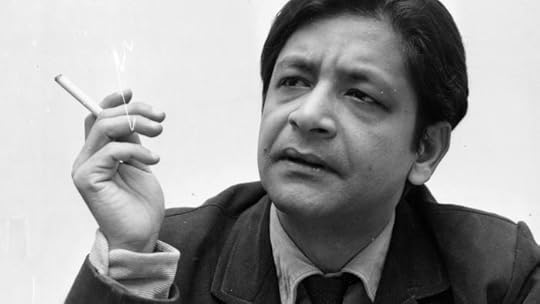
*There is listed praise on the book's spine by the likes of Graham Greene, Bruce Chatwin, Larry McMurtry + the London Sunday Times. **My version of the book has the colorful image of an acacia tree at sunset & is not among the versions of North of South portrayed at Goodreads. ***Images within my review: author Shiva Naipaul; the Makuba Express train between Dar es Salaam, Tanzania & Zambia taken by Naipaul.
Since I lived in East Africa just before the time-frame Naipaul details & happened to feel in need of something less engaging than the works of philosophy I'd been assigned for a university continuing ed. course, coupled with a sense of nostalgia for the period when I lived in Kenya, North of South seemed to fill a distinct need. If anything, Naipaul's book was much better than I'd remembered at my initial reading of the book.
Yes, there is an acerbic quality to the writing and a far less than positive view of the potential for post-colonial Africa & the Africans Naipaul encounters but there was also something that I'd not recalled, the author's feeling of being in no-man's land as a Trinidadian of East Indian extraction who had come to maturity in England, especially when he meets those labelled "Asians" within Africa and even a fellow at Olduvai Gorge in Tanzania who wants to be known as an "Indian National" rather than an East African born "Asian", pigment coming to grips with nationality as it were to define a different sort of tribalism.
Apart from these, there were the "Watu wa Benzi", the Sikhs who stood quite apart from other East African Asians & who often drove a Mercedes-Benz, not to mention the Roman-Catholic Goans from what had until then been Portuguese Goa. (They were usually considered the most trustworthy of Indians & assigned to work in banks by the British.)
Living in East Africa, it took some time to master the full declension of these as well as the indigenous African points of tribal definition, particularly since folks who seemed so similar to an outsider often saw themselves as exceedingly different from each other. I suspect that Naipaul felt like an outsider even among those who were not considered to be in the ascendancy in newly independent East Africa, as opposed to the powerful Kikuyu tribe and the remaining whites (called "Europeans") who braved this post-colonial phase with greater finesse than others. And yet, Shiva Naipaul gets caught up in a defense of the Asian population of E. Africa:
Who banished the African from what became the "White Highlands" & confined him to overcrowded reservations? Who denied him--and the Asian--an effective political voice? Whose despoliations were the direct cause of Mau Mau? On whose behalf was fought the brutal campaign of suppression that followed? I see nothing particularly "symbolic" in this dismal chronicle of settler civilization. I see only the poacher has turned gamekeeper--with a vengeance.In turn, the Asian communities in Kenya, Tanzania & Uganda were vilified by both the white settlers as well as Africans living in these newly independent countries. Unlike the European, the Indian or Asian communities remained forever cloistered from Africans, merely "a face across the counter of the duka (small storefront in villages & larger businesses in places like Nairobi) & nothing more." Asians (including some whose far-off extended families became part of Pakistan after the partition) were brought to East Africa from India by the British 80 years or so prior to independence & just stayed on, for the most part lacking in any other options.
"Out of that void of non-reaction arose the Indian tragedy. He failed not because of what he did but because of what he failed to do." Naipaul's shorthand explanation of the resultant post-colonial pecking order is reported as "never come between the master & his slave, who is a born conservative." Meanwhile, the Asian in Africa remains "the eternal other".
What also surprised me is that the author takes considerable pains to differentiate Kenya's approach to independence from that of Tanzania and also to Zambia, a country in which he spent less time but observed what might be called regional peculiarities, as each nation attempted to define itself in the early post-colonial years.
Jomo Kenyatta's approach to rule in Kenya is rather different than that of Julius Nyerere in Tanzania (a country with no discernibly dominant tribes, unlike Kenya) and also quite apart from that of President Kenneth Kaunda in Zambia. And Naipaul looks upon the white population of Kenya as detailed by Karen Blixen & Elspeth Huxley, authors who represent a "displaced aristocracy & who speak of a mystical kinship with the land".
Every journey, particularly within a Third World country is defined by the people one meets en route and because Shiva Naipaul is limited by lack of fluency in tribal languages & also by budget, he does speak primarily with white people living in E. Africa, with Asians who are accessible to outsiders & to Africans who are fluent in English. He can be exceedingly judgmental & surly with those he crosses paths with but is often dependent on their help to reach the next place on his itinerary or takes extremely down-trodden buses packed with local people + chickens & goats. In the midst of such a journey, Naipaul attempts to
work himself into a trance-like state of mind, which is the sine qua non of long-distance travel in this part of the world. It is a state of mind that combines fatalism, self-surrender & a steely determination to maintain one's toehold of possession. I have come a long day since my first matatu (bush taxi) ride. No more do I give way to either outrage or compassion.There are most certainly people who could be painted as "gargoyles" because of their approaches to life, including a Kenyan woman named Alberta who fills her large home in an unnamed town in the Highlands with copies of Rubens' artwork, a bust of Mozart, Scandinavian furniture + two large freezers as a sign of wealth and whose daughters provide a rendition of Gilbert & Sullivan for visitors. Americans are mostly portrayed as boorish & incurious, while Germans come off poorly as well. An international cast of young tourists bound for South Africa & its inflexible Apartheid rule seem more interested in the fate of African animals than the African people.
A visit to an office that includes a publisher of African books on Socialism in the Tanzanian capital seems to treat Naipaul with mixed indifference & condescension, while an African-American woman working there offers only contempt. On the Indian Ocean island of Lamu, rich in Arab history, the reader is informed of visiting Swiss & Austrian "sex tourists", both male & female. An Arab resident is described as "woolly haired, flat-nosed & thick-lipped" and it is commented that apparently being Arab can be "just a state of mind". There are indeed distracting & insufferable authorial flaws that can't be overlooked.
Beyond all of that however, and for many this may represent damning faint praise, Shiva Naipaul writes very well and comparisons with the books of Paul Theroux are not out of place, especially when near journey's end Naipaul takes a long train ride between Kapiri Mposhi, Zambia & Dar es Salam, Tanzania on the just-completed route built by the Chinese. With Theroux, experiencing the process of travel, especially via rail, is more important than destinations and there are often intersections with famous authors & references to classic novels read en route, not the case with North of South.
This is a 40 year old work by a comparatively young author who died at age 40, a book that is definitely not for everyone but which is a travel account I somehow managed to enjoy more at 2nd reading than I did when it was initially published.
*There is listed praise on the book's spine by the likes of Graham Greene, Bruce Chatwin, Larry McMurtry + the London Sunday Times. **My version of the book has the colorful image of an acacia tree at sunset & is not among the versions of North of South portrayed at Goodreads. ***Images within my review: author Shiva Naipaul; the Makuba Express train between Dar es Salaam, Tanzania & Zambia taken by Naipaul.

January 21, 2008
I read this book on my flight back from fieldwork in northern Zambia. It is beautifully written, but struck me initially as somewhat cynical. Maybe it was my perspective--having been living in Zambia forty years after independence. Across the wide variety of people I know and talked with, across wealth and geography, one of the general sentiments I inferred was that people endure; they don't hope for future improvement too much. This was in marked contrast to the way that people spoke of the first decades after independence. So, when I read Shiva Naipaul's depiction of traveling from Kenya down to Zambia in the 1970s, I wished for a more heartening description of optimism and hope. I didn't get it. Nevertheless, I don't believe that Naipaul is distorting the Africa he witnessed. In many respects, my initial surprise made this a better book to read.

November 18, 2013
Wow. Basically hated this.
Tedious, aimless, superficial. I had to skim the last 20% of this book, as I just couldn't bear to read any more of Naipaul's one-note caricaturing of East Africa, or, as the book frequently proclaims, AAAAAAFRICA. This is a reductivist and therefore incredibly boring portrayal of Kenya, Tanzania, and Zambia. Its main message seems to be: "Whoa, this place is a shithole. And everyone here is an idiot!" Yeah, thanks, Shiva.
I can see why this book would be praised for its seemingly gloves-off "brutal honesty" about the racism and political failures of 1970s Africa. But, honestly, I think the people who would offer such praise probably (1) haven't visited the region, and (2) if they have, came away with a pretty skewed interpretation of it all.
Everyone Naipaul portrays in this book speaks with the same voice (a red flag) and exhibits the same one-dimensional stupidity. Everyone in this book - from the over-anxious Indian Kenyan in the first pages, to the lugubrious, hypocritical Tanzanian bureaucrat falling asleep in his AC, to basically any American/European in a "crazy/racist expat" cameo - is a fool. And (I suspect) Naipaul revels in it. "Look at these people! No wonder this place is so poor!" seems to be the implicit conclusion.
I live in Tanzania, and have lived in other developing countries. And I was deeply disappointed by this book, as it covered incredibly interesting topics (the Ujamaa policy in Tanzania, and the troubled history of the South Asian diaspora in East Africa), and there just aren't that many books to read about here.
This is essentially a travel journal Naipaul keeps on his (relatively brief) trip through East Africa, and I don't see any reason why his musings should be any more valuable than, say, just a plain ol' history book. His tone stank of condescension throughout but - when he arrived in Tanzania and visited places I've visited myself - any illusion that his writing was anything but mockery was shattered. I've been to those places. Yes, sometimes things don't work. No, not everyone is such a full-blown idiot. Fans of this book may be surprised to find that there are a number of intelligent, well-rounded, nice folks here too. And sometimes things work really well. *COUGH*M-Pesa*
If you're wondering why some places are poor and some places aren't, and if you're curious about a (brief) history of (anywhere in) Africa, I'd recommend this or this instead.
I should also note that this book seems to be part of a worrying Cynical and Snarky Among the Less Fortunate genre: similar to things like The Sex Lives of Cannibals or Eksil (Exile). Or Slumdog Millionaire. i.e. "Gritty realism" which is really just poverty porn with a bad attitude. i.e. Stuff that relies entirely on othering the people you choose to write about.
Argh, and don't even GET ME STARTED on Naipaul's portrayal of women in this. GARBLE GARBLE FEMRAGE GARBLE. *tears out hair*
tl;dr: Mocking caricatures of E. Africa. Don't waste your time.
Tedious, aimless, superficial. I had to skim the last 20% of this book, as I just couldn't bear to read any more of Naipaul's one-note caricaturing of East Africa, or, as the book frequently proclaims, AAAAAAFRICA. This is a reductivist and therefore incredibly boring portrayal of Kenya, Tanzania, and Zambia. Its main message seems to be: "Whoa, this place is a shithole. And everyone here is an idiot!" Yeah, thanks, Shiva.
I can see why this book would be praised for its seemingly gloves-off "brutal honesty" about the racism and political failures of 1970s Africa. But, honestly, I think the people who would offer such praise probably (1) haven't visited the region, and (2) if they have, came away with a pretty skewed interpretation of it all.
Everyone Naipaul portrays in this book speaks with the same voice (a red flag) and exhibits the same one-dimensional stupidity. Everyone in this book - from the over-anxious Indian Kenyan in the first pages, to the lugubrious, hypocritical Tanzanian bureaucrat falling asleep in his AC, to basically any American/European in a "crazy/racist expat" cameo - is a fool. And (I suspect) Naipaul revels in it. "Look at these people! No wonder this place is so poor!" seems to be the implicit conclusion.
I live in Tanzania, and have lived in other developing countries. And I was deeply disappointed by this book, as it covered incredibly interesting topics (the Ujamaa policy in Tanzania, and the troubled history of the South Asian diaspora in East Africa), and there just aren't that many books to read about here.
This is essentially a travel journal Naipaul keeps on his (relatively brief) trip through East Africa, and I don't see any reason why his musings should be any more valuable than, say, just a plain ol' history book. His tone stank of condescension throughout but - when he arrived in Tanzania and visited places I've visited myself - any illusion that his writing was anything but mockery was shattered. I've been to those places. Yes, sometimes things don't work. No, not everyone is such a full-blown idiot. Fans of this book may be surprised to find that there are a number of intelligent, well-rounded, nice folks here too. And sometimes things work really well. *COUGH*M-Pesa*
If you're wondering why some places are poor and some places aren't, and if you're curious about a (brief) history of (anywhere in) Africa, I'd recommend this or this instead.
I should also note that this book seems to be part of a worrying Cynical and Snarky Among the Less Fortunate genre: similar to things like The Sex Lives of Cannibals or Eksil (Exile). Or Slumdog Millionaire. i.e. "Gritty realism" which is really just poverty porn with a bad attitude. i.e. Stuff that relies entirely on othering the people you choose to write about.
Argh, and don't even GET ME STARTED on Naipaul's portrayal of women in this. GARBLE GARBLE FEMRAGE GARBLE. *tears out hair*
tl;dr: Mocking caricatures of E. Africa. Don't waste your time.

April 4, 2025
Book Review
North of South
Shiva Naipaul
5/5 stars
"A 50 year old travel memoir that could have been written yesterday"
(1577 word review: 5m44s)
*******
Verdict: Recommended
This classic is a snapshot in time of East Africa in the early '70s. (Kenya, Tanzania, and Zambia. This is around the time of the Indian expulsion from Uganda.)
Zambia (35 pages; 10%)
Tanzania (162 pages; 49%)
Kenya (117 pages; 35%)
It's a jewel, because there are very few people that can write honestly, perceptively, neutrally and engagingly about their surroundings. It feels like someone who could write about this particular time is about is probable as the Big Bang.
The author is a Trinidad Indian, and a fly on the wall for the events. He gathers his information by talking to Everyman on the street. ("The answer to such questions cannot be found in the abstract speculations of theorists and professional revolutionaries - who often simply don't see the world in which they live.")
On the one hand, he doesn't think too much of the Africans, obviously. (African hatred of Indians is a running theme throughout the book.)
But on the other, the Africans really aren't much to write home about-- And maybe the author was just being objective. (Several decades later, the Chinese found them equally unimpressive.. It's also interesting that they have been building shoddy infrastructure for them for about half a century. p.334)
It's really a lot of the expected, which is: low general mental ability, incompetence, and corruption. (p.205. The Kenyan border official took the author's money right at the border and put it directly in his pocket.) There's also a substantial recurrence of unattractive white women that come there to make bacon with the African men (p.259). Or, Loopy Guilty White People (p.336). Or, ignorant black Americans that try to shoehorn Africa into their racial conceptual space (p. 283).
The largest Indian population in Africa is in South Africa. 1.6 million out of a population of 63 million. (Kenya: 110,000 out of a population of 55 million; 13,000 in Zambia out of a population of 21 million; 60,000 in Tanzania out of a population of 67 million.)
Tiny numbers of people, really, for them to occupy the African's thoughts to hate them so much. (p.321: "as is the case all over Eastern Central Africa, it is not the wife's who aroused the greatest animosity, but the Asian Indians. My state coincided with a vigorous anti-Asian campaign in the Zambian press.)
I think the quotes are enough to give the reader an idea:
(19) Cancellation of the flight would come about only if President or Madame Mobutu suddenly decided he or she needed a plane.
(23) "They need us. We are indispensable. Without us they would still be swinging from the trees."
(25) "They only kill each other as a rule. They never touch Europeans- - or hardly ever."
(28) British citizens of Asian (=Indian) origin needed a visa to enter Kenya
(31) A week later my suitcase did - miraculously - - turn up, minus my transistor radio and a number of lesser items. (Author had his bags rifled
through and stolen by the airline ground crew in Africa.)
(45) "The only thing to do with Africans is give them a nice chair, give them a nice sounding title to go with it and put them where they can do the least harm"..... Stories of African conceptual incapacity have acquired something of the abstract quality of fable.
(54) We can lose one self without gaining another. Our development can be indefinitely arrested at the stage of caricature.
(71) 'I'm sorry to seem so jailer-like, but pilfering, I'm afraid, is a big problem. I have to keep everything under lock and key. They take the oddest things sometimes, things they can't possibly have any use for."
(90) He told the story of the government official who had openly declared that he would never allow his children to be taught by Africans..... Nearly all the long settled English I met in Kenya had succumbed to a similar degenerative process: They lived off their Englishness and whiteness. It was their chief asset.
(106) The Gujarati merchant I met in Mombasa said to me his family had been resident in Mombasa for over a hundred years, but they have remained of India..... He, though born in East Africa, had been educated in India, and it was to India he had gone to find a bride of the required purity.
(121) It's not accidental that the sexual and accessibility of Asian [Indian] women excites so much rancor.
(145) It was not the society that had thrown them out, and not any place in the whole world either, but time had done it, they did not belong to their century.... They were examples of atavism.
(163) She wanted, as her hairstyle indicated, to be proudly African and at the same time, as the skin lightening creams in her bedroom indicated, to abolish Africa.
(165) None of them could, properly speaking, be said to have a stable personality. They were made up of a number of separate and warring selves. Hence the wild veering between farce, piety, and up-to-date cynicism.
(204. Nyrere) If the price of goodness is backwardness, then Tanzania will remain backward.
(214) Nyrere is following the right policies. I do not wish to see them develop. To be frank, speaking sociologically, I do not believe they are truly capable of such things. Why make them reach for the impossible? It will only lead to unhappiness..... I think their brains have been conditioned in a different way from ours.
(219) There were flies everywhere, settling around the eyes of the children and their mothers, feeding greedly on sores, spreading the infections which the clinics sought to combat. No attempt was made to brush the flies away: the victims seemed untroubled by their depredations.
(238; in 1978) The new environmentalism is part of the privileged consumption pattern of the affluent and industrialized; those who can afford the airfares, the hotels, the Land rovers and the guides; those whose children don't draw a water from wells and rarely get savaged by marauding hyenas.
(250) The road out of town was in a truly terrible state, its existence often more notional than actual.
(259) One of the strangers specimens was a lone American girl, dowdy and appearance in Ernest in Manor, who said she had come to Africa and search of a "relevant ethnic experience." I told [the hotel owner] this. "What she means," he said, "is that she wants to be fucked by black men."
(271) The pat words, the pat phrases, unleavened by thought, came pouring out of Abdallah's mouth. In this society he would qualify as an "intellectual."
(272) Had I not learned, after all this time, that nothing in Africa had meaning? That nothing could be taken seriously?
(284) In Tanzania, where performance consistently negates intention, where every commodity - - butter, milk, meat, cheese, fish, chocolate, knives, forks, spoons, cups, saucers, baby diapers - - is in short supply, the socialist revolution is being built with words.
(297) The [eclipse] over Tanzania was a portent of supreme revolutionary significance. It was a warning that the oppressed and exploited could no longer be denied.
(314) The Zambian landscape is one note endlessly repeated.
(320) Zambia's finances are so bad that the salary is of civil servants are often in arrears; the university is unable to buy books to stock its libraries; cigarettes are insured supply because the manufacturers have no foreign exchange to purchase the necessary packaging materials.
(321) The economy of Mozambique would probably collapse of it did not allow South African technicians to operate its sports and railroads and encourage substantial numbers of its citizens to work in the mines of the enemy.
(329) Beer is a major -- some say *the* major--obsession of the Zambian people. Zambians, so the rumor runs, our second only to Australians in consumption of the beverage.
(332) Author: "Could you support 30 children?" Captain: "A few may die. But people are born to die. I want to see lots of people in Zambia who look like me. It is in my blood to give girls a pregnancy... And I pay... A girl attending University, about 900 kwacha; A girl in the 6th Form, about 700; a girl in the 5th Form, about 500; a Form 2 girl about 90. I give a pregnancy mainly to the Form 2. That is cheaper for me."
(334) The Chinese, for reasons best known to themselves, head kept their railroad separate from the Zambian network..... The railroad had been in operation for only a few months, but decay had already begun to set in."
(347) Black and white deserved each other. Neither was worth the shedding of a single tear: both were rotten to the core..... Civilized man, it seems common can no more cope with prolonged exposure to the primitive than the primitive can cope with prolonged exposure to him.
Vocabulary:
raddled
rallying (UK usage)
dhoti
kurta
pandit (spelled here as "pundit")
duka
navvy
cataleptic
heraldry
Robert Ruark
mangrove
reprovingly
kekoi (male sarong)
bwana
immure(d)
simper
aslant
"grins cadaverously"
Factoids:
1. The author is very Anglicized; speaks English as a mother language and no Indian languages. (This is not uncommon; I read that 10, 000 people speak Hindi as a second language out of a population of 547K people.)
2. It also appears that caste disappeared in Trinidad Indians.
3. Nyrere translated Shakespeare into Swahili.
North of South
Shiva Naipaul
5/5 stars
"A 50 year old travel memoir that could have been written yesterday"
(1577 word review: 5m44s)
*******
Verdict: Recommended
This classic is a snapshot in time of East Africa in the early '70s. (Kenya, Tanzania, and Zambia. This is around the time of the Indian expulsion from Uganda.)
Zambia (35 pages; 10%)
Tanzania (162 pages; 49%)
Kenya (117 pages; 35%)
It's a jewel, because there are very few people that can write honestly, perceptively, neutrally and engagingly about their surroundings. It feels like someone who could write about this particular time is about is probable as the Big Bang.
The author is a Trinidad Indian, and a fly on the wall for the events. He gathers his information by talking to Everyman on the street. ("The answer to such questions cannot be found in the abstract speculations of theorists and professional revolutionaries - who often simply don't see the world in which they live.")
On the one hand, he doesn't think too much of the Africans, obviously. (African hatred of Indians is a running theme throughout the book.)
But on the other, the Africans really aren't much to write home about-- And maybe the author was just being objective. (Several decades later, the Chinese found them equally unimpressive.. It's also interesting that they have been building shoddy infrastructure for them for about half a century. p.334)
It's really a lot of the expected, which is: low general mental ability, incompetence, and corruption. (p.205. The Kenyan border official took the author's money right at the border and put it directly in his pocket.) There's also a substantial recurrence of unattractive white women that come there to make bacon with the African men (p.259). Or, Loopy Guilty White People (p.336). Or, ignorant black Americans that try to shoehorn Africa into their racial conceptual space (p. 283).
The largest Indian population in Africa is in South Africa. 1.6 million out of a population of 63 million. (Kenya: 110,000 out of a population of 55 million; 13,000 in Zambia out of a population of 21 million; 60,000 in Tanzania out of a population of 67 million.)
Tiny numbers of people, really, for them to occupy the African's thoughts to hate them so much. (p.321: "as is the case all over Eastern Central Africa, it is not the wife's who aroused the greatest animosity, but the Asian Indians. My state coincided with a vigorous anti-Asian campaign in the Zambian press.)
I think the quotes are enough to give the reader an idea:
(19) Cancellation of the flight would come about only if President or Madame Mobutu suddenly decided he or she needed a plane.
(23) "They need us. We are indispensable. Without us they would still be swinging from the trees."
(25) "They only kill each other as a rule. They never touch Europeans- - or hardly ever."
(28) British citizens of Asian (=Indian) origin needed a visa to enter Kenya
(31) A week later my suitcase did - miraculously - - turn up, minus my transistor radio and a number of lesser items. (Author had his bags rifled
through and stolen by the airline ground crew in Africa.)
(45) "The only thing to do with Africans is give them a nice chair, give them a nice sounding title to go with it and put them where they can do the least harm"..... Stories of African conceptual incapacity have acquired something of the abstract quality of fable.
(54) We can lose one self without gaining another. Our development can be indefinitely arrested at the stage of caricature.
(71) 'I'm sorry to seem so jailer-like, but pilfering, I'm afraid, is a big problem. I have to keep everything under lock and key. They take the oddest things sometimes, things they can't possibly have any use for."
(90) He told the story of the government official who had openly declared that he would never allow his children to be taught by Africans..... Nearly all the long settled English I met in Kenya had succumbed to a similar degenerative process: They lived off their Englishness and whiteness. It was their chief asset.
(106) The Gujarati merchant I met in Mombasa said to me his family had been resident in Mombasa for over a hundred years, but they have remained of India..... He, though born in East Africa, had been educated in India, and it was to India he had gone to find a bride of the required purity.
(121) It's not accidental that the sexual and accessibility of Asian [Indian] women excites so much rancor.
(145) It was not the society that had thrown them out, and not any place in the whole world either, but time had done it, they did not belong to their century.... They were examples of atavism.
(163) She wanted, as her hairstyle indicated, to be proudly African and at the same time, as the skin lightening creams in her bedroom indicated, to abolish Africa.
(165) None of them could, properly speaking, be said to have a stable personality. They were made up of a number of separate and warring selves. Hence the wild veering between farce, piety, and up-to-date cynicism.
(204. Nyrere) If the price of goodness is backwardness, then Tanzania will remain backward.
(214) Nyrere is following the right policies. I do not wish to see them develop. To be frank, speaking sociologically, I do not believe they are truly capable of such things. Why make them reach for the impossible? It will only lead to unhappiness..... I think their brains have been conditioned in a different way from ours.
(219) There were flies everywhere, settling around the eyes of the children and their mothers, feeding greedly on sores, spreading the infections which the clinics sought to combat. No attempt was made to brush the flies away: the victims seemed untroubled by their depredations.
(238; in 1978) The new environmentalism is part of the privileged consumption pattern of the affluent and industrialized; those who can afford the airfares, the hotels, the Land rovers and the guides; those whose children don't draw a water from wells and rarely get savaged by marauding hyenas.
(250) The road out of town was in a truly terrible state, its existence often more notional than actual.
(259) One of the strangers specimens was a lone American girl, dowdy and appearance in Ernest in Manor, who said she had come to Africa and search of a "relevant ethnic experience." I told [the hotel owner] this. "What she means," he said, "is that she wants to be fucked by black men."
(271) The pat words, the pat phrases, unleavened by thought, came pouring out of Abdallah's mouth. In this society he would qualify as an "intellectual."
(272) Had I not learned, after all this time, that nothing in Africa had meaning? That nothing could be taken seriously?
(284) In Tanzania, where performance consistently negates intention, where every commodity - - butter, milk, meat, cheese, fish, chocolate, knives, forks, spoons, cups, saucers, baby diapers - - is in short supply, the socialist revolution is being built with words.
(297) The [eclipse] over Tanzania was a portent of supreme revolutionary significance. It was a warning that the oppressed and exploited could no longer be denied.
(314) The Zambian landscape is one note endlessly repeated.
(320) Zambia's finances are so bad that the salary is of civil servants are often in arrears; the university is unable to buy books to stock its libraries; cigarettes are insured supply because the manufacturers have no foreign exchange to purchase the necessary packaging materials.
(321) The economy of Mozambique would probably collapse of it did not allow South African technicians to operate its sports and railroads and encourage substantial numbers of its citizens to work in the mines of the enemy.
(329) Beer is a major -- some say *the* major--obsession of the Zambian people. Zambians, so the rumor runs, our second only to Australians in consumption of the beverage.
(332) Author: "Could you support 30 children?" Captain: "A few may die. But people are born to die. I want to see lots of people in Zambia who look like me. It is in my blood to give girls a pregnancy... And I pay... A girl attending University, about 900 kwacha; A girl in the 6th Form, about 700; a girl in the 5th Form, about 500; a Form 2 girl about 90. I give a pregnancy mainly to the Form 2. That is cheaper for me."
(334) The Chinese, for reasons best known to themselves, head kept their railroad separate from the Zambian network..... The railroad had been in operation for only a few months, but decay had already begun to set in."
(347) Black and white deserved each other. Neither was worth the shedding of a single tear: both were rotten to the core..... Civilized man, it seems common can no more cope with prolonged exposure to the primitive than the primitive can cope with prolonged exposure to him.
Vocabulary:
raddled
rallying (UK usage)
dhoti
kurta
pandit (spelled here as "pundit")
duka
navvy
cataleptic
heraldry
Robert Ruark
mangrove
reprovingly
kekoi (male sarong)
bwana
immure(d)
simper
aslant
"grins cadaverously"
Factoids:
1. The author is very Anglicized; speaks English as a mother language and no Indian languages. (This is not uncommon; I read that 10, 000 people speak Hindi as a second language out of a population of 547K people.)
2. It also appears that caste disappeared in Trinidad Indians.
3. Nyrere translated Shakespeare into Swahili.

December 25, 2023
Lazy, one dimensional, mean

November 17, 2013
What is missing from Siva Naipaul's account of Africa is Africans. His writing is sharp and incisive, but most of it is based on interactions with the people he manages to interact without much effort: hoteliers, bureaucrats, fellow travellers, immigration officials. As such, the picture he portrays of Africa in the seventies is how Whites, Asians, and a few mid level African bureaucrats. His dismissal of socialism in Tanzania is entirely based on whether the hotel bus works or not, what one particular local individual has to say about the state of affairs, and a few other characters. What is missing is an understanding of the state of the majority. At least in Tanzania, he tries but fails to visit a concept village, but in Kenya and Zambia, he doesn't even bother to try to find out for real how common people have fared under ideological states like Tanzania, semi-idealist state of Zambia and the completely free-for-all-takers Kenya.
What saves this book somehow is a reasonably well articulated investigation of African hatred of Asians and a few generalizations (e.g. both blacks and whites deserve each other, both are not worth a tear, both have been corrupted by contact with each other), which though sweeping in nature, are thought provoking enough to call for a better book to dwell more thoroughly on the same questions. Shivaji Das
What saves this book somehow is a reasonably well articulated investigation of African hatred of Asians and a few generalizations (e.g. both blacks and whites deserve each other, both are not worth a tear, both have been corrupted by contact with each other), which though sweeping in nature, are thought provoking enough to call for a better book to dwell more thoroughly on the same questions. Shivaji Das

November 21, 2014
Shiva Naipaul's subject matter of Kenya, Tanzania and Zambia of the late 70s was well chosen. Each of those countries shared experiences in common but, strangely enough, they also chose different paths forward. Naipaul, like his Nobel-winning brother, writes well and he also shares his misanthropy. Most misanthropes I've met, balance their antipathy towards their fellow man with a love for nature and its non-human animals. Not Naipaul. He seems to have a distaste for both. Generally speaking, being a bit of a misanthrope myself, I should have a soft spot for someone like Naipaul. I think, unlike Paul Theroux, what undermines Naipaul is a crankiness that is rarely leavened by wit. It's a flaw in North of South and I don't know if I'll persevere to find out if or if not it is a flaw in his other books.

August 30, 2011
This was a very readable, intelligent and thoughtful book that was written with I am not sure what purpose. Shiva Naipaul, the brother of VS Naipaul, traveled through Kenya, Tanzania and Zambia in search of Africa, and came back with some pretty negative, but sometimes amusing, impressions. The journey took place and the book was written in the 1970's, so the book is a bit dated. But its very datedness was very educational - I know very little about semi-recent African politics and Naipaul's work helped fill in some holes. What perplexes me is why Naipaul wrote the book - he is so wry, negative, hopeless about the countries he visits and the people he meets. Did he really mean to leave us with the message that it is all hopeless?

July 24, 2022
Neither travel journal nor novel, but something in between. Unusual, insightful, raw, and memorable picture of a handful of African countries during the 1970s. Naipaul the man is a fascinating character in himself - his cynicism, bluntness (almost to the point of being rude or socially inept, yet so direct and honest), his eye for really seeing people (similar to Tom Wolfe), his sharp commentaries on society and culture and race are all unheard of, even anathema, in modern writing. Yet this book felt more genuine and truthful than that modern writing would be, especially since the topic was post-colonial Africa.
Read
April 18, 2021Words ..words. words. That is the story of Africa.

February 13, 2015
Here is another a Naipaul (younger brother to the famous V.S.) who is an insightful and generally unpleasant man. However, this may just add to the outsider providing perspective with scathing social commentary. Once again I appreciate the unusual take on race politics from the Trinidad born Indian traveling in Africa. Normally one only hears about blacks and whites, but I appreciated hearing about the self-imposed isolation of the Asian population and its effects. While much of it seems dated, he did articulate sentiments I couldn't put into words myself. Commentary on eco-tourists with interest in animals alone, not the native (human) population, had me giggling with familiarity. I know people who spent thousands on African safaris who found Africans themselves were a distraction. Would love to discuss this with those living in that region now.. I hope things have changed because it's fairly depressing.
Read
July 9, 2011Delightful deconstruction of settler literature about Africa, "Baroness Blixen" in particular!
Shiva Naipaul (VS' late brother) writes with remarkable prescience about variety of conflicts that had yet to be thought of as conflicts when he wrote in 1978-- the environmentalism of the rich, for instance, and the marginalisation of local communities dwelling around conservation reserves.
He is, on occasion, apt to use the particular to illustrate the general, sometimes in ways that distort both. This is an afflication widespread in that generation of travel writers, no matter how perceptive they might otherwise be.(Pico Iyer is often guilty of this, too). Fortunately the tendency seems to have faded in more recent travel writing.
Rather enjoyed the book, these minor irritations notwithstanding.
Shiva Naipaul (VS' late brother) writes with remarkable prescience about variety of conflicts that had yet to be thought of as conflicts when he wrote in 1978-- the environmentalism of the rich, for instance, and the marginalisation of local communities dwelling around conservation reserves.
He is, on occasion, apt to use the particular to illustrate the general, sometimes in ways that distort both. This is an afflication widespread in that generation of travel writers, no matter how perceptive they might otherwise be.(Pico Iyer is often guilty of this, too). Fortunately the tendency seems to have faded in more recent travel writing.
Rather enjoyed the book, these minor irritations notwithstanding.

May 25, 2021
An account of East Africa in the 1970s written by V.S. Naipaul's younger brother, who travelled through Kenya, Tanzania and Zambia. Interesting to see how different the political systems of the countries were back then! Kenya was almost as crazily capitalist as it is now; Tanzania was a socialist mess; Zambia was just bizarre.
These days the three nations are quite similar to each other but even back then the Chinese engineers were controlling large sectors of their economies, especially the railways and ports. Shiva's account tells of meetings with old colonialists, hippies, idealists, eccentrics, corrupt officials and madmen.
Like his elder brother, Shiva is at his best when describing encounters and conversations with the people he chances to meet and at his worst when philosophising about human behaviour in general. On the whole it's a good book. Sad in parts, funny in others.
These days the three nations are quite similar to each other but even back then the Chinese engineers were controlling large sectors of their economies, especially the railways and ports. Shiva's account tells of meetings with old colonialists, hippies, idealists, eccentrics, corrupt officials and madmen.
Like his elder brother, Shiva is at his best when describing encounters and conversations with the people he chances to meet and at his worst when philosophising about human behaviour in general. On the whole it's a good book. Sad in parts, funny in others.

Read
September 16, 2019I am not going to give it any stars. I dont nessicarly hate it but I didn't love it either. For it being a non fiction narrative I enjoyed it. There was a lot of interesting topics. However, I thought the author could of done a better job on some things. For example interacting more with the natives. Second, not portraying everyone he meets as bad or annoying. Also, I did not like the ending. We get that he needs to go back home and that he sees someone he doesn't like. Who does he see and why does it bother him? It's a cliff hanger even though we knew the journey was coming to an add. Plus I fled is a strange way to end a book. But all in all I was impressed I enjoyed it as much as I did. Now to go and write a paper about it. Yay me!

September 30, 2011
This one's a tough book to review as it's really all the travel lit we have from the author before his early death. Although the material is rather dated now, Naipaul does such a good job navigating post-Colonial Africa as someone neither black nor white, so recommended for that, as well as emphasis on the black-Asian rift; the journeys take place long after Amin tossed the Asians out of Uganda. Moreover, he's fairly good natured about going with the flow in the often-dysfunctional circumstances encountered.

Read
August 23, 2015Don't really remember...

October 5, 2022
Not for everyone, as you can tell from the Goodreads reviews below. Some people are going to hate Naipaul and hate this book. He is cynical, suspicious, and highly critical. Especially if you decide that you don't buy his criticisms of what Paul Johnson called the "Bandung Generation" - African socialism and more generally all those post-colonial Third World nations that distinguished themselves in the decades following World War 2 with a Marxist-flavored anti-Western stance - you will find no shortage of reasons to discard his assertions. He doesn't talk to the right people, he makes broad generalizations, he brings his theory with him and tries to impose it on reality etc etc.
In other words, this is a highly subjective and personal travelogue with clear biases. For whatever reason I find Naipaul highly interesting, in the sense that his ideas seem both plausible to me and also very perceptive. Both this book and Journey to Nowhere are loaded with honest and incisive observations. Naipaul wasn't afraid to challenge the socially approved pablum. He views human nature as radically (viz., located in the core, not in every aspect) depraved. The racism of the old-type European stragglers in East Africa is evil; the consumption-based environmentalism and blind adoration of anything African by the new-type European fellow-travelers is evil; the self-destructive delusion and corruption of the newly self-governing Africans is also evil.
Naipaul doesn't serve us comfort food here. But it does smell of reality.
In other words, this is a highly subjective and personal travelogue with clear biases. For whatever reason I find Naipaul highly interesting, in the sense that his ideas seem both plausible to me and also very perceptive. Both this book and Journey to Nowhere are loaded with honest and incisive observations. Naipaul wasn't afraid to challenge the socially approved pablum. He views human nature as radically (viz., located in the core, not in every aspect) depraved. The racism of the old-type European stragglers in East Africa is evil; the consumption-based environmentalism and blind adoration of anything African by the new-type European fellow-travelers is evil; the self-destructive delusion and corruption of the newly self-governing Africans is also evil.
Naipaul doesn't serve us comfort food here. But it does smell of reality.

August 30, 2021
While the writing style is engaging, and many of the anecdotes are humorous, I found this book lacking in many areas.
It is obviously written from a colonialist perspective and is frequently patronising and dismissive. No effort is made to put what the writer encounters in a historical context. This would be less problematic if the tone were not judgmental.
Blatant hypocrisy raises its ugly head on page 107 -
"I was treated to a modest display of the African's 'deep resentment' of the 'Asian'. (I dislike the term: it was coined as a convenient shorthand to lump together all the peoples of the subcontinent."
and overt racism on p.290 -
"China's [...] disciplined labor [...] cultural identity and its superiority to neighboring nomadic peoples, is far removed from a tribal confederacy of low technical and intellectual attainment".
The vast majority of dialogue is with colonial whites and no attempt seems to have been made to find interpreters to achieve a better balance.
As a travelogue, it's an interesting read, but in the introduction Naipaul stated his intention to write about what revolution, liberation and socialism meant to the people of Kenya, Zambia and Tanzania. On this, I believe he fails.
It is obviously written from a colonialist perspective and is frequently patronising and dismissive. No effort is made to put what the writer encounters in a historical context. This would be less problematic if the tone were not judgmental.
Blatant hypocrisy raises its ugly head on page 107 -
"I was treated to a modest display of the African's 'deep resentment' of the 'Asian'. (I dislike the term: it was coined as a convenient shorthand to lump together all the peoples of the subcontinent."
and overt racism on p.290 -
"China's [...] disciplined labor [...] cultural identity and its superiority to neighboring nomadic peoples, is far removed from a tribal confederacy of low technical and intellectual attainment".
The vast majority of dialogue is with colonial whites and no attempt seems to have been made to find interpreters to achieve a better balance.
As a travelogue, it's an interesting read, but in the introduction Naipaul stated his intention to write about what revolution, liberation and socialism meant to the people of Kenya, Zambia and Tanzania. On this, I believe he fails.

November 11, 2020
Disappointingly shallow but with moments of real insight. Shiva Naipaul has his brother's misanthropic authorial voice and skeptical outlook but I thought this was a subpar effort. It's a travelogue but you never get the sense that he has spent the time or energy to do real analytical work or get deeply in touch with the areas he is traveling through (Kenya, Tanzania). Instead it amounts to a series of vignettes, some tiresome, some interesting and he is pretty open about the fact that he doesn't know much about the places he's visiting. Makes me want to go back and read more of V.S.'s travel writing to see if, in retrospect, it suffers from the same shallowness. Still, there are moments of brilliance and the scorn is spread widely (universally, even). There are moments that read, to me, as racist from the vantage of 2020; white settlers and colonial administrators are more forcefully criticized and ridiculed than the Kenyan's and Tanzanians he interacts with but the outright scorn with which he observes much of his surroundings and the people he comes in contact was discomforting.

June 19, 2019
This book turned out to be more readable/interesting than I'd expected based on when it was written and the ad hoc basis for its narrative. I appreciated getting to learn about the countries in a manner not dissimilar to what one would experience themselves via travel. However, I wish the author had also discussed whatever positive aspects existed in the countries (rather than allowing his attention to be drawn to the individuals who seemed the saddest or most outlandish) and sought out more perspectives from locals living in each area (rather than relying on whichever tourists and government officials he happened to encounter in his travels). I personally disagree with the racist and colonialist views shared in the book, but I suppose it cannot be faulted for being the messenger of what the individuals he encountered felt at the time.

September 21, 2023
Naipaul is a Shakespearean in his views of the black and white east africa. I like the honesty geared especially at the political failures and the greed that he encountered. I also like how brutally realistic he portrayed the racism that everyone guessed is still going on the continent but never quite openly discussed, especially in the form of the self-isolation of Indians (“Asians”). But what I don’t like is the contrast/confusion between Naipaul’s jadedness about the “corrupted soul” and how much comfort he derives from “shades” and a “five star shelter”. He seems to be a guy that disdains capitalism but enjoys “a good cigar or good caviar”. But I guess the point is that there was not a single good person that he met during his journey north of south, not including himself

September 18, 2019
The claimed objectives of this book were hardly touched on -- this guy hardly bothered to interact with day-to-day citizens, and just about every time the author could lower himself enough to speak to any person at all, it was clearly to show how horrible, dumb, or prejudiced they were.
This whole thing is like a pity party hiding behind a (poorly-written yet elitist) collection of tumblr-esque landscape descriptions.
This whole thing is like a pity party hiding behind a (poorly-written yet elitist) collection of tumblr-esque landscape descriptions.
July 16, 2019
S Naipaul is not lost. He knows what defines him. His experience is at odds with the South Asian experience in Africa, where by all accounts they have not been assimilated as the rest of the diaspora. Overall, it's an enjoyable account his travels, but I believe that he fails to capture the African viewpoint entirely.

August 5, 2019
It’s a travelogue given the uncertainty of a boardwalk funhouse—all of it made literary by Naipaul’s observant, suggestive (and outsider) mind. Each new spot he visits invites fresh uncertainties and introduces strange interactions. We move through and are moved by the mystery of Africa, it’s competitive cultures and the troubling racial dynamics. You should read this book.

October 10, 2019
The criticism that Naipaul uses one voice for every character holds up, as does the way he makes everyone but him seem foolish, corrupt, or both. Overall there's little plot and Naipaul doesn't seem to develop or grow as the result of his travels, aside from declaring a condemnation at the end. There's a lot, and I mean a lot of anger in the subtext of this book.
June 9, 2020
Written by the younger brother of VS Naipaul, at the age of 40, Naipaul had a fatal heart attack while working at his desk. "North of South: An African Journey" concerns Naipaul's travels in Kenya, Tanzania and Zambia. Naipaul was particularly interested in the Asian populations of these countries. The "South" in the title refers to South Africa.
Read
April 21, 2021I didn't look at the author's name when I was deciding to read this book. I read the jacket blurb from Graham Greene and that was enough for me. I was in Kenya in 1973 as a college student, and hung out with a few Sikh fellows while I was there. It was all so interesting, and this book brought that back, with even more context.

October 29, 2022
I found so much relevance in tbis book, 50 years after it was written. Nailpuls' observations are almost unscrutable but his opinion is crystal clear through clever structure and a scathing final paragraph so unlike the rest. With tbis book he has changed my perspective of the world. Feels like a timely intervention.

February 21, 2018
I first read this book many years ago when I was living in Kenya and decided to read it again a few days ago. It lived up to my memories of it .... an excellent introduction to late 1970s Kenya, Tanzania and Zambia.
June 19, 2020
This is a very cynical book about Kenya and Tanzania (with a few pages on Zambia).
I have travelled many times to both of these east African countries and had memorable, wonderful experiences in both. I suppose you either love or hate this book. I disliked it tremendously.
I have travelled many times to both of these east African countries and had memorable, wonderful experiences in both. I suppose you either love or hate this book. I disliked it tremendously.
Displaying 1 - 30 of 58 reviews