ReadHowYouWant publishes a wide variety of best selling books in Large and Super Large fonts in partnership with leading publishers. EasyRead books are available in 11pt and 13pt. type. EasyRead Large books are available in 16pt, 16pt Bold, and 18pt Bold type. EasyRead Super Large books are available in 20pt. Bold and 24pt. Bold Type. You choose the format that is right for you. An atmosphere of mystery and occult pervades the whole narrative, Anstey has beautifully amalgamated his imagination with supernatural elements and the result is a spine chilling work. To find more titles in your format, Search in Books using EasyRead and the size of the font that makes reading easier and more enjoyable for you.
Thomas Anstey Guthrie was an English novelist and journalist, who wrote his comic novels under the pseudonym F. Anstey.
He was born in Kensington, London, to Augusta Amherst Austen, an organist and composer, and Thomas Anstey Guthrie. He was educated at King's College School and at Trinity Hall, Cambridge, and was called to the bar in 1880. But the popular success of his story Vice Versa (1882) with its topsy turvy substitution of a father for his schoolboy son, at once made his reputation as a humorist of an original type. He published in 1883 a serious novel, The Giant's Robe; but, in spite of its excellence, he discovered (and again in 1889 with The Pariah) that it was not as a serious novelist but as a humorist that the public insisted on regarding him. As such, his reputation was further confirmed by The Black Poodle (1884), The Tinted Venus (1885), A Fallen Idol (1886), and other works. Baboo Jabberjee B.A. (1897) , and A Bayard from Bengal (1902) are humorous yet truthful studies of the East Indian with a veneer of English civilization.
Guthrie became an important member of the staff of Punch magazine, in which his voces populi and his humorous parodies of a reciter's stock-piece (Burglar Bill, &c.) represent his best work. In 1901, his successful farce The Man from Blankleys, based on a story that originally appeared in Punch, was first produced at the Prince of Wales Theatre, in London. He wrote Only Toys (1903) and Salted Almonds (1906).
Many of Anstey's stories have been adapted into theatrical productions and motion pictures. The Tinted Venus was adapted by S.J. Perelman, Ogden Nash, and Kurt Weill into One Touch of Venus in 1943. Vice Versa has been filmed many times, usually transposed in setting and without any credit to the original book. Another of his novels, The Brass Bottle, has also been filmed more than once, including The Brass Bottle (1964).
This story is about failed young man whose uncle has sent him to Australia for work and after failing in various professions there decides to return to England. On board ship he soon meets a distraught young man named Agustus McFadden who reveals that he is cursed due to his family's history, and the narrator becomes entangled in the eerie events surrounding this curse.
McFadden charges him with finding a young heiress named Chlorine who is to be his betrothed. A wish that was asked of him from his deceased aunt, yet he now feels he is unworthy to marry. He devises a plan where he has the narrator agree to bring Chlorine a message that unfortunately Agustus has died. McFadden having gotten the narrator to agree to do this is relieved and resumes his life in Australia.
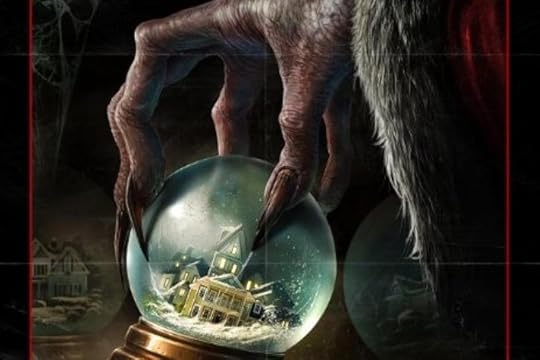
The penniless narrator soon devises a plan to assume McFadden's identity in order to marry Chlorine and claim control of her inheritance. The story humorously revolves around a series of misadventures that unfold. The narrator believes that the purpose of his visit is to wed the beautiful and rich daughter of the house, but actually he is supposed to lay the family monster that curses the family. He may well lose his life in the attempt. The monster appears in the Grey Room on Christmas Eve and checks the family accounts. Here the narrator turns out to be an amusing coward.
I started reading this story on the 24th of October 2021 and ended it on the same day. I give a four-star rating for this work. In the first few pages of the story, I soon noticed that the author’s writing style is surprisingly engaging and absorbing. The characters were very well conceived, and I should mention that I was particularly interested in Miss Chlorine. The narrative proceeds at a satisfying pace, not overwhelming the reader. However, the author inevitably failed at the end of his work. I believe that he could have structured the last chapter — or even written an epilogue — in a way that the reader could have understood clearly the fate of each character. I believe that it is necessary to congratulate the writer, as this work shows great maturity.
“As we were continually together, I began to regard her with an esteem which I had not thought possible at first. Her looks improved considerably under the influence of happiness, and I found she could converse intelligently enough upon several topics, and did not bore me nearly as much as I was fully prepared for.”
A young man discovers that to marry an heiress he must confront a Christmas demon. He finds it impossible to summon the nere required for the confrontation and suggests to any eligible bachelor that the opportunity is still available to one brave enough.