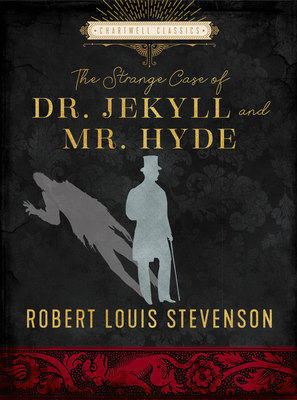
Discover the mesmerizing tale of two personalities in a war over the soul of one man.
The Strange Case of Dr. Jekyll and Mr. Hyde is a tale of Victorian horror. The personalities of the pleasant Dr. Jekyll and the violent Mr. Hyde vie for control over a single body. This gothic horror novel is presented alongside five short stories:
A Lodging for the Night The Suicide Club The Body-Snatcher The Bottle Imp The Isle of Voices
This elegantly designed jacketed hardcover edition features a new introduction by English scholar and professor Allen Grove and a timeline of the life and times of Robert Louis Stevenson .
Robert Louis Balfour Stevenson was a Scottish novelist, poet, and travel writer, and a leading representative of English literature. He was greatly admired by many authors, including Jorge Luis Borges, Ernest Hemingway, Rudyard Kipling and Vladimir Nabokov.
Most modernist writers dismissed him, however, because he was popular and did not write within their narrow definition of literature. It is only recently that critics have begun to look beyond Stevenson's popularity and allow him a place in the Western canon.
«If I am the chief of sinners, I am the chief of sufferers also»
Right off the bat I’ll say: if you have the opportunity of going into this completely blind, I urge you to do it. I, together with what I assume to be many others, was already familiar with the mythical motif of «Dr. Jekyll and Mr. Hyde» through pop cultural references or metaphorical language, which unfortunately deprived the story of its mysterious and shocking quality. I definitely think the best way to enjoy this is to approach it as cluelessly as the Victorian Englishmen did in 1886.
This was an engaging novella that was just the right length for what it wanted to accomplish, and I could comfortably finish the audiobook in one sitting. The tone was strange and ominous, giving a sensation that much of the plot was occurring in the shadowed background while we were only seeing the scattered traces. The plot was relatively simple and easy to follow, with a small cast of characters with distinct roles, making it a digestible mystery that still harbored deeper themes.
!!! —— As I find it impossible to discuss anything else without revealing the premise, there will be SPOILER-y references from now on —— !!!
The story is most notable for its take on the great battle between good and evil - not between the angels and the devils, heroes and villains, but between parts of our very selves. Human nature is composed of various tendencies that all compete to influence our behavior, both of the primitive and egocentric kind and of the sophisticated and harmonic kind, each wanting to improve our life quality in some way. Robert Louis Stevenson personifies this internal struggle as a dual existence: at once the upright, noble and social Dr. Jekyll and the hideous, rash and violent Mr. Hyde.
Instead of drawing the line between «good» and «bad» people, Stevenson invites the idea that these opposing forces naturally coexist within every person. While portraying this split in a comically literal way, the story can also be interpreted as equalizing by highlighting this inherent quality of all humans: the capacity of both goodness and evil.
«I learned to recognise the thorough and primitive duality of man; I saw that, of the two natures that contended in the field of my consciousness, even if I could rightly be said to be either, it was only because I was radically both.»
I was also intrigued to learn about its impact on the public consciousness when Jack the Ripper terrorized London in 1888, two years after the novel was published. With the story’s moral freshly in mind, the people of England were haunted by the idea that the unidentified killer could be anyone in society, as even the most respectable figures might be hiding monstrous tendencies. Their fellow emergence hence established a cultural connection between the fictional story and the real-life murders, which must have made the novella and its themes feel extra chilling at the time.
Lastly, the story also has a notable metaphorical value for the hardships of drug addiction and substance abuse. Personally, I was familiar with «Dr. Jekyll and Mr. Hyde» as a metaphor for transforming into a completely different person while being under the influence of alcohol. In the story, we not only see the act of drinking a mysterious potion being the origin of the evil Mr. Hyde, but also Dr. Jekyll developing an addiction to the potion to either access or control his alter ego, then how the personal consequences eventually spiral beyond the potion’s control. Eventually, Dr. Jekyll realizes that what started as naïve experimentation with the drink is now threatening to destroy his life by trapping him within the corruption.
!!! —— End of SPOILER zone —— !!!
It was fun to finally get around to this book, but in the end I think that the myth will hold a stronger hold on me than the story itself. Compared to «Frankenstein», arguably my all-time favorite book, I didn’t feel like I discovered much additional content in this story that could rework, expand or accompany my original idea of it.
«The Strange Case of Dr. Jekyll and Mr. Hyde» definitely deserves its reputation and its place in the literary canon, and it still holds relevance today, but the reading experience becomes less suspenseful and mind-blowing if you already get the gist. That’s why I think it is best experienced without any prior expectations, allowing it to mimic the effect it had on readers when it was first published.
Lo empecé anoche y lo terminé ya entrada la madrugada. En a penas tres horas había acabado con él.
Desde el mismo momento en que lo empiezas te transporta al Londres victoriano. Stevenson logra crear una ambientación perfecta que, además, es muy propicia para los misterios y el suspense -a pesar de que el desenlace de esta historia es, cuanto menos, intuíble por ser tan de cultura popular-.
La trama es brillante. Quizá no tanto en lo que se refiere al propio suspense, pero sí en lo que respecta a la reflexión filosófica que hay detrás. Típica dicotomía entre el bien y el mal, la dualidad de las personas, recurso que por otro lado ha sido alegado por criminales alrededor del globo, algunos de ellos en España.
«All human beings, as we meet them, are commingled out of good and evil»
The only bad thing about reading classics is that you don't truly get the experience of reading the story for the first time. I think I would have enjoyed this story even more if I didn't already know much about the storyline. But I did like this and sometimes it's nice to read a short story and move on to more on your list quickly.
HURRAY, Phoebe is back with her "reads a mystery" podcast, and I nearly jumped for literal joy when I received a notification from Stitcher (which sadly is disappearing!! Thanks Sirius XM for ruining all the good things.)
Anyways, she could read anything and I swear I wouldn't hate it, and I don't hate this either. 2.5 stars. It's short, which is nice, but the problem is we all already know the plot. All work and no play makes Jack a dull boy, and all work and no murdering makes Dr. Jekyll take some type of "white salt" and get right back to murdering!!
Clarification: Of this anthology, I was ONLY looking to read The Strange Case of Dr. Jekyll and Mr. Hyde, so I'm afraid I have yet to read the rest. Suppose that makes it a DNF. XD
Fascinating use of language from the Victorian era. Easy to see how this became a classic, though I feel like I'll need to take a class or two in the English language before I truly understand everything presented. Due to my own lacking of knowledge, 3 stars.
"With every day, and from both sides of my intelligence, the moral and the intellectual, I thus drew steadily nearer to the truth, by whose partial discovery I have been doomed to such a dreadful shipwreck: that man is not truly one, but truly two."
This is my first ever read through of The Strange Case of Dr. Jekyll and Mr. Hyde, and I must admit: As drawn out as the concept of this work is in popular culture, you're still learning something reading the source material. Obviously the good and evil in one body is a trope used so often (Fight Club, Black Swan, I would even dark say The Hulk) that you think you know everything that's to come in this novella. And maybe to an extent you do, but I found myself reading this and plucking out new information that never seems to be fully put across in it's contemporary counterparts.
I couldn't imagine coming across a discovery such as the one Dr. Jekyll had, only to use it in a way that benefits only myself to do things I normally wouldn't do, only for it to backfire in my face so outrageously as it had him. There was something eerie about the parts where Jekyll was turning into Hyde without having drank the "potion," and just sometimes waking up as him. Shivers, really. And to know that you're slowly running out of this mixture, that you're now having to take larger doses of in order to not turn into Hyde, and finding that something in your original formula was "impure" and you now can't replicate it is a tragedy of its own. Basically have to sit there and let the "evil" take over is scary in of itself and so very hopeless.
I can see myself revisiting this novella - I do always love gothic literature.
"A change had come over me. It was no longer the fear of the gallows, it was the horror of being Hyde that racked me."
"Man is not truly one, but truly two," observes Dr. Jekyll, commenting on the conflict between different aspects of the self.
The Strange Case of Dr. Jekyll and Mr. Hyde explores the duality of human nature, emotional repression, and hypocrisy, among other things.
The book is as relevant now as it was in the Victorian society it was written for - perhaps more so, if we look at some of the recent unveilings of private evils done by public figures.
I knew the plot/premise beforehand; what startled me (in a good way) was the care and concern of Mr. Utterson for his dear friend, all the ways he wished to save him, and how he continued to see him even after certain unpleasant events.
Honestly, his friendship and feelings for Dr. Jekyll formed, for me, the heart of the book.
At the end, I just wanted to know how Mr. Utterson felt about the whole thing after reading the confession... I was left wanting more.
Stevenson, couldn't we at least have an epilogue?
Overall thoughts:
A really good story, for its time, but I'd have loved to see it differently executed - perhaps with different use of perspective? - so that a lot of the mysterious clues wouldn't have been explained in that one confession at the end which left me dissatisfied.
Besides the relationship between Mr. Utterson and Dr. Jekyll, the themes of the book were what excited me the most.
A must-read for lovers of classics and gothic/horror genres.
I really enjoyed this book, and read it in 3 sittings. It's engaging, and the plot is solid. It's interesting to me that, reflecting on the plot of the book, I started wondering why the plot twist is not brought in a more climactic fashion. My tendency, with my environment of current movies, is that climaxes should be epic, and the ultimate highlight. Yet, this story somehow drops this climax rather anticlimactically, and then continues to ponder on the morality.
Initially, I was going to give it 4 stars because I didn't quite think the structure was perfect. But I really enjoyed the read. So why not 5.
I have only read the Strange Case of Dr. Jekyll and Mr. Hyde, not the other stories in this collection.
A fun story that has the unfortunate problem of being a cultural phenomenon. The plot is spoiled for anyone aware of the idea of Jekyll and Hyde however even if it is spoiled for you I would rate this a 3.5. If one is so lucky as to not be aware of this text, and read it for the first time I would rate it a 4/5 as I have done so here.
The introduction by Dr. Allen Grove provides a brief outline of the story as well as a look at some analysis around the text itself.
A novella with a classic and influential premise but which doesn't quite meet its potential. Stevenson's clear style is appreciated as always, and he does keep up the intrigue with twists & genuine suspense throughout. Mystery plot is ok but loses considerable impact when one knows the twist. Inciting incident is a bit contrived. Transformation potion is a bit of a plot hole, as it the post-Lanyon reveal. Has some thematic interest in last chapter. Suffers largely due to content.
This was ok. I would have liked more description of the acts of Hyde rather than a vague "He did some disreputable things". But maybe that was the point - intentional vagueness lets your imagination run wild with it. I was expecting more of a violent crime/monster book based on the description, but this was more "My friend has been acting oddly".
I think there was potential here to evoke exhiliration through the freedom of Hyde, but Jekyll's "basest impulses" are a bit vague and one might be left to wonder, for what good in the end did he create the potion? Without exact details, I'm just not fully convinced that he enjoyed his time as Hyde.
This entire review has been hidden because of spoilers.
i think i just don't really appreciate classics also maybe because this is a classic, i already pretty much knew the story so everything was super expected. the story was actually very simple and straightforward. what drew me to this book was potential internal conflict and musings, but there was close to none at all
This entire review has been hidden because of spoilers.
The classics are classics for a reason, even the simpler ones like this. Well written and told from an interesting angle - through conversations between friends of Dr. Jekyll and documents by several parties. I read the edition with an introduction by Vladimir Nabokov which I very much enjoyed.
First of all, this is a long short story. Don’t be like me and panic that you got an abridged version! Second of all, did RLS read Romans 7 before going to be and dreaming up this story? Because that’s all I could think of. I will definitely be re-reading this one!
I’m not sure I have anything profound to add to this classic story. I did wonder if Stevenson had access to the Native American proverb about the two wolves living in each of us. Which one wins? The one you feed.
I really enjoyed this! I went into this book knowing the general premise of the story and I thought there would be more to the story once I read it. Such as, Jekyll's POV when he transforms into Hyde and what he does as Hyde and all his thoughts. Although it was a short book, it still felt developed and well thought out. The message of this story - the two part of mans nature; good and evil. It was interesting to look at the character through the possibility of him having DID. He obviusly didn't bc Hyde and Jekyll were two different people but in the same body, but it can be argued that people with DID turn into different poeple when they switch. The author's take on hipocrasy was intersting too, even though I don't agree with it. Jekyll and Hyde were doomed personality with an inner fight between social acknowledgement and dark needs. This book is about perception as well - we all want to be seen as good people but we all have these flaws and insecurities that we dont like and we want to hide and would hide if we could. It was also very intersting to see that Hyde wasn't a monster but just a short ugly guy. There were a lot of great quotes too!
I buddy read this with Aima and it was so fun/interesting to discuss. The messaging and the psychology behind the story made it an intriguing conversation. We loved discussing what our "Hyde" was lol.
This entire review has been hidden because of spoilers.
The book was divided into multiple stories. I wish to say that all stories related to Jekyll and Hyde, but they didn't. I gave three stars simply because some stories were stretched and a bit boring after the story of Jekyll and Hyde. The stories around the Foundation that helped people end their life and thus created murderers, as opposed to the magical bottle, were interesting but not to the same level as the original Jekyll and Hyde. Maybe I've misunderstood or am too 'young' to appreciate the rest of the stories. I can say one thing, I loved Jekyll and Hyde. How it begins, evolves and ends. The story requires science and all the ethical strings it is attached to.
The duality of man and the epic struggle of the good vs evil within us all. The saying " a Jeckyll and Hyde character" now part of the English language thanks to this classic tale by RLS. Still captivating to this day.
Honestly didn’t enjoy and DNF. I read most of and and some of the stories were okay but I was pretty bored and not happy. Might have been my frame of mind. Annoying writing style. I liked Markheim
Beautifully written story about three accomplished friends, one of whom realises a crazy idea. An iconic, legendary piece of work with great pace for its time.