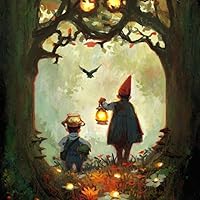
Esta es la historia de un niño que todo el mundo creía estupendo y sin problemas... En realidad, sus padres no lo conocían, creían que ya era mayor. Nadie sabía como se sentía, ni que a veces tenía miedos y malos ratos, excepto su abuela. Una vez su abuela tiene que irse de viaje un tiempo y le hace un ¡Un osito! Los padres creen que ya es mayor para jugar con un osito, pero este se vuelve el compañero y confidente de nuestro niño, hasta que vuelve su abuela. Los mayores piensan que es divertido ser niño, pero no siempre es así.
Generally, kids try to play cool outside. They tend to pretend who they are not in front of parents and friends. After all, it is not simple being a kid. Our protagonist shares who he really is in front of his grandmother. But with his parents, he wears a mask.
One day, grandmother leaves. What is the boy supposed to do now? This is a book I would like my kids to read to me.
A fearful little boy receives from his Grandmother a Teddy bear, just before she leaves on a trip. This boy, fearful of the dark and of his parents arguments, finds consolation in his talks with the teddy bear until his Granny comes back!
This was a really simple book, but something that could definitley be relatable for the age group it is targeted towards. Basically every kid has a stuffed animal they loved, talked to, and felt was listening, even though it wasn't a real person, and they knew that.
"A Cool Kid- Like Me!" is a story about a young boy who shows a "cool" personality on the outside, but has some hidden fears in the inside that he can only tell his grandmother. But when his grandmother goes on a vacation, she gives the boy a teddy bear to tell all his secrets to while she is away. The boy's parents disapprove of their son having a stuffed teddy bear, but he doesn't care. The boy tells his bear about how he worries about many things, such as sleeping in the dark, not having a best friend, and even about his parents fighting--and it made him feel better. After showing his feelings to his stuffed animal, the boy feels like "a cool kid" again and is excited when he sees his grandmother when she comes home.
Because of peer pressure and school norms, children (especially boys) feel a huge sense of pressure to hide any kinds of feelings from their friends and family. This book is very efficient in showing children that even though you don't want to share them with your friends, having and expressing your feelings is 100% okay. It encourages children to reach out to someone they are comfortable with to talk about their emotions and to say your feelings aloud, even if it's just towards inanimate objects, because it can be very helpful. Also, this book breaks gender norms in children, especially when the boy becomes best friends with his teddy bear. By doing this, the author is showing young boys that having a special stuffed animal is normal and not just for girls. Not only did I give this book 5 stars because of the life lessons it teaches children, but also because the illustrations and plot are very engaging. I recommend this book to all parents and teachers due to its applicability and the valuable message it presents.
Being a cool kid, something we all felt we were as a young child. But the character in this book sometimes feels that's not the coolest kid around. He has problems that everyone else has. Find out how he deals with these problems.
I believe that this book is realistic fiction. According to Children's Literature, Briefly, Contemporary realistic fiction is defined as "something that tells a story that did not happen but could have happened." This story tells of a boy who on the outside seems perfectly fine and happy, but on the "inside" he has some problems. I think that this is the perfect example of what a realistic fiction really looks like, because a lot of kids would be able to relate to this topic. I for one can relate to not feeling as if I were good enough, or whether people around me really were listening to what I had to say. I think this book will be able to open a conversation that may feel taboo, and let children know that they're not alone.
Future Educators! An activity that can be done with this book is a more personal one. Students can take home a paper with an outline of a person on it. They can decorate it however they want to. The students on the other side of the paper will write something that others may not know about them. They can put it into an envelope to make it anonymous. We can post it around the classroom and make sure no names are visible.
I liked this book because the kid talked about his feelings, even though he was considered a "cool kid". He needed a teddy bear even though his parents thought it was lame. He liked to sleep with it because he was scared of the dark and he could talk to it.
This book is about a very common struggle kids face nowadays: absent parents. Parents who might not be uncaring but are indeed too busy to get involved with their children.
This is the first book I ever read in French--and I was 26 at the time! Embarrassing, perhaps, but due to the weakness of my French, this simple little tale was more of an intellectual exercise than reading Kant (OK, OK, perhaps that's an exaggeration)! It was surprisingly poignant, I must say, and I came damned near close to getting teary-eyed a couple of times. The simple emotions of the protagonist, who is just a little boy, were portrayed with simple language, and their effects were simply heart-wrenching. He's a little boy who wears a cool countenance, whose parents essentially ignore him, and whose only friend is his grandmother. Before going on a vacation, she gives him a teddy bear (or "nounours," in the French edition), which his awful parents try to take away from him immediately. Thankfully, his grandmother shoos them away from such an idea, and the little boy and the bear become great friends. It sounds quite formulaic, and indeed the story is nothing to write home about. But sentences like these really choked me up. In the French edition, it reads:
"Et Nounours savait que j'avais peur que ma mère me laisse et ne revienne jamais! Je sais que c'était stupide mais parfois je ne pouvais pas m'empêcher d'avoir peur."
My attempt at translating would be:
"And Teddy knows that I am afraid that my mother will leave me and never return! I know that I am stupid but sometimes I can't stop myself from being afraid."
Interestingly enough, it seems so much sadder in French.
Reading this has made me curious about books I read, or my parents read to me, when I was very young. I can't remember any of them as being very affecting, emotionally, but perhaps if I re-read them now I'd feel differently.
Grownups think it's fun to be a kid. But it's not fun all the time.
Kadang kita lupa betapa dunia anak bisa terasa begitu keras. Ada keinginan untuk diterima teman, dikagumi teman, diperhatikan dan didengarkan orang tua. Hans Wilhelm mencoba menyajikan rasa tidak aman anak dengan tepat, satu sisi si anak ingin terlihat keren tapi di sisi lain dia merasa tidak nyaman dengan hal-hal buruk yang mungkin terjadi.
I start every New Year reading children's books, not only to remember my own childhood, but mostly because I miss my Granddaughters an love reading out to them.
Maria Carmo,
Lisbon 2nd January 2023.
The English version of a book I had already read a few years ago, in German and Catalan... lovely!
His parents think he's so cool, so he acts according to that infront of them, keeping his inner fears to his very best friend; his grandmother. Umm, what happened when she left for a long vacation?!