I got this book while stuck in a foreign airport for a very delayed flight only to realize I had already read its original French edition, which was released in the early 2000's as the first of a series of novels about the same fictional character. This was the first incursion of the cinematographer Xavier-Marie Bonnot into writing "polar" novels (short for "policier" in France) titled "La premiere empreinte," which translates as the first imprint or --for an impression [empreinte] of a part of the body-- footprint (more than a fingerprint). Since Bonnot has developed this same plot over more than one book of the series, given the English title I mistakenly thought this was a new release.
Besides usual argot, the French text is full of expressions typical from Marseille, which have made their translation into other languages difficult (or, as in this case, simply abandoned by the British translator of this edition, who lives in Paris) and losing much of their linguistic flavor, when not a bit awkward. This is enough of an issue that the initial French edition had a glossary of expressions for the non Marseillaises, which was abandoned in later books.
The main character here is Michel De Palma, aka the "Baron," an inspector of the judicial police of the Marseille region (criminal investigations in France are handled by the judicial police, always under the authority of a magistrate). Similarly to Dexter's Morse and Mankell's Wallander, De Palma is an opera lover and readers are regaled with an abundance of short opera lyrics. Bonnot paints him as a muscular man with a solid frame, though in the following book of the series ("La bête du marais" [The Beast of the Camargue]) he changes to the opposite of his short and beefy childhood friend Maistre and has a svelte physique. He is less refined than a posh-like Morse, and has less scruples than a melancholic Wallander; the image of Lino Ventura in his mid-50s playing a tough "flic" kept popping up in my mind.
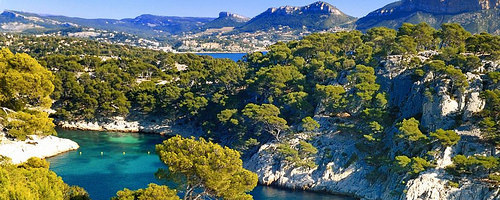
The story centers on the region of Marseille, the second largest city of France, whose rather unique culture is fueled by the melting pot of many waves of immigration. About a third of its population has Italian origins and this is reflected by the surnames of some characters, including De Palma's itself, which is also that of Bonnot's grandmother. However, the focus of the novel is not so much on the city proper, but on a region some 20 miles south from it: "La calanque de Sugiton," part of the Parc National des Calanques. (A calanque is a shoreline creek, in the British-English sense of a narrow fjord-like inlet, with steep rocky walls, that extends farther inland than a cove.) This creek, next to Cape Sugiton, is the only one open to tourists during the summer and the spring and fall weekends.
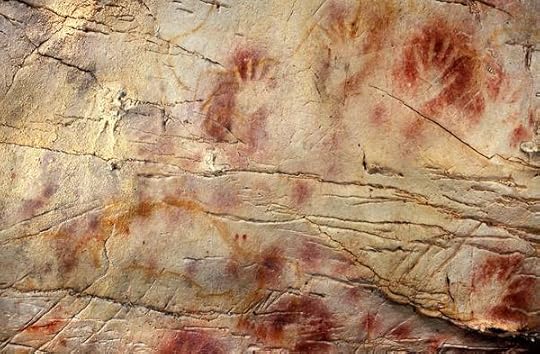
The story opens and, but for a few the final pages, closes at the Le Guen's cave. This is a fictional cave inspired on La Grotte Cosquer, a paleolithic grotto in the creek de la Triperie, next to cape Morgiou. This eponymous cave was found by the diver Henry Cosquer in 1985, but reported to the Maritime Affairs District only in 1991, after the accidental death of three divers in the 574-ft long and narrow underwater access corridor (named "La Galerie") to the cave, whose entrance is ca. 120 ft under the current sea level. This grotto has dozens of Upper-Paleolithic art items from as far back as 27,000 years BP. Classified as historic monument, its only entrance was barred by blocks of concrete in 1993, which were replaced by a heavy stainless steel gate in 2015. The Le Guen's cave reappears in other books of the De Palma's series.
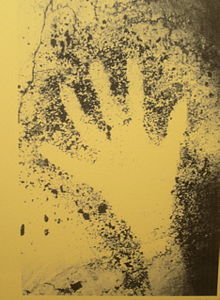
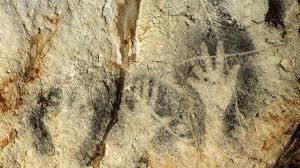
When a female professor of prehistory is killed in the Sugiton creek next to the Le Guen's cave, the site where several divers descending into the cave had died in separate occasions spanning several years, De Palma is called to investigate. Ritualistic, gruesome murders accompanied by the sign of a hand image in negative, with only three fingers extended, like some images in the Le Guen's cave, start occurring around the region, leading De Palma to suspect the deaths have in common some shamanistic motive. The plot is interesting but its development has an erratic course, repetitive at times, confusing at others, with a rather unconclusive end of story. There is quite an abundance of details, ranging from merely irrelevant to absolutely out-of-line in writing fiction, like the phone number with a Marseille area code in chapter 5, which at the time of writing is a listed number in the city district in which "La Capelette" (the zone where De Palma lives) is one of its six neighborhoods.
The blurb about the author claims he has a double doctorate (History and Sociology) and two masters (History and French Literature). Alas, that is *false*. What Monsieur Bonnot received was a master degree in literature [Maîtrise de lettres], and a DEA [Diplôme d'études approfondies] in history from the University of Provence. (The DEA is not a doctorate but a certificate of the French educational system that existed from 1964 to 2005, equivalent to having completed the second-year studies for a Master degree.) That Bonnot has not corrected such falsehoods after so many years is a deception. In fact, he seems complacent, if not complicit, given his silence.