De todos los poetas contemporáneos, ninguno ha tenido tal gesto conmovedor, tal necesidad de entregar su vida a los otros de un modo tan fascinante, tan compasivo y trágico como Paul Verlaine. Porque nadie ha sido tan frágil ante el peso del destino. Toda su virtud poética reside en lo opuesto a la grandeza: en la vulnerabilidad. Produjo así una poesía ancestral, pura humanidad, sencilla queja, humildad, balbuceo, ira y reproche, primitivos sonidos de sublime forma.
Stefan Zweig was one of the world's most famous writers during the 1920s and 1930s, especially in the U.S., South America, and Europe. He produced novels, plays, biographies, and journalist pieces. Among his most famous works are Beware of Pity, Letter from an Unknown Woman, and Mary, Queen of Scotland and the Isles. He and his second wife committed suicide in 1942. Zweig studied in Austria, France, and Germany before settling in Salzburg in 1913. In 1934, driven into exile by the Nazis, he emigrated to England and then, in 1940, to Brazil by way of New York. Finding only growing loneliness and disillusionment in their new surroundings, he and his second wife committed suicide. Zweig's interest in psychology and the teachings of Sigmund Freud led to his most characteristic work, the subtle portrayal of character. Zweig's essays include studies of Honoré de Balzac, Charles Dickens, and Fyodor Dostoevsky (Drei Meister, 1920; Three Masters) and of Friedrich Hölderlin, Heinrich von Kleist, and Friedrich Nietzsche (Der Kampf mit dem Dämon, 1925; Master Builders). He achieved popularity with Sternstunden der Menschheit (1928; The Tide of Fortune), five historical portraits in miniature. He wrote full-scale, intuitive rather than objective, biographies of the French statesman Joseph Fouché (1929), Mary Stuart (1935), and others. His stories include those in Verwirrung der Gefühle (1925; Conflicts). He also wrote a psychological novel, Ungeduld des Herzens (1938; Beware of Pity), and translated works of Charles Baudelaire, Paul Verlaine, and Emile Verhaeren. Most recently, his works provided the inspiration for 2014 film The Grand Budapest Hotel.
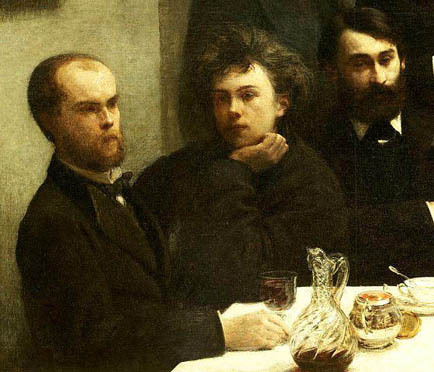
Paul Verlaine and Arthur Rimbaud - detail of a painting by Henri Fantin-Latour (1872)
Il faut, voyez-vous, nous pardonner les choses. -Paul Verlaine
I chanced upon this little book while looking for a good biography of Paul Verlaine,(*) and though Stefan Zweig (1881-1942) apparently wrote Paul Verlaine when he was 23 years old, he was already in full possession of his prosodic powers and psychological insight. In a finely honed turn-of-the-century prose Zweig indicates in broad strokes the life of a man he presents as weak and easily influenced, though highly gifted and sensitive: from the perfect childhood through the beginnings of the fall when he was placed in a Parisian boarding house at the age of 14 so that he may study in a Parisian school, through the addiction to absinthe and the oh-so-brief career as a bureaucrat in the Parisian City Hall, through the arrival from the provinces of some stunningly new poems by a fifteen year old prodigy, through the obsessive, self-destructive relationship with said prodigy - which ended not with the famous gunshots and the two year incarceration in a Belgian jail, but with a tragicomic drunken brawl on the banks of the Neckar after Verlaine was released and tried to convert the young monster to Catholicism; Rimbaud was just about ready to say adieu to literature and to Europe - through the long years of artistic and physical decline after the apogee of the passionate poems of religious fervor written in the Belgian prison.
It is particularly of this last and longest period in Verlaine's life that I learned the most from this little book. Zweig argues convincingly that Verlaine's belief flagged once again, leaving him only with a nostalgia for belief, but that he was trapped in a role he felt he could not abandon. Curiously, while generating reams of Catholic poèmes d'occasion Verlaine also published work Zweig characterizes as pornography, both for much the same reason: money.(**) The final years of Verlaine's life are most regrettable as he alternated absinthe soaked revels while wearing the tattered costume designed for him by the newspapers with longer and longer stays in hospitals.
Zweig quotes freely from Verlaine's poetry and Confessions, working them seamlessly into the text to illustrate his points. Along the way we also learn what the young Zweig thought about poetry in general and about the failings of French poetry in particular. As a good Germanic Austrian he found the art of French poetry to be too abstract, too distant from the sources of great poetry. He asserts that, next to Villon, Verlaine was the first lyrical genius of France, but that Verlaine's prose and sole piece for the theater are of interest only for insight into Verlaine's life. Zweig writes, "er hat ja nie die Welt recht verstanden und nur gewusst, sich selbst zu erzählen."(***) That could well be true...
(*) There are many biographies of Rimbaud, but I am still looking for a modern biography of Verlaine. This book is available free online in English translation, and the original German edition (with excellent illustrations including a self-caricature of Verlaine I had never seen) is similarly available here: http://babel.hathitrust.org/cgi/pt?id... .
(**) He mentions explicitly two under-the-counter publications, Femmes and Hombres. I've never seen these texts before, but now my curiosity is aroused.
(***) He never rightly understood the world and only knew how to narrate himself.
Es muy cuco el recato con el que Zweig cuenta "el episodio Rimbaud". Pero leerle es un placer y esta semblanza de Verlaine se me ha quedado corta por lo poco que se llega a vislumbrar en el despliegue de todas las contradicciones del personaje.
«Si la poesía consiste en cierta susceptibilidad del alma, reacción al contacto débil y cauteloso, y no violencia activa, salvaje, dominadora, sin duda Verlaine ha hallado el sentido más profundo de los misterios órficos; el chiquillo que escribía los Poemas saturnianos en su pupitre ha escuchado su destino entero con ese fino oído que no solo advierte la verdad de la vida, sino que ve su futura máscara, como la sentencia de un oráculo que solo ha sabido interpretar cuando ya todo lo que la voz pítica de su intuición le había susurrado se había cumplido».
Curiosa la interpretación de Zweig sobre la llegada de ese meteorito poético y vital que supuso la creación de los Poemas saturnianos para Verlaine. Estamos ante un libro primerizo, la primera biografía que Zweig escribió. Hasta entonces solo había publicado un libro de poemas y este sería su primer estudio «serio». Es verdad que no pasa de ser un pequeño ejercicio de indagación en la figura del poeta francés, que una vida tan plagada de acontecimientos y tragedias apenas dio para unas ochenta y pocas páginas, pero más que retratar la vida de Paul Verlaine este estudio biográfico desea adentrarse en la obra poética y soltar un anclaje en lo vital.
Se nota que es un libro de un autor primerizo, con el deseo de agradar y no meterse en polémicas. Zweig toca con mucha suavidad los episodios más escandalosos de la vida de Verlaine. Es más, no se encuentra muy cómodo cuando tiene que afrontarlos. En buena medida le adjudica a Verlaine una personalidad «débil» y sensitiva, capaz de arrastrarse por la absenta y zarandearse en la violencia más sórdida; hasta el niño Rimbaud es presentado como una fuerza hercúlea de la naturaleza. Esto puede deberse a dos cosas: la leyenda de Verlaine era todavía muy cercana en el tiempo y podría molestar a la moral bienpensante del Imperio austrohúngaro; y dos: Stefan Zweig siente tanto respeto por la obra poética de Paul Verlaine que no desea que sus escándalos etílicos empañen la percepción de la literatura que él desea resaltar. En los dos polos de estas cuestiones debe hallarse la verdad.
«Se arrojó de buen grado en brazos de todos los peligros: las mujeres, la religiosidad, la bebida y la literatura. Todo esto lo asfixió y lo desgarró, pero las gotas de sangre vertidas son poemas espléndidos, acontecimientos imperecederos, sentimiento primigenio y cristalino».
Estructuralmente es un libro muy sencillo. Se abre con una visión general y pasamos enseguida a la infancia y primeros años de Verlaine, quizá su único periodo de felicidad. Y así vamos, de forma muy sucinta y muy rápida, por los distintos periodos vitales del poeta francés. Las personas más importantes en la vida de Verlaine pasan como bólidos por nuestros ojos. No hay tiempo para detenerse en la madre de Rimbaud, ni en la desventurada Elisa, ni siquiera en Rimbaud. Los acontecimientos que no se pueden ocultar se hacen también presentes: el tiroteo de Verlaine a Rimbaud, la pelea a puñetazos, la definitiva separación. Rimbaud marchará a África y se perderá viajando por media Europa, pero antes tendrá que dar testimonio de su fin poético, y ese no será otro que Una temporada en el infierno, librito que se autoeditó y que pasó sin penas ni gloria hasta que, al hilo de la fama de ser incluido en el libro de Los poetas malditos de Verlaine, Rimbaud comenzó a ser conocido.
«Hasta ahora todo es fuerza, amenaza, y no hechizo: tan solo la magia de una pasión, esa fuerza magnética elemental e insondable que encadena personas a personas. Solo lo inconcebible puede vencer a un poeta. Puede derrotar a la miseria y a la vida porque las desprecia. Desactivar los vicios, porque se arrepiente de ellos. Puede superar el azar. Pero no puede detener al destino, combatir a lo incomprensible. Una nueva fuerza entra en la vida de Verlaine: Arthur Rimbaud». La cárcel, el arrepentimiento y el abrazo del cristianismo por parte de Verlaine también están tratados de forma muy veloz. Desde luego, sus apreciaciones sobre la calidad inigualable de Sensatez no son compartidas por este que escribe la reseña: para mí no pasa de ser un buen libro de poemas dentro de una gran trayectoria; pero se nota que hay un deseo de Zweig de que los libros más acordes con la moral bienpensante sean los más resaltados. Únicamente así se puede apreciar que La buena canción, en definitiva el libro de matrimonio de Paul Verlaine, reciba tantos elogios por ponderado y equilibrado. De hecho, un libro que considero crucial en su última etapa, Antaño y hogaño, y que en buena medida es vanguardista de una forma muy osada, no es ni siquiera mencionado.
Y así llegamos a los últimos años de Verlaine. A la tragedia absoluta. Zweig lo único que nos menciona es que escribía versos en los hospitales y que una corte de poetas que querían trepar lo elogiaba y lo perseguía por todas partes. Esto es cierto y no lo es. La cantidad de dolencias que padecía Verlaine lo llevaba cada dos por tres a ser ingresado, pero el poeta francés abrazaba la bohemia con la mejor de sus voluntades. No hay mención alguna a los amigos y amantes de entonces. Como casi siempre, se olvida que la única persona que lo cuidó y le ayudó fue una prostituta, Eugenia Krantz, que aunque en este libro de Zweig ni se menciona, fue capaz de escribirle a Lepelletier tras la muerte de Verlaine solicitándole y rogándole algo de dinero: se lo había gastado todo cuidando a Verlaine y no tenía para pagar el alquiler de la vivienda.
Todo este tipo de cosas están ausentes de este libro. Lo que no sabemos es si no están incluidas por no conocerlas (supongo que el joven Zweig trabajaría con un par de libros y los poemas de Verlaine) o por evitarlas.
En todo caso es un libro agradable y con breves destellos de esa calidad poética y honda que Zweig desplegará más adelante. «Quedaría por decir si, de esta vida que tuvo su arranque en Metz y se extinguió un día de enero del año 1896 en la angosta estancia de una buhardilla de París, del ser humano llamado Paul Verlaine y su obra, se despliega uno de esos efectos que podríamos llamar permanentes por miedo a la orgullosa y sonora palabra eternos. Porque la valoración de los poetas verdaderamente grandes supera las fronteras de la literatura, pasa indiferente ante lo que se llama influencias y ambientes artísticos. Lo eterno de las grandes obras poéticas anhela eternidad».
Como colofón, señalar que el librito incluye algunos versos de Verlaine y, por lo general, la gracia y la desenvoltura de un jovencísimo Zweig, que si bien no estaba aún en el apogeo de sus capacidades ya demostraba, al menos, ciertos dotes. Hasta otra.
"Gerçek bu, Verlaine anlık duyguların adamıydı. Velaine, eserlerinde hayat şiiriyle, ormanın sesiyle, rüzgarın öpüşüyle, sazların hışırtısı ve akşam karanlığının sesi ile bir olabilen bir şairdi."
Zweig Usta'nın bu kendi ince ama ifadeleri dolu dolu olan kitabı sayesinde Verlaine isimli bir Fransız şairi yakından ama çook yakından tanımış oldum... Ve bir kez daha anladım ki , çocuklukta yaşanan, bilinç altında saklanan tüm olaylar, eksik duygular, inişler çıkışlar, özlemler, boşluklar kişi büyüdüğünde kendini daha büyük bir patlama ile ortaya çıkarıyorlar... Zweig bence tam bir insan anlatma ustası. Allah insanı yaratmış, Zweig ise insanı en iyi şekilde anlatmış.
Imposible no apreciar las palabras de Zweig: “La sensibilidad no es solo hija del sentimiento, sino suma y resta de todos los sentimientos a la vez …”. Este escritor siempre revela y descubre algo nuevo de quien escribe y de nosotros mismos.
Verlaine nació el 30 de marzo de 1844. Su padre era un oficial que había luchado en Waterloo y se casó con una rica heredera. Pasó sus años de estudiante en un internado pero pronto se convertirá en un pícaro parisino y será en esta época de 1860 cuando debuta como poeta. Sin embargo, Verlaine elige una profesión burguesa.
Verlaine tiene un espíritu débil y huidizo, por lo que se lazó dócilmente a los brazos de todos los peligros: las mujeres, la religiosidad, la bebida y la literatura.
Stefan Zweig nos narra la vida tan turbulenta que tuvo este poeta así como su proceso de creación y cómo publicó su primera obra con una prosa poética maravillosa. A pesar de cómo fue en vida este poeta, se le coge mucho cariño y una se compadece gracias a cómo lo describe todo Zweig maravillosamente.
Gracias a esta "biografía" he conocido datos como el alcoholismo que marcó toda su vida o el episodio de Rimbaud, del que no se sabe con seguridad si fueron realmente amantes o solo amigos.
"En estas pocas páginas se comprime todo [...], todos los atributos de Verlaine: el penitente acusador que nunca dejó de ser, el borracho colérico, el poeta tierno y nostálgico, el buen pecador de una fe infantilmente inteligente y a la vez tan enigmática en su ingenuidad..."
Sólo un deseo tengo: que Zweig resucitara y escribiera mi biografía, porque así podría saber, por fin, quien soy yo. Desde que leí los "Momentos estelares", Zweig está en mi top 3 escritores de todos los tiempos. El tío no falla nunca, es un maestro de la miniatura y el retrato sin entrar en datos ociosos ni descripciones enfangadas.
Justo en este librito sí le he visto un poco más verborreico, cosa que no me ha gustado. Se suma también que a Verlaine no le he leído nada (o casi nada), así que no puedo comparar el retrato con el original. Pero quitando estos dos puntos...sigue siendo Zweig.
Sobre lo que más habla este libro, como es natural, es sobre la poesía. Es más una especie de arte poética a través de Verlaine que una biografía del mismo. Y tengo que decir que los pensamientos aquí expresados son muy zambranianos, aunque expuestos con mejor gusto, sintaxis clara y sin ese tono beatil y de letanía. Propongo cambiar Z por Z y hacer de este libro el nuevo "Claros del bosque", nos aprovecharía más.
Muy disfrutable, pero no sería el primero por el que empezaría si tuviera que decir mis libros favoritos del escritor vienes. Un capricho a la francesa.Verlaine, "la ruine insuffisamment ruinée".
Absenta para huir de los otros y quizás de uno mismo... la distancia entre la muerte de los mitos y la juventud paradisiaca contra la madurez decrépita y enferma; El buen infante, la prosa mágica y el beato místico: lascivo y blasfemo al unísono, entre papeles y hospitales malolientes. Una vida entre la pomposidad y la mórbida ternura de la mendicidad. Descerrajó un tiro a la estrella perecedera de Rimbaud por desengaño y deslealtades... También la belleza inmensa de las primeras prosas y rimas, de los mitos y lo femenino; Verlaine según Stefan Zweig es la esencia y el sentimiento más puros: “de ciega e inagotable nostalgia de la totalidad y el infinito.” Algo purísimo que se transformó en un referente tardío para la juventud poética francesa y en una caricatura mortal de sí mismo y de sus debilidades, filias y miedos.
Uno de los primeros libros de Zweig, bastante cortito que te lees en una tarde. Con cierto toque poético en términos biográficos el libro es bastante interesante, aunque quizás demasiado corto, sirviendo así como una introducción y apreciación a la vida y obra de Verlaine que te permite conocerlo de cerca.
Büyük ama aykırı bir şairi yine büyük bir edebiyat adamının ağzından pek anlayamadığım için üzgünüm. Bu biyografi sanki, benim gibi, psikoloji üzerine, edebiyat üzerine orta halli bir birikim sahibi, sıradan bir okur için yazılmamış. Bu sebeple bu kitabın 5 yıldız üzerinden kaç yıldız edebileceğini değerlendirebilecek durumda bulmuyorum kendimi. Öte yandan psikolojiye ve sıra dışı kişiliklere olan merakım nedeni ile kitabı okumaktan vazgeçmedim. Her sayfasında sadece Verlaine’i değil Zweig’ı da anlayabilmek ümidi ile ilerledim. Bu bakımdan, anlaşılması zor olsa da, kitap benim için akıcıydı diyebilirim.
Zweig , Verlaine üzerine yazarken aslında şiir ve şairi anlattığı bir çerçeveyi de kaleme dökmüş gibi. Uçarılığı, deliliği, hüznü , bir taraftan özgür , kalıp tanımaz , bohem, utanmaz, yabanıl, diğer yandan saf, samimi , bir şeylere sığınma ihtiyacı içindeki Verlaine , Rimbaund ile ilişkisi, katolikliğe sığınışı, içkiyle dostluğu ile , bu çerçeveyi dokunulabilir gerçekliğe döken bir örnek. Verlaine ve şiiri ile ilginiz olmasa da , yukarıdaki çerçeve açısından okuması keyifli bir Zweig kitabı.
Una biografía breve y soporífera. Sobre el retrato, más bien flojito, que Zweig hace de la relación entre Verlaine y Rimbaud mejor no hablamos.
Por qué hablar de "una fuerte corriente subterránea de entusiasmo personal en su amistad" cuando eran maricones que se admiraban, se querían y se follaban.
Desconocía la vida de Paul Verlaine. Me ha parecido bastante peculiar, pues se encuentra totalmente fuera de los valores que comparto. Stefan Zweig nos muestra su vida y acontecimientos con detalle. Si de por si es corta la monografía Zweig la hace aún más amena.
"Son dönemin hiçbir şairinde, Paul Verlaine'den daha mecburi, acılı ya da trajik bir kendi hayatını başkalarına açıklama ihtiyacı yoktur çünkü Verlaine kadar hiçbir şair kaderin baskısı altında zayıf değildir. Verlaine'in bütün yaratıcı erdemi tersine çevrilmiş güçtür. Zayıflığı onun gücüdür."
"Verlaine'in eserlerinde çıplak, ehlileştirilmemiş, hem insansı hem de tanrısal güzellikle parlar. Böylelikle ilkel lirizme ulaşmıştır: saf insan, basit yakınma, alçak gönüllülük, çocuksu tutukluluk, gazap ve sitem."
"Her halükarda, hayat günümüzdeki hiçbir şairde olmadığından çok daha derin biçimde onun tenine etki etti. Ruhu, hiçbir şeyin sessiz kalmadığı o kadar sıkıca ve acınası şekilde yaralanmıştı ki, ölünceye kadar inleyerek, sevinerek ve ağlayarak kanadı."
"Faust ve Mephisto karakterleri Verlaine'de hiçbir zaman tam olarak birbirine bağlanmamış, sadece iç içe geçmiştir. Her alanda gösterdiği aşırı kendini adamışlık kapasitesi ile hayatını sadece tensel ya da manevi olanla birleştirebilirdi. Fakat böyle bir isteği olmayan Verlaine sürekli yön değiştirmeye bir son nokta koyamamış ve bu yön değiştirmeler onu pişmanlık duyduğu tutkularından bir anlığına çekse de yine onu tutkuların nefret dolu ellerine fırlatmıştır. Bu yüzden Verlaine'in hayatı yukarı doğru yükselen bir çizgi değildir. Onun hayatı yorgunluklarla sonuçlanan baş aşağı inişler, felaketler, yükselmeler ve değişimlerden oluşur."
"Mükemmel hislerin adamı olan Verlaine, kendi tarzını hayata uygular. İçindeki şefkati açlık, sarhoşluk ve vahşi bir kader boğmuştur. Rimbaud ile olan arkadaşlığının da zararlı biçimleri vardır. Sıklıkla kavga etmeye başlarlar. Neredeyse her saat Rimbaud'nun fokurdayan sinirleri ile Verlaine'in geçici sert, vahşi tavırları çatışır. Hiç şüphesiz ikisi de sarhoştur. Güçlü olan Rimbaud, güç isteği için, renklerin parladığı dürtülerin daha bir şiddetlendiği ve birlikteliğin daha hızlı, keskin ve cesur olduğu bir sarhoşluk istediği için içmektedir. Verlaine, pişmanlığı, elemi ve zayıflığı boğmak için absent içer. Hayatın bütün kötülüklerinin içinde damıtılmış gibi durduğu bu tatlı içkiden Verlaine vahşiliği ve hararetli karmaşaları çıkarır."
"Verlaine, duyulara tatlılık ve harikulade bir huzur veren ama bizi asil, güçlü, cesur ve mütevazı yapmayan nadide bir çiçek gibi harika, güzel ve fuzulidir."
A short book, which I read in one day. The first part is interesting from a biographical view point. Verlaine relationship with Rimbaud is intriguing from any conventional perspective. The remainder of the book was rather too sweet for me. My favorite quotes:
"The leitmotiv of Verlaine's poetry was his yearning and the infinitely beautiful and persistent impulse of the unhappy toward childhood and the magic of a primitively reverent life close to God. These wrought the miracle."
"The significance of great poets passes the boundaries of literature and ignores what is known as 'influences' and 'artistic atmosphere.' The eternal element of great works of poetry reaches back toward eternity. For humanity poetry is infinity which it joins with the ether, and the great poets are those who were able to help in elaborating the wonderful bond which stretches from the distant darkness to the red of the new dawn."
Paul Verlaine is more an appreciation of the poet in the tradition of Alfred Kazin’s On Native Ground than an in depth literary biography. Zweig, the great writer of obsession, considers Verlaine’s relation with Rimbaud with almost 19th century detachment and circumspection. Several poems are reproduced in French, but the editor only provides a translation of “Art Poétique,” the only poem which Zweig analyses in any detail. Although this biography assumes the reader is familiar with Verlaine’s work in French, it is a good introduction to Verlaine for the general reader and an illustration of the theme of obsession that drove his biographer’s fiction.
This brief book is awesome and worth reading because of how little regard Zweig has for his subject.
"It does not diminish Verlaine's stature if we do not count him among the heroes of life. He was an isolated phenomena, too significant to be typical and too weak to become eternal... His effect is deep, but yet on that account not great."
Much of Zweig's distaste for Verlaine seems due to the various salacious episodes in the poet's life, the details of which Zweig tactfully omits; but he simply doesn't like the Frenchman's poetry, either.
Satranç ' tan sonra hayal kırıklığı. Tek artısı Paul Verlaine hayatı ile birlikte 1900. yy Fransız sanatçılarının yaşamı hakkında bilgi veriyor olması. Türkçe çevirisi kötü yapılmış
One of my favorite German authors writing about one of my favorite French poets; a unique style, almost poetic itself, in a very short biographical work.