“An eloquent account of the American immigrant experience.” — Booklist (starred review) “Deserves to become a modern classic.” — BookPage (starred review) “A resounding welcome to immigrants.” — Kirkus Reviews (starred review)
Based in part on a 100-year-old family journal, Rosemary Wells brings to life a story that the diary’s fragile pages tell. It’s the story of a wooden rocking chair handmade in about 1825 by her great-great-grandfather, an immigrant Jewish boy who made his way to America from Germany in the early 1800s.
In 1807, Sam Siegbert is born in southern Germany. Sam’s favorite pastime is carpentry, much to his father’s displeasure. His mother says he has a gift from God in his hands. After moving to America, he builds a wooden chair with the word WILLKOMMEN on the back. The chair’s back panel was later marked with welcome s by four generations of the family in four different languages.
After the family lost track of the old chair, the author created a new life for it among new owners from other corners of the world. All the families who loved the chair came to America, escaping religious conformity, natural disasters, tyrannies, war, and superstition. In its lifetime, the rocking chair, with its earliest word WILLKOMMEN , stood for openness, hospitality, and acceptance to all who owned it or rocked safely in its embrace.
Librarian Note: There is more than one author in the Goodreads database with this name.
Rosemary Wells is an American writer and illustrator of children's books. She often uses animal characters to address real human issues. Some of her most well-known characters are Max & Ruby and Timothy from Timothy Goes To School (both were later adapted into Canadian-animated preschool television series, the former’s airing on Nickelodeon (part of the Nick Jr. block) and the latter’s as part of PBS Kids on PBS).
First sentence: In the year 1807, Sam Seigbert is born in the kingdom of Bavaria.
Premise/plot: An immigrant, Sam Seigbert, crafts a wooden rocking chair and engraves it with the word 'welcome.' (Technically WILLKOMMEN) Through the years, the word 'welcome' is engraved in a handful of different languages. The picture book provides a glimpse into almost two hundred years' worth of immigration stories. (Not that there is a story for every year--or even decade. But the book allows for readers to see how immigration and immigrants has been viewed. The first story taking place circa 1820s.)
My thoughts: I went into this one wanting to love it or at the very least like it. It has at least three starred reviews (Booklist, BookPage, Kirkus). It is on a timely subject--immigration. The fact that the author was inspired by a family diary from a hundred years ago, it made me want to love it.
But it just didn't work for me. I thought the story linking all these immigration stories together into one bigger story was weak. The individual stories had merit--I just didn't see the need to link them all together by using a physical chair. I didn't see how one chair could find its way about so many families, so many generations, so many places.
The author's note reveals that some of the earlier stories were from her own family tree, but she felt the need to tack on other immigration stories from other decades to bring the story to the present day. And the other stories do feel tacked on. Yes, that's just my opinion. Yes, I'm just one person. There are many, many, many people who seem to love and adore this one just as is. But for me it just didn't work.
A rocking chair carved with words of welcome is passed down through generations of immigrants to the U.S.
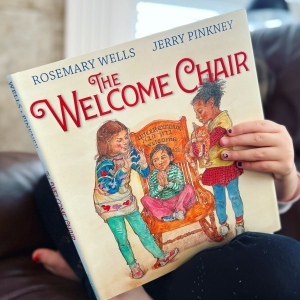
As always, Jerry Pinkney's pictures, done in his signature style, are a beautiful accompaniment to the text of this book. He captures each historical time period covered by the story, evoking a particular era with just one or two images. The details of architecture, clothing, furniture, tools, and even a ship are carefully rendered on each page. Facial expressions, too, help convey the emotions of the people in the story and contribute to the reader's understanding of the significance of the chair.
The main text of this book, which begins with true events from Rosemary Wells's own family history and finishes with a story from her imagination, would be excellent to read aloud to an elementary audience. My concern, though, is that the preface and author's note politicize the subject by alluding to immigration issues of the present day as though there is only one right way to think about them. This is a much more nuanced topic that requires proper context if one is going to have an informed opinion. I would probably not read the author's note aloud to younger kids, but with older ones it might be possible to use the book as a jumping off point for discussion, provided an adult gave them additional context.
This book reminds me a bit of The Quilt Story by Tony Johnston and Tomie dePaola, but The Welcome Chair covers a much longer time period and has much more depth. While the main focus is on immigration, this book also speaks to themes of family history, community, friendship, and hope. I think it's probably best suited to grades 3 and 4. I also think it would be interesting to read this book with other chair-themed stories, such as A Chair for My Mother by Vera B. Williams and Peter's Chair by Ezra Jack Keats.
I received a digital review copy of The Welcome Chair from Simon & Schuster Children's Publishing in exchange for an honest review.
Don’t let the cover art fool you. This is a picture book written for adults, not children, with page after page of text-heavy narrative. Half of the story is based on events chronicled in an old family diary about how The Welcome Chair came to be; the other half imagines the fate of the rocker after it assumes a life of its own. Even Pinkney’s lavishly detailed illustrations can’t create a coherent story out of this patchwork of fact and fiction.
This review was originally written for The Baby Bookworm. Visit us for new picture books reviews daily!
Hello, friends! Our book today is The Welcome Chair, written by Rosemary Wells and illustrated by Jerry Pinkney, a moving story of the immigrant experience in the United States.
Partially based on Wells’s family history, the story begins with a young woodcarver from Bavaria leaving home to strike out on his own, traveling across the sea to the United States. He finds work as a bookkeeper and apprentice, creating a rocking chair with the word “Willkommen” (German for “Welcome”) carved into the backrest as a gift for his employers. As the chair is passed down through his family, then eventually on to other immigrant families, the Welcome Chair has a new word for “welcome” added to it: “Baruch Haba” in Hebrew, “Welcome” in English, “Fáilte” in Irish, and more. With each new culture that makes the chair a part of their home, they add to its beauty and legacy, until it becomes a gift to a newly arrived refugee family, a gesture of friendship and, of course, welcome.
Gorgeous. Wells takes a deeply personal story and expands upon it to highlight the fact that, to this day, the United States is a nation built on immigration and diversity. The welcome chair is both a unique and memorable artifact as well as a poignant symbol of how a diversity of cultures can add to the beauty of the whole, and its story is compelling to read. Pinkney’s realistic illustrations give a grounded view of the chair and its long life, giving the necessary gravity to the characters that surround it and their often-serious circumstances and experiences. These experiences (which include brief descriptions of deaths, war, and other weighty subjects), as well as the tone and length, make this a story best suited to older elementary to middle grade readers; JJ enjoyed the illustrations but struggled with the more advanced text and tone. Overall, however, this is a beautiful story about the immigrant experience, and it’s absolutely worth the read. Baby Bookworm approved!
(Note: A copy of this book was provided to The Baby Bookworm by the publisher in exchange for an honest review.)
This is a tale, which beckons young listeners to sit, listen, and leave with a smile in their hearts.
Sam was a Jew born in Germany in 1807, who made his way to the US to find his own way of life and freedom. There, he became a carpenter and created a rocking chair with the word 'Wilkommen'. From there, the chair moved with his family, and then made it's way to others, each time gaining another welcome in a different language.
This is a lovely tale, which takes young listeners through a bit of history while celebrating immigrants and teaching various situations and events people went through. This is not a completely non-fiction book, though. While the chair, Sam and the origins are based on diaries, the stories after that are pieced together and reflect the history and/or tales of individuals and/or situations, which the author has happened across herself. By weaving all of this together around the journey of a chair, a beautiful tale has been created.
This book is perfect as a read-aloud. There is a bit too much text and depth for the youngest listeners but slightly older ones will be captured by the various experiences. Each person's tale is kept short, allowing the chair to quickly move on, but still, there's enough information to give a very interesting glimpse into each event. The true-to-life atmosphere and historical tidbits are intriguing, especially since the author does a masterful job at writing it in a way, which is anything but boring. Listeners are never spoken down to, but rather, hear the experiences in an engaging way. It's great for individuals, classrooms, and even homeschoolers.
The illustrations are very well done and fit perfectly to the historical journey. It's enjoyable to gaze through them even on their own and watch the list of words on the chair grow. Plus, it's inspiring to see how something can be handed from one family to the next, how different each person's life is, and how something as simple as a chair can bring joy through time. This is a book with a purpose, which the author and illustrator go into with a bit of depth. I found these personal notes added a nice touch, which also fit the atmosphere of the book itself. I received an ARC and found the author did an amazing job at combining true-to-life history with a wonderful tale.
A wonderful narrative of immigration and the reasons people came to America. The chair starts as a creation in the 1800s of a Jewish German carpenter, then gets an Hebrew word from the his new wife who left her country because her club foot was considered a deformity making her unmarriagable. then an Irish word for an immigrant escaping starvation. A Spanish word for two nuns fleeing persecution in 1939 Dominican Republic, French for a Haitian orphan baby adopted by a man who went to help after an earthquake. Then finally a Syrian word for a new child who came after fleeing her war torn country and losing her infant sister who fell from the boat. Very moving and representative of different experiences coming to America. Although they are all based on some kind of disaster or persecution so almost seem like refugee stories. Are disasters or danger the only reason people come to America?
Notes: Immigrant story with many different countries. Illustrations feel a lot older than the 2021.
Meh. A nice story which seems a mediocre imitation of a Patricia Polacco book. It starts out strong. A clean narrative thread draws you into the lives of immigrants. The illustrations are excellent. Then a bit over halfway through my son said "wait, this can't be true." It kind of fell apart.
I appreciate that the the story of what happened to the actual welcome chair is lost to the author. But it's so unique and enriching, it just didn't work to kind of hodgepodge together a bunch of other immigrant stories that seemed wildly unrelated.
It seems like it would have been a better execution to say that the chair was lost, but had it still existed to imagine the different immigrants who may have been welcomed. And that just as tangible objects can disappear, so can intangible values. As we imagine who might be next to sit in the welcome chair if it were to exist, so it is important that we resurrect the actual welcoming of those who may.
The first part of the book is based on the author's life as her great, great grandfather, Sam, comes to America. He works for a family and when that family's first child is born, Sam makes them a wooden rocking chair, carving Wilkommen on it. They head west and that is where Sam meets Ruth whom he marries. When they have their first child, Henry, they carve Baruch Haba in the chair, so he will know his heritage. Henry dies at Gettysburg, but his younger sister, Helen, gets the chair when she marries. Helen then gives the chair to Lucy, the family seamstress, when she marries. Failte is carved into the chair which is an Irish welcome. This is where the family's written account comes to an end, so the author brings the chair to present day combining other people's immigration stories.
The author's emphasis is the importance of our country being a place that will welcome those who are in need of a new home, not a country who closes its doors to others.
This picture book for older children comes from two giants in children's literature! Wells and Pinkney share in telling an important story of immigrations to the USA, based in part on the diary of Wells' great great grandparents. The tale begins in Germany in the 1820s and continues to the present day. A special handmade rocking chair continues to find a new home with a variety of immigrant families. Readers may find it a challenge to understand relationships through the generations as the surnames change with marriages. The connecting thread is the welcome chair which passes from family to family and home to home. The text is more detailed than most picture books. Adult encouragement may be needed.
Use to inspire students to discover where their families came from. What heirlooms have their families passed down? Tie-in with grandparents' day, social studies of immigration, family heritage, refugees.
I found this on the library shelf and eager to read something new by Rosemary Wells, my attention was also peeked when I saw Jerry Pinkney was the illustrator - Copyright 2021
In the preface Wells, in summary she tells how her father made her memorize the line from the Statue of Liberty: 'Give me your tired, you poor, your huddled masses yearning to breathe free." He explained; "American's door is open to suffering people....It's America's fundamental generosity that makes her [Lady Liberty] hold her head high in a world of trouble..." Wells continues "My father's words were true until recently. Lady Liberty's message is today challenged by those who want to shut the door."
The book's beginning is based on family legend, and Wells ends it with experiences overheard and current to this day.
This one should become a classic, and who can doubt that with the powerhouse of Rosemary Wells and Jerry Pinkney? The story's beginning is based on Wells's family history, but she continues the story of the chair beyond family lore to bring it to the present day, and to celebrate this country's place in the world as welcoming to all. A chair that is created as a gift is passed from hand to hand, each time adding a new translation of the word welcome for the new owner. Pinkney's illustrations are full of life and movement. Perhaps a perfect book with a beautiful story. Highly recommended for all.
Powerful story with the illustrations alone. Pinkney's work is stunning. When paired with Wells story about immigrants overcoming struggles and finding their way to the United States, this book may well become a classic. Wells writes about a chair that began in her family's history and tells the story of how it was shared/sold/restored by other families who overcame their own challenges to be in this country. I love the connection when "welcome" is added in each language. Do read the author and illustrator notes at the end to learn more about the backstory of various characters and designs.
The Welcome Chair is beautiful, part fiction and part family memoir. This book is rich in love, adventure, and joy. This is a great way to bring children into a broader worldview. From the different ways to say “welcome” to the individual journeys of each character, this book engages the heart and mind.
This fantastic story left me with a feeling of joy and love. I thoroughly enjoyed it and think that children will too. I listened to the audiobook, so I missed the artwork. I trust that the artwork enhances the beauty of the story, and I look forward to buying a copy.
Based on true events from Wells' family, a hand-carved chair welcomes different people who move to the U.S. by adding "welcome" in their language. Since the Statue of Liberty's message is mentioned, I wish it was hidden in the illustrations somewhere. An appreciation of the "American dream." Instead of talking about Columbus, this book would be a better choice. This would also be a good book to pair with a book that also talks about the people who were forced to America against their will. Two greats of children's literature coming together.
The Preface of the book ends with: “America’s door is open to suffering people from foreign lands,” my dad told me. “It’s America’s fundamental generosity of spirit that makes her hold her head high in a world of trouble. And it will always be so.” My father’s words were true until recently. Lady Liberty’s message is today challenged by those who want to shut that door.
Aside from this being an overtly political message, the story doesn’t come together. It tries to bring all these people together with a chair and it ends up falling short.
I mean, most kids today won't read the dedication or the author's note in the back, so they will likely miss the political message. The story should've stopped with the information the author had. There wasn't really any need to bring it to the present day, and those clips of the present day could've been expounded to picture books of their own. Maybe. I got it cheap at a library book sale, and I'm still undecided if it will stay in our home library. I love Rosemary Wells and Jerry Pinkney, but they both have better books.
History comes alive in the book The Welcome Chair by Rosemary Wells. The story unfolds from a bit of Well’s own family lore as she writes about a rocking chair handed down through her immigrant family. She weaves the stories of other immigrants into this picture book, illustrated by the great Jerry Pinkney, and creates a satisfying look into the many people that make up the fabric of United States history. This would be a great addition to classroom immigrant studies. For ages 5 – 10.
What a glorious final tribute to one of the world's greatest illustrators, Jerry Pinkney. This historical fiction story follows the tale of a chair carved 2 centuries ago as the Welcome Chair. Each new episode gives a voice to the many immigrant populations, individualized and personal from bits and pieces from Rosemary Wells' family history. The blend of these two legends is magical and majestic with an important message of what our country stands for.
Ohmygod. Rosemary Wells and Jerry Pinkney team up and it's everything you thought it would be. Wells takes a family history story, adds some additional layers that maybe didn't happen but should have, and Pinkney makes it all live and breath. Exceptional opportunity and catalyst for family history sharing amid the cuddles that will happen when this story is read aloud.
A generational tale of immigration to America and the history of how one single rocking chair provided comfort for the many different people who came into possession of it through the centuries. Based on a partial reading of her great-great-grandmother's diary the author takes bits and pieces and weaves this tale.
A sweet story of a 'welcome' chair, partly based on Rosemary Wells' grandmother's diary, and partly hopeful fiction about where else the chair might've gone in the years after the diary ended. Jerry Pinkney's art is lovely, and the story of welcoming family from all over the world is very touching.
What a wonderful story! Rosemary Wells' family story, woven into a multigenerational, multicultural tale of immigrants' experiences in the United States. This is Wells' and Pinckney's response to those who would close borders, but it is not preachy or strident.
A moving story with wonderful illustrations about a chair that is passed down through the years from the 1800's to the present day, illustrates the immigrant experience as it travels from one family to another.
3.5 stars. From the 1820s until now, a special rocking chair continues to find a new home with a variety of families. This would be a great book to inspire students or children to discover where their families came from. What heirlooms have their families passed down?
After reading this story aloud to my 8 year old daughter she asked, "Mom, can we find more books about history?" Thank you Rosemary Wells for igniting my daughter's interest and compassion with your beautiful stories.
A story of American through different waves of immigrants as the Welcome Chair is passed to friend or employee or neighbor, always with Welcome added in a new language.