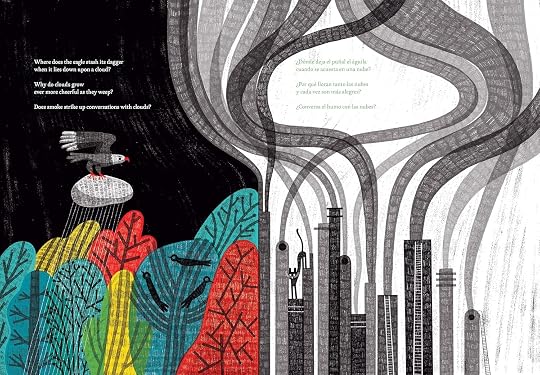
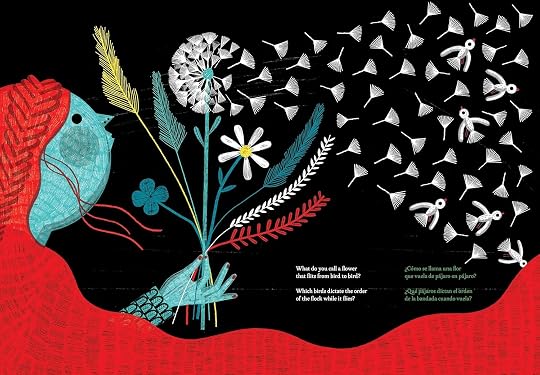
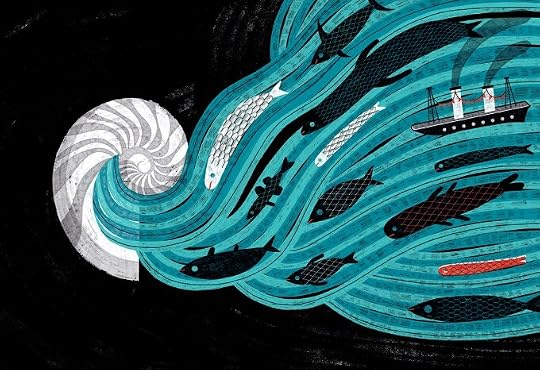
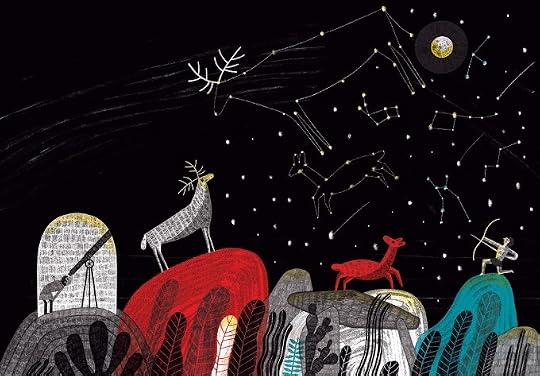
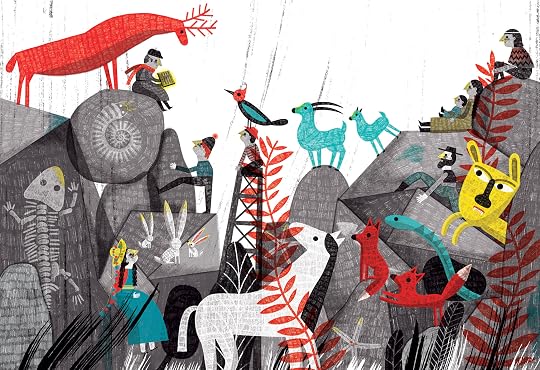
Where is the center of the sea? Why do the waves never break there? A book containing unanswerable, fantastical questions, inviting us to be curious, while simultaneously embracing what we cannot know. A New York Times Best Children's Book of 2022 A Marginalian (fka Brain Pickings ) Favorite Book of 2022 A New York Times Bestseller! A USBBY Outstanding International Book of 2023 A 2023 Bologna Ragazzi Award Amazing Bookshelf Selection Selected for the Academy of American Poets 2022 Featured Fall Books List for Young Readers Starred reviews in The Horn Book, Kirkus, SLJ, and PW ! This bilingual Spanish-English edition is the first illustrated selection of questions, 70 in all, from Pablo Neruda's original poem (320 questions) The Book of Questions . Holding the wonder and mystery of childhood and the experience and knowing that come with growing up, these questions are by turns lyrical, strange, surreal, spiritual, historical and political. They foreground the natural world, and their curiosity transcends all logic; and because they are paradoxes and riddles that embrace the limits of our ability to know, they engage with human freedom in the deepest way, removing the burden and constraint that somehow, we are meant to have answers to every question. Gorgeously, cosmically illustrated by Paloma Valdivia, here Neruda's questions, already visual in themselves, gain a double visuality that makes them even more palpable and resonant. So clearly rooted in Chilean landscapes as they are, the questions are revealed as a communion with nature and its mysteries.
Pablo Neruda, born Ricardo Eliécer Neftalí Reyes Basoalto in 1904 in Parral, Chile, was a poet, diplomat, and politician, widely considered one of the most influential literary figures of the 20th century. From an early age, he showed a deep passion for poetry, publishing his first works as a teenager. He adopted the pen name Pablo Neruda to avoid disapproval from his father, who discouraged his literary ambitions. His breakthrough came with Veinte poemas de amor y una canción desesperada (Twenty Love Poems and a Song of Despair, 1924), a collection of deeply emotional and sensual poetry that gained international recognition and remains one of his most celebrated works. Neruda’s career took him beyond literature into diplomacy, a path that allowed him to travel extensively and engage with political movements around the world. Beginning in 1927, he served in various consular posts in Asia and later in Spain, where he witnessed the Spanish Civil War and became an outspoken advocate for the Republican cause. His experiences led him to embrace communism, a commitment that would shape much of his later poetry and political activism. His collection España en el corazón (Spain in Our Hearts, 1937) reflected his deep sorrow over the war and marked a shift toward politically engaged writing. Returning to Chile, he was elected to the Senate in 1945 as a member of the Communist Party. However, his vocal opposition to the repressive policies of President Gabriel Gonzalez Videla led to his exile. During this period, he traveled through various countries, including Argentina, Mexico, and the Soviet Union, further cementing his status as a global literary and political figure. It was during these years that he wrote Canto General (1950), an epic work chronicling Latin American history and the struggles of its people. Neruda’s return to Chile in 1952 marked a new phase in his life, balancing political activity with a prolific literary output. He remained a staunch supporter of socialist ideals and later developed a close relationship with Salvador Allende, who appointed him as Chile’s ambassador to France in 1970. The following year, he was awarded the Nobel Prize in Literature, recognized for the scope and impact of his poetry. His later years were marked by illness, and he died in 1973, just days after the military coup that overthrew Allende. His legacy endures, not only in his vast body of work but also in his influence on literature, political thought, and the cultural identity of Latin America.
Why is it so hard, the sweetness of the heart of the cherry?
Is it because it must die or because it must carry on?
。。。
poetry in question form. sometimes these questions are beautiful, sometimes they made me say... huhhhh? definitely hit and miss!
i think picking up a bilingual version of this one is essential. i really enjoyed having a choose your own adventure type reading experience with the poems side by side in english and español. it's interesting to get such a different impression of each poem depending on which language my brain receives it in first.
Taking Libro de las Preguntas (Book of Questions) by Pablo Neruda as a guide this book is a wonderful way to introduce children to this iconic poet. The artist (Paloma Valdivia) spent time researching Neruda for some time - her illustrations are lavish and lush with the same immersive vibrancy that the poetry of Neruda is known for. If I had children this would be a book I would read with them often. Highest recommendation.
Small children ask many questions. It’s a rather understandable instinct, to be honest. If you are young and encountering as vast, wide, and mysterious a world as this one, your little human brain may react by wishing to clarify and categorize everything you see. Sheer human necessity dictates an endless stream of questioning. Naturally, it can’t last. Once the children are a little older their questions may not disappear entirely but they certainly taper off. A tad older still and suddenly they consider themselves founts of wisdom. What can this old world teach them when they already know so much? Personally, I’d say that this would be the point to hand them Book of Questions: Selections by Pablo Neruda. A bilingual production, the book is as physically beautiful as it is mentally engaging. For the know-it-alls amongst us, turns out Mr. Neruda still has something to teach us, young and old.
Mere months before his death in 1973, the great Chilean poet Pablo Neruda completed his last great work of poetry. Book of Questions originally contained 74 poems and 320 questions. Now 39 of the 74 poems have been selected, a mere 70 questions arranged thematically. In this context the questions are just parts of poems. Even so, with the aid of Chilean artist Paloma Valdivia, the book creates questions that can't help but expand the minds of young readers. Even as they enjoy the natural world and geography present in the illustrations, kids and adults will come over and over again to ponder many of these questions and, hopefully, come up with some of their own.
It isn’t as though we haven’t seen children’s books full of questions before. While it’s not quite so common that you’d deem it a trope, it’s pretty standard stuff. You write a picture book full of lightly philosophical queries, then sit back and let some genius illustrate it. Badda bing, badda boom, instant graduation present! And so I offer you this word of warning to the wise: Do not expect this book to follow that well trod path. Here are some typical questions you might find on these pages: “Do unshed tears wait in little lakes? Or become invisible rivers that rush toward sadness?” “Do you hear explosions of yellow in the middle of the fall? If we use up all the yellow, with what will we make bread?” And perhaps my favorite, “If flies produced honey, would they offend the bees?” As an adult I look at these and wonder if these are questions meant to not have answers. But then there’s that other part of me that knows that for some kids out there, their reaction to these questions would be, “Challenge Accepted!” I would pay great heaping gobs of cash to watch some quick thinking children provide serious answers to these queries. Someone go make that video!
Who created this book? That may sound like a flippant question but I’m dead serious. You might say that Pablo Neruda is the true author, these being his questions and all, but he never envisioned in his lifetime a book that looked like this one. Heck, we can only imagine his reaction to finding his poems broken down, decontextualized, and reconstituted as they are here. Is the true creator of this book the illustrator then? She certainly writes movingly in her note at the end of the book of the influence of such locations as Araucania and Bundi Lake. But Paloma never selected which poems would fall onto these pages. It seems to me that the true creator, the person who looked the 1974 publication and saw its potential, would have to be its editor. And since this is an Enchanted Lion Books production, the odds are good that her name is Claudia Zoe Bedrick. Conventions being what they are, you’ll not find her name on this book. Even the Editor’s Note at the end refers to her as simply her title: Editor. Still, her fingerprints are all over this book. A little internet research (particularly from an NPR review) also reveals that the translator Sara Lissa Paulson also had a heavy hand. It says, “in curating the selection, translator Sara Lissa Paulson and editor Claudia Bedrick wanted to highlight those that would be in the realm of experiences that young children are excited to discover. They chose 70 questions mostly related to the relationship between humans and the natural world.” So let us place credit where credit is due (even when the people involved aren’t even crediting themselves).
Speaking of the translator, The Book of Questions / Libro de las preguntas is a marvelous window into the state of bilingual children’s book publishing today. We’ve come a long way from the days when a bilingual book meant a picture taking up the entirety of one page, and a white page full of text on the other. Often bilingual children’s literature trades in design and beauty for utilitarianism. Such books still exist, but isn’t it nice to have options? In this title, you can get a palpable sense of the care taken with each and every last one of these pages. Note the color of the English font vs. the Spanish font. Where are the words placed in the context of the images? Is the English kept near the Spanish or is it separated and, if so, why? Generally speaking I was deeply impressed by what I saw on these pages, but I was a bit disappointed that the Spanish language version was so often printed in a green font that had a tendency to blend in with some of the black backgrounds. A person with dimmed eyesight could be forgiven for entirely missing some of these Spanish sections, to say nothing of dyslexic readers. So while I admire the dedication to changing the font colors, I do wish that the Spanish language was as easy to read as the English. Even if that means (gasp!) the two being the same color.
In her Illustrator’s Note, Paloma Valdivia hits on one of the possible frustrations inherent in a project of this sort. She writes: “Illustrating these poems was like deciphering a map of the poet, exploring the territories of his words, looking for meanings in his houses and among his collections, tracing symbolic pathways – only to arrive at understand, after five years of creative labor, that there are no answers, only more questions arising from Neruda’s questions.” A hazard of the job. Images at the back of the book show a little of Ms. Valdivia’s process, but the essential magic is kept hidden from readers. Maybe that’s for the best. I mean, Pablo Neruda’s great and all, but for many of us who weren’t raised on his poems, the real way this book lures you in is through Valdivia’s marvelous art. On a personal level, I was delighted with the frequency with which she would paint scenes against black backgrounds (fonts aside). I started trolling through the professional reviews to see how they describe her style since I couldn't quite put words to it. Horn Book called it, “a limited, muted palette” which I take a bit of issue with. Kirkus felt a bit more on the nose when they said that the, “stylized artwork . . . feels grounded in folk-art traditions.” Finally, PW calls the art, “dark and mysterious,” and there’s some truth to that. It’s what I love best about it. This is the kind of art that will take root in a child’s subconscious and memories for the rest of that person’s life. It will influence the shape of their dreams. It will seep into how they interpret the world. And if I could plaster it all over the walls of my own home, you can bet that I would.
Shh…. Do you hear that? There . . . there it is again. Do you know what that is? That, my friends, is the sound of thousands of amazing teachers’ hearts as they simultaneously realize the potential curricular applications of this book. And not just elementary school teachers either, I’d add. While the book is certainly the size and shape of a picture book and is marketed to the Grades 2-3, I see far greater potential for it. Imagine units in which kids come up with their own questions. With their own poetry! Now imagine a middle school or high school unit that begins with this book, and then transitions seamlessly into considering the original text. High schoolers could then attempt to write their own poems of three to six questions (“six to twelve lines with each question one, two, or four lines”). I’m not going to say that the possibilities for this are endless. They’re just very very broad.
Poetry for kids has a tough row to hoe. The American Library Association does not have a designated award for children’s poetry alone. Public schools are generally more interested in discussing poetry for brief snatches at a time in April (National Poetry Month) rather than interstitially throughout the year. And translated poetry? Hoo boy. It’s out there but hardly common. But in spite of all of this, I think that The Book of Questions has a number of points in its favor. First off, it’s an absolute beauty to look at. Even its transparent book jackets works in its favor. Second, the very fact that it’s bilingual means that it can only increase its potential audience. And finally, there’s no denying that the name “Pablo Neruda” carries with it some significant sway. Add in the fact that the book is actually fun to read and use and ponder, and you’ve got yourself an eclectic title with great potential. It certainly doesn’t resemble any other poetry book for kids out there, and I’d say that that is a wonderful thing. A little weird, a little wild, hand this book to the child that’s forgotten how to ask questions with the same vivacity they did when they were little.
I adore this wonderfully illustrated bilingual edition! From the Editor's Note:"For this edition, we have drawn from 39 of the 74 poems, presenting a total of 70 questions. These questions represent parts of poems, with poem LVI being the only full poem in the book, but even in this case, not all of the poem's couplets appear on the same page. The 70 questions were arranged into more or less thematic groups, informed by the relationship between humans and the natural world, mind and geography, in order to make space for a visual narrative that could become a cohesive visual web of associations and reverberation."
"Why does night's hat fly away full of holes?
Why, in the darkest of times, is everything written in invisible ink?
¿Por qué el sombrero de la noche vuela con tantos agujeros?
¿Por qué en las épocas oscuras se escribe con tinta invisible?"
Book of Questions (/Libro de las preguntas/), selections, Pablo Neruda, illustrated by Paloma Valdivia, English translation by Sara Lissa Paulson
No answers.
Imaginative questions. Not good questions, but imaginative:
¿Por qué no enseñan a sacar miel del sol a los helicópteros? = Why don't they teach helicopters how to draw honey from the sun?
In English and Spanish. Sometimes it's clear that Spanish is the original:
¿Y sabes lo que es más difícil entre granar y desgranar? = And do you know which is more difficult, to sprout or to reap?
¿Dónde encontrar una campana que suene adentro de tus sueños? = Where can you find a bell that rings inside your dreams?
For kids young enough that these questions make sense.
Editor's note: Pablo Neruda completed /Book of Questions/ (/Libro de las preguntas/) just months before his death in September 1973. It is entirely questions in a sequence of 74 poems, for a total of 320 questions, all unanswerable. This edition has 70 of the questions, from 39 of the poems.
This book consists of Neruda's poetry written shortly (months) before his death. It consists of koan like questions, amazing in their simplicity and profoundness at the same time. In an age where everybody demands and expects easy and fast answers, this book is beautiful illustration of the idea that often the most moving questions have no answers.
This is a gorgeous, bilingual, illustrated collection of Pablo Neruda poetry. I couldn't help but pause on each page to appreciate the beautiful illustrations.
Date: April 2022 Genre: Poetry Awards: Outstanding International Book
This book was quite interesting to me, it invited readers to reflect rather than search for answers. The art was quite amazing but the poetry honestly made it a bit hard for me to catch onto the point of the book. However, each short poem created a tiny moment of curiosity or wonder, almost like flipping through a series of miniature daydreams. The book doesn’t follow a linear story, but it builds an emotion around noticing the world more deeply.
Gorgeously rendered book of 70 of the questions from Pablo Neruda's book of questions. Thematically arranged with double page spreads and open up pages enough to entrance and engage readers old and young.
Fascinating illustrations with a gorgeous color way. Some of the text appealed to me; some didn’t. The book had several fold out pages that I found annoying.
A book to sit with and wonder at. This edition is severely abridged; I've not read the original, though, so it's hard to comment on how the format and addition of these lovely illustrations impact the overall experience. The illustrations remind me a little of Michaela Goade in the sense that each illustrator incorporates a variety of images within each other and so there is a lot to see. While their overall styles are very different, they both offer really engaging visuals.
At first, I did not realize these questions were parts and pieces of poems. So there's not a lot of direction or cohesion. The entire experience left me with the sensation of sitting on a hillside and looking at clouds, wondering random (and sometimes nonsensical) things about the world. There was ample backmatter that gave some nice context to Neruda, and which noted that the original edition was published mere months before Neruda died.
This was the only version my library had of Neruda's Libro de las preguntas. I was not particularly bothered by the fact that it contained only selections from the original 74 poems (which each contain 3-6 questions) for a total of 320 questions, but I was very much annoyed to discover that they pulled from various poems, rearranged the question with only one poem presented in full and "even in this case, not all of the poem's couplets appear on the same page." The editor's excuse is "By fragmenting the poems into free standing questions, we sought to create the conditions of possibility for a visually unified rendering of the landscape with which to locate the poet." I feel pretty cheated. That said, the illustrations are quite nice. Bold, reminiscent of the 1960s and 70s style when the poems were written and with more than a touch of South American iconography. Five pages fold open for extra-wide spreads.
This is the book I have most wanted to read over the last year, but, sadly, I was able to find a copy in my usual book places. I was joyous, exuberant, ebullient to see it at the Enchanted Lion booth at TLA this year, and how happy I was to be allowed to buy a copy and take it home. It did not disappoint. Written in Spanish and translated into English, this is a book of thoughtful and surprising questions from one of the world's greatest poets of the last century, Pablo Neruda. The illustrations illuminate the questions and add to the complex simplicity of this amazing book. I can see this book being read by children, of course, but also by adolescents and young adults and middle-aged folks, and even old ladies aged 66. This book is a keeper.
Some of the poems would be quite hard to understand for a small child. In general, this book feels more like a beautiful, artistic edition of poetry for appreciative adults. I was thankful for the editor's decision to include the original text since the poems flow better in Spanish than in their English translation.
The crowning glory of this edition is in the wonderful illustrations by the talented and insightful Paloma Valdivia. They're cohesive, yet they don't feel repetitive. Hats off to her skill in interpreting the text so vividly.
An interesting idea. Some questions were clever and provocative; some just seemed silly or senseless. I guess they all had you thinking, even if the outcome was that it was senseless. The illustrations may require a few viewings to fully appreciate. Some of the memorable questions: Why do rocks have so many wrinkles and so many holes? What irritates volcanos so much that they spit fire, ice and fury? Do unshed tears wait in little lakes? Where is the center of the sea? I thought about it for my 7-year-old grandson who is pretty sharp, but I think it is mostly beyond him. Maybe in a year or so.
Long ago I was enchanted by Neruda's Book of Questions, but re-reading a number of them in this volume, beautifully illustrated by Paloma Valdivia, over all they seemed less full of magic than I remembered. While a good number continue to resonate with the unanswerableness of living, too many try too hard.
I took the book out of the library for the illustrations and they did not disappoint. The images open up and expand the mysteriousness of the universe, the living world that surrounds us. They remind us to pay attention to even the smallest things that accompany us as we navigate the world.
I'm trying to figure this out. I think Goodreads has the actual translations of Neruda's Book of Questions on the same review page as this one, a picture book edition adapted from those poems into a picture book for children.
Yeah, I have read Neruda that has made me weep. But this felt silly in many ways. Maybe the questions come across as more profound before translation. This, however, is just a mishmash of questions that are going to bore kids, and kids aren't stupid.
The illustrations her, though? Top notch. Perfection.
The translation is okay, the illustrations are charming, and the questions themselves are often intriguing. I would not read this book twice, but a child might enjoy it if provoked by the questions, which are the best part.
I am long-time admirer of Neruda. I replaced my collection of his poems in both Spanish and English several times. I would loan it out and it would travel until it could not find its way back. That made me smile.
I had fun reading the English version of the questions and the “reading” or deciphering the Spanish version. Made me realize how close I could come to reading Spanish….if, of course, I put a lot more time and work into it.
The questions are ephemeral and quirky and thought-provoking and unanswerable and made me want to read the all of them in Neruda’s original book.
The artwork is distinctive and colorful and almost always against a white or black background.
Neruda's last work before he died was Book of Questions, which contained a total of 320 questions. In this beautifully illustrated book, the authors take 39 of 74 poems for a total 70 questions and pay hommage to Neruda's questioning the mysteries of the world and the relationships between humans and the natural world. The dual language is a bonus. Loved it!
Read for the Mock Caldecott Awards occurring in January 2023. This is a beautifully illustrated book, in fact it is the first illustrated copy of this book, with page after page of fascinating questions (in English and Spanish) that would stymie the most knowledgeable of parents!! The questions are from the poems that Pablo Neruda wrote and published in 1974. Fun to think about.
A wonderful book with lovely and powerful illustrations of some of Pablu Neruda's poems (questions) from the collection "Libro de las preguntas". The poems (questions) appear in English and Spanish. The book is gorgeously illustrated by Paloma Valdivia.
4.5 stars, rounding up. I loved this whole book, the whole package. The questions as a long poem and the illustrations. Unfortunately I haven't read the original. I wanted MORE to the poetry, since the original was edited way down I'm not sure what I actually got compared what is available.