

What do you think?
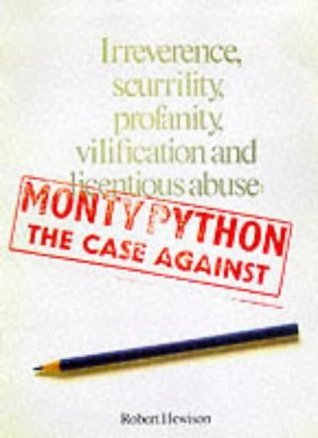
Monty Python: The Case Against
What have been the motives and the methods of those who have sought to censor and ban Python? How have the pythons responded to the censor's and the editor's pressures? How do these pressures operate in the entertainment business generally? Robert Hewison answers these questions and many others in this book.
96 pages, Paperback
First published September 17, 1981
Ratings & Reviews
Friends & Following
Create a free account to discover what your friends think of this book!
Community Reviews
Displaying 1 - 6 of 6 reviews

September 13, 2017
This book addresses the legal complications the Pythons faced, primarily involving censorship, up to and including Monty Python's Life of Brian--so we are overdue for an updated edition! It is short and easy to read (except for the reproduced primary documents, which are often too small or not clear enough to be read by the unaided eye--at least these unaided 54-year-old eyes), written in a straightforward, accessible style. That is, it is not, despite the legalese-sounding title, written from the point of view of legal scholarship. Basically, it's a book on Python legal issues for a general audience. It's also not really "the case against" but rather a history of many of the cases that have been made against Python; its own point of view is decidedly pro-Python, and Hewison clearly had the Pythons' cooperation in making the book, as he had access to a great many primary source documents. It makes for interesting reading, notably the account of the lawsuit against ABC, who edited episodes without consent. That led to a landmark case that the Pythons more or less won, though not on the grounds I would have expected. Anyway, this is a worthwhile read for Python fans, though it is not really a deep or analytical study but rather more of a history/summary of some of the opposition the Pythons have faced. Especially now, some thirty or more years later, some of the objections to their work look quaint and even absurd.

February 3, 2019
Hewison's book is an important addition to the body of critical & supporting literature on Monty Python and its creators, due in no small part to the detail of its study of the relationship between censorship and the comedy team's work. This is a significant aspect of forming an understanding of what was achieved by the Pythons, as their comedy was often underpinned by an anarchic and anti-establishment ethos. It is an obvious corollary that sketches, books, films, images and songs that provoke laughter in conjunction with shock, anger, ridicule and derangement would in turn lead to opposition forces attempting to restrict or even put an end to elements of the Python's comedy.
This book takes a straight forward and detailed approach to its subject, addressing each of the key moments in the history of the group where and when censorship reared its head. At times this censorship may be seen as based on some kind of political or moral basis (as seen as the influence of the intellectually moribund Festival of Light on 70s British TV and society in general), or commercial and legal concerns. Then there is the notorious history of how numerous bodies, evangelical or council based reacted to the most affronting work by the Pythons, "Monty Python's Life of Brian". Hewison does a very good job indeed in describing how this movie faced resistance from religious groups and certain government authorities based almost always on wilful ignorance. The chapter focused on '...Brian' is fascinating as history; considering this is the 40th year since that movie was first released there have been some seismic changes in how film and censorship interact since then, and yet there are also some hints that we have not come that far at all.
The earlier parts of the book are all informative, with perhaps the most important contribution form Hewison on Python scholarship being the chapter on the legal action taken by the group to circumvent the butchering of their work by the American TV conglomerate ABC. The study of this episode is coherent and well founded with documentary evidence from the case. At this point it is necessary to pass comment on a problem with the publication, viz its design and layout. Several items presented in the book (e.g. legal memos, letters etc) are shown as photos; they are almost all hard to read (bordering on the impossible). If the editorial and design staff at Methuen had done their job better these documents either would have been printed in a larger format or perhaps supplied as appendices at the back of the book. It is not a minor problem, and one that does detract from the overall impact of the book.
The fact that Hewison devotes considerable space and energy on the Pythons' books and audio releases is to be commended. Whilst the former may not have been as corporately developed by the group (relying on Eric Idle for much of their creation), it is important to always remember that Monty Python was a multi-media comedic enterprise from its earliest days. It must be said that the importance of books in this account is facilitated by Hewison's title being published by Eyre Methuen, the publisher of Python-related books in the 70s and 80s.
Aside from the aforementioned issue with the documentary items included within the text, there is little else to fault in the book. The prose is clear and without too much reliance on either an intimate knowledge of the Pythons nor of laws and conventions that informed the censorship encountered by the group. The author's use of primary source material from the Pythons is valid and significant, though it may be argued that combined with Hewison's acquaintance with several of the group's members means that he is open to charges of bias. Another concern, though not one of the author's making is that it is limited to the first ten years of the Pythons' activities. It would be interesting to see what further censorial activities resulted from Python-projects post 1979 (specifically 'Monty Python's Meaning of Life').
In conclusion, for anyone who is a fan of Monty Python and wants to understand more about their work then Hewison's book is a must. It is also worth reading for anyone who is intrigued by the relationship between censorship and the arts.
This book takes a straight forward and detailed approach to its subject, addressing each of the key moments in the history of the group where and when censorship reared its head. At times this censorship may be seen as based on some kind of political or moral basis (as seen as the influence of the intellectually moribund Festival of Light on 70s British TV and society in general), or commercial and legal concerns. Then there is the notorious history of how numerous bodies, evangelical or council based reacted to the most affronting work by the Pythons, "Monty Python's Life of Brian". Hewison does a very good job indeed in describing how this movie faced resistance from religious groups and certain government authorities based almost always on wilful ignorance. The chapter focused on '...Brian' is fascinating as history; considering this is the 40th year since that movie was first released there have been some seismic changes in how film and censorship interact since then, and yet there are also some hints that we have not come that far at all.
The earlier parts of the book are all informative, with perhaps the most important contribution form Hewison on Python scholarship being the chapter on the legal action taken by the group to circumvent the butchering of their work by the American TV conglomerate ABC. The study of this episode is coherent and well founded with documentary evidence from the case. At this point it is necessary to pass comment on a problem with the publication, viz its design and layout. Several items presented in the book (e.g. legal memos, letters etc) are shown as photos; they are almost all hard to read (bordering on the impossible). If the editorial and design staff at Methuen had done their job better these documents either would have been printed in a larger format or perhaps supplied as appendices at the back of the book. It is not a minor problem, and one that does detract from the overall impact of the book.
The fact that Hewison devotes considerable space and energy on the Pythons' books and audio releases is to be commended. Whilst the former may not have been as corporately developed by the group (relying on Eric Idle for much of their creation), it is important to always remember that Monty Python was a multi-media comedic enterprise from its earliest days. It must be said that the importance of books in this account is facilitated by Hewison's title being published by Eyre Methuen, the publisher of Python-related books in the 70s and 80s.
Aside from the aforementioned issue with the documentary items included within the text, there is little else to fault in the book. The prose is clear and without too much reliance on either an intimate knowledge of the Pythons nor of laws and conventions that informed the censorship encountered by the group. The author's use of primary source material from the Pythons is valid and significant, though it may be argued that combined with Hewison's acquaintance with several of the group's members means that he is open to charges of bias. Another concern, though not one of the author's making is that it is limited to the first ten years of the Pythons' activities. It would be interesting to see what further censorial activities resulted from Python-projects post 1979 (specifically 'Monty Python's Meaning of Life').
In conclusion, for anyone who is a fan of Monty Python and wants to understand more about their work then Hewison's book is a must. It is also worth reading for anyone who is intrigued by the relationship between censorship and the arts.
December 17, 2025
As of 2025, "Always Look on the Bright Side of Life" is among the most popular songs played at funerals in the UK, and jokes from Monty Python's Life of Brian are embedded in the country's popular culture. Meanwhile, one of the film's creators, Michael Palin, is widely regarded as one of television's most genial and sympathetic presenters, meeting all sorts of people as he criss-crosses the globe making travel programmes. This book, by contrast, recalls a time when "Monty Python" was a byword for controversy and offence.
Monty Python: The Case Against is a short work, its double-column presentation broken up by reproductions of primary sources scattered through the pages: Hewison is an old friend of Palin since university days, and the publisher, Eyre Methuen, appears to have an extensive archive of legal materials and other correspondence relating to its responsibility for producing Python-related tie-in books. While Brian raised the spectre of Britain's then-archaic blasphemy laws, the books and records (the latter produced by Charisma Records) meant navigating issues relating to "copyright, libel and obscenity", and there were also corporate censorship battles: the higher echelons of the BBC were troubled by some of the material they were broadcasting (although they didn’t always understand it, on one occasion misinterpreting a severed arm in a sketch as a "big penis"), and the "mutilation" of their material in the US led to Pythons acting as litigants for a change. American law does not recognise "moral rights", but judges in New York were prepared to consider that cutting up their work might be financially damaging and that "to call the resulting programme 'Monty Python' might be a misdirection under the Lanham Act". The matter was settled, but the Pythons had "made a contribution to the new laws of the entertainment industry."
On the issue of copyright, there was an early skirmish when a firm of ukulele tutors objected to the reproduction of some sheet music in a spoof advertisement; more serious was when a copyright clearance for "Annie's Song" on an LP was disputed on the grounds both that the permission had not been for a parody and that the new lyrics were defamatory of John Denver. A curiosity of obscenity law was that whereas a jury trial might be persuaded to throw out a prosecution case, the law also allowed the police simply to seize materials and ask a magistrate to authorise their destruction. The Pythons did bend when proportionate, agreeing to remove a passing sexual reference from a printed monologue to prevent a publishing schedule being derailed.
The battle over Brian, of course, is the most celebrated controversy, and the title for Chapter 5 – "This Sick Enterprise" – is taken from a quote from the Nationwide Festival of Light, which overlapped with Mary Whitehouse’s National Viewers and Listeners Association. A few years previously, NVLA had successfully sued Gay News over a "blasphemous" poem, and the Pythons turned to the paper's barrister, John Mortimer, for advice. Given the litany of comdemnation from various clerics, it is interesting that Graham Chapman received a supportive hand-written letter from a canon of St George's, Windsor (from the acknowledgements identifiable as James Atherton Fisher), who based on his reading of the script and a tape of the dialogue took the view that, while the film may be offensive, it "is not meant to be blasphemous and that it is extracting the maximum comedy out of false religion… and out of all who use religion as a cover for their particular form of sin".
The publisher of the tie-in book was also nervous until the film was cleared for release by the British Board of Film Censors (BBFC) as an "AA" without cuts; however, the printer still refused to handle it after taking advice from John Smyth, the barrister who had previously brought the case against Gay News (more recently, it has come to light that Smyth was a notorious flagellomanic obsessed with beating boys, and may have been responsible for a fatality in Africa – the discovery of the scandal led to the resignation of the Archbishop of Canterbury over his knowledge of Smyth's predilections).
The final chapter deals with the furore around the release of the film, focusing on the USA and the UK but also surveying other countries. In Britain, local councils could censor what cinemas were allowed to show, creating a bizarrely haphazard approach: Hewison quotes James Ferman, the Secretary of the BBFC as describing West Yorkshire as "the most heavily-censored area in the English-speaking world – and that includes South Africa." The Pythons refused to allow a compromise where some cinemas offered to exhibit the film as an "X" certificate. Abroad, Norway worked around censorship by simply not giving certain lines Norwegian subtitles, which had minimal impact in a country where English is widely understood. As expected, this chapter also includes an account of the famous TV chat-show clash with Malcolm Muggeridge and Mervyn Stockwood.
Monty Python: The Case Against is a short work, its double-column presentation broken up by reproductions of primary sources scattered through the pages: Hewison is an old friend of Palin since university days, and the publisher, Eyre Methuen, appears to have an extensive archive of legal materials and other correspondence relating to its responsibility for producing Python-related tie-in books. While Brian raised the spectre of Britain's then-archaic blasphemy laws, the books and records (the latter produced by Charisma Records) meant navigating issues relating to "copyright, libel and obscenity", and there were also corporate censorship battles: the higher echelons of the BBC were troubled by some of the material they were broadcasting (although they didn’t always understand it, on one occasion misinterpreting a severed arm in a sketch as a "big penis"), and the "mutilation" of their material in the US led to Pythons acting as litigants for a change. American law does not recognise "moral rights", but judges in New York were prepared to consider that cutting up their work might be financially damaging and that "to call the resulting programme 'Monty Python' might be a misdirection under the Lanham Act". The matter was settled, but the Pythons had "made a contribution to the new laws of the entertainment industry."
On the issue of copyright, there was an early skirmish when a firm of ukulele tutors objected to the reproduction of some sheet music in a spoof advertisement; more serious was when a copyright clearance for "Annie's Song" on an LP was disputed on the grounds both that the permission had not been for a parody and that the new lyrics were defamatory of John Denver. A curiosity of obscenity law was that whereas a jury trial might be persuaded to throw out a prosecution case, the law also allowed the police simply to seize materials and ask a magistrate to authorise their destruction. The Pythons did bend when proportionate, agreeing to remove a passing sexual reference from a printed monologue to prevent a publishing schedule being derailed.
The battle over Brian, of course, is the most celebrated controversy, and the title for Chapter 5 – "This Sick Enterprise" – is taken from a quote from the Nationwide Festival of Light, which overlapped with Mary Whitehouse’s National Viewers and Listeners Association. A few years previously, NVLA had successfully sued Gay News over a "blasphemous" poem, and the Pythons turned to the paper's barrister, John Mortimer, for advice. Given the litany of comdemnation from various clerics, it is interesting that Graham Chapman received a supportive hand-written letter from a canon of St George's, Windsor (from the acknowledgements identifiable as James Atherton Fisher), who based on his reading of the script and a tape of the dialogue took the view that, while the film may be offensive, it "is not meant to be blasphemous and that it is extracting the maximum comedy out of false religion… and out of all who use religion as a cover for their particular form of sin".
The publisher of the tie-in book was also nervous until the film was cleared for release by the British Board of Film Censors (BBFC) as an "AA" without cuts; however, the printer still refused to handle it after taking advice from John Smyth, the barrister who had previously brought the case against Gay News (more recently, it has come to light that Smyth was a notorious flagellomanic obsessed with beating boys, and may have been responsible for a fatality in Africa – the discovery of the scandal led to the resignation of the Archbishop of Canterbury over his knowledge of Smyth's predilections).
The final chapter deals with the furore around the release of the film, focusing on the USA and the UK but also surveying other countries. In Britain, local councils could censor what cinemas were allowed to show, creating a bizarrely haphazard approach: Hewison quotes James Ferman, the Secretary of the BBFC as describing West Yorkshire as "the most heavily-censored area in the English-speaking world – and that includes South Africa." The Pythons refused to allow a compromise where some cinemas offered to exhibit the film as an "X" certificate. Abroad, Norway worked around censorship by simply not giving certain lines Norwegian subtitles, which had minimal impact in a country where English is widely understood. As expected, this chapter also includes an account of the famous TV chat-show clash with Malcolm Muggeridge and Mervyn Stockwood.

June 21, 2015
great anecdotes and reproductions of artefacts from Monty Python's history and creative process. discussion of censorship is thin and rather centres around a systematic summary of the group's run-in with broadcasters. more journalistic stenography rather than anaylsis and insight. keep it as a textbook.
Read
April 11, 2010Monty Python The Case Against by
February 26, 2012
Bit dated, from 1981 or so, but fascinating what they had to deal with.
Displaying 1 - 6 of 6 reviews