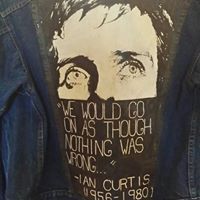
I freaking love Joy Division. They're easily my second-favorite band after the inimitable Beatles, and I don't even think the Beatles should be considered as anything less than God status so such petty concerns as "favorite band" don't qualify to them. Thus, Joy Division would then be my favorite band. And I've read several books about them in the past. My first was Deborah Curtis' memoir "Touching From a Distance," which detailed the life she led with Ian Curtis, her husband and the lead singer of Joy Division. That book is a must-read for JD fans, and it's at times very harsh and brutal in its depiction of Ian (who did cheat on Debbie while she was raising their newborn daughter and leave her to fend for herself when he took his own life). But this book, by Mick Middles and Lindsay Reade, is a more balanced and objective tome by comparison. That doesn't make it a better book than Debbie's by any stretch. But it does offer an alternative.
"Torn Apart" is, however, at times clumsily written, with some repetition and instances where typos or chronological errors that could've been caught by a sure-eyed editor were allowed to pass unnoticed. But my concerns about those faded as I got more into the book, which follows Curtis from his birth and childhood all the way to his untimely demise on the eve of Joy Division's first American tour. Middles, a veteran Manchester rock journalist, has previously written a book about Factory Records, so he's got an inside scoop on the actual story of the band's music and how it evolved (something that is missing from Debbie's book because, as she contends, Ian shut her out from his music world almost from the beginning). Reade, the first wife of Factory boss Tony Wilson, is perhaps even more of an insider, and the two pen a thorough accounting of Ian's formative years, early marriage, and incipient steps towards starting his own band. In this book, we get the formation of Joy Division (as Warsaw, initially), and their growing reputation as a band on the rise.
Early on, I wasn't sure that such devotion to Ian's early life was warranted; plenty of biographies of famous people reduce childhood memories and events to a chapter or two for the better, because the narrative drive sometimes doesn't need exhaustive details like school records or dental appointments and the like. But the book became more interesting (and thus merited a fourth star) when detailing the emerging Manchester punk scene and how Joy Division found their own unique, profound sound. There are better books about Joy Division, honestly (Jon Savage's oral history is the best, though don't sleep on bandmate memoirs from the likes of Peter Hook and Stephen Morris), but this one was entertaining because it presented Curtis as much more than just the portrait that Debbie serves up in her book.
As I stated earlier, Debbie's book was probably the first one I ever read solely about Joy Division, and she painted a portrait of Ian that wasn't always complimentary. I've rarely ever thought to ask if she might have had an ax to grind or any reason to "soil" Ian's reputation, and I am not going to start now. "Touching From a Distance" is the story of a woman whose husband cheated on her and took himself away at the moment when most couples' lives are really just beginning to carry on more weight, with the birth of a child who would depend on the presence of both parents to be there (which is not always the case or even a requirement, as this son of a single mother can attest, but it's tragic when anyone kills themselves, much less a parent to a newborn child). In my younger years, I idolized Ian for the very notion that his was an artistic suicide, a self-killing born of a deeper purpose to make his art matter. I don't believe that anymore, and haven't for a long time, and one of the many saving graces of this book is that it doesn't, either. Ian Curtis was a human being whose life got away from him in some ways due to events he could control, but just as often from events that he couldn't. His debilitating epileptic seizures, long a part of his live performance, were worsened by the life of a rock star (staying up late, partying), and the emotional affair he had with Annik Honore helped to cause his marriage to break up. Ian Curtis didn't die for anyone's sins, as neither did Kurt Cobain, Anthony Bourdain, Robin Williams, or any other high-profile celebrity suicide.
"Torn Apart" is well worth seeking out if you're a fan of Joy Division, because while the prose is a bit chunky and wonky at times, the story it tells is important. Plus, the photo selection is generous (for a band with a short life due to the death of Curtis just as they were on the cusp of stardom, Joy Division got a lot of photos taken of themselves). I would say to read Debbie's book first, because it is perhaps one of the most honest memoirs of any rock-star spouse. But Ian's family (particularly his mother and sister) are on hand with this book to help round out the portrait of Ian, to fill it out more than just what Debbie saw. I believe that both sides of this "divide" saw Ian as truthfully as they could, and that their versions of who he was (as well as Annik's version of Ian and their relationship) can be true at the same time. "Torn Apart" is a good look at a tragic figure in rock history, whose early demise ensured a degree of legend but left a whole lot of suffering in his wake.