Jump to ratings and reviews
Rate this book

Dominicana

Rate this book
From IMPAC Dublin Award finalist Angie Cruz, an urgent, beautifully told novel about a Dominican teenager’s arranged marriage and immigration to New York City, set against the political turmoil of the 1960s.

Fifteen-year-old Ana Cancion never dreamed of moving to America, the way the girls she grew up with in the Dominican countryside did. But when Juan Ruiz proposes and promises to take her to New York City, she has to say yes. It doesn’t matter that he is twice her age, that there is no love between them. Their marriage is an opportunity for her entire close-knit family to eventually immigrate. So on New Year’s Day, 1965, Ana leaves behind everything she knows and becomes Ana Ruiz, a wife confined to a cold six-floor walk-up in Washington Heights. Lonely and miserable, Ana hatches a reckless plan to escape. But at the bus terminal, she is stopped by Cesar, Juan’s free-spirited younger brother, who convinces her to stay.

As the Dominican Republic slides into political turmoil, Juan returns to protect his family’s assets, leaving Cesar to take care of Ana. Suddenly, Ana is free to take English lessons at a local church, lie on the beach at Coney Island, see a movie at Radio City Music Hall, go dancing with Cesar, and imagine the possibility of a different kind of life in America. When Juan returns, Ana must decide once again between her heart and her duty to her family.

336 pages, Paperback

First published September 3, 2019

1639 people are currently reading
51797 people want to read

About the author

Angie Cruz

25 books1,168 followers
Angie Cruz was conceived in Dominican Republic and born in 1972 in New York City's Washington Heights. She continued to travel to and from, every summer, until she was sixteen years old. She went to La Guardia High School concentrating on Visual Arts and by default decided to follow a path in Fashion Design at Fashion Institute of Technology. During those four years of college, she worked as a salesperson, manager and then window designer in an upscale Madison Ave. boutique. In 1993, four of her children stories were featured on BET's Story Porch. Soon after, she gave up her fashionista lifestyle to become a full-time college student at SUNY Binghamton where her love affair with literature and history began. She graduated from the NYU, MFA program in 1999. Her passion for literature fueled her desire to be active in community. In 1997, she co-founded WILL: Women In Literature & Letters with Adelina Anthony and Marta Lucia, an organization that produced readings, workshops, and a conference using literature as a tool to build community and transform society. In 2000, WILL was put on hold due to lack of resources and the women's desire to make more time to write. Angie Cruz has contributed shorter works to numerous periodicals including Latina Magazine, Callaloo and New York Times. She has won awards for her writing and/or activist work such as The New York Foundation of The Arts Fellowship, Barbara Deming Award, Yaddo, and The Camargo Fellowship. She published two novels, Soledad and Let It Rain Coffee. She currently is working on the screenplay for Soledad, optioned by Nueva York Productions and working on her third novel.

Ratings & Reviews

What do you think?
Rate this book

Friends & Following

Create a free account to discover what your friends think of this book!

Community Reviews

5 stars
12,420 (32%)
4 stars
18,073 (47%)
3 stars
6,248 (16%)
2 stars
824 (2%)
1 star
145 (<1%)
Displaying 1 - 30 of 3,820 reviews
Profile Image for Roxane.
Author 130 books168k followers
February 27, 2020
Engrossing story about a 15 year old girl who is forced to marry a much older man and move to NYC where she knows no one and doesn’t speak the language. It’s a story of how she grows into herself and it is beautifully told. Interesting structure that sometimes doesn’t work but still the story itself and Ana, the protagonist are terrifically interesting. Loved this.
Profile Image for Rincey.
904 reviews4,695 followers
August 24, 2019
I got so engrossed in this novel that I accidentally took too long of a lunch break. And then I got so engrossed again later that night that I almost forgot to leave my house to go hang out with my friend.

So yeah, I think you could say I enjoyed this book.

Watch my full review: https://youtu.be/E3xnmai3gQk
Profile Image for Nilufer Ozmekik.
3,115 reviews60.6k followers
June 2, 2020
Four yesss another heart-wrenching, powerful, emotional, shaking you to the cores kind of amazing story about a young woman who learn how to get out of the restraints and earn her own independence stars!

Young Ana didn’t know what kind of future she was about to embrace when she left her life in Dominican countryside by accepting Juan’s marriage proposal and moved to NYC in mid-60’s.
Finally she realizes that is not only a journey to another continent, city, culture, civilization but that is also a big journey to her self-discovery.

She begins to learn how to survive in difficult situations and lighten up her mood at the darkest times. Her communication with her doll was outstanding and so emotional that reminds us even she’s married woman, she is still a young child.

She’s struggling to get rid of her boring life she has to live with her abusing and neglecting husband but she also needed to support her family financially and help them immigrate to the states. So that’s her dilemma that she needed to find a way to accept her realities and resume her new life.

Her interactions with her brother-in law helped her feel still alive and discover more about herself and see the different life forms from different perspectives to broaden her horizon. As the time passed, she was not the naïve, little girl who was trapped in a marriage, forced to live in a foreign country. She developed, grew up, adapted. She learned more about her own flaws, her weaknesses, her strengths. She was not a victim anymore, she was fighter, survivor.

I like her journey, I like heartwarming storytelling. The only thing I didn’t like much is ending of the book. I think this epic, moving, colorful journey deserved more meaningful ending. But that’s just my opinion. Mostly this is really good written book and I loved to read every part of Ana’s story.

Well done Angie Cruz, looking forward to read more books of yours.

Thanks to Flatiron Books and NetGalley for sharing ARC COPY of this emotional journey in exchange my honest review.
Profile Image for Angela M .
1,456 reviews2,116 followers
September 10, 2019
“The first time Juan Ruiz proposes, I’m eleven years old, skinny and flat chested. I’m half asleep, my frizzy hair has busted out from a rubber band, and my dress is on backwards.” I couldn’t help but smile as the novel opens, picturing eleven year old Ana Cancion. It was hard to smile when at fifteen, Ana is in an arranged marriage with Juan, who is thirty two. She is sent with him to the US by her family with the hopes of “money and papers” and a better life. She didn’t want to go and it was a pitiful sight to see what this young girl is made to endure for the sake of her family. This is the immigrant experience with the backdrop of 1965 New York City and we see it through the inner thoughts of a young girl. We get an intimate look at her fear, her loneliness, her confusion. All she has are these words from her mother:

“I promise nothing bad will happen to you. You go to New York and you clean his house and cook for him the kind of food that will make him return home every night. Never let him walk out of the house with a wrinkled shirt......I’ll come to New York as soon as you send for me to be with you, and together we’ll build something.”

Ana finds that things are not as she thought when she arrives at Juan’s filthy walkup apartment and faces his infidelity and abuse. But Ana is strong and has the desire for more. When Juan returns to the Dominican Republic, concerned about business endeavors during this time of political unrest there, she takes this opportunity to take English classes, sell food at the factory where Juan’s brother Cesar works and to spread her wings and open her heart when she thought it was impossible. It was a joy to watch her grow, to experience life. The story is filled with the tension between loyalty to family and personal happiness. The relationships are complicated and Ana’s future is dependent on a decision she has to make. She is definitely not the same fifteen year old girl at the end of the book as she was when she stepped off the plane months before. I rooted for her every step of the way, hoping for more for her, as she hoped for herself. It’s a wonderfully written story, funny and sad, heartbreaking and hopeful. I read in an interview with Cruz that Ana’s story is based on her mother’s story and that makes this so much more meaningful. This is a link to that interview but I recommend that you read it after you’ve read the book. https://electricliterature.com/in-dom....


I received an advanced copy of this book from Flatiron Books through Edelweiss.
Profile Image for Sujoya - theoverbookedbibliophile.
789 reviews3,512 followers
October 31, 2022
4.5⭐️

(Book: 4⭐️ ; Audio Narration: 5⭐️)

"Take the needle to the thread. Not the other way around. That’s the secret. Always yield to the needle because it’s inflexible. It’s the secret with people too. If a person seems inflexible, yield, then slip in sideways and get what you want."

Newly married to a much older man, fifteen-year-old Ana Cancion moves to New York from her home in the Dominican Republic in January 1965. We follow Ana as she tries to make sense of her new situation- a new country, new language and culture very different from the one she has been accustomed to. Her husband Juan who is both emotionally and physically abusive does not make it easy for her. Ana is young, innocent and naïve in the ways of the world but she is aware of the enormous responsibility she carries on her shoulders- the responsibility of her family back home who expect her to help them move to America once she has settled in. Only when her husband Juan travels back to the Dominican Republic for a short interval to due to business-related issues does Ana get the opportunity to experience life in her new country- learning the language, starting her own little venture selling homemade delicacies, making friends and bonding with her brother-in-law Cesar. Torn between her duties toward her family and her own happiness, Ana will have to make a choice that would determine the trajectory of her future.

Dominicana by Angie Cruz is a well-written story about a young immigrant girl who finds a way to cope with an unfavorable situation with hope, resilience and determination. The author mentions that she drew inspiration for this story from her mother’s life. Ana is smart and learns from observing the people and places around her. Not all her experiences are happy ones , but Ana does not give up. Though there are intense and disturbing moments in the narrative the author balances the heavy parties with moments of hope. I loved Ana’s joy at her new experiences in the city. While I rooted for Ana from the very beginning and enjoyed seeing her evolve into a stronger character, I did feel that the end was a bit rushed. I won’t say that this was a happy story but I am glad that it ends on a hopeful note.

I paired the book with the exceptional audio narration by Coral Peña which definitely elevated my reading experience.

I absolutely loved Angie Cruz’s How Not To Drown in a Glass of Water
and I couldn’t wait to pick up more of her work. Though not as good as How Not To Drown in a Glass of Water, Dominicana does not disappoint!
Profile Image for Rachel.
604 reviews1,055 followers
March 7, 2020
Dominicana was one of the flattest and most poorly written things I have read in a while.  There was a sort of painful obviousness to the way this entire story was told; if you've read even a single historical fiction novel about immigration, this will offer nothing new or fresh or dynamic.  The whole thing unfolded so predictably that I don't think I experienced a single moment of tension or anxiety while reading.

That's mostly down to the fact that Angie Cruz never earned my investment, and I didn't believe any of it; I didn't believe the story and I didn't believe the characters.  At one point in this book, Ana, the narrator, has resolved to leave her husband, Juan, and return to the Dominican Republic.  Juan is abusive (a decision which I found frustrating in and of itself - the arranged marriage with an abusive black immigrant husband was chock full of stereotypes, none of them challenged), and Juan has just choked her so hard she passed out.  She wakes up, terrified, puts on all of the clothes she owns, and runs to the bus terminal, where she happens to run into her brother-in-law César.  While reminding you that Ana was AFRAID FOR HER LIFE moments ago, this is how the exchange between Ana and César is written:

"He pulls out a cigarette from his jacket pocket.  You leaving without saying good-bye?

It's not like you're ever around, busy with all your girls.  I say it in a voice I don't recognize.  Why am I flirting?  Now?  And with César!"


Some other choice quotes to illustrate the egregious prose:

"I just wish he would say to me that I'm beautiful, whisper in my ear that I'm his only little bird and mean it.  That he would cover the bed with flowers and look at me like a man in love, like Gabriel looked at me as if my curves were a riddle."

"Juan is pale, César the color of the crunchy skin off of juicy roast chicken thigh, creamy hot chocolate, buttered toast, dark honey, the broth of slow-cooked sancocho."

"I love him.  I fucking love him.  His mischievous eyes, his firm ass, his muscular legs."


Moreover, this book was a structural enigma to me. It felt to me like Angie Cruz was so determined to Capture the Immigrant Experience that she crammed in as many details as possible to further this goal while following through on none of them.  The historical details felt shoehorned in to remind the reader of historical context (Malcolm X is assassinated right outside Ana's door, conveniently) while lacking sufficient commentary; none of the characters' motives are really explored outside of Ana's and therefore everyone feels like a caricature or a plot device; the way Cruz attempted to balance Ana's first-person narration in New York with updates from back home was... perplexing.  The result is a disjointed mess.

The one thing I thought Angie Cruz did well was capture Ana's loneliness and alienation in the United States, but even the strength of this element began to wane once Ana met César.  Ultimately I hated reading this, and how it earned its way onto the Women's Prize longlist is beyond me.
Profile Image for Elyse Walters.
4,010 reviews11.9k followers
November 23, 2019
Audiobook…narrated by Coral Pena

I totally enjoyed this coming-of-age story about Ana - a young girl who immigrants to New York....
by this wonderful Dominican author who now lives in America.

The bonus-interview with the author at the end of the Audiobook, was great, too.
Angie talks about storytelling contributing to social change.
‘This’ story, set in the 60’s was inspired by her mother.

*ANGIE* is inspiring to listen to, and very likable.

This fiction tale allows us to understand women
immigrants who came to the United States in the 60’s....their circumstances, challenges, skin color, working, being in a new marriage, and language struggles they had to face every day.

There’s a lot vivid imagery from The Dominican Republic.... as well as NYC.

VERY HEARTFELT from beginning to end. Powerful entertaining novel!!!
Loved it!!!!
Profile Image for Kelly (and the Book Boar).
2,819 reviews9,510 followers
September 9, 2019
Find all of my reviews at: http://52bookminimum.blogspot.com/

♫♪♫♪[COMMUNITY:]
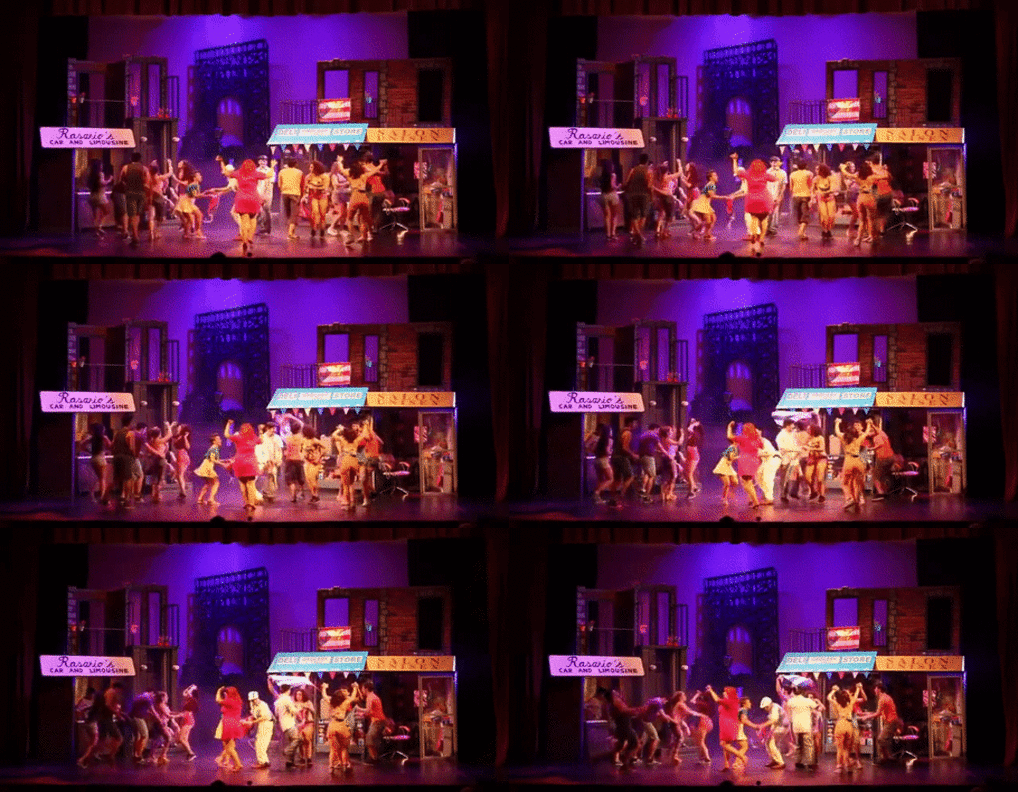
In the heights
I flip the lights and start my day
There are fights

[WOMEN:]
And endless debts

[MEN:]
And bills to pay
♫♪♫♪

I’m so disappointed that I found this to be disappointing, but sadly that’s the case. As you can see from above, this story reminded me a bit of another that was already done – and better . . . .


And before anyone jumps my ass and tells me these stories aren’t alike at all and . . . .


I realize that it may seem like a bit of apples and oranges – so let me explain. The problem with Dominicana is there is not much to it. Told from the perspective of 15-year old Ana who has been (smuggled, pretty much) into America by a “husband” twice her age, you only get to know what she knows and/or understands which translates into some pretty flat characters. Ana’s life mainly consists of the small apartment where she and Juan live and when monumental historical events (i.e., Malcolm X’s assassination) conveniently happen literally outside of her door she’s oblivious to their significance (which make them seem thrown in just to remind readers that this is an attempt at being a “historical” novel). Juan, the kidnapper/husband (depending on your viewpoint, I guess) has a job, is able to send money back to the DR and invests in property acquisition/building development with his brothers, but no details are given regarding anything. The story development would lead you to believe this arranged marriage was organized in order to benefit Juan’s family, yet he holds up his end of the bargain (spoiler here so watch out ). Why? Because family? I don’t buy it. Not from a rapey drunken abuser. Oh, and that’s another thing. Way to perpetuate racial stereotypes there. FFS, are authors today incapable of writing hardworking immigrant men? It’s like a damn dead horse being beaten. What else can I slam? Oh yeah, the writing is bizarre (I seriously thought this was a YA novel for a giant chunk), the school of Cormac McCarthy has been followed when it comes to the non-usage of quotation marks and the ending is pretty much unbelievable (again spoilsies: Yeah right).

So where does In the Heights come in? Well, not only is it set in the same neighborhood, but it does explain all of things Dominicana does not. You get to know where the characters came from originally and how they ended up in The Heights and you know their hopes and dreams and goals and who they love and why they love them and how important family truly is (whether via birth or simply association). Not to mention they are like the majority of immigrants who are hard-working and not women trying to have an anchor baby as soon as they set foot in the country or men who are all wife beaters! It is well written (by a TEENAGER, no less) and also????? It has songs I can drive my family crazy singing all the time . . . .


That right there is called a bonus.

I might recommend Dominicana to a high schooler looking for some diversity in their reading repertoire, but I don’t know if (m)any of my Goodreads friends would dig it. I’d be interested to see their take.

Profile Image for Brina.
1,238 reviews4 followers
January 5, 2020
In anticipation of new books by Isabel Allende and Julia Alvarez this year I decided to get a heads up on my Latina amiga reading with Dominicana by Angie Cruz. Dominicana has been touted as a story of immigration for all times that every American can relate to. It has been lauded by Alvarez and Sandra Cisneros, another favorite author of mine, and even was the inaugural pick for Good Morning America’s book club. Always on the look out for fresh Latina writing, I decided to pick up a copy.

It is the early 1960s and the Canción family lives in poverty in Guayacanes, Dominican Republic. The parents have almost no education and live a life of poverty but the mother believes that if they can move to New York, everything will be better, an adherent of the American dream before even stepping foot on American soil. The Ruiz brothers have been eyeing the Canciones’ land for years, businessmen determined to expand their fledgling empire that consists of all of one restaurant. A match between the two families would insure that the Ruiz’ would get their land and the Canciones could begin to immigrate to New York. One issue preventing the coming together of the two families is that Juan Ruiz, a so called savvy New York businessman is thirty years old, and his would be bride Ana is a mere fifteen, a school girl, and uninterested in leaving her family. Yet, with political unrest surrounding the island, Ana’s mother pleads with her to marry Juan and leave, paving the way for the rest of the family to follow her to a better opportunity.

Cruz has said that Ana’s story is her mother’s story of immigration to New York, and research for this book has been pulled from years of interviews with family and friends. Ana’s voice rings clear as she navigates being a newly arrived teenager to an intimidating city, not being able to speak the language, knowing no one. Juan is a stereotypical Hispanic male and rubbed me all the wrong ways. He has a woman on the side after years as a bachelor, tells Ana to always remain in their apartment and do his bidding, and even becomes abusive if she does not measure up to his mistress. Getting Ana pregnant with his future child does nothing to alleviate Juan’s behavior patterns that appear all too often in Hispanic machismo culture. My dislike of Juan, even though he managed to make it in New York to a certain extent, downgraded my overall like for this book, but I was determined to make it work for me.

Ana Ruiz is also a archetypal portrait of an immigrant. Juan has to return to return to the Dominican Republic amidst the political unrest there, and Ana flourishes. She takes English classes, ventures out of her apartment with her brother-in-law Cesar, cooks traditional foods to stay rooted to her culture, and actually appears to be making it in America. This is only because Juan has left her in Cesar’s care, and Ana, full of hormones, finds herself falling for her brother-in-law, in a way she could never love her husband. I thought this relationship was too cliched but I enjoyed how Cesar convinces Ana to sell food to factory workers and earn her own money, her own American Dream. He takes her to the movies and dancing, to Coney Island and the World’s Fair, and the two of them fall for each other, making plans to start a new life without Juan. Whether this aspect of the story is part of Cruz’ mother’s story or not, the love triangle turned an otherwise quality Latina written story into a telenovela.

Maybe I have been spoiled after all these years reading Allende and Alvarez, Cisneros and Garcia. They were the pioneers and their early work paved the way for new generations of Hispanic women writers, writers like Angie Cruz. The historical fiction in this story- upheaval in the Dominican Republic, the assassination of Malcolm X, Juan Marichal- worked for me. The stereotypical Hispanic characters did not. I do like how Ana gets stronger as the novel progresses, determined to make it in New York to give her family a better chance in life. If this was actually the case for Cruz’ mother, then her family did just fine in the United States. I am willing to give this author a second chance and hope that her characters work better for me a second time around.

3.5 stars
Profile Image for Barbara .
1,840 reviews1,513 followers
January 1, 2020
“Dominicana” is loosely based on author Angie Cruz’s mother’s tale. Cruz wanted to tell the story of Dominican immigrants. Her narrator, Ana, is fifteen years old when she’s married off to a thirty-two-year-old Dominican man who resides in the USA. Ana acknowledges that her marriage is bigger than her, that the marriage will shoulder her family’s ability to leave war-torn Dominica Republic. Just before she’s married off, she has her first kiss from her neighborhood boyfriend. Ana is an innocent.

What Cruz conveys is the pressure and fear that go hand in hand with these child brides, who become responsible for their family’s future. Ana’s husband is abusive, and she has no foundation for help. Her mother’s only interest is for Ana to be a perfect wife so that she paves the way for the rest of the family to come to America. From early on, Ana’s mother has been molding Ana to be the perfect wife. Ana’s husband is both emotionally and physically abusive. Cruz’s writing is amazing. The reader smells the stench, feels the loneliness and pressure, tastes the food, and sees the humanity of Washington Heights.

This is a great novel that exposes the reader to experiences of immigrants in the 1960’s.
Profile Image for Thomas.
1,863 reviews12k followers
January 29, 2022
Appreciated this slice-of-live novel about a fifteen-year-old girl, Ana Cancion, who immigrates to the United States with her bully of a husband Juan Ruiz. I most enjoyed the saliency of themes related to gender throughout Dominicana. Angie Cruz shows us with straightforward prose how Ana’s day-to-day suffering stems from the limitations imposed upon her by patriarchy – her lack of choice in marrying Juan, her difficulties securing financial independence, and her limited options for independence as an immigrant woman who wants to bring the rest of her family to the United States too. I liked how Cruz crafted Ana in a three-dimensional way, showing her wistful dreams as a fifteen-year-old girl as well as her heartfelt attempts, successful or not, at earning money, learning English, and fighting for a better life for herself.

Though I didn’t find the prose in Dominicana that captivating, I’d still recommend it to those interested in its synopsis. I agree with Cruz’s author’s note that voices of immigrant women and women of color are marginalized within the publishing industry and I’m glad that she wrote this book and shared it with us.
Profile Image for Richard Derus.
4,165 reviews2,263 followers
July 17, 2020
THIS ENTIRE REVIEW MUST BE READ AT YOUR OWN RISK

The pages turned...


Some more pages flip...


It's a bog-standard immigrant story. It could be told by any woman of any nationality, not one thing here is unique. The author had a very good editor, one who left in enough Dominican Spanish to make the text more engrossing, and she possesses a finely honed sense for how much story she can tell before she hits telenovela territory. I didn't dislike it but in a week I won't remember a thing about it.

2020 UPDATE I don't remember a single thing about the book.
Profile Image for BookOfCinz.
1,609 reviews3,747 followers
September 12, 2019
In Dominicana we meet fifteen year old Ana who lives with her family in the countryside of the Dominican Republic. Ana is part of a big a family, with her mother assuming responsibility of the children and the household- hardly taking into consideration her husband's perspective. Growing up in the 1960s a lot of persons thought the best way to "escape" and make a better life is to move to America. Ana gets this "opportunity" when one of the Ruiz brother- Juan proposes to her and makes her promise to wait on him. Only fifteen years old and promised to a man twice her age, Ana is forced to go along with this plan so her mother and younger siblings will also have the opportunity to move to America.

Ana departs for America on a tourist vista with her husband Juan. Having never left the countryside of the Dominican Republic, Ana experiences a lot of firsts. She is thrust into the role of wife, homemaker and caregiver with little to no warning or education. The deck is stacked against Ana who didn't graduate from high school, living in a city with no income of her own, doesn't speak English, is at home all day without company and is being hounded by her family back home to send money.

Ana's husband returns to the Dominica Republic for three months so she is left alone. During that three months Ana decides to take English classes, find work for herself, she also find herself falling for Cesar, Juan's younger brother. Added to this is Dominica is in a political upheaval and Ana worries for her family and husband back home.

I did not enjoy and liked this book at all even though I generally enjoy books that tells the Immigrant story- especially if that person is from a Caribbean island. I did like that Cruz incorporated all the historical things happening in Dominica Republic during the 90s so I was able to learn more about the country's history. Aside from the historical look, I remained underwhelmed and bored for the entire read.

Have you ever read a story where a lot was happening but nothing was happening- all at the same time? That is how this exactly how this book read. Things were happening, but nothing was really *happening*. The characters were very one dimensional and mostly unlikeable- even Cesar who we are asked to like for Ana. The book felt very all over the place and did not have to be "so long" even though it was only 320 pages. There were A LOT of plot holes and unnecessary scenes that that A. weren't resolved or B. didn't help in moving the plot along or added dimension to the characters. The writing itself felt very sloppy and not sharp. Coming down to the end of the book I did not care what became of Ana and her family because I was so checked out.

I really wanted to like this book because its got all the ingredients I like for a story but it just fell flat for me. :-(
Profile Image for Book of the Month.
317 reviews17.3k followers
Read
August 6, 2019
Why I love it
by Idra Novey

The best novels, I find, are books I begin for one reason and end up loving for another. That unpredictability is what makes a novel come alive for me. For many years, I have admired the vitality of Angie Cruz’s writing, and I anticipated that Dominicana would be full of dynamic scenes and fearless candor. What I didn’t expect was how intensely and often I would go on considering the resilience of its mesmerizing protagonist, Ana, after finishing this book.

Dominicana celebrates the tenacity of Ana Cancion, a 15 year old forced to marry a 32 year old as a business arrangement. Raised on a farm in the Dominican Republic, Ana ends up stuck in a hot apartment in New York City with a terrifying husband who obliges her to have sex she doesn’t want to have. Terribly alone in New York living with this oppressive, older husband Juan, Ana forges a bond with Juan’s younger brother, Cesar, and her sense of the possibilities of what her life may hold begin to expand.

Despite being trapped in a terrifying marriage she didn’t choose, Ana does not resign herself to quiet suffering. She remains defiantly open to joy. What fuels a person’s capacity for resilience is an elusive question that fiction is uniquely suited to answering, and Angie Cruz explores it in this novel with such subtlety and insight.

Read more at: https://bookofthemonth.com/dominicana...
Profile Image for Hugh.
1,293 reviews49 followers
May 4, 2020
Shortlisted for the Women's Prize 2020
This is my fifth of the six books on this year's Women's prize shortlist and so far it is a very strong list. I really enjoyed this story, inspired by Cruz's mother, of a Dominican immigrant's first years in New York in the mid 60s as a young bride. Cruz captures the period and the situation very well, and her story is readable and quite moving in places.

The heroine Ana is expected by her family to marry Juan, whose family are regarded in the Dominican Republic as a successful one. At 15 she agrees to join him in New York, and he arranges fake documentation to facilitate this. On arrival she discovers that many of her expectations were empty dreams, but by the end of the book she has established herself, despite a husband who discourages her aspirations and already has a married lover who he cares for more.
Profile Image for Lisa (NY).
2,138 reviews824 followers
August 21, 2019
I opened up “Dominicano“ on a plane and for the rest of my trip was transported to 1965 New York City. I experienced the city through the eyes of 15 year old Ana, newly married and separated from her family in the Dominican Republic. Every page felt fresh, vibrant and unpredictable!

(Thank you to the publisher for sending me an ARC.)
Profile Image for Camille.
127 reviews208 followers
August 22, 2019
When BOTM issued the warning about the lack of dialogue queues I thought "hey, that's not so bad" but as I began reading it became quite distracting. However, once I got used to the style of the book I couldn't put it down! Amazing story with political undertones. It led me to research some of the history of the DR, and it's quite fascinating
Profile Image for Michael Finocchiaro.
Author 3 books6,259 followers
April 15, 2020
This was a well-written story of the odyssey of 15 year-old Ana Cruz from the Dominican Republic to New York in 1962. It is moving and rather depressing, but a good read. For more about this period in the DR, don't miss the masterpiece of Mario Vargas Llosa, Feast of the Goat.

Ana is given in marriage at the tender age of 15 to a much older Juan Ruiz who promises her riches and happiness, but following their move to the promised land of New York (a rundown neighborhood in the Bronx as it turns out), she is paid in violence and loneliness like her porcelain doll, Dominicana: My sweet, hollow Dominicana will keep all my secrets: she has no eyes, no lips, no mouth. (loc 778)

She makes an erstwhile friend Marisela who betrays her. To make some side money, she learns how to hem pants for stolen suits that Juan sells out of the apartment: Take the needle to the thread. Not the other way around. That’s the secret. Always yield to the needle because it’s inflexible. It’s the secret with people too. If a person seems inflexible, yield, then slip in sideways and get what you want. (loc 903)

Her family remains in the DR and suffers greatly from the daily violence. There is a beautiful interlude however where her sister, Teresa (herself pregnant at 16 from a local lowlife):Teresa grabs a pigeon with both hands and blows into its ear: Ana, come home already. She lets it loose, pointing its beak in my direction. (loc 966)

Juan is a negligent husband with a Puerto Rican lover, Caridad and Ana has to learn to defend herself: Mamá says all animals have to defend themselves. Goats stamp and charge their attackers, fish swim away for cover, but flies play dead. (loc 2278)

At several points, this book reminded me of The Mambo Kings Play Songs of Love because of how the author drew the brothers Juan and César and the Latinx community in Manhattan in the 50s and 60s. I did enjoy the trip to the World's Fair (I believe that my father visited that year as well), but the book was truly depressing for the most part. Well-written, but very depressing. I will probably get around to reading other fiction from Cruz hoping that I find something a bit more uplifting.

My List of 2020 Pulitzer Candidates: https://www.goodreads.com/list/show/1...
My blog about the 2020 Pulitzer: https://wp.me/phAoN-19m
Profile Image for Linda.
Author 2 books256 followers
October 14, 2021
Shortlisted for the Women's Prize for Fiction 2020
3.5
In Dominicana, Angie Cruz pays homage to the first generation of Dominican women who immigrated to New York City after Trujillo's assassination in the 1960s. Ana Cancion, the green-eyed beauty of a rural family, is her mother's hope for obtaining papers for a better life for the family in New York. So she convinces her 15-year-old daughter to marry 32-year-old Juan Ruiz, who works in New York and hopes to build a restaurant and apartments in Santo Domingo.

Juan is an overprotective and controlling husband. He attempts to instill fear in Anna, fear of her surroundings so she won't leave their apartment in Washington Heights, and a fear of disobeying him. Juan is at times physically and verbally abusive, especially when drunk. The book chronicles Anna's daily life, her limited contact with Juan's friends and business associates, her growing sense of isolation and sorrow.

Anna becomes pregnant, and when Juan must return to the Dominican Republic to attend to business there, he leaves her under the protection of his younger brother, Ceasar. The latter encourages her to leave the apartment and explore her new environment. She starts taking English classes at the local church and, with Cesar's help, begins cooking and selling Dominican dishes food to local factory workers. She begins to enjoy life.

While Juan has the necessary connections and funds to obtain papers for her extended family, she dreads his return. Although she wants to help her family, she does not wish to remain in an abusive marriage. Her resilience and attempts to resolve this dilemma become the focus of the remainder of the book.

Dominicana is well-written and heartfelt. I listened to the audio, and the lively reading and the insertion music add to the ambiance!
Profile Image for Gumble's Yard - Golden Reviewer.
2,189 reviews1,794 followers
June 9, 2020
I read this book due to its longlisting for the 2020 Women's Prize - a prize for which it has now been shortlisted.

Other than a brief prologue, the book is set in 1965 and written in a simple first person present tense, the narrator a fifteen year old (Ana) from a family in the Dominican countryside. Her older sister already hooked up to a local without prospects, Ana accepts her mother’s instructions to accept a proposal of marriage from Juan (who with his brothers is something of a local big-shot – with connections, a nascent restaurant in the Capital and with frequent trips to New York).

Ana’s mother’s has a clear strategy for Ana: move to New York where she will join Juan in his more prosperous life there; insist, using her feminine wiles and determination, on education, the opportunity to start her own business, money to send back to her family; pave the way for the rest of the family to join her and live the American dream.

The reality is somewhat different – both in Juan’s circumstances (he lives in a run-down apartment, flits between various unsecure jobs and illegal moneymaking schemes) and in Ana’s ability to execute the plans (she is quickly cowed into a resentful submission by Juan’s forcefulness and by her own lack of confidence founded around her inability to speak English and lack of knowledge of American society and New York geography – an inability and lack of knowledge Juan is keen to maintain as it gives him greater power over her).

When Juan’s force turns to violence, Ana who has been finding ways to save small amounts of money herself plans an escape back home, but is persuaded to stay by Juan’s darker-skinned, easy-going brother Cesar (particularly as they realise she is pregnant). Juan returns to the Dominican Republic to try to sort out his affairs leaving Ana finally free, with the encouragement of Cesar, to explore the City and learn the language and begin to form her own life as well as, more dangerously, her own attachment to Cesar.

Later Ana’s mother is able to travel to America and the strongest scenes of the book I think are when she first arrives and is cowed by unfamiliarity and her sadness as she realises the realities of Ana’s life in America and the sacrifices she has made.

All of this plays out against two backgrounds.

The first and most immediate is personal to Ana: her pregnancy, Juan’s trials in Dominica and the prospect of his return, and the increasing pressure from Ana’s mother to facilitate the wider family’s passage to American. Ana herself always has to juggle her own wants and ambitions against her family responsibilities.

The second is events in the wider world:

The Assassination of Malcolm X (which rather coincidentally takes place almost on Ana’s doorstep) and the events leading up to and around the 1965 Civil Rights Act (this leads to the Dominicans discussing their own interactions with black rights activists – are they a fellow minority or in some ways interlopers on a historical struggle for freedom; as well as bringing out the racism inherent in Dominican society itself – the advancement of those like Juan with lighter skin)

The First American troops in Vietnam: this takes away the husband of Juan’s love, his relationship with her and her frequent calls to their home (silent when Ana answers) cast a poison over what Juan and Ana’s already limited relationship. Further of course the American controversy over their troops presence in Asia is contrasted with indifference to their presence in Dominica that year, intervening in the Civil War which calls of all Juan’s plans into doubt and claims the life of Ana’s younger brother

The Beatles first stadium concert, the Immigration bill (stopping national quotas and we know now the start of increased Hispanic migration), The New York World fair (where Ana and Cesar try and fail to make a fortune selling unofficial snacks but gain a glimpse of a future world), events in Baseball and the fall of a Dominican hero (https://www.espn.com/mlb/story/_/id/1...)

This is overall a fairly simple tale and in many ways a familiar one – its difference I think largely stemming from the concentration on Dominican immigrants.

For me the strongest aspect was around the importance of language teaching – a Nun giving English language to an assortment of immigrants plays a crucial role in Ana developing some confidence and freedom.

It is I think interesting that its mainly right wing, immigration-sceptical politicians who emphasise the need for language learning to aid assimilation (or testing to act as a barrier to entry) and yet what the book shows (and what I have also seen recently) is that a lack of language teaching can be discriminatory to female immigrants, particularly those from (even) more patriarchal societies where the women can end up largely helpless and housebound.

My thanks to John Murray Press for an ARC via NetGalley.
Profile Image for Eric Anderson.
716 reviews3,919 followers
August 25, 2020
Who would have thought the story of a fifteen year old girl who moves from the Dominican Republic to the United States in 1965 is exactly what I wanted and needed to read right now? Over the past several months I've been desperate to lose myself in some really good stories to temporarily avoid the difficult reality we're living through. It's such a blissful relief from the chaos and the magic of a great novel is discovering new love for a character I never could have imagined. “Dominicana” is a novel that swept me up in the immediacy of its story of young Ana Canción whose family pressure her to marry Juan, a man over twice her age. He brings her to New York City even though it was never her dream to live in America. Her family see this pairing as part of a strategic plan for them to eventually move to America as well. Juan and his brothers also seek their own benefits from this match. There's such an intense pressure built into this transactional marriage that made me whole-heartedly feel for Ana's difficult position where she essentially becomes a prisoner in a dank 6th floor apartment in Washington Heights. But I also revelled in the joys and passion she unexpectedly discovers in her accelerated maturity and as she gradually discovers what she truly wants in life. Angie Cruz evokes the intense feeling of this perilous coming-of-age tale with evocative detail.

Read my full review of Dominicana by Angie Cruz on LonesomeReader
Profile Image for N.
1,214 reviews58 followers
December 16, 2024
Book #5 and final book read for Hispanic Heritage Month, 2023

Finished 10/15/2023.

A big hearted, beautiful novel of the American Dream that’s almost perfect. 4.5 stars.

Weaving its setting between the heat and humidity, and the vibrancy of The Dominican Republic, and the cold, unforgiving concrete jungle of Washington Heights, New York—Angie Cruz writes the story of Ana, an unforgettable heroine whom she has based on her mother’s story, of how they both assimilated themselves into America.

Juxtaposed during the turbulent 1960s and 1970s, against the backdrop of the downfall of El Jefe Trujillo, the Civil Rights Movement, and the horrors of the Vietnam War, Ana’s story is a coming of age one.

Ana marries at 15, via an arranged one by her family to the brutish Juan Ruiz who is decades older than she is. Juan, and his brothers Cesar and Hector live in Washington Heights and working for their slice of the American Dream, and with dreams to one day operate a restaurant in Santo Domingo.

Ana endures sex at such a young age that it is blurred by the fact that even though the reader witnesses sexual assault, her body reacts to the act of sex through a feeling of pleasure that can unnerve the reader—making for a complicated unpacking of Ana’s psyche.

Ana however, with her pluck and will, transforms from demure teenager to a world weary and wise woman during a short time span. When Juan departs New York for the Dominican Republic to take care of business, Ana is left alone, and falls for his brother Cesar.

Cesar opens her up to a world of possibilities: the importance of English classes to learn English, and to use language as a way to communicate and navigate the everyday rhythms of City life. Cesar introduces her to The Four Tops, music, and the magic of Coney Island.

Cesar gives her the possibility that a love like theirs may be possible, “we can’t go back now and pretend nothing happened…I’ve trained all my life. Pretend” (Cruz 268). But when Juan returns and with her family in tow, especially her domineering mother, Selena- Ana has to make the big choice- which marks the suspense of the novel at its rising action.

Ana is also pregnant throughout the novel with her daughter, Altagracia. Ana’s interior thoughts are all about how she wants to make a better life for her, and her own plans for both of them to be educated.

There’s the subplot of Juan’s mistress, and Ana’s neighbor taking advantage of her kindness and of her and Juan’s money. And Ana’s brother and nephew, whose lives are marked by tragedy before her nephew makes out to Washington Heights.

Ms. Cruz’s ending of the novel is a touching one, where the story shifts to Selena and Ana’s relationship as mother and daughter, becoming a solidified unit where they will endure and become the true, unsung matriarchs of the novel as men like Juan and Cesar are weak, “Mama’s cries come in…her wail with no top or bottom. Finally, she understands everything” (Cruz 317).

However, for me it’s the one gripe I have about the book. The book ends abruptly without giving the reader more insight on their newfound relationship. What about Juan? He’s still in the picture and is capable of physical and mental abuse?

This is where the book could have actually used at least 50 more pages of Selena’s own story, told by Ana, of how she attempts to assimilate.

A novel that is spare, as it is insightful, a story of toxic masculinity and violence, of sex- of celebrating life, and of family- this book should be on every list as one of the seminal coming of age novels in the tradition of giant writers such as Sandra Cisneros, Julia Alvarez and Junot Diaz.
Profile Image for Neale .
358 reviews196 followers
April 5, 2020
Longlisted for the 2020 Women's Prize for Fiction.

3.5 Stars!

The story is told in the first person by Ana. Ana's world is turned completely upside down when she is virtually forced to marry Juan Ruiz and move to America from the Dominican Republic.

When Juan asks Ana to marry him, he is thirty-two, she is fifteen. It is a marriage bereft of love. Both Juan and Ana’s family want something different from the union. Juan is looking to get the land that Ana’s family own, and Ana’s family want to emigrate to America which Juan can deliver.

Anna herself has dreams and aspirations. She wants to study, start her own business, but this is the Dominican Republic and it’s 1965, Anna’s aspirations do not even come close to consideration for her future. Whatever benefits the family, that is the choice that will be chosen. Ana knows this, and selflessly puts her family’s needs before her own.

So, for her family Anna moves to another country and lives with a man over twice her age. She may as well be moving to another planet. At only fifteen, Ana is terribly innocent with no experience of the world at all. This becomes painfully obvious when after moving into their apartment she asks Juan where she gets the water and gas from.

As soon as they arrive in America Juan is safe to drop his charade and show his true face to Ana. He starts treating her like a possession and starts to use physical violence on Ana. Only slaps, but you can feel an anger within Juan and a potential for so much more.

The title of the book refers to a small ceramic doll in which Ana hides any money she can squirrel away for her family. The doll is a metaphor for Ana herself. It has no face and at times that is just how Ana feels, a faceless puppet being used by husband and family alike.

When Juan is forced to return to the Republic, Ana is looked after by her brother-in-law, Cesar. Life immediately does not seem to be a constant chore anymore, and she begins to see what life with Cesar and not Juan would be like. She begins to fall in love with Cesar.

The narrative is always told by Ana in the first perspective and there are times in the novel where this perspective just does not seem to work and perhaps a perspective change would have worked better, but overall, the writing is solid.

I can appreciate that this novel was inspired by the author’s mother and while I did enjoy this book it never reached any great heights for me, and I found myself wondering if this book would have resonated and had a greater impact with me, if I lived in New York or had been an immigrant moving from the Dominican Republic to America to help improve my family’s life. And yet isn’t that what fiction is supposed to do, transport us to this life that is so different in so many ways from my own. I guess what I am trying to say is that while I did enjoy the book, it never drew me completely into the world of a young immigrant bride in America in the 1960’s. It described it to me, and it was an enjoyable read, but I never felt that wonderful feeling of immersion that a great novel provides. 3.5 Stars.
Profile Image for Rebecca.
4,182 reviews3,447 followers
March 7, 2020
(4.5) It’s easy to assume that all the immigration (/Holocaust/WWI, etc.) stories have been told. This novel is proof that that is not true. It felt completely fresh to me. Ana Canción is 11 when Juan Ruiz first proposes to her in 1961 – the same year dictator Rafael Trujillo is assassinated, throwing their native Dominican Republic into chaos. The Ruiz brothers are admired for their entrepreneurial spirit; they jet back and forth to New York City to earn money they plan to invest in a restaurant back home. To Ana’s parents, pairing their daughter with a man with such good prospects makes financial sense, so even though Ana doesn’t love him and knows nothing about sex, she finds herself married off to Juan at age 15. With fake papers that claim she is 19, she arrives in New York on the first day of 1965 to start her new life.

It is not the idyll she expected. Ana often feels confused and isolated in their tiny apartment, and the political unrest in NYC (e.g. the assassination of Malcolm X) and in DR mirrors the turbulence of her marriage. Juan is violent and unfaithful, and although Ana dreams of leaving him she soon learns that she is pregnant and has to think about her duty to her family, who expect to join her in America. The content of the novel could have felt like heavy going, but Ana is such a plucky and confiding narrator that you’re drawn into her world and cheer for her as she comes up with ways to earn money of her own (hemming clothes, selling her pastelitos to homesick factory workers and at the World’s Fair) and figures out what she wants from life.

This allowed me to imagine what it would be like to have an arranged marriage and arrive in a country not knowing a word of the language. Cruz based the story on her mother’s experience, even though her mother thought her life was far too common and boring to interest anyone. The literary style – short chapters with no speech marks – could be offputting for some but worked for me, and I loved the tongue-in-cheek references to I Love Lucy. Had I managed to read this in December, it would have made my Best of 2019 list.
Profile Image for Peter Boyle.
581 reviews742 followers
April 13, 2020
It's the mid-1960s and 15-year-old Ana lives on a farm in the Dominican Republic. Under pressure from her mother, she marries the 32-year-old Juan, a man with big business ideas who is making a go of things in New York. The plan is that Ana will get a job in the US and send money home so that the rest of her family can eventually join her. She's intimidated by the brutish Juan but feels obliged to go along with her mother's wishes. Juan turns out to be an abusive husband, and New York is overwhelming for a sheltered teenager with no English. Life in this strange land is certainly tough to begin with, but Ana gradually begins to broaden her horizons and learns to make the best of her situation.

Ana is an easy character to root for - her innocence made me sympathetic towards her plight, but I also liked how resourceful and resilient she became in the face of such difficult circumstances. The story is also strong on the pressures of the immigrant - Ana feels compelled to do things she is very uncomfortable about, all for the love of her family. I would have liked more of her wide-eyed view of New York city in the 60s - I suppose it doesn't help that she is not allowed to leave the apartment for much of the story. And I felt like the death of one character was a bit glossed over. But I enjoyed Dominicana for the most part - it is a colourful coming-of-age story and and an insightful examination of what it means to be an immigrant.
Profile Image for Laura • lauralovestoread.
1,644 reviews283 followers
September 14, 2019
4.5 stars for Dominicana!!

Wow this book really did sneak up on me in such a beautiful way. The vivid writing of Angie Cruz sucked me in right away, and I loved her sense of imagery to paint the picture of Dominican life. From the story of how Ana, 15 years old, and living in the Dominican Republic, but agrees to marry a much older man and move to America to help give her parents and siblings a better life in NYC.

Dominicana is a coming of age story, but so much more. From the descriptions of the delicious food, to the POC representation, and putting the Dominican community on the map, I just loved this novel so much.

*Thank you to Macmillan audio and Libro.fm for the free audiobook for review
Profile Image for Sarah.
1,247 reviews35 followers
December 28, 2019
Dominicana tells the story of Ana, a 15-year-old from rural Dominican Republic who is married off by her family to a much older man, Juan Ruiz, with whom she moves to New York in search of a better life. The story is set in the mid 60s, a time of great political and racial turmoil in the US, and the author tries to shoehorn some events from this period into the narrative. I requested this novel because I know next to nothing about the Dominican immigrant experience in the US, and hoped Cruz's novel might shed more light on the topic.

I hate to be so negative about a book but this story has been told a hundred times before, and Dominicana brings nothing new to the table. The characters are flat and cliched, the writing pedestrian and the plot anticlimactic. I didn't believe in (or care about) Ana's story, and am unsure why I didn't DNF this when I realised it wasn't for me.

Thank you Netgalley and John Murray Press for the advance copy, which was provided in exchange for an honest review.
Profile Image for Simone.
643 reviews713 followers
July 29, 2019
A friend of mine recommend this book to me months ago. She read it for work and told me that it was definitely going to be something I would really enjoy. So, when I got the opportunity to pick up an ARC of the book, I grabbed it. After working with the publisher to give away two copies of the book, I decided it's a great opportunity to read and whoa. The results blew me away.

Dominicana is the story of a young girl named Ana, who's about to embark to New York from the Dominican Republic to marry Juan, a man twice her age. The reason? For the opportunity to make money in the country that promises a lot of big dreams. However, the reality of the "American Dream" comes fraught with a husband who doesn't hesitate to hit her, who doesn't let her leave the house, who doesn't let her talk to anyone, who doesn't give her anything but sadness and a baby. And all along the way, her family asks for money to send home and help them out.

So Ana begins to hustle selling suits, her home cooking, and doing small jobs from her little apartment while her baby continues to grow in her belly and Juan continues to mistreat her including sleeping with another woman.

But when Juan hears about the turmoil in the Dominican Republic, he rushes off to defend his country leaving Ana alone with his younger brother, Cesar. What Cesar provides to Ana is everything she wanted with Juan; nights at the movies, working together, going to Coney Island, eating a hot dog, and the security of someone who can navigate the twisted American streets. What Cesar provides is exactly what Ana wants including a loving companion and when Juan finally returns from his trip, she has to decide if she wants to run away with Cesar or stay at home with her husband.

When I was reading this at first, I thought this had a lot of the same feelings I had for A Woman is No Man by Etaf Rum. But as you continue on, you find that this book is much more complex than just a woman struggling to find her voice in her family.

The story takes place over the span of a year during the 1960s right at the height of the Vietnam War, Malcolm X's death, and around the time 42,000 US Marines are sent to the Dominican Republic to avoid another Cuba happening. Angie Cruz does a great job incorporating a little of this into her book, but with a lot of subtly. It was interesting to include this especially when Juan decides to go down to the Dominican to help. It would have been nice to have this incorporated more into the book, but I can also see how that would deter the reader from the main story. Also, I don't fault fiction authors for leaving information out. That's just up to the reader to look up later.

The biggest theme in this whole book is the American Dream. I found it so great that no matter what gets thrown at Ana, she just dusts herself off and creates a new dream for herself. Right before she left the Dominican, she and her family plans on how she'll go to school in America, then send for some people to continue making money, and eventually getting her whole family to America. Each time her plans fail, she makes up a new plan on how she'll prosper in this world. When I think about it, this is what we do all the time. We make big plans, try to bring them to fruition, and while we get knocked down by our circumstances or some third-party fails us, we continue to dream about the next thing that'll get our families into America and hope for the best.

I really love the scenes where Ana’s age is obvious. For the entire book, she's 15 years old. In some situations, she's beholden to the "wife" role her mother put on her. She cleans the entire house. She cooks all the meals. She listens to her husband. But then there are moments where her age is apparent. She'll be wearing Juan's suits dancing around the house and mimicking him. She'll listen to music on the radio so loud that the neighbor downstairs knocks on the floor for silence. She even feeds Juan a pigeon she catches on her windowsill just to see if he'll get food poisoning. I love that Angie Cruz incorporates this into the story. I feel like a lot of times in these stories, the teenager ages way beyond their years because their situation forces them to. While this is happening for Ana, I love that she's able to keep a little part to herself. It also reinforces the fact that all these terrible things are happening to a kid. Ana is someone you want to look out for because no one is really looking out for her.

Angie Cruz's writing style also needs to be mentioned. While peppered with fragmented sentence structures and no quotations over the dialogue, I felt like it really embodied Ana and her youth. She's young and the writing reads that way, but it also has a sense of maturity you don't see in YA. The phrasing and word choices really make you think you're reading from Ana's mind and that immersion ties together her youth, her vulnerability, and her strength extremely well.

The last thing I want to mention is how desperate Ana is to find someone who will stay with her. Being alone in a country where she barely speaks the preferred language and with a husband that treats her poorly, she clings to the people she encounters. From Juan's clients to her ESL teacher, she's always looking for a kind hand to spend her days with. It's obvious that she does feel something for Cesar especially since he's such a kind person, but when she finally has her baby, she sees who's the most important person that she knows she can rely on.

I received a copy of this book from Flatiron Books for free in exchange for an honest review. My opinions have not been influenced by the publisher or the author.
Displaying 1 - 30 of 3,820 reviews

Can't find what you're looking for?

Get help and learn more about the design.