

What do you think?
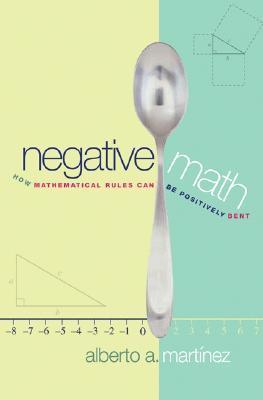
Negative Math: How Mathematical Rules Can Be Positively Bent
A student in class asks the math teacher: Shouldn't minus times minus make minus? Teachers soon convince most students that it does not. Yet the innocent question brings with it a germ of mathematical creativity. What happens if we encourage that thought, odd and ungrounded though it may seem?
Few books in the field of mathematics encourage such creative thinking. Fewer still are engagingly written and fun to read. This book succeeds on both counts. Alberto Martinez shows us how many of the mathematical concepts that we take for granted were once considered contrived, imaginary, absurd, or just plain wrong. Even today, he writes, not all parts of math correspond to things, relations, or operations that we can actually observe or carry out in everyday life.
Negative Math ponders such issues by exploring controversies in the history of numbers, especially the so-called negative and impossible numbers. It uses history, puzzles, and lively debates to demonstrate how it is still possible to devise new artificial systems of mathematical rules. In fact, the book contends, departures from traditional rules can even be the basis for new applications. For example, by using an algebra in which minus times minus makes minus, mathematicians can describe curves or trajectories that are not represented by traditional coordinate geometry.
Clear and accessible, Negative Math expects from its readers only a passing acquaintance with basic high school algebra. It will prove pleasurable reading not only for those who enjoy popular math, but also for historians, philosophers, and educators.
Key Features?
Uses history, puzzles, and lively debates to devise new mathematical systems
Shows how departures from rules can underlie new practical applications
Clear and accessible
Requires a background only in basic high school algebra
Few books in the field of mathematics encourage such creative thinking. Fewer still are engagingly written and fun to read. This book succeeds on both counts. Alberto Martinez shows us how many of the mathematical concepts that we take for granted were once considered contrived, imaginary, absurd, or just plain wrong. Even today, he writes, not all parts of math correspond to things, relations, or operations that we can actually observe or carry out in everyday life.
Negative Math ponders such issues by exploring controversies in the history of numbers, especially the so-called negative and impossible numbers. It uses history, puzzles, and lively debates to demonstrate how it is still possible to devise new artificial systems of mathematical rules. In fact, the book contends, departures from traditional rules can even be the basis for new applications. For example, by using an algebra in which minus times minus makes minus, mathematicians can describe curves or trajectories that are not represented by traditional coordinate geometry.
Clear and accessible, Negative Math expects from its readers only a passing acquaintance with basic high school algebra. It will prove pleasurable reading not only for those who enjoy popular math, but also for historians, philosophers, and educators.
Key Features?
Uses history, puzzles, and lively debates to devise new mathematical systems
Shows how departures from rules can underlie new practical applications
Clear and accessible
Requires a background only in basic high school algebra
288 pages, Cloth
First published January 1, 2005
Ratings & Reviews
Friends & Following
Create a free account to discover what your friends think of this book!
Community Reviews
Displaying 1 - 2 of 2 reviews

February 11, 2019
First, I am not a mathematician, and in fact for most of my life I've hated doing math despite my ever returning interest in its—to me—mystical operations and results. Since the days I had first encountered Plato's thoughts on numbers I had realized that mathematics must have a place in any grand philosophical system, it is a part of reality and our comprehension of it which could not be left out. Nonetheless, as an informal outsider to the arcane arts of mathematical formality I have long had a distaste for the posited character of mathematics as it is commonly taught, I have for a few years now been aware that what I really want to know is the what and the why of mathematical operations and results. It has been a goal in the back of my mind to eventually tackle this issue by going back to the roots of mathematics, to Euclid's geometry, and then moving up through the basic mathematics of arithmetic, perusing the various fundamental interpretations of the objects and operations of math. This book was an accidental read, I simply chanced upon it on a youtube video comment, but this has served the purpose of giving me some insight into these questions of the what and why of mathematics. It is a fascinating read, it is also an incredibly clear and easy read for anyone not well versed in mathematics, after all we're dealing with the most basic numbers and operations.
Imaginary numbers are strange and unintelligible—everyone knows and believes this when they first are introduced. How can we take the square root of a negative number? When we attempt to think of it in quantitative terms there is no possible meaning to the operation.
The source of the problem is an innocuous kind of number that we all simply take for granted nowadays, surely nobody thinks that *negative numbers (-n)* don't make sense. They are debts, quantities of lack, they are a smaller quantity than their positive counterparts, etc. I didn't think such numbers were problematic either. I had questioned why (- * - = +), why the - sign changed a + but a + didn't change a -. I wondered why in the world it made sense to take the square root of -1, but I never questioned what the + and - as operators really meant, and further I didn't question the meaning of the relation of the +numbers and -numbers.
This book brings to light the history of these negative numbers and their ground shattering consequences when the rules of traditional mathematics were extended to them in asymmetric ways to the +. The reasons for why (- * - = +) came both from purely formal yet unintelligible reasons, and when intelligible reasons were given we found that mathematical operations beyond a specific use and interpretation kept producing unintelligible relations and results which simply did not cohere for the entire system which used the -numbers and the - operation of subtraction.
This problem was considered so outrageous as to undermine the validity of algebra as a genuine science for nearly 300 years, with the debate centering on what the content meaning of such operations and numbers really represented, if any. Geometry in those days was the queen of the sciences, the surest knowledge humanity had produced and discovered, and most objections to algebra's strange results were based on the fact that geometry did not suffer such silliness as negative quantities. Since the numbers proved to be useful in certain everyday cases as well as simply being an interesting exercise of "what if we just go along, what does it produce?" Most mathematicians, even those against such numbers, nonetheless studied and found eventual applications. That certain numbers, in the way they were contrived to operate, found eventual real use, however, did not ever answer the fundamental question of what these numbers and operations meant in themselves as quantities. This question was still open up to the 1830s, but by that time the use and simple formal acceptance of the negative and imaginary numbers just became so overwhelming that the naysayers were silenced by general indifference and disinterest in the question. The math worked regardless of our ability to comprehend any of it in intelligible ways, and that was that.
With the questions of the intelligibility of mathematics thrown into the dustbin of history, math ceased to be what it was once purported to be, it was no longer the science of quantity and its relations. Formalism eventually won. The numbers no longer represented quantities, the + and - operations no longer represented objects given or taken, square roots no longer necessarily meant intelligible operations, etc. With the fall from grace of Euclidean geometry after more than a millennium of being the queen of the sciences, itself reduced to just another arbitrary formal system with the discovery of new geometries, algebra and its strangeness was saved from one of its strongest bases of attack, those who saw geometry as elegant, simple, clear, and unquestionable.
So what do the negative numbers and the negative operations ultimately mean? Nothing, mathematics simply cared about symbol manipulation and its proper syntax with no meaning necessary other than the operations which moved and related symbols. All of math was shown to ultimately be imaginary.
But if all math is imaginary, the book asks us, if it is all revisable in principle, can we at least make it accord just a bit more with our common sense comprehension so that it remains just that much more intelligible? Why not (- * - = -)? Indeed, why not. In fact, why not a mathematics of quantity, a modern algebra of quantity which shall never produce the strange result of negative numbers which have no physical meaning?
The first half of the book retells the history of this controversy, the second half of the book offers to us a vision of a mathematics that, for those of us who wish to have an intelligible mathematics, can return to these old questions and offer new attempts to approximate if not satisfy the old desire for a fully intelligible science of quantity.
Imaginary numbers are strange and unintelligible—everyone knows and believes this when they first are introduced. How can we take the square root of a negative number? When we attempt to think of it in quantitative terms there is no possible meaning to the operation.
The source of the problem is an innocuous kind of number that we all simply take for granted nowadays, surely nobody thinks that *negative numbers (-n)* don't make sense. They are debts, quantities of lack, they are a smaller quantity than their positive counterparts, etc. I didn't think such numbers were problematic either. I had questioned why (- * - = +), why the - sign changed a + but a + didn't change a -. I wondered why in the world it made sense to take the square root of -1, but I never questioned what the + and - as operators really meant, and further I didn't question the meaning of the relation of the +numbers and -numbers.
This book brings to light the history of these negative numbers and their ground shattering consequences when the rules of traditional mathematics were extended to them in asymmetric ways to the +. The reasons for why (- * - = +) came both from purely formal yet unintelligible reasons, and when intelligible reasons were given we found that mathematical operations beyond a specific use and interpretation kept producing unintelligible relations and results which simply did not cohere for the entire system which used the -numbers and the - operation of subtraction.
This problem was considered so outrageous as to undermine the validity of algebra as a genuine science for nearly 300 years, with the debate centering on what the content meaning of such operations and numbers really represented, if any. Geometry in those days was the queen of the sciences, the surest knowledge humanity had produced and discovered, and most objections to algebra's strange results were based on the fact that geometry did not suffer such silliness as negative quantities. Since the numbers proved to be useful in certain everyday cases as well as simply being an interesting exercise of "what if we just go along, what does it produce?" Most mathematicians, even those against such numbers, nonetheless studied and found eventual applications. That certain numbers, in the way they were contrived to operate, found eventual real use, however, did not ever answer the fundamental question of what these numbers and operations meant in themselves as quantities. This question was still open up to the 1830s, but by that time the use and simple formal acceptance of the negative and imaginary numbers just became so overwhelming that the naysayers were silenced by general indifference and disinterest in the question. The math worked regardless of our ability to comprehend any of it in intelligible ways, and that was that.
With the questions of the intelligibility of mathematics thrown into the dustbin of history, math ceased to be what it was once purported to be, it was no longer the science of quantity and its relations. Formalism eventually won. The numbers no longer represented quantities, the + and - operations no longer represented objects given or taken, square roots no longer necessarily meant intelligible operations, etc. With the fall from grace of Euclidean geometry after more than a millennium of being the queen of the sciences, itself reduced to just another arbitrary formal system with the discovery of new geometries, algebra and its strangeness was saved from one of its strongest bases of attack, those who saw geometry as elegant, simple, clear, and unquestionable.
So what do the negative numbers and the negative operations ultimately mean? Nothing, mathematics simply cared about symbol manipulation and its proper syntax with no meaning necessary other than the operations which moved and related symbols. All of math was shown to ultimately be imaginary.
But if all math is imaginary, the book asks us, if it is all revisable in principle, can we at least make it accord just a bit more with our common sense comprehension so that it remains just that much more intelligible? Why not (- * - = -)? Indeed, why not. In fact, why not a mathematics of quantity, a modern algebra of quantity which shall never produce the strange result of negative numbers which have no physical meaning?
The first half of the book retells the history of this controversy, the second half of the book offers to us a vision of a mathematics that, for those of us who wish to have an intelligible mathematics, can return to these old questions and offer new attempts to approximate if not satisfy the old desire for a fully intelligible science of quantity.
March 29, 2013
This was my original post on Amazon copied here with a slight modification re: a reference to a previous poster:
------------------------------------------------------------------------------------
tl;dr: This book is amazing and will set the stage for further understanding. It not only explains WHY a minus times a minus is a plus, but also reveals that (essentially) the same reason is responsible for imaginary numbers and also vector algebra and its seemingly archaic rules. It opens the doors to a very deep understanding of mathematics.
----
This book does much more than just explaining why a negative times a negative is a positive. It also explains the existence of imaginary numbers AND the justification and origin of the seemingly arbitrary rules of vector algebra. It is _the_ book I have been dreaming of to explain the three biggest questions I have had about math.
Understanding all this has been a long time quest for me; in high school, all three questions (minus times minus equals positive, imaginary number justification and vector algebra justification) became nagging obsessions. Countless books later, I am lucky to have stumbled upon this book that answers all three!
I was initially most curious about imaginary numbers. I read Paul Nahin's An Imaginary Tale (1998) and Barry Mazur's Imagining Numbers (2002) [...] but was not satisfied. Those books attempted "proof through application" and hazy analogies/ethereal elegance, respectively. In fairness, Mazur's book did reveal to me that math could be made to do things "just because." It also refocused my interest in the negative times negative equals positive "conundrum." This refocus lead me to Negative Math and I devoured it.
By using history, Martinez transported me back to when negative numbers were not so easily accepted. This was comforting in a way since I realized that very great mathematicians asked the same questions but (some) never came to an answer. It allowed me to see how the idea of a negative times a negative (and imaginary numbers and, eventually, vector algebra)
evolved and went _logically_ from nothing to what we have now. This beats analogies and empirical evidence because, essentially, I was right there discovering these things one step at a time instead of having someone explain the end product.
Martinez then shows why mathematicians had troubles with negatives by demonstrating what happens if a negative times a negative _isn't_ positive. This _REALLY_ helped me because I learn best when I can see the "wrong" way of doing something and what kind of results it produces. It showed that you can have two systems that are different but equally valid. It also helped reveal why vector algebra is the way it is; it is essentially a "wrong" way of doing regular algebra but that, critically, works.
I rarely get a book that excites me, but I feel that this new found understanding provided by Negative Math will open the doors to even deeper and more mysterious aspects of math. How cool?!
------------------------------------------------------------------------------------
tl;dr: This book is amazing and will set the stage for further understanding. It not only explains WHY a minus times a minus is a plus, but also reveals that (essentially) the same reason is responsible for imaginary numbers and also vector algebra and its seemingly archaic rules. It opens the doors to a very deep understanding of mathematics.
----
This book does much more than just explaining why a negative times a negative is a positive. It also explains the existence of imaginary numbers AND the justification and origin of the seemingly arbitrary rules of vector algebra. It is _the_ book I have been dreaming of to explain the three biggest questions I have had about math.
Understanding all this has been a long time quest for me; in high school, all three questions (minus times minus equals positive, imaginary number justification and vector algebra justification) became nagging obsessions. Countless books later, I am lucky to have stumbled upon this book that answers all three!
I was initially most curious about imaginary numbers. I read Paul Nahin's An Imaginary Tale (1998) and Barry Mazur's Imagining Numbers (2002) [...] but was not satisfied. Those books attempted "proof through application" and hazy analogies/ethereal elegance, respectively. In fairness, Mazur's book did reveal to me that math could be made to do things "just because." It also refocused my interest in the negative times negative equals positive "conundrum." This refocus lead me to Negative Math and I devoured it.
By using history, Martinez transported me back to when negative numbers were not so easily accepted. This was comforting in a way since I realized that very great mathematicians asked the same questions but (some) never came to an answer. It allowed me to see how the idea of a negative times a negative (and imaginary numbers and, eventually, vector algebra)
evolved and went _logically_ from nothing to what we have now. This beats analogies and empirical evidence because, essentially, I was right there discovering these things one step at a time instead of having someone explain the end product.
Martinez then shows why mathematicians had troubles with negatives by demonstrating what happens if a negative times a negative _isn't_ positive. This _REALLY_ helped me because I learn best when I can see the "wrong" way of doing something and what kind of results it produces. It showed that you can have two systems that are different but equally valid. It also helped reveal why vector algebra is the way it is; it is essentially a "wrong" way of doing regular algebra but that, critically, works.
I rarely get a book that excites me, but I feel that this new found understanding provided by Negative Math will open the doors to even deeper and more mysterious aspects of math. How cool?!
Displaying 1 - 2 of 2 reviews