When Osamu, a lonely sail maker, nurses an injured crane one blustery night, he never suspects that this simple act of kindness will change his life forever. This retelling of a traditional Japanese folktale teaches readers young or old a lesson about life and love.
This is an adaptation of the Japanese tale in which a poor sail maker rescues an injured crane, nurses it back to health, and frees her. Some time later, a beautiful woman visits him, stays at his home and eventually they fall in love and marry.
The mysterious woman, whose identity you can easily guess from the get-go, then makes magical sails for selling, which improves her husband's fortune and standing. His fame grows and one day a famous personage arrives and demands a magical sail. These sails cost a lot from the wife to make, and she needs secrecy, but on insistence of the husband, she accepts on condition he again stays away. But days pass by and there's no sail, so the man breaks his promise and loses his wife.
It's a melancholy and bittersweet story, with more of the bitter to it than the sweet. I don't particularly like the plot because it lacks any idea of reparations or redemption, and I'm not a fan of stories in which one single mistake costs a lifetime of regret or consequences. It's a rather brutal message for my tastes. The artwork here is very beautiful, as I've come to expect from Spirin, and the presentation overall is excellent.
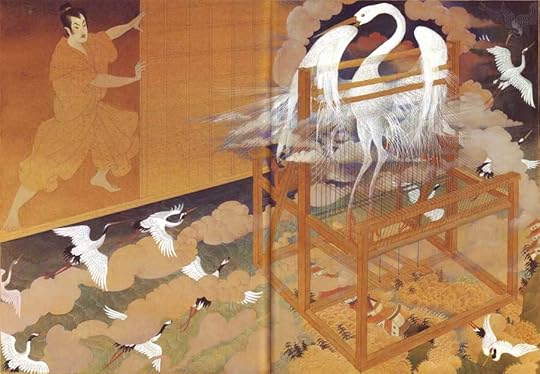
Never a favorite tale of mine, but this was well told, full of pathos, and Spirin's illustrations are phenomenal. This was my favorite, it reminded me of a Remedios Varo painting:
My brothers and I were not raised speaking Japanese, but we did learn classic folktales and this is one of the oldest. There are some differences in details, but the basic story is the same as well as the messages about kindness, love, sacrifice, and the cost of greed. How can I resist a telling with a character who shares my name? The illustrations are gorgeous.
Lush illustrations by Gennady Spirin highlight this retelling of the classic folk tale about a man whose lust for gold costs him his wife. A lovely yet melancholy book.
Here is my blackboard response on The Crane Wife and Dawn, two traditional tales on the same theme that were quite relevant and depressing after screwing up big time with a physically and intellectually beautiful girl this summer.
What They Were About (NECESSARY SPOILER ALERTS)
The Crane Wife
Retold by Odds Bodkin, The Crane Wife is a Japanese story of "…a lonely sail maker named Osamu" who longs for a wife but has nothing more than "…one rice steamer, one pot for making tea, and little else" but a great view of the white cranes that fly near his house "…built high upon the sea." Anyways, one evening in the fall, Osamu is awakened at night by a great crane that flies into his door. Osamu nurses the crane back to health in three days and then watches it fly away. Following the passage of some time, Osamu hears a knock on his door during a great storm. He is surprised to find a lovely, young lady with striking, black eyes like the crane at the door. Osamu invites the woman into his house but only learns that her name is Yukiko. Following the passage of even more time, Yukiko remains at the surprised Osamu's house, and eventually a "…a love grew between them" and the two are married. Even though Osamu has found his wife, he knows that he is still a poor, old sail maker. Showing her love for her husband, Yukiko tells Osamu that she will weave a magic sail for him that he could sell for gold as long as he promises not to look at her while she works on the gift. Osamu agrees, and a tired Yukiko works through the night on the sail, which is then sold for sixth months worth of gold. Osamu and Yukiko live happily ever after, that is, for six months until all of their money has run out, prompting Osamu to ask his wife to weave him another sail. Despite her reluctance, Yukiko is loyal to her husband and weaves another sail on the promise that he won't look at or ask her to weave a third sail. Once again, a tired Yukiko makes the magic sail, which Osamu sells for enough gold for sixth months. Rinse. Wash. Repeat. The money eventually runs out, and Osamu is offered "a lifetime's gold" by a rich ship captain who wants him to weave another magic sail. With his head cluttered by greed, Osamu orders his wife to make him another magic sail, despite her protests that "they take so much from me." Ever faithful, Yukiko agrees to weave the sail, as long as her husband doesn't look. As his wife takes days to work on the sail, Osamu begins to wonder why he can't learn to weave a magic sail, which he rationalizes would save his wife from having to do it in the future. Breaking his promise, Osamu enters the room as his wife works on the sail, only to find the white crane that he had saved weaving the loom with her feathers. With sad, black eyes and feathers trembling, the crane flies away for good. Osamu is left alone for the rest of his days, weaving simple sails and waiting "…f or a knock on his door."
Dawn
A freely adapted version of The Crane Wife, Molly Bang's Dawn is set in 19 th century New England, with the story beginning as a father and his daughter Dawn sit in rocking chairs on the front porch of their home. The father starts telling the daughter a story about how he used to build ships "…a long time ago" from straight and tall trees. One day while looking for wood in the swamp, the father came upon a wounded Canada goose, which had been shot and was sitting still in the water with a broken wing. Like The Crane Wife, the man nurses the wounded bird back to health, this time in weeks rather than days, until the goose flies away as healthy as ever. Following the passage of some time, the shipbuilder is surprised when a beautiful, young woman arrives and asks him if he needs a sail maker. Who would have guessed it but the shipbuilder needs a sail maker, though he "…never thought I'd find one like her." Anyways, the young woman turns out to build the "…finest and toughest" sails around. Eventually, the man and woman get married, with Dawn born out of their love. With his extremely happy family in place, the father builds a sailboat, which his wife/Dawn's mom caps off with one of her well-crafted sails, which are so well-received that people call them the "Wings of Steel" and a rich man eventually propositions the father to make such sails for his racing schooner. Despite Dawn's mother saying that she would not make the "Wings of Steel" for the man, since "…she only made that cloth once, for us, and she couldn't do it again," the father eventually convinces his wife to do so. Finally agreeing, the wife makes the husband promise that he will not come into the room while she is weaving the sails. With the boat due on the first of August, both the husband and wife get to work; however, by early June, Dawn's mother is becoming very weak, just as she predicted when she warned Dawn's father that the sails "…would take too much out of her." With the deadline looming, Dawn's father gets angry that his now-frail wife is taking so long; however, he is reassured that she will finish as long as he doesn't bother her. Down to the wire in the last three days, Dawn's father realizes the error of his ways, feeling guilty about making his wife work so hard on the sails. As the rich man arrives for the sails a half hour before they are due, Dawn's father loses patience and breaks his promise, going into the room while his wife is working. Dawn's father sees no other than a Canada goose at the loom, "plucking the last feathers from her breast and weaving them into sailcloth." A bunch of geese then fly into the room and carry Dawn's mother off. After noting that he hasn't seen his wife since that day, the father is reassured by Dawn that she will set sail on the family's sail boat and bring Mother back.
Response: What a sad story about loss, though I found Molly Bang's adaptation more powerful as it tapped into the guilt of the father, who laments the behavior that cost him his wife. Just prior to telling Dawn about when he broke the promise, the father asks " Why couldn't I have waited?" and then shares the extremely private and haunting revelation that "What I saw there, Dawn, I've seen every night since. I'll see it until I die." Talk about some gut-wrenching, mind-boggling grief that will make a man, left alone with nothing but the thoughts in his mind, go crazy.
In comparison, the pain of loss is much more subtle yet still sadly present in The Crane Wife, with Bodkin ending the story with the haunting image of Osamu waiting "…for a knock on his door." It's safe to say that that knock is never coming, though Dawn spins a more positive ending with the hope that Dawn will find her mother on the sailboat.
As this folktale has been traditionally titled The Crane Wife and told around the bird turned woman, I really appreciated the new slant that Bang gives the story, specifically with the title being the name of the child and the word "Dawn" holding some powerful symbolism, specifically the hope that a new day will emerge when the father, daughter and mother will reunite and be happy again. Of course, I still felt uneasy at the end of the story that the mother is never going to return, but at least there's some sort of hope, even if it's coming from a naive yet still brave child. Yet as an adult (in name only), I know that there will be no happy ending to either version of this folktale, making the overall lesson of not letting material concerns cloud the good things you have even more prescient.
While both stories were beautifully told through simple storytelling and incredible illustrations, I cannot help but feel as if I had been punched in the gut at the end of each tale, making me think of two of my favorite songs of all time, one from the late Jeff Buckley and another from the great Jason Lytle of Grandaddy. Anyways, I think both of these songs sum up the regret, pain, longing and what ifs of this folktale quite well, especially these lyrics from Buckley:
"Sometimes a man gets carried away, when he feels like he should be having his fun And much too blind to see the damage he's done Sometimes a man must awake to find that really, he has no-one." OUCH!
Relating these lyrics to the stories, at least the father in Dawn has Dawn. As for Osamu in The Crane Wife, all he has are the simple sails that he makes. That's pretty freaking depressing to me.
Additionally, the end of this folktale makes me think of the conclusion to The Godfather, Part III, when the old Michael Corleone falls off his chair and dies a lonely man in Italy after living the last years of his life in regret for what the life he chose did to his family, specifically the death of his daughter.
Specifics: Both The Crane Wife and Dawn are built around the same motif: a tradesman is awarded for his sensitivity after caring for an injured bird (a crane and Canadian goose, respectively) in the form of a lovely, young woman who not only becomes their respective wife but possesses some magical, mysterious looming power that helps the men financially. Despite living happily with their new loves, the men eventually lose sight of what they have as they get clouded by monetary and material possibilities, thus forcing their wives to do something that they are hesitant to do. Ever so loyal, the wives agree to obey their husbands, as long as they promise not to enter the room while they are weaving their magic sails. Overcome with ambition yet grief of what they have done to their wives, the men crack and break the promise, finding their wives to be the wounded bird that they respectively saved, with the ultimate price being that they lose their wives forever and have to wonder what if for the rest of their lives.
● Both versions of this folktale are built around powerful and sometimes contrasting themes of sensitivity/insensitivity, love, greed/ambition, loyalty/impatience, regret/remorse, happiness/sadness, etc. In other words, there is a lot to work with here as a teacher using these books in the classroom.
● How the settings are presented is especially interesting in these different versions. Like folktales that don't spend a lot of time going into the setting (TMY, chapter 7), The Crane Wife establishes the setting within the first four words (Once, in ancient Japan) and then leaves it at that. I didn't even know that Molly took place in 19 th century New England until reading the inside flap of the book after my first reading of the story.
● Passage of time is also interesting. In The Crane Wife, the reader is constantly reminded that time has past, typically with the phrase "Time passed" and the introduction of the different seasons. In Dawn, the passing of time is more natural through life events like the birth of a child, showing how this adaptation breaks in some ways from traditional folktales.
● Both versions utilize foreshadowing when introducing the mysterious young woman, though Molly does a stronger version in my opinion. In The Crane Wife, the beautiful, young woman is introduced with "…her black eyes shining" which refers to when the injured crane's "…black, shining eyes opened" as Osamu nursed it back to health. In Dawn, Bang provides a more detailed description of the young woman in relation to the Canada goose, going beyond the black eyes when noting that "…She had a long, slender neck and tiny teeth, delicate and white. She had a scar on her arm (referring to the gunshot wound). I noticed it when she took off her cloak. How could I know what it was from?" Ultimately, such foreshadowing and rhetorical questioning made Dawn feel more personal and tangible to me than The Crane Wife, which was definitely the more traditional version.
● The strong text in both versions is brought to new levels by the beautiful, colorful illustrations, which cannot be fully conveyed in my words but need to be observed by my peers in class on Monday night.
Curricular Connections
These seemingly simple stories have much relevance beyond the primary grades. If I was teaching these books, I would focus on the many themes that I talked about above, have the students compare and contrast the similarities and differences of The Crane Wife and Dawn, and examine not only the literary elements (foreshadowing, rhetorical questioning, symbolism of birds, etc.) but the illustrations, specifically how they convey the text but take the story to new places.
For older students, I think this simple yet complex tale could spark great discussion about the regret of not appreciating someone until he or she is gone. Even for adults, these "kids" tales are prime material for talking about failed relationships and missed opportunities.
This is yet another book in my collection with incredible illustrations of [[Gennady Spirin]]. I am locating and purchasing as many books illustrated by Spirin as I can find. His works of art never cease to amaze me! This story of the [[Crane Wife] is no exception. His illustrations seem magically sheer and beautifully rendered.
A story of love, but also greed and selfishness, this is the tale of Osamu, who lives high in the Japanese mountains. He makes sails and sells them as his only way of making a living. One cold, cold night a crane was thrown tempest-tossed by the howling wind. Osamu couldn't help but help the lovely crane. Three days of providing care, he nursed the lovely bird back to life so that it could once again fly in the lovely mountains.
Years later, another storm brought a lovely lady to Osamu's door. They fell in love and married. Yukiko saw the poverty of Osamu and offered to help by building a sail that he could take and sell in the village. Weaving a magical sail, her only request was that he not watch her as she wove a thing of incredible beauty. Magically, Yukiko wove the wind into her sails. Because of the uniqueness of the sail, it sold and was paid for in gold. There was enough gold to last a year.
When spring returned, so did the gentle, stunningly beautiful cranes. When the money was gone, Osamu pleaded with his wife to make yet one more sail. She told him that making these works of art caused her severe lack of energy. Exhausted, she gave a new sail to her husband, and again he was paid with enough gold to last another year.
Rather than working for both of them, he relied on his wife. And, again, when the gold was gone, he needed yet another sail. When a huge sailing ship arrived in the harbor, upon hearing of the incredible sails, he demanded one to be made and in return enough gold for a last time was promised.
Entreating her husband that making the sails literally takes life from her, nevertheless selfishly demanded another sail...a final one! Another selfish act occurred when the husband broke the rule of never coming into the room as the sails were made. He entered the room, and he say an actual crane weaving the magic. Weaving its white feathers into the sail, the wife/crane lifted herself and sailed out with the wind with the company of the other cranes.
Sadly, Osamu, was once again lonely. He lost his love through his selfish demands. The rest of his life he spun his simple sails and waited, hoping he would once again hear the gentle knock on the door.
A poor sail-maker, who lives by himself in a house high above the sea, Osamu finds himself nursing a wounded crane back to health, when it crashes into his home one stormy night. As if this visitor weren't surprising enough, a beautiful young woman appears on his doorstep, during the next storm! Although she will answer none of his questions, telling Osamu only that her name is Yukiko, the two soon fall in love, and marry. When money becomes scarce, Yukiko weaves a magic sail, with the sound of the wind in it, making Osamu promise not to watch her in the process. But soon even the money from this wonderful sail runs out, and Yukiko must weave another, and then another. And then one day, Osamu forgets his promise...
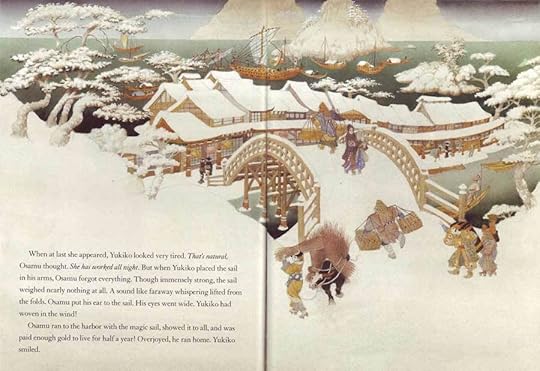
Of course, readers will guess Yukiko's secret from the beginning, but Odds Bodkins' retelling of this classic Japanese folktale will keep them engaged all the same, happy at the union of Osamu and Yukiko, and saddened by their inevitable parting. The watercolor and gouache illustrations by Gennady Spirin - whose other folklore projects include The Tale of the Firebird and The Fool and the Fish - are breathtakingly lovely, accentuating the sense of loneliness evoked by the story. This beautiful picture-book is one that all folk and fairy-tale lovers will want to peruse, both for the narrative and the artwork. Highly recommended!
Pretty standard telling of a common folk-tale 'type.' Most of the pictures were lovely, but do be sure to read with good light. (Neither story nor pictures are good for bedtime.)
Richly illustrated in a traditional Japanese style, this is the story of a poor sail maker who meets his soul mate. She comes to him a year after he has rescued a crane, his favorite kind of bird. After they marry, he learns that she can weave magic sails that carry the wind. She agrees to weave for him, but only if he promises not to look at her while she works. He promises, but such promises are hard to keep.
Students identified the lessons learned: the danger of greed and the importance of keeping a promise.
Beautifully illustrated traditional Japanese story of a lonely sail maker who nursed an injured crane back to health; shortly afterward the companionship he had always longed for literally knocked on his front door. The Crane Wife is a sad yet sweet fable of love, appreciation, and regret.
Gorgeous illustrations, metaphorical allusion to woman's life as a hidden sacrifice; however, the story could have been enhanced if the roles could have been reversed and the woman could have rescued the man. However, I appreciated the fact that the wife escaped her imprisoned enslavement to her marriage and took flight as the strong, independent female crane she was created to be.
A beautifully illustrated retelling of a Japanese story about a man who cared for a hurt crane, and later married a beautiful woman with a bit of magic about her (the ability to weave magical sails) . . .
Grade/interest level: K Reading level: 320L (2nd) Genre:Folktale
Main Characters: Osamu and Yukiko Setting: ancient Japan, a house on a hill POV: narrator
Summary: A lonely sail maker sits at his loom making ordinary sails. He loves watching the cranes outside while he thinks about how wonderful it would be to have a wife. Knowing he has little to offer, he doubts the possibility of ever finding a wife. One night there is a terrible storm and Osamu finds a crane in the need of his help. He willingly takes the crane inside and nurses it back to health. The crane returns to the wild. Shortly after there is another brutal storm that brings a young woman to his door in seek of help.
The woman ends up staying and being Osamu's wife. Her name is Yukiko. Eventually the couple runs low on food. Yukiko offers this one time to make a magical sail to sell for lots of gold, but he cannot watch her work. The sail is beautiful and filled with the wind. The sail is sold for six months’ worth of gold. When the couple again runs out of food, he begs her to make another magical sail and because she loves him she does. One day a captain comes searching for the man with the magic sails. When Yukiko refuses to make another sail because it takes so much of her, Osamu is overcome with greed and demands that she make him a sail. Days into making the sail Osamu peeks at her making the sail and discovers his wife is the crane that he saved in the storm. She flies away leaving Osamu lonely again.
Classroom Use: I think this storm portrays the downfall of greed. This book can be used to teach young children about what can happen when they become too greedy. Much like in the story, they can be left with no friends and nothing to show for their greed.
There are many cautionary tales about people falling in love with otherworldly creatures. Most of them end rather badly. Curiosity, the great failing of the human race, the one that leads all of us to bite into that apple, is usually at the root of it. The magical or magicked partner begs their human loved one not to see them or spy on them or question them, etc., and this secret causes such stress that the human invariably breaks their word. Psyche spies on Cupid in the dark, the girl from the North learns the young man who sleeps beside her at night is her bear in human form, Elsa demands to know Lohengrin’s name, Pandora opens the forbidden box, etc.
But many of the fairy tales based on this premise also bring the pressure to bear upon the masculine gender as well, proving that men aren’t immune to the fatal lure of curiosity. The Crane Wife is one such tale.
This ancient Japanese story is retold in bare prose about a sail maker whose tenderness and greed are rewarded in equal measure when a mysterious, beautiful woman appears at his door. The story is accompanied by breathtaking illustrations rendered like Japanese watercolors. Rich in warm tones, they are the perfect accompaniment for Osamu’s story. The Crane Wife is a vision of haunting beauty, fit for children of any culture. It's sorrowful ending lends it a mature edge, too, that lifts it above classic fairy tale sweetness.
This 27 page book is another version of the Japanese folktale, "The Crane Wife." In this version, the man's name is Osamu and he is a sail maker. In the other version by a different author named Sumiko Yagawa, the man's name is Yohei and he is a poor fisherman. -------------------- I would have kids write a story about what happens when people get too greedy. Let's write about the character traits of the wife, then we can contrast the character traits of the husband.
Written by Odds Bodkin and Gennadii Spirin, illustrated by Gennadii Spirin, published by Gulliver books, 1998.
Summary: A classic Japanese folktale about a sail maker who compared his sails to the cranes. One night a crane crashes into the sail maker's door and he nurses it back to health. Then the crane returns to the sail maker disguised as a beautiful women who he falls in love with. The crane wife says she can make a magic sail for him to sell but the husband must promise not to look at her while she is making it. In the end, he breaks his promise and never sees her again.
Response: I think this folktale is a tragic love story that may be too difficult for children to understand. It is beautifully illustrated and interesting.
This is a beautiful story but it is a little sad. It is a transformational Japanese story about a lonely man who finds a wife and this wife tests his confidence and word. The younger students might not understand the meaning behind this story or the transformation that takes place in it, but I would definitely recommend it for the older grades during a folklore unit because I think the story would really pull them in.
This book is a great book. I really liked the message behind the story and I think that 3rd-5th graders would really enjoy this story. It has good lesson behind the story and is appropriate for elementary students. It allows the students to make predictions about what they think is going to happen and predict who they think the wife really is. They can retell the story in their own way too as a beyond activity (using different people and animals that represent them or someone they know).
A Japanese fairy tale with beautiful illustrations reminiscent of traditional Japanese art by Gennady Spirin. The tale is predictiable enough to feel familiar, even though I’ve not read it before. I wish there was an author’s note with some history of the story at the end as I’ve seen with a few fairy tale children’s picture books. Still, a worthwhile read.
pore sail maker finds and helps a crane who magically turns into a woman who makes 2 magical sails that she forms from her feathers, he rushed into her when he was told not to see her and she flew away never to be seen again.
read this to 5th graders whose writer's workshop theme was "kindness". I've also used this story with grade 2: folk tales from around the world. Odds Bodkin is a talented story teller, but there are other versions of this story that are just as good.
A Japanese folktale about how greed can triumph over love, and ultimately, ends up despairing everyone. It kinda reminds me of the Korean tale about the goddess who became a human and married a human because her towels and clothes were stolen by him...
Just gorgeous illustrations. And (half-hearted spoiler alert) I liked that the crappy husband didn't get to live happily ever after. So it's a sad story, but oh, the illustrations are worth it. I want to frame them and have them on my walls.