

What do you think?

A Long Time Ago in a Cutting Room Far, Far Away: My Fifty Years Editing Hollywood Hits—Star Wars, Carrie, Ferris Bueller's Day Off, Mission: Impossible, and More
"For its sheer excellence, diversity, and cultural impact, Paul Hirsch's filmography speaks for itself. They say a film is made in the editing room, and this book is easily the most comprehensive, revelatory, and illuminating account of this essential cinematic art. A must-read for both the casual moviegoer and the serious cinephile alike." —Mark Hamill
A Long Time Ago in a Cutting Room Far, Far Away provides a behind-the-scenes look at some of the most influential films of the last fifty years as seen through the eyes of Paul Hirsch, the Oscar-winning film editor who worked on such classics as George Lucas’s Star Wars and The Empire Strikes Back , Brian De Palma’s Carrie and Impossible , Herbert Ross’s Footloose and Steel Magnolias , John Hughes’s Ferris Bueller’s Day Off and Planes, Trains & Automobiles , Joel Schumacher’s Falling Down , and Taylor Hackford’s Ray .
Hirsch breaks down his career movie by movie, offering a riveting look at the decisions that went into creating some of cinema’s most iconic scenes. He also provides behind-the-scenes insight into casting, directing, and scoring and intimate portraits of directors, producers, composers, and stars.
Part film school primer, part paean to legendary filmmakers and professionals, this funny and insightful book will entertain and inform aficionados and casual moviegoers alike.
A Long Time Ago in a Cutting Room Far, Far Away provides a behind-the-scenes look at some of the most influential films of the last fifty years as seen through the eyes of Paul Hirsch, the Oscar-winning film editor who worked on such classics as George Lucas’s Star Wars and The Empire Strikes Back , Brian De Palma’s Carrie and Impossible , Herbert Ross’s Footloose and Steel Magnolias , John Hughes’s Ferris Bueller’s Day Off and Planes, Trains & Automobiles , Joel Schumacher’s Falling Down , and Taylor Hackford’s Ray .
Hirsch breaks down his career movie by movie, offering a riveting look at the decisions that went into creating some of cinema’s most iconic scenes. He also provides behind-the-scenes insight into casting, directing, and scoring and intimate portraits of directors, producers, composers, and stars.
Part film school primer, part paean to legendary filmmakers and professionals, this funny and insightful book will entertain and inform aficionados and casual moviegoers alike.
392 pages, Paperback
First published November 5, 2019
Ratings & Reviews
Friends & Following
Create a free account to discover what your friends think of this book!
Community Reviews
Displaying 1 - 30 of 136 reviews
May 9, 2021
For anyone interested in film editing, this is a fascinating look at an underappreciated art form. For everyone else, it’s probably boring as hell. Luckily I fall into the former camp.
Bonus game — take a drink every time Hirsch describes a director’s beard.
Bonus game — take a drink every time Hirsch describes a director’s beard.
January 12, 2026
Is Paul Hirsch a great editor? Yes, but I know that simply from his credits, because there’s no way top directors like Brian de Palma, George Lucas, John Hughes, or Herbert Ross would hire him repeatedly unless his judgment, skills, and demeanor were all next-level. Unfortunately, what may not convince you of his mastery is reading this memoir, mostly because film editing is largely a process of thousands of tiny, instinctual decisions, all ideally invisible to the audience.
Sometimes, of course, editors suggest larger changes that dramatically alter the tone, telling, or meaning of the story, and its Hirsch’s anecdotes of this nature that will most interest film buffs. The trouble is, he doesn’t really tell them with any particular flair. They all start out well: “We had x problem on this famous movie, so I said let’s try y and z,” but by the time he gets to the solution, the one you'll recall if you know the movie, it all kind of lands with a thud.
Another reason editing isn’t exactly pulse-pounding is how removed it is from the drama of the set. Editors are rarely disturbed by whatever colorful personalities wrote, financed, produced, directed, or starred in the picture. If anything, the editing bay chills out such people. It’s a safe space, to think, and reflect, and focus. Hirsch certainly clashed with a few assholes along the way, but whether he’s sitting beside a maverick director, a button-down studio head, or Tom Cruise, the vibes are invariably professional and amiable. Which doesn’t make for a great “tell-all.”
I was incredibly fortunate in my career to work for a director who started out as an editor, and thus spent every minute of his ‘director’s cut’ weeks actually cutting the movie alongside the editor, which is not how they do it in Hollywood. And I didn’t just sit in, but was an active participant, treated as a creative partner. It was like getting to play with somebody’s $10 million train set.
And, much as I love the craft and process, I don’t know that I could make it any more interesting to a layman than Mr. Hirsch does. It’s like extolling the efforts of a professional housepainter.
Sometimes, of course, editors suggest larger changes that dramatically alter the tone, telling, or meaning of the story, and its Hirsch’s anecdotes of this nature that will most interest film buffs. The trouble is, he doesn’t really tell them with any particular flair. They all start out well: “We had x problem on this famous movie, so I said let’s try y and z,” but by the time he gets to the solution, the one you'll recall if you know the movie, it all kind of lands with a thud.
Another reason editing isn’t exactly pulse-pounding is how removed it is from the drama of the set. Editors are rarely disturbed by whatever colorful personalities wrote, financed, produced, directed, or starred in the picture. If anything, the editing bay chills out such people. It’s a safe space, to think, and reflect, and focus. Hirsch certainly clashed with a few assholes along the way, but whether he’s sitting beside a maverick director, a button-down studio head, or Tom Cruise, the vibes are invariably professional and amiable. Which doesn’t make for a great “tell-all.”
I was incredibly fortunate in my career to work for a director who started out as an editor, and thus spent every minute of his ‘director’s cut’ weeks actually cutting the movie alongside the editor, which is not how they do it in Hollywood. And I didn’t just sit in, but was an active participant, treated as a creative partner. It was like getting to play with somebody’s $10 million train set.
And, much as I love the craft and process, I don’t know that I could make it any more interesting to a layman than Mr. Hirsch does. It’s like extolling the efforts of a professional housepainter.
November 14, 2019
Through clever use of colorful examples, film editor Paul Hirsch explains four mysterious processes extremely well: what film editors do, where ideas come from, how free-lance careers work (and don’t) and how creative people collaborate to make the best possible film for the audience. A page-turner. I found the description of his cutting process for Ferris Bueller, Planes, Trains and Automobiles and Star Wars particularly illuminating. A welcome addition to the cinema canon.

December 3, 2020
A Long Time Ago in a Cutting Room Far, Far Away is astonishing. What one can learn from a book sometimes is amazing. I didn’t go into this audiobook looking to learn anything. However, Paul Hirsch demonstrated just how important editing is to a movie. Some people just slap things together and hope for the best. But a great editor will look at every frame as if they are puzzle pieces and put them exactly in the right spot. Whether it’s cutting out an entire subplot of a film or something so minuscule as putting a line of dialogue from later in the picture in the beginning - editing is an art and Hirsch is its Picasso.
Paul Hirsch has been doing this for 50 years and has some great stories to tell along the way. His interactions; from the great Bernard Hermann to helping out the up and coming directors of today like Duncan Jones are all fascinating to a film buff such as myself.
In addition, Hirsch is humble beyond measure. He has become friendly with some of the truly great Hollywood artists and never once has he lost sight of the end goal: make the movie the best it can be!
The only qualm I have with the audiobook is the narrator and his habit of stretching out the last bit of every sentence. For instance: it seems as if he’s saying Star Warssss instead of just Star Wars. It’s totally a minor nitpick, but it’s very noticeable.
Paul Hirsch has been doing this for 50 years and has some great stories to tell along the way. His interactions; from the great Bernard Hermann to helping out the up and coming directors of today like Duncan Jones are all fascinating to a film buff such as myself.
In addition, Hirsch is humble beyond measure. He has become friendly with some of the truly great Hollywood artists and never once has he lost sight of the end goal: make the movie the best it can be!
The only qualm I have with the audiobook is the narrator and his habit of stretching out the last bit of every sentence. For instance: it seems as if he’s saying Star Warssss instead of just Star Wars. It’s totally a minor nitpick, but it’s very noticeable.

May 28, 2020
This is a must read for anyone who loves movies. After reading this I have a newfound respect for film editors. I always knew basically what they did, but this book filled in the details. I also loved hearing about the different styles of the directors Mr. Hirsch has worked with - from the ones who hovered over his shoulder and didn't want to give up "their baby" to the ones who told him to go ahead and edit the film as he saw fit. Mr. Hirsch has worked on some of my favorite movies and while I found those chapters especially interesting, I thought the whole book was interesting, well written, and very entertaining.

December 6, 2022
I read this forever ago and am just getting around to writing a review now. Hirsch has a ton of interesting stories about working on some of Hollywood’s biggest successes (and flops), and his relationship with Brian de Palma sounds particularly tortured, but the book too often felt like an editor was in his ear, telling Hirsch to go more gossipy and keep the pace moving. I wanted more on his philosophy of editing, stories about specific editing choices, and experimentation with the technology and how it helped or hurt the art of storytelling. 3.5 stars rounded somewhat unfairly down.
April 12, 2022
I really enjoyed this book. It's not for everyone but (to paraphrase the cover blurb from Brian De Palma) if you want to learn how the sausage is made, this is the book for you. Hirsch is a great storyteller and his body of work is incredible. He's probably most famous for editing STAR WARS and EMPIRE STRIKES BACK but he's cut dozens of 1980s classics -- everything from FOOTLOOSE to STEEL MAGNOLIAS and even CREEPSHOW. I was eager to read this book because I'm a big De Palma fan and I wanted to read the chapters on CARRIE and BLOW OUT and MISSION: IMPOSSIBLE. And if you're a John Hughes fan, there are some great stories about FERRIS BUELLER and PLANES TRAINS AND AUTOMOBILES. Really, there's just a ton of great information here for writers & storytellers & aspiring filmmakers & anyone interested in movies.
My favorite chapter was devoted to a movie I've never even seen -- the 1994 romcom I LOVE TROUBLE, with Julia Roberts and Nick Nolte. The movie was a dud, and Hirsch chronicles all the big missteps that led to its failure. It's a fascinating lesson in how NOT to make a movie.
My favorite chapter was devoted to a movie I've never even seen -- the 1994 romcom I LOVE TROUBLE, with Julia Roberts and Nick Nolte. The movie was a dud, and Hirsch chronicles all the big missteps that led to its failure. It's a fascinating lesson in how NOT to make a movie.

January 4, 2021
Paul Hirsch edited and collaborated on some of the most iconic contemporary films. His career started with Star Wars, a series in which I have little interest (I agree with Pauline Kael on that assessment), but Hirsch's story is quite impressive. Hirsch is a smooth and intelligent writer with lots of stories from his collaboration with directors and producers. Despite being a top editor, he engages the reader with commodious observations about career decisions, luck and timing, and holding his own in a cutthroat business. Hirsch is never bitter nor full of himself but writes with pride about his best work providing insights on his creative process and instincts as an artist. There are humbling admissions about things that went awry and judgments made about those with whom he worked that, though critical, are measured, fair, and without malice. As an editor, he worked with big names, but that is not a reason for braggadocio, it just makes the story more compelling and historically interesting. He confesses he can still be wowed by the occasional movie star or film artist.
In his recalling films, he has a frank attitude towards his profession. He seems to find a successful balance between being a husband and father and his responsibilities as an editor. Similarly, he appears to stand up for what he believes is right and best for every motion picture, writing honestly about his opinions. For instance, we find him aghast about the critical reaction to two films on which he worked in the same year: World War Z (2013), which received better reviews and did better box office than the Great Gatsby (2013), Baz Luhrmann's conscientious adaptation of the novel. It's a sobering reaction says much about his integrity as an artist and about where commercial filmmaking is headed in the age of digital overload.
Similar insights and opinions are offered with sound judgments and a professional's perspective. Hirsch provides insider anecdotes but never dwells on extraneous details or rambles on about the ramifications of this or that; instead, he moves his narrative forward eschewing unnecessary detail.
The afterward is a sober reflection on the enormous changes that his craft has undergone and new technologies in both editing and filming affect film art. I found Hirsch's honesty quite moving at times.
NOTE: I listened to this as an audiobook. The narrator, Richard Ferrone, has a warm, raspy baritone that effectively expresses Hirsch's attitude and intelligence. Highly recommended.
In his recalling films, he has a frank attitude towards his profession. He seems to find a successful balance between being a husband and father and his responsibilities as an editor. Similarly, he appears to stand up for what he believes is right and best for every motion picture, writing honestly about his opinions. For instance, we find him aghast about the critical reaction to two films on which he worked in the same year: World War Z (2013), which received better reviews and did better box office than the Great Gatsby (2013), Baz Luhrmann's conscientious adaptation of the novel. It's a sobering reaction says much about his integrity as an artist and about where commercial filmmaking is headed in the age of digital overload.
Similar insights and opinions are offered with sound judgments and a professional's perspective. Hirsch provides insider anecdotes but never dwells on extraneous details or rambles on about the ramifications of this or that; instead, he moves his narrative forward eschewing unnecessary detail.
The afterward is a sober reflection on the enormous changes that his craft has undergone and new technologies in both editing and filming affect film art. I found Hirsch's honesty quite moving at times.
NOTE: I listened to this as an audiobook. The narrator, Richard Ferrone, has a warm, raspy baritone that effectively expresses Hirsch's attitude and intelligence. Highly recommended.

January 16, 2021
Some cool editing stories, some insight into some great movies and filmmakers, and an occasional dishy or catty anecdote or two - good fun! Hirsch also a very fluid and readable writer. Actually wish there had been MORE in depth discussion or editing on more projects or discussion of techniques and styles.
January 6, 2020
A fascinating read for anyone who wants to go deeper with their film reading, with plenty of anecdotes from behind the scenes of some modern classics.

June 5, 2021
This is just a informed and illuminating book about a little understood part of the filmmaking process. This book is great, funny, sad; it is basically all the emotions!

February 13, 2023
I am going to point out how this book was suggested to me, for a very unique reason. Jacob Hall is a film critic and podcaster I respect. As an editor for /Film Jacob is on the site’s podcast from time to time. He also does a podcast currently On hiatus called Trekking Through Time and Space that I am a huge fan of. Jacob has great reading taste, He suggested this book on one of the podcasts and I put it on hold at the library almost instantly. It was a few months before the hold came through but I wanted to mention this because as someone who recommends lots of books on my podcast, it is nice to know when people reach out and say – yeah that book ruled.
Thanks, Jacob!
First, let’s talk about what this book is. Film editing before personal computers and the current technology is a seriously lost art form. The relationship authors have with book editors is one thing, but the relationship between film editors is even more intense. When we write novels our editors work with our words, it is an intimate relationship but it is entirely words. A film editor works with pictures, actors' performances, music, pace, and energy. There is a reason certain filmmakers and editors are tied together forever. When Tarantino’s long-time editor died his movies were very different.
Anyone who loves movies will love Paul Hirsh’s stories. He started working with Brian DePalma and his big break was working on Star Wars and the Empire Strikes Back. He also worked on Mission Impossible and a Couple John Hughes movies. His stories are amazing.
There is one major reason I would suggest this book is for writers and storytellers there is lots of great advice about how film meets the storytelling process. He tells one story about editing Star Wars. He has lots of stories about little ways he influenced the franchise, including picking Lightsaber colors, that would eventually take on canon meaning, and suggesting a change to Vader’s ship so you knew which one he was in. My favorite though is when he suggested flipping the scene when Luke and Ben watch Leia’s message to the end of the scene after Ben tells him Clone war stories. “We moved the beginning of the scene, as written, to the middle now when they hear the full message, they react to it immediately instead of ignoring it.”
There are lots of stories about the grassroots experience that making Star Wars was, and it should give the reader a certain respect for the risk they were taking. I also love a story he told about Marcia Lucas (George’s wife) who was an editor on the film and took days working on the shot of the Falcon saving the day at the Death star. She said if the audience doesn’t cheer we are toast. There is a cool story about the first audience they showed it to and the editors sharing a look.
There are lots of neat stories of working with Directors and actors. I liked hearing about Empire Strikes Back and the Shining being made at the same time on the same lot. Hirsch worked in Hollywood on massive hits and flops. He saw the technology change. This is a fascinating look at the industry from one master of the craft’s experience. Highly recommended.
Thanks, Jacob!
First, let’s talk about what this book is. Film editing before personal computers and the current technology is a seriously lost art form. The relationship authors have with book editors is one thing, but the relationship between film editors is even more intense. When we write novels our editors work with our words, it is an intimate relationship but it is entirely words. A film editor works with pictures, actors' performances, music, pace, and energy. There is a reason certain filmmakers and editors are tied together forever. When Tarantino’s long-time editor died his movies were very different.
Anyone who loves movies will love Paul Hirsh’s stories. He started working with Brian DePalma and his big break was working on Star Wars and the Empire Strikes Back. He also worked on Mission Impossible and a Couple John Hughes movies. His stories are amazing.
There is one major reason I would suggest this book is for writers and storytellers there is lots of great advice about how film meets the storytelling process. He tells one story about editing Star Wars. He has lots of stories about little ways he influenced the franchise, including picking Lightsaber colors, that would eventually take on canon meaning, and suggesting a change to Vader’s ship so you knew which one he was in. My favorite though is when he suggested flipping the scene when Luke and Ben watch Leia’s message to the end of the scene after Ben tells him Clone war stories. “We moved the beginning of the scene, as written, to the middle now when they hear the full message, they react to it immediately instead of ignoring it.”
There are lots of stories about the grassroots experience that making Star Wars was, and it should give the reader a certain respect for the risk they were taking. I also love a story he told about Marcia Lucas (George’s wife) who was an editor on the film and took days working on the shot of the Falcon saving the day at the Death star. She said if the audience doesn’t cheer we are toast. There is a cool story about the first audience they showed it to and the editors sharing a look.
There are lots of neat stories of working with Directors and actors. I liked hearing about Empire Strikes Back and the Shining being made at the same time on the same lot. Hirsch worked in Hollywood on massive hits and flops. He saw the technology change. This is a fascinating look at the industry from one master of the craft’s experience. Highly recommended.

December 30, 2023
2 Stars as in "it was okay".
I once thought it would be a fun and cool job to be a film editor, which is why I picked this up. Admittedly, I did not have a clue who Paul Hirsch is though I guessed what he worked on by the presentation of the title.
Hirsch's memoir is a somewhat captivating read about the evolution of Hollywood filmmaking as seen through the eyes of a film editor. With a career spanning five decades and a resume that includes iconic movies like "Star Wars," "Carrie," "Ferris Bueller's Day Off," and "Mission: Impossible," Hirsch provides a fascinating behind-the-scenes look at the art and craft of film editing.
He blends personal anecdotes with technical insights, making for a narrative that is both informative and entertaining (although it also comes off a bit snobbish at times). He takes the reader through the intricacies of editing, offering a glimpse into the process of piecing together some of the most well-known films in history.
The book delves into Hirsch's collaborations with directors like Brian De Palma, George Lucas, and John Hughes but also sheds light on the collaborative nature of filmmaking, and which can and sometimes does go awry.
For "Star Wars" fans, there are some interesting insights into the challenges faced during the editing process of the film, showcasing how pivotal decisions in the cutting room shaped the final product.
The writing is fairly engaging, making even the technical aspects of editing understandable for readers without a background in filmmaking. He balances technical details with engaging storytelling, ensuring that the book appeals not only to film professionals but also to anyone with an interest in the magic behind movie-making.
While the book focuses mainly on Hirsch's professional journey, he adds bits from his personal life, such as staying in George Lucas' or Stephen Spielberg's house which are kind of fun and interesting. He also touches on the evolving landscape of Hollywood, technological advancements, and the changing dynamics within the industry.
A good read for cinephiles, aspiring filmmakers, and anyone fascinated by the magic of cinema.
I once thought it would be a fun and cool job to be a film editor, which is why I picked this up. Admittedly, I did not have a clue who Paul Hirsch is though I guessed what he worked on by the presentation of the title.
Hirsch's memoir is a somewhat captivating read about the evolution of Hollywood filmmaking as seen through the eyes of a film editor. With a career spanning five decades and a resume that includes iconic movies like "Star Wars," "Carrie," "Ferris Bueller's Day Off," and "Mission: Impossible," Hirsch provides a fascinating behind-the-scenes look at the art and craft of film editing.
He blends personal anecdotes with technical insights, making for a narrative that is both informative and entertaining (although it also comes off a bit snobbish at times). He takes the reader through the intricacies of editing, offering a glimpse into the process of piecing together some of the most well-known films in history.
The book delves into Hirsch's collaborations with directors like Brian De Palma, George Lucas, and John Hughes but also sheds light on the collaborative nature of filmmaking, and which can and sometimes does go awry.
For "Star Wars" fans, there are some interesting insights into the challenges faced during the editing process of the film, showcasing how pivotal decisions in the cutting room shaped the final product.
The writing is fairly engaging, making even the technical aspects of editing understandable for readers without a background in filmmaking. He balances technical details with engaging storytelling, ensuring that the book appeals not only to film professionals but also to anyone with an interest in the magic behind movie-making.
While the book focuses mainly on Hirsch's professional journey, he adds bits from his personal life, such as staying in George Lucas' or Stephen Spielberg's house which are kind of fun and interesting. He also touches on the evolving landscape of Hollywood, technological advancements, and the changing dynamics within the industry.
A good read for cinephiles, aspiring filmmakers, and anyone fascinated by the magic of cinema.
June 8, 2025
An excellent deep dive into the world of Paul Hirsch growing his portfolio while working on high profile pictures. It’s got a nice dry wit to it, and his deeper dives into the technology or his process were deeply fascinating. It all builds as the progression of new technology and digital filmmaking begins to rear its head, with this book feeling like a last gasp from an old guard. It was fun to watch some of the films he worked on as I read it, seeing his influence and work in real time. It was great!
July 22, 2021
Really great stories with some fun technical stuff that gives you a broader understanding of how movies are made!

June 6, 2022
A fascinating book about the career of the editor of a number of excellent movies, among which Star Wars - A New Hope and The Empire Strikes Back. So many amazing anekdotes about the impact that the editing process had on the final result we now take for granted! Highly recommended.

January 28, 2023
Really loved this. I’ve watched several of Paul’s films without even realizing it. This was a great look at the behind the scenes of what goes on in a cutting room and how movies come together.

April 27, 2021
Great stories, fascinating insights and hugely entertaining. Devoured it. Will make you see movies in a new light.

May 1, 2023
Some interesting insights into the world of editing, particularly in terms of how it fits into the overall schedule of a film's production, but overall the book suffers from the author's need to claim credit for every decision he might have had a hand in (and also an odd fixation on describing the facial hair of every man he works with).

January 22, 2025
Takeaway points: artists be petty and sensitive!
A solid memoir, with fascinating fly-on-the-wall, in-the-room-where-it-happens anecdotes about films that I adore - I learned a lot about the editing process from this book, such that when I attended a recent screening of The Brutalist, I found myself viewing the film in a different way than before, admiring the craft of its editing, how it contributed to the storytelling.
A solid memoir, with fascinating fly-on-the-wall, in-the-room-where-it-happens anecdotes about films that I adore - I learned a lot about the editing process from this book, such that when I attended a recent screening of The Brutalist, I found myself viewing the film in a different way than before, admiring the craft of its editing, how it contributed to the storytelling.

May 1, 2020
Oscar-winning editor Paul Hirsch breaks down his career movie-by-movie, and in the process provides an inside look at an integral part of making movies, but one that seldom receives much attention.
Directors, actors, score composers and even cinematographers receive praise (or criticism) for movies they make, but the editor is the one responsible for taking all that film footage and music and cutting it together into a coherent picture. I knew very little about film editing before reading Hirsch's book, but we all know some of the movies he's edited: "Carrie;" the first two "Star Wars" films ("A New Hope" and "Empire Strikes Back"), "Ferris Bueller's Day Off;" "Planes, Trains and Automobiles;" and "Mission: Impossible."
Hirsch, in his own engaging way, recalls his experiences bringing to life the visions of directors like George Lucas, Brian De Palma and John Hughes, as well as working with legendary composers like Bernard Herrmann. But film buffs and anyone who aspires to work in the film industry will appreciate the technical portions of the book, with cut-by-cut descriptions of an editor's work when movies were still shot on film in the 1970s-1990s, on through the digital age of movie production.
You might expect an Oscar winner to come across as arrogant but Hirsch stops just short of that in his book: confident in his work, yes, but also still humble and grateful for the chance to work in pictures. That humility, along with an inside look at some of the greatest movies ever made, kept me turning the page from start to finish.
Chad D. / Marathon County Public Library
Directors, actors, score composers and even cinematographers receive praise (or criticism) for movies they make, but the editor is the one responsible for taking all that film footage and music and cutting it together into a coherent picture. I knew very little about film editing before reading Hirsch's book, but we all know some of the movies he's edited: "Carrie;" the first two "Star Wars" films ("A New Hope" and "Empire Strikes Back"), "Ferris Bueller's Day Off;" "Planes, Trains and Automobiles;" and "Mission: Impossible."
Hirsch, in his own engaging way, recalls his experiences bringing to life the visions of directors like George Lucas, Brian De Palma and John Hughes, as well as working with legendary composers like Bernard Herrmann. But film buffs and anyone who aspires to work in the film industry will appreciate the technical portions of the book, with cut-by-cut descriptions of an editor's work when movies were still shot on film in the 1970s-1990s, on through the digital age of movie production.
You might expect an Oscar winner to come across as arrogant but Hirsch stops just short of that in his book: confident in his work, yes, but also still humble and grateful for the chance to work in pictures. That humility, along with an inside look at some of the greatest movies ever made, kept me turning the page from start to finish.
Chad D. / Marathon County Public Library

March 21, 2021
Oh how I wanted to enjoy this book more. The films that Paul Hirsch has edited shows off an incredible resume...and the stories within each of these editing projects is interesting to read about....but I just had a hard time liking Paul.
There were exciting stories of his time working on Carrie, Star Wars, Ferris Bueller and Ray (among many other films), but some of the paragraphs, sentences and comments just hit me as snarky and borderline pretentious.
I also struggled with the “who is this book for” question. The 14-page introduction was filled with dull explanations of film editing and there were many instances where the book was written with (what I felt was) the mindset of needing to explain basic film facts so everyone could understand. Yet subsequent paragraphs would delve into the specific details of people, places and film editing practices that I think only film geeks would be attracted to.
I feel this book would have benefitted from better writing. I think Paul wrote this thing himself and could have benefitted more from a writer...or an editor.
No regrets at all in reading this book. I enjoyed hearing from an editor who transitioned from the pure film cutting days to the current digital state. But Paul’s disdain for modern filmmaking just kept rearing its ugly head.
It’s a shame too....he’s led an incredible working life (over 50 years editing major motion pictures). I wish more of the incredible stories came to the forefront.
Fun read for an editor. Wouldn’t recommend it otherwise.
There were exciting stories of his time working on Carrie, Star Wars, Ferris Bueller and Ray (among many other films), but some of the paragraphs, sentences and comments just hit me as snarky and borderline pretentious.
I also struggled with the “who is this book for” question. The 14-page introduction was filled with dull explanations of film editing and there were many instances where the book was written with (what I felt was) the mindset of needing to explain basic film facts so everyone could understand. Yet subsequent paragraphs would delve into the specific details of people, places and film editing practices that I think only film geeks would be attracted to.
I feel this book would have benefitted from better writing. I think Paul wrote this thing himself and could have benefitted more from a writer...or an editor.
No regrets at all in reading this book. I enjoyed hearing from an editor who transitioned from the pure film cutting days to the current digital state. But Paul’s disdain for modern filmmaking just kept rearing its ugly head.
It’s a shame too....he’s led an incredible working life (over 50 years editing major motion pictures). I wish more of the incredible stories came to the forefront.
Fun read for an editor. Wouldn’t recommend it otherwise.
October 13, 2021
Paul loves music and views editing as dancing. His style permeates this book, and he has a charmingly personal way of writing.
The high level, headline grabbing stuff is great. This book really humanized Brian Depalma, George, and Robert DiNiro. It gives a look at what makes Harrison Ford and John Travolta tick, as actors and as people. It shows a very astute and craftsmanlike attitude by Tom Cruise. Reading between the lines, these people all respect Paul because of his fussy technical ability complemented by his deeply artistic soul.
If you want to get even a different look at the making of Star Wars and Empire Strikes Back, from someone who saw all the possibilities and sat side by side with the Lucases when cutting, those two chapters are phenomenal.
However, if you're a fan of film, a cinephile as Mark Hamil puts it in his ringingly erudite endorsement on the back cover, then read this cover to cover, as I did. Paul captures an increasingly classic era, where filmmaking involved chemistry and darkrooms and hot splices. He warns, in the epilogue, of a world dominated by technology that (in my words) does not work for us so much as we work for it.
Each story, from Carrie to Mission:Impossible reveals a new world, a new depth. There are too many movies, too many styles, too many directors for anyone to know them all. Books like this one preserve the influences that masters of their craft took in, and are now attempting to pass on in their own turn.
Amazing.
The high level, headline grabbing stuff is great. This book really humanized Brian Depalma, George, and Robert DiNiro. It gives a look at what makes Harrison Ford and John Travolta tick, as actors and as people. It shows a very astute and craftsmanlike attitude by Tom Cruise. Reading between the lines, these people all respect Paul because of his fussy technical ability complemented by his deeply artistic soul.
If you want to get even a different look at the making of Star Wars and Empire Strikes Back, from someone who saw all the possibilities and sat side by side with the Lucases when cutting, those two chapters are phenomenal.
However, if you're a fan of film, a cinephile as Mark Hamil puts it in his ringingly erudite endorsement on the back cover, then read this cover to cover, as I did. Paul captures an increasingly classic era, where filmmaking involved chemistry and darkrooms and hot splices. He warns, in the epilogue, of a world dominated by technology that (in my words) does not work for us so much as we work for it.
Each story, from Carrie to Mission:Impossible reveals a new world, a new depth. There are too many movies, too many styles, too many directors for anyone to know them all. Books like this one preserve the influences that masters of their craft took in, and are now attempting to pass on in their own turn.
Amazing.

November 29, 2019
This book reminded me of the role serendipity can play in finding books to read that I enjoy. This was sitting on the new book shelves at the public library branch and it caught my eye with its title that is a play on words from the intro to "Star Wars" and I read it in less than a week.
This is the author's memoir of his career in working as a film editor. The longest section is about his work on the first installment of "Star Wars" but he was involved with other films that I was familiar with, such as "Ferris Bueller's Day Off" and others. The almost 50 or so pages about "Star Wars" was the heart of the book for me. "Star War's was an released when I was in college and was clear at the time it represented some kind of breakthrough in movies portraying the future (if not exactly science fiction).
The author provides a good introduction to explain how he learned over time about film editing. Despite having lower case Roman numeral pagination, it is a key part of the book. The author is interested in readers learning something about his views on how good movies are edited, and how complex that can be, how the interaction of the views and work of everyone involved can play out.
There is a certain amount of discussion of people one has heard of, from George Lucas to Tom Cruise. While that sort of thing isn't what I was looking for, some of it was amusing.
Really a good read.
This is the author's memoir of his career in working as a film editor. The longest section is about his work on the first installment of "Star Wars" but he was involved with other films that I was familiar with, such as "Ferris Bueller's Day Off" and others. The almost 50 or so pages about "Star Wars" was the heart of the book for me. "Star War's was an released when I was in college and was clear at the time it represented some kind of breakthrough in movies portraying the future (if not exactly science fiction).
The author provides a good introduction to explain how he learned over time about film editing. Despite having lower case Roman numeral pagination, it is a key part of the book. The author is interested in readers learning something about his views on how good movies are edited, and how complex that can be, how the interaction of the views and work of everyone involved can play out.
There is a certain amount of discussion of people one has heard of, from George Lucas to Tom Cruise. While that sort of thing isn't what I was looking for, some of it was amusing.
Really a good read.

July 20, 2021
I found this book fascinating. As a long-time movie buff, I am as interested in how movies are made as watching them. I've read about stars, directors, and cinematographers, but didn't know much about the editing process. Mr. Hirsch tells about his long career in the field with details about how things are done and what it's like working with different directors and producers. He's a great writer and storyteller. Highly recommended.
November 21, 2021
Paul Hirsch has a lot of scores to settle!

June 30, 2021
Quick, what's your favorite book by a film editor?
Alright I should have realized most of the people reading this probably have at least two and one of them is by Walter Murch. Entering the contest, is editor Paul Hirsch's ALONG TIME AGO IN A CUTTING ROOM FAR, FAR AWAY (A LONG…). Paul Hirsch is an Oscar winning editor whose work extends five decades and covers many of the biggest hits of those decades. Trust me, you're familiar with at least a half dozen of the films he's worked on.
This is Hirsch's autobiography and for as expansive as his career has been, he's clever enough to realize most readers don't want to thrash through hundreds of pages of technical jargon and self-aggrandizement. Hirsch keeps the stories quick and easy enough that the 350 pages are compelling and move briskly enough that as soon as you start reading about one film… you are done and want more. Fortunately Hirsch is happy to oblige.
He begins his book with a brief description of his childhood, but soon, we're into the good stuff: the movies! And what movies. It is fortunate that he started editing with Brian de Palma, a director known for stylized compositions and editing choices, and Hirsch gives us some of the methods behind the choices. One of those choices being the decision to use some Bernard Hermann as a temp score… which led to de Palma then hiring Hermann for the picture in question (SISTERS) and Hermann's subsequent career resurrection (which would last five years until his death).
After a few more chapters about other movies, Hirsch then talks about how he ended up on the project which made him: STAR WARS. He talks about working with the other great editor on the films (Marcia Lucas) and the entire atmosphere around it. For instance, Hirsch tells the story of how George Lucas decided on the colors of Luke and Darth Vader's lightsabers.
Today, entire segments of the STAR WARS mythos are dedicated to the fact that Vader had a red lightsaber. It almost wasn't. Lucas considered making Vader's lightsaber blue. It was only after a brief discussion of Renaissance color theory that Lucas went with red.
This and so many other details about the film give the reader a feeling that they're almost in the rooms where so many of the little, critical, decisions were made. There's even a brief reference to Hirsch having dinner with STAR WARS producer Gary Kurtz at Los Angeles restaurant El Coyote (made famous by Quinten Tarantion in ONCE UPON A TIME IN HOLLYWOOD- it's a really good restaurant).
And at this point the book isn't half done. It has to be the only book in the last thirty years to discuss KING OF THE GYPSIES.
Hirsch takes time to tell stories of director John Hughes and how FERRIS BUELLER'S DAY OFF was constructed through edit after test screening to the next edit.
Not only do we learn about how these films came together, we learn about the human qualities of directors like Herbert Ross and Brad Bird among others.
There's even a great story about James Cameron. I won't go too far into detail, but you'll howl when you get to it.
Hirsch also talks about his time of THE ADVENTURES OF PLUTO NASH. It is a credit that I went looking for a source to watch this as it sounded interesting.
It's hard to think of the last five decades as "classic film" but they are. Many of the creators and actors have passed on and these films are spoken of in terms both revered and current, as though they never left. It's amazing that we have a first person account of these films as their status as "legendary" tends to affect how they're viewed.
In Paul Hirsch's hands, they are immediately relatable.
Alright I should have realized most of the people reading this probably have at least two and one of them is by Walter Murch. Entering the contest, is editor Paul Hirsch's ALONG TIME AGO IN A CUTTING ROOM FAR, FAR AWAY (A LONG…). Paul Hirsch is an Oscar winning editor whose work extends five decades and covers many of the biggest hits of those decades. Trust me, you're familiar with at least a half dozen of the films he's worked on.
This is Hirsch's autobiography and for as expansive as his career has been, he's clever enough to realize most readers don't want to thrash through hundreds of pages of technical jargon and self-aggrandizement. Hirsch keeps the stories quick and easy enough that the 350 pages are compelling and move briskly enough that as soon as you start reading about one film… you are done and want more. Fortunately Hirsch is happy to oblige.
He begins his book with a brief description of his childhood, but soon, we're into the good stuff: the movies! And what movies. It is fortunate that he started editing with Brian de Palma, a director known for stylized compositions and editing choices, and Hirsch gives us some of the methods behind the choices. One of those choices being the decision to use some Bernard Hermann as a temp score… which led to de Palma then hiring Hermann for the picture in question (SISTERS) and Hermann's subsequent career resurrection (which would last five years until his death).
After a few more chapters about other movies, Hirsch then talks about how he ended up on the project which made him: STAR WARS. He talks about working with the other great editor on the films (Marcia Lucas) and the entire atmosphere around it. For instance, Hirsch tells the story of how George Lucas decided on the colors of Luke and Darth Vader's lightsabers.
Today, entire segments of the STAR WARS mythos are dedicated to the fact that Vader had a red lightsaber. It almost wasn't. Lucas considered making Vader's lightsaber blue. It was only after a brief discussion of Renaissance color theory that Lucas went with red.
This and so many other details about the film give the reader a feeling that they're almost in the rooms where so many of the little, critical, decisions were made. There's even a brief reference to Hirsch having dinner with STAR WARS producer Gary Kurtz at Los Angeles restaurant El Coyote (made famous by Quinten Tarantion in ONCE UPON A TIME IN HOLLYWOOD- it's a really good restaurant).
And at this point the book isn't half done. It has to be the only book in the last thirty years to discuss KING OF THE GYPSIES.
Hirsch takes time to tell stories of director John Hughes and how FERRIS BUELLER'S DAY OFF was constructed through edit after test screening to the next edit.
Not only do we learn about how these films came together, we learn about the human qualities of directors like Herbert Ross and Brad Bird among others.
There's even a great story about James Cameron. I won't go too far into detail, but you'll howl when you get to it.
Hirsch also talks about his time of THE ADVENTURES OF PLUTO NASH. It is a credit that I went looking for a source to watch this as it sounded interesting.
It's hard to think of the last five decades as "classic film" but they are. Many of the creators and actors have passed on and these films are spoken of in terms both revered and current, as though they never left. It's amazing that we have a first person account of these films as their status as "legendary" tends to affect how they're viewed.
In Paul Hirsch's hands, they are immediately relatable.

December 12, 2023
The best book about making movies I've ever read
File under: creative solutions with what you have to work with.
If you care about movies as an art form, as one of the last collective experiences in our society, as something more than background noise with famous people in it, Then I highly recommend this book -Especially if you are interested in the HOW, and the why they do it this way and not another way.
Funny thing, since Covid I've read more book about movies than I've watched movies. and that counts streaming movies at home.
A lot of the books I've read tell you about HOW movies get made, but none so well as this book.
Yes there are anecdotes a plenty about Lucas, and Speilberg, and a lot about Brian De Palma, but to me those are the filler between the real meat of this book. Information I've never come across anywhere else. Reasons behind the creative choices you see up on the screen.
What I absolutely loved about this book is that Paul Hirsch talks about specific scenes & footage from movies. He sets how the rough cut was arranged, and how it didn't work, or what impression or affects that had on the audience or the movie as a whole. NOW GET THIS! Paul Hirsch then tells you what changes they make to that scene, usually something subtle or a re sequencing of the order of events, and Ta-Da! all the exact same frames of film, presented in a different order ( or with different sound) completely change the context of what we've seen and the impact of the entire movie. This doesn't sound like much but I found it enthralling.
Here's just one example: The scene with Luke & Ben in Obi-Wan's home.
In the rough cut Luke & Ben see the message from Leia and do the back story exposition about the clone wars and Luke tells Ben he can't go with to Alderaan. -and the scene just didn't work. Not only did that scene not work, but it was throwing off the pacing of the whole first act and dragging the fim down. Can anything be done to fix this? Luke & Ben got a distress call from a princess, and then they sit back and chit-chat about galactic history and play show & tell with an light saber witch made people forget the message from Leia in the first place. It's like Luke & Ben don't care one bit about the life Leia or the fate of the galaxy. What to do? After looking at it over and over the light bulb went on!
Paul took the hologram message from Leia and put that at the end of the scene, and then had Ben turn to Luke and say "You must learn the ways of the Force if you are to come with me to Alderaan."
Ah, I let out a long satisfied sigh at that point in the book. Such an elegant solution for a more civilized age. It might not seem like much the way I'm retelling it here, but this book is jam packed with Eureka moments like that. Little tweaks informed by brilliant insights that had outsized effects.
Paul Hirsch says good editing can fix anything but bad casting, and he will tell you about more fixes than you knew there were problems.
This book is also told in chronological order so you get a history of Hollywood from the 60's to 2019 and so many of the technological changes that have shaped films and our lives.
There are books that seem so basic on the surface, they seem to be about almost nothing much, and yet they pop my eyebrows up into my hairline. they rearrange my neurons and I think about things differently from then on. This is one of those books ( although to maybe to a lesser extent than the rest) but this one was a little more fun to read.

July 22, 2020
Very interesting, nay, fascinating read! Consisting of a long introduction followed by 31 chapters and 350 pages, the author Paul Hirsch doesn't give us his back story until chapter 2. Growing up in the 1960's he loved going to the movies and after finishing college as an art history major he found his way into a friend's home editing room, watched him put together someone's indie film, and was hooked by all the tools and hands-on process of Hollywood post-production. Another friend offered him a job cutting a small B-film and from then on, Hirsch knew what he wanted to do for the rest of his professional life. Let the adventure begin!
This is what makes reading this book so neat, especially if you've seen the mega-hits like "Star Wars," "Footloose," "Ferris Bueller's Day Off," the first "Mission Impossible" with Tom Cruise, just to name a few that Hirsch worked on. He takes us along on his journey, learning the ropes, the wisdom gained from failures and the sweet success when a film he helped work on won an award or gained a cult following later in life. The editor's job is more important than many people realize and after reading this book you'll never look at movies the same way again.
Some parts of the book do get a little slow. If you haven't actually seen the movie then reading about the post-production work that went into it might put some readers into a daze. He does a lot of name dropping of music composers and movie directors some common folk readers will probably not recognize but I was impressed by just how many movies this author worked on that I'd actually seen at least once, then promptly forgot! "I Love Trouble" was one of them.
As Hirsch tells the reader in his introduction, the tiniest change such as the insert of a single shot into a movie can totally alter everything about the story and even affect the rating of the film. As the title reveals, the best story this author tells is the one from his "Star Wars" gig. Hirsch describes working on the "Ben's Cave" scene. It was HIS idea to restructure the now-famous scene so our two heroes discover Leia's message in the MIDDLE instead of at the beginning as it was originally written in the script before they sidetrack to talk about the Clone Wars and introduce light sabers. Moving the most important plot point to another spot so the characters could react to it made it more believable. George Lucas agreed and the reader is left wondering where Hirsch was when Lucas was making those awful prequels *ducks flying trash from die-hard Star Wars fans*
Read this book and pass it on to everyone you know who loves movies. Learning about the movie making process is a blast thanks to Hirsch's ability to tell a good story, as all editors have to do if they want to keep their jobs!
This is what makes reading this book so neat, especially if you've seen the mega-hits like "Star Wars," "Footloose," "Ferris Bueller's Day Off," the first "Mission Impossible" with Tom Cruise, just to name a few that Hirsch worked on. He takes us along on his journey, learning the ropes, the wisdom gained from failures and the sweet success when a film he helped work on won an award or gained a cult following later in life. The editor's job is more important than many people realize and after reading this book you'll never look at movies the same way again.
Some parts of the book do get a little slow. If you haven't actually seen the movie then reading about the post-production work that went into it might put some readers into a daze. He does a lot of name dropping of music composers and movie directors some common folk readers will probably not recognize but I was impressed by just how many movies this author worked on that I'd actually seen at least once, then promptly forgot! "I Love Trouble" was one of them.
As Hirsch tells the reader in his introduction, the tiniest change such as the insert of a single shot into a movie can totally alter everything about the story and even affect the rating of the film. As the title reveals, the best story this author tells is the one from his "Star Wars" gig. Hirsch describes working on the "Ben's Cave" scene. It was HIS idea to restructure the now-famous scene so our two heroes discover Leia's message in the MIDDLE instead of at the beginning as it was originally written in the script before they sidetrack to talk about the Clone Wars and introduce light sabers. Moving the most important plot point to another spot so the characters could react to it made it more believable. George Lucas agreed and the reader is left wondering where Hirsch was when Lucas was making those awful prequels *ducks flying trash from die-hard Star Wars fans*
Read this book and pass it on to everyone you know who loves movies. Learning about the movie making process is a blast thanks to Hirsch's ability to tell a good story, as all editors have to do if they want to keep their jobs!

March 27, 2025
This is a great book for anybody interested in how movies are made. Paul Hirsch compares the role of the editor to that of the bassist or drummer in a rock band. It isn’t the flashiest job, but it is essential to the success of the whole project. Hirsch goes into the technical side of things but also provides plenty of fun stories from his 50 years in the business. As a movie buff, I loved every minute I spent reading A Long Time Ago, in a Cutting Room Far, Far Away.
Hirsch has had significant creative influence on many films he has worked on over the years, while always in direct collaboration with the directors. His work on Star Wars (1977), with George Lucas, Marcia Lucas, and Richard Chew, can be said to have been “saved” the film from failure. Writer/director John Hughes did an enormous amount of work with Hirsch in the post-production of two movies – the initial cut of Ferris Bueller’s Day Off (1986) was 2 hours and 45 minutes, and the initial cut of Planes, Trains, and Automobiles (1987) was an epic 3 hours and 40 minutes. I can only imagine how much money and time could have been saved by Hughes taking more time to work on the screenplay before shooting! But it gave Hirsch plenty of opportunity to reshape the storytelling of these movies and help turn them into classics.
As a side note: when you come down to it, film is a mongrel art form. It takes aspects of older art forms such as music, painting, theatre, literature, photography, and radio, and mashes them together. Hirsch early on in A Long Time Ago, in a Cutting Room Far, Far Away makes clear that it is editing that truly sets movies and television apart from these other media.
************************************************************************************************
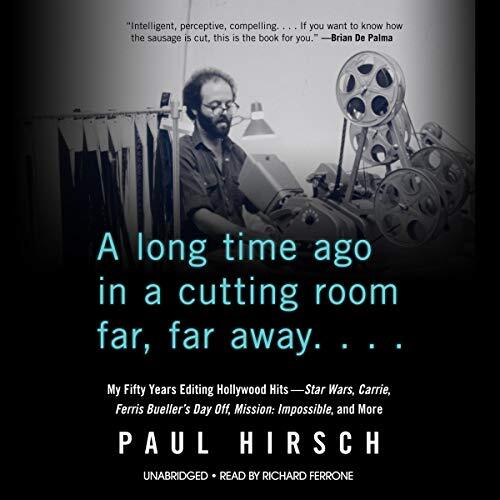
[Image: Book Cover]
Citation:
Hirsch, P. (2019). A long time ago, in a cutting room far, far away: My fifty years editing Hollywood hits - Star Wars, Carrie, Ferris Bueller’s Day Off, Mission: Impossible, and more. Blackstone Publishing. https://www.audible.com/pd/A-Long-Tim...
Title: A Long Time Ago, in a Cutting Room Far, Far Away: My Fifty Years Editing Hollywood Hits - Star Wars, Carrie, Ferris Bueller’s Day Off, Mission: Impossible, and More
Author(s): Paul Hirsch
Year: 2019
Genre: Nonfiction - Film history, autobiography, film-making
Page count: 392 pages
Date(s) read: 3/20/25 - 3/27/25
Book 65 in 2024
************************************************************************************************
Hirsch has had significant creative influence on many films he has worked on over the years, while always in direct collaboration with the directors. His work on Star Wars (1977), with George Lucas, Marcia Lucas, and Richard Chew, can be said to have been “saved” the film from failure. Writer/director John Hughes did an enormous amount of work with Hirsch in the post-production of two movies – the initial cut of Ferris Bueller’s Day Off (1986) was 2 hours and 45 minutes, and the initial cut of Planes, Trains, and Automobiles (1987) was an epic 3 hours and 40 minutes. I can only imagine how much money and time could have been saved by Hughes taking more time to work on the screenplay before shooting! But it gave Hirsch plenty of opportunity to reshape the storytelling of these movies and help turn them into classics.
As a side note: when you come down to it, film is a mongrel art form. It takes aspects of older art forms such as music, painting, theatre, literature, photography, and radio, and mashes them together. Hirsch early on in A Long Time Ago, in a Cutting Room Far, Far Away makes clear that it is editing that truly sets movies and television apart from these other media.
************************************************************************************************
[Image: Book Cover]
Citation:
Hirsch, P. (2019). A long time ago, in a cutting room far, far away: My fifty years editing Hollywood hits - Star Wars, Carrie, Ferris Bueller’s Day Off, Mission: Impossible, and more. Blackstone Publishing. https://www.audible.com/pd/A-Long-Tim...
Title: A Long Time Ago, in a Cutting Room Far, Far Away: My Fifty Years Editing Hollywood Hits - Star Wars, Carrie, Ferris Bueller’s Day Off, Mission: Impossible, and More
Author(s): Paul Hirsch
Year: 2019
Genre: Nonfiction - Film history, autobiography, film-making
Page count: 392 pages
Date(s) read: 3/20/25 - 3/27/25
Book 65 in 2024
************************************************************************************************
Displaying 1 - 30 of 136 reviews