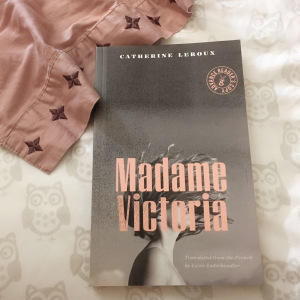
Prix Adrienne-Choquette À partir d’une série de portraits de femmes, Catherine Leroux décline les vies potentielles de son héroïne avec une grande liberté. D’abord nettes comme le jour, ses hypothèses plongent de plus en plus loin dans l’imaginaire, comme des flèches filant vers un point où la mémoire et l’invention se confondent, vers un minuit où tout est possible, jusqu’au dernier souffle. Édition enrichie du texte : « Victoria en femme » « Absolument maîtrisé, on en apprécie chaque paragraphe, chaque mot. »Josée Lapointe, La Presse
Catherine Leroux est née en 1979 non loin de Montréal, où elle vit aujourd’hui avec un chat et quelques humains. Elle a été caissière, téléphoniste, barmaid, commis de bibliothèque. Elle a enseigné, fait la grève, vendu du chocolat, étudié la philosophie et nourri des moutons puis elle est devenue journaliste avant, de publier La marche en forêt. Finaliste au Prix des libraires du Québec, ce roman d’une grande humanité a charmé le public et la critique. Le mur mitoyen est son second roman.
In 2001, a skeleton was discovered in the woods behind the Royal Victoria Hospital in Montreal, Quebec. The remains were never claimed. The mystery woman was lovingly referred to as Madame Victoria by those who sought to identify her. Her case was eventually set aside, replaced by more urgent matters. But Catherine Leroux won’t let Madame Victoria be forgotten. In this compelling novel, Leroux has crafted twelve possible backgrounds for Madame Victoria.
Each individual history is equally breathtaking and heartbreaking. The stories are framed by the tales of the people affected by Madame Victoria’s discovery. Their realization that she will never be identified and the impact that this has on their lives complements the mystery woman’s possible histories in a tragically beautiful way.
The stories are connected by common imagery and the theme of invisibility. Through each story, Leroux reveals a kaleidoscope of emotion and human experience. Each version of Madame Victoria was forgotten for different reasons. A few of the stories towards the end became fantastical – with a little science fiction and fantasy thrown into the mix. This added to the complexity and sheer uniqueness of the book, although my favourite stories are those based in realism.
Leroux uses captivating imagery in her writing, and the words drip off the pages like liquid sugar. She could write about filing your taxes and turn it into a poignant piece that leaves the reader in tears. I look forward to reading more from her in the future.
I recommend this book to those who want to read a modern Canadian literary gem, and for those who don’t mind a little tragedy in their leisure reading. That said, I can see Madame Victoria becoming an assigned book in high school French language classes across Canada.
*Thank you to Biblioasis for the advanced reader copy!*
okay. so. this is a tricky one for me to rate. (i read this for an in-person book club i've just started attending.) there was much i liked and admired about this book, yet there were things that just didn't work for me. let me get the criticisms out of the way first:
i really had trouble with the flow of the book. granted, i managed to go into it not realizing it was connected short stories so i take ownership for that bit of dumb-dumbness. but setting that aside, this is what happened: in the very first story (heartbreaking) we are introduced to an empathetic nurse. in an unusually short amount of time, i got very attached to him. and then he was gone. and i wanted more from/about him and his daughter. later on in the book, he crops up in another story... but it was so in passing, he barely took root before i was missing him again. silly. i know! along with that wee issue, every chapter is a new beginning. new version of victoria. there is no subtle way to segue from one story to the next. moving from one iteration of victoria to the next was jarring. (though i recognize this could be a very desired effect, this feeling of being unnerved.) my final minor issue had to do with consistency. apart from confirmed identity, we are given very specific information about who the discovered bones were from - gender, age, geography, state of health. some of the imagined victorias were beyond these boundaries. so that was a bit of a puzzle to me (only because the author laid it out for us upfront. if the information garnered from the bones has been less vague, i likely would not even be thinking about this point.)
so that's my petty niggling.
on the upside - and there is more than one:
leroux is a lovely writer, and i enjoyed the translation. despite the difficulties endured by the various victorias, the writing was a sustained exercise in elegance. if that makes sense? i'm not totally sure how to describe it. the writing is beautiful, but it can also be matter-of-fact at times. somehow, leroux has balanced that in a formal way that doesn't feel pretentious.
leroux went straight for my empathy gene. OOF! as i was reading, i found it difficult to not become attached to many of the victorias, and feel worry and concern for them. with the start of each new victoria, the outcome is known. the in-between was fairly harrowing for many of the victorias.
this is a very creative and clever book. rather than smashing us in the face with its purpose, leroux is a kind guide. i believe her purpose in writing each of these stories, and fictionalizing a true event, was to provide a window into the lives of women, and the challenges faced just by existing. the sad point of truth is that a real woman disappeared, and died outside. no one missed her, or was looking for her. even after intense efforts to identify her and find family or friends, investigators (and the media) were not successful. how easy it is for a woman to vanish, and no one notices. leroux gives value and purpose to each of her victorias.
there were some motifs which spanned across the stories which really grabbed my attention and made me curious... unfortunately they weren't much discussed at the meeting. if you've read this one, i would LOVE to hear your thoughts on
this book made for a really interesting book club discussion - there really is a lot of ground to cover in considering each story, and the volume as a whole. the group was fairly divided between loving it and really disliking it. one member was so angry at the book - mostly, i believe, by what the book asks of readers. they were not having it. another member was so emotionally gutted by it they had to set the book aside after each story to recover. it did turn out to be a polarizing read for the group. so i was a bit of an outlier by falling in the middle. but... books that create this reaction always seem to have more dynamic discussions, don't they?
Gosh, Catherine Leroux is good. The writing is captivating.
In 2001, a woman's skeleton was found in the woods overlooking Montreal's Royal Victoria Hospital. Her identity was never determined. Leroux constructs twelve different histories for Madame Victoria, and in doing so honours all women on the margins, those dismissed & unmissed by society. I can't wait to read more by this author.
Un autre grand roman par Catherine Leroux ! Ce qui semble être un recueil de nouvelles se révèle être un beau roman ! Portraits de femme(s). Portrait humain. Portraits vivants et riches. Les mots sont sublimes et l(es) histoire(s) est(sont) touchante(s)...
Catherine Leroux possède une plume agile et sensible, mais ce projet semble inachevé, ou peut-être incomplet. Le patchwork ne colle pas tout-à-fait. Je suis restée à la surface de cet assemblage de petites histoires sans réussir à y plonger.
À la fois recueil de nouvelles et exercice de style, cet ouvrage rassemble des fictions qui sont toutes basées sur un fait divers réel : la découverte des ossements d'une inconnue dans un parc de Montréal. Dans chacune de ces histoires, l'autrice réinvente la vie de cette femme anonyme, dont l'identité demeure encore un mystère à ce jour.
Un florilège de portraits de femmes s'enchaînent, d'abord plausibles et réalistes puis de plus en plus créatifs et fantaisistes. Très variés, un thème commun les unit cependant : la solitude. En effet, il faut probablement être bien seul pour mourir dans un buisson de la métropole sans que personne s'en inquiète. Quelles malchances, quels choix de vie peuvent conduire à un tel isolement? C'est la question difficile que pose ce livre. Et la réponse est limpide et terrifiante : cela pourrait tous nous arriver.
J'ai trouvé l'idée derrière l'écriture de ce recueil très originale et le traitement, franchement réussi. L'écriture est très agréable, parfois poétique. Je ne connaissais pas Catherine Leroux avant, mais je lirai assurément ses autres publications.
A series of vignettes that are linked only in the fact they imagine a life history for an unidentified skeleton found in Canada. The writing is terrific - each short story draws you in completely. Not for the faint hearted though, Leroux’s ladies have lived hard lives. But this is perhaps the point, or one of them. By creating the various lives, she shines a spotlight on those who exist in the shadows of life across the centuries. She also highlights the brutality experienced by women either as objects of pity, of adulation or of derision.
Une histoire qui raconte les multiples vies d'une Victoria prise dans la terre, mais qui se débat pour exister. Catherine Leroux écrit un roman qui fait le portrait des différentes vies qu'aurait pu avoir cette Madame Victoria, véritable flèche pointant vers le nord. Cette femme est intemporelle, tout comme cette oeuvre tissée avec finesse.
The novel obviously reads as more of a collection of shorts (similar to 'The Party Wall'), but they’re all linked thematically and symbolically to imagine the real (if there is a real) Victoria’s life before her body was discovered. It’s mostly lyrical rumination on alienation and solitude, but cloaked in twelve vividly imagined fables. Just an absolute TREAT to read.
Special mention to the Russian-spy-turned-québécois-drag-queen Victoria that (unknowingly) maintained my commitment to a queer 2019 book list.
"If she expires here, stretched out in the mud, if she dies with no one to bury her, to pray for her soul to cross the final rivers, if she disappears without anyone even noticing, will she have lived?"
DNF Beautiful prose and symbolism. Not-so-beautiful torturing women. I get that pain can be an integral part of a narrative, but after five different ways in which the same woman suffers and then dies, or dies while suffering, I need a break.
Mis à part un certain manque de cohésion dans l'ensemble, j'ai vraiment adoré ce livre. Quelques histoires m'ont touchée davantage, mais elles étaient toutes incontestablement bien écrites et intéressantes dans leur singularité.
A collection of short stories of which some stood out more than others. This may be the result of the authors surprising ability to write each story in its own unique way, with its own unique voice, which I acknowledge is an amazing technical strength. However, if someone reads this seeking some kind of congruity in writing styles between the stories they may come away disappointed, as I have. My impression is that it reads more like an exercise in writing, written more for the author herself than for the reader. Although turbulent, it’s still a great read.
The concept of this book is fascinating. Each story is an imagining of the life lived by an unidentified woman whose body was found near the Mount Royale hospital in Montreal. Each story is different in genre and tone, varying from sci-fi, fantasy, realism, a story of time travel, a runaway, a workaholic, a celebrity, a goddess, a slave, an indigenous women. While some of the stories are stronger than others, the collection itself is moving and reflects the many lives of women who dissapear in this country.
À partir d'un fait divers, soit la découverte des restes d'une femme à proximité de l'Hôpital Royal-Victoria, Catherine Leroux tisse et retisse l'histoire d'une, de deux, de cinq, de dix Victoria. Multiples femmes, mais une seule solitude, immense, pesante. Quelle belle plume. Plaira aux lecteurs.trices aimant les multiples possibilités et déclinaisons que peuvent offrir un personnage. L'art de la page couverture est particulièrement bien choisi.
Catherine Leroux écrit toujours aussi bien. Le projet est ma foi fort intéressant. Mais malgré les tentatives, il y a pour moi manqué un peu d'unité pour que j'adhère complètement. Bien aimé mais pas un coup de coeur, comme ça avait été le cas pour les deux autres romans de l'auteur.
Suivre l'auteure dans son enquête nous permet de rencontrer une série de ''Madame Victoria'' dans des portraits fascinants, troublants, totalement imprégnés d'un parfum mystérieux, celui de l'imaginaire et de l'inconscient en liberté.
I like to read books as much unknown as possible and this one I got from a library grab bag of Canadian authors. In the first chapter the aged skeleton of a woman is found outside Victoria Hospital in Montreal. Catchy start. I read a few more chapters and I was enjoying the book but felt a little lost, like I had missed something. I subsequently went looking for understanding. It made the book better. The story it turns out is inspired by a news story about a woman’s skeleton found outside of Victoria Hospital in Montreal. At the time of this books publishing the remains are still unidentified. This book is a series of short stories that tell possible versions of who this woman might have been and how she might of ended up on the hill behind the hospital. The stories are all wonderfully written and tell all sorts of possibilities that range from the possible to the fantastical. The stories start out “normal” for lack of a better word and they are wonderful stories but when Leroux ranges into the territory of Horror, Spies, and Sci-Fi the book really hits another level. All of these latter stories impressively stay grounded even when they reach beyond the realm of reality and none are “conventional” genre tales. Instead Leroux borrows some known tropes of these genres to expand the mini-universe she creates. It is also worth noting how impressive it is that the reader can easily connect with and care about each version of Victoria and feel suspense when we know from the onset that each story will end in death and we even know where. Truly a beautifully written book. I, not speaking French, read the translation by Lazer Lederhendler and kudos to him for a fine job. This could not have been an easy task. This is the type of book where words matter ALOT and in this translation they are beautiful.
Un corps est retrouvé près de l'hôpital Royal Victoria et donc on lui donne le nom de Madame Victoria. On ne connait pas le vrai nom de cette personne, on sait seulement quelle était dans la cinquantaine. Après cette ouverture, le lecteur a droit aux conjugaisons de Madame Victoria... qui elle a pu être, ce qu'elle a pu vivre, etc. et cela se termine toujours au même endroit où le corps a été découvert.
Vraiment intéressant comme concept, vraiment bien écrit, la narratrice Annie Girard dont la voix est douce et calmante m'a plu. Certaines histoires sont meilleures que d'autres, j'ai moins aimé le dernier quart du livre quand les histoires deviennent un peu impossible, mais c'était quand même très bon; il y différents genres dans les différents chapitres : roman historique, contemporain, fantastique, science-fiction pour tous les goûts. Ma préféré a été Victoria dehors qui est la première réitération de Victoria, celle la est très triste et comme c'est l'introduction au concept, il y a beaucoup d'impact à travers celle-ci.
Je suis tombée sur ce livre complètement par hasard en regardant les livres québécois disponibles et en me laissant accroché au résumé; je suis bien contente que le résumé n'était pas très précis parce que en ayant su qu'est-ce que le livre était, je ne l'aurais pas choisi, mais je suis contente de l'avoir connu.
Oh MAN. You know those books that you finish and instantly want to reread? This is one of those, but for a very particular reason: it is an essay and a half waiting to happen. The premise barely does it justice, and it's a strong premise --non-fiction: a still-unidentified woman's body is discovered on Mont Royal. Fiction: twelve vignettes that imagine what might have led "Victoria" to her resting place. What isn't really mentioned in the summary is the sometimes-subtle, sometimes-blatant overlapping elements of several of the dozen vignettes. But even the obvious ones seem like a mystery: why is "Eon" not mentioned in all the vignettes? Is there an underlying character present in all those people with mismatched eyes? Some of this is clarified by the last couple pages, but the majority of it is left open, ready for investigation (pardon the pun). This book is SMART, beautiful, and both honest & gentle in the treatment of all its Victorias. Plus, Leroux tooootally captures a contemporary lived experience of Montreal & Quebec, as well as how I think we all imagined it once was, listening in our Québecois elementary school to the descriptions of the bygone days. It's a nostalgia book as much as it's an opening up of narrative, femininity, and life purpose; it does both superbly.
Cette oeuvre de Catherine Leroux est basée sur un fait réel, sur la découverte de cette femme inconnue, ce corps retrouvé sur un terrain de l’hôpital Royal Victoria à Montréal, ce squelette que l'on a humanisé en lui donnant un nom : Madame Victoria. Ici, nous sommes investis dans un roman qui n'en est pas vraiment un, puisque la structure narrative est empruntée à celle du recueil de nouvelles, tout en ayant un fil narratif qui rattache chacune des histoires. Histoires qui inventent et explorent des Madame Victoria potentielles, des femmes différentes qui ont pour point commun un personnage aux yeux vairon, une odeur, la solitude et la mort. Mort ayant lieu sur le terrain de l’hôpital. Au début, les portraits de cette femme sont réalistes, mais les récits deviennent de plus en plus fantastiques, avec même une occurrence dans la science fiction. La réalité n'a plus aucune prise au fil des pages tournées, et Madame Victoria peut devenir une esclave métisse, une autochtone d'une époque ancienne ou une Indienne habitant un Montréal ressemblant plus à un village du Bengale qu'à une métropole Nord-américaine.
Bref : un roman subtil, poétique et rêveur, nous rappelant les dangers de la solitude extrême, de l'isolement jusqu'à la mort.
Un squelette retrouvé près de l’hôpital Royal Victoria à Montréal porte l’autrice à dresser une série de portraits de femmes qui pourraient tous être Victoria. Plus l’autrice va dans l’imaginaire, plus ses portraits me plaisent. Grosse préférence pour les portraits suivant Victoria dans le temps (une très jolie jeune femme qui voyage dans le passé pour une expérience et qui réalise qu’elle n’est pas « belle » à cette époque) Victoria Kumari (la petite fille déesse) Victoria amoureuse (le portait d’une esclave qui tombe amoureuse du fils de son maître) Victoria en sursis (le pacte de suicide des deux jeunes adolescents, elle survit, lui non et elle passe le reste de sa vie au côté des parents de son premier amoureux).
Comme toujours, l’écriture de Catherine Leroux est magique et nous transporte dans des images fortes grâce au pouvoir des mots. Les descriptions sont belles, les morales à tirer de chaque portrait quant aux différentes vies que peut mener une femme, les mots choisis, tout est beau.
C’est une belle lecture d’automne. Pas beaucoup d’actions ou de dialogues, très descriptif.
3.5 stars. As expected, this novel reads quite a bit like a collection of short stories, but each story is a different possibility regarding the identity of the mysterious (and real) Madame Victoria. I will admit that this is the first French translated or Quebecois novel I have ever read, so maybe some of what I found weaker in this novel is just a trait of this particular type of storytelling. Some of the stories were particularly strong and almost earned the book a solid 4 stars, while Leroux made decisions in others that I didn't always see the reason in. I really loved how she integrated common imagery and names throughout many of the stories, giving at least a small element of possible truth to each one. However, while I didn't dislike all of the stories with magical or sci-fi elements, I did dislike that some of them were imaginative to the point that the Victoria in that story couldn't possibly have been the real Victoria based on what limited forensic evidence there was.
3.5 rounded up. An interesting, well written collection of short stories. I enjoyed the read, even though it was dark at quite a few points.
I just had a couple of points of criticism. - I resent the implication that the only way a woman could end up dead and unidentified is that she met an end that was somehow tragic. I feel like that leans into very normative ideas of women being defined by their relationships. A woman alone isn't an inherently negative thing and death is not inherently tragic. - I felt like the author shone best when writing cis white women which makes sense. I can't speak to the stories centering Black, Asian, or Native main characters but the story centering the trans woman felt a bit off somehow. I couldn't tell you exactly what felt wrong about it without serious analysis but having read a good amount of trans fiction, I could tell that the way gender was concieved of was wrong for that specific experience.
Madame Victoria est un récit ressemblant à une courtepointe. De différents motifs dépareillés, mais ayant tous une chose en commun la protagoniste au prénom de Victoria et une mort dans un sous bois.
Ma lecture fût agréable, mais pas marquante. Étant donné qu’à chaque chapitre, il s’agit d’une histoire différente, on n’est pas à la recherche d’une suite qui nous garde en haleine. Cependant, la plume de Catherine est fabuleuse et elle met en lumière l’histoire mystérieuse d’une dame qui a réellement existée. Je n’ai pas pu ne pas aller voir le reportage d’enquête par la suite!