
What do you think?
Rate this book


328 pages, Hardcover
First published September 1, 1943


"I can't live in this house any longer," she whispered. "I just can't!" Her voice was faint and floating, like a trailing tendril of dust.


In China, as elsewhere, the constraints imposed by the traditional moral code were originally constructed for the benefit of women: they made beautiful women even harder to obtain, so their value rose, and ugly women were spared the prospect of never-ending humiliation. Women nowadays don't have this kind of protective buffer, especially not mixed-blood girls, whose status is entirely undefined.I love Pearl S. Buck, I really do, but the way her written legacy interfered with that of Eileen Chang's is a tragedy. Readers introduced through the Nobel Prize Winner to China would expect exacting honor, high drama, sultry romance, any other conjunction of the profligating misnomer known as the 'East'; even more absurd a concept when said readers are US bound and must look to the west for their fill of fiction. They would not have been satisfied with these short and biting works, bred on an entirely different culture with strains more akin to Fitzgerald and O'Connor than anything the historical fiction trends of the States could conjure up. And so we left yet another author to their own devices, till when dead and gone we could sift through and lift up their works in as fitting a posthumous manner as we please.
The white Liang mansion was melting viscously into the white mist, leaving only the greenish gleam of the lamplight shining through square after square of the green windowpanes, like ice cubes in peppermint schnapps. When the fog thickened, the ice cubes dissolved, and the lights went out.Keep an eye on that NYRB cover, Ah Xian's China, China: Bust 34 in profile. It conveys the book better than I ever could.

Upon the translucent blue silk umbrella myriad raindrops twinkled blue like a skyful of stars that would follow them about later on the taxi's glistening front window of crushed silver and, as the car ran through red and green lights, a nestful of red stars would fly humming outside the window and a nestful of green stars.
(p224, The Golden Cangue)
"Hong Kong's defeat had brought Liusu victory. But in this unreasonable world, who can distinguish cause from effect? Who knows which is which? Did a great city fall so that she could be vindicated? Countless thousands of people dead, countless thousands of people suffering ... Liusu didn't feel there was anything subtle about her place in history. She stood up, smiling, and kicked the pan of mosquito-repellant incense under the table.
Those legendary beauties who felled cities and kingdoms were probably all like that."
"[Chang] tried , with little success, to break into the English-language fiction market... But the cultural and linguistic gaps were to wide to cross. As C. T. Hsia, one of her earliest and most perceptive advocates, remarked, mid-century American readers' views of China were greatly influenced by writers like Pearl S. Buck, which left them unprepared for Chang's melancholy incisiveness and insider's perspective."
"This pot of jasmine tea that I've brewed for you may be somewhat bitter; this Hong Kong tale that I'm about to tall you may be, I'm afraid, just as bitter. Hong Kong is a splendid city, but a sad one too.
First pour yourself a cup of tea, but be careful--it's hot! Blow on it gently. In the tea's curling steam you can see... a Hong Kong public bus on a paved road, slowly driving down a hill. A passenger stands behind the driver, a big bunch of azaleas in his arms. The passenger leans against an open window, the azaleas stream out in a twiggy thicket, and the windowpane behind becomes a flat sheet of red."
 Next is the title story, Love in a Fallen City, which was made into a movie with the same name in 1984, played by Chow Yun Fat (The King and I, Pirates of the Caribbean). I really wanted to see the movie, but it's an old movie and it's so hard to find with proper subtitle so I gave up looking. But I searched some clips on youtube and watched some to have a feel of the atmosphere during the time as I don't think I've ever watched a Chinese or Hong Kong movie from this era. I was especially intrigued by the clothes. During the time of reading, I had a hard time imagining the clothes they were wearing, so it was nice to see the clips and learned what they actually might look like. The story itself is one that most resembles a love story, with a man and a woman who find love in each other in the middle of turbulence and chaos.
The military situation that creates this interlude is presented very obliquely; all that we know is that the authorities have shut down, or condoned off, all or part of the city. The authorities, in this case, are probably the Japanese occupiers or (more likely) the Chinese puppet government that answered to them. Chang made a point of never directly referring to the political or military situation in Shanghai prior to the defeat of the Japanese, and thus she usually escaped censorship and was never thrown in prison (as did befall those of her associates who took a more aggressive stance).
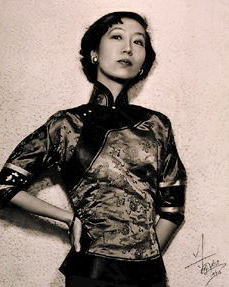 Interesting insight into the political situation of that time. Chang left China when she was 32 and for the next three decades was a banned writer in her homeland, though still much loved by loyal readers in Hong Kong, Taiwan, and the overseas Chinese communities. Sealed Off is told to be one of the stories that impressed Hu Lancheng, an influential man of the time, that "he looked her up, swept her off her feet, and became her husband" (from the Introduction).
"There were two women in Zhenbao's life: one he called his white rose, the other his red rose. One was a spotless wife, the other a passionate mistress. Isn't that just how the average man describes a chaste widow's devotion to her husband's memory--as spotless, and passionate too?
Maybe every man has had two such women--at least two. Marry a red rose and eventually she'll be a mosquito-blood streak smeared on the wall, while the white one is "moonlight in front of my bed." Marry a white rose, and before long she'll be a grain of sticky rice that's gotten stuck to your clothes; the red one, by then, is a scarlet beauty mark just over your heart."
"Yanli rarely spoke or raised her head and always walked a little behind him. She knew very well that according to modern etiquette she should walk in front, left him help her put on her coat and wait on her, but she was uncomfortable exercising her new rights. She hesitated, and this made her seem even slower and more awkward." ~ Red Rose, White Rose, p294


