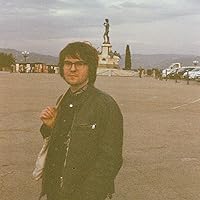
In settings ranging from the Buenos Aires subway to a luxurious Martinique resort, stories by an Argentinian master blend unsettling suspense, intellectual play, clever fantasy, and intense emotional conflict
Julio Cortázar, born Julio Florencio Cortázar Descotte, was an Argentine author of novels and short stories. He influenced an entire generation of Latin American writers from Mexico to Argentina, and most of his best-known work was written in France, where he established himself in 1951.
Cortázar had the face of a lion and the ability to defamiliarize the everyday. His lengthy paragraphs are more entertaining than Henry James' because more happens, but the subtle connections between his warring ideas are often obscured by leaps in logic, incongruous character behaviors, and piquant observations. Cortázar doesn't hold the reader's trembling hand. To read his work is to tear the membrane between thought and action, place and interiority. Padding down corridors of oneiric imagery and literary references, you are bound to encounter Cortázar's convolutions amid Gombrowicz's cool abrasive intellect and Kafka's dungeon-crawling mentality. This is a generous, varied, and unpredictable collection. Not as absorbing as some of his work, but approachable, perplexing, and of a piece with his novels. There is an indefinable texture to his writing. Some sentences you may have to read twice. Ambiguity is embraced and multiple readings will uncover peculiar consistencies between his works.
Out all of the writers I adore, Julio Cortazar is among the most frustrating. Partially because the success of his stories rely heavily on a delicate balance of power between plotting and that of the intricate linguistic and POV acrobatics he’s rightfully known for. If they become too concerned on plotting then they lose that trademark magick and emotional intensity, which sets Cortazar apart from all nearly all other writers (like in his debut novel, The Winners). On the other hand if they become too obsessed with wordplay and structural ambiguity then they become borderline incomprehensible and quite the chore to read (such is the case with his novel, 62: a Model Kit). Yet when Cortazar is able to hit that sweet spot between succinct plotting and the wizardry of his prose, then the result is something to truly be admired, and perhaps even feared (IE his masterpieces Blow-Up and Hopscotch).
And so this brings me to this collection of short stories written in the waning years of Cortazar’s career, a compendium that complies his last three or so volumes. And it’s quite a scattershot grab-bag of sorts…nearly a third of the stories are classic Cortazar—such as the spellingbindly creepy “Story with Spiders” about a couple who retreat to a beachside bungalow and promptly spy on their next door neighbors with arachnid like secrecy. Or “Someone Walking Around” about a secret agent who lands on the shores of Cuba in an attempt to stage a coup and is promptly strangled in cold blood by a “foreigner”. My personal favorite from the entire collection is a rather simple one entitled “There but Where, How?” about a writer whose haunted by memories of his deceased friend, who keeps reoccurring in his dreams for decades on end, leading him to question the finality of death and the metaphysical space that dreams occupy…It’s one of the shortest stories but damn does it pack an emotional wallop, left me on the verge of tears.
Another third of the stories have their moments but unfortunately meander on way to long and in many cases reach anti-climactic or even downright unsatisfying conclusions such as the longest story in the collection, “The Ferry, Or Another Trip to Venice”, which Cortazar himself admits in the opening aside kinda sucks. It recounts a women on holiday in Venice who’s raped by a gondola driver, there’s also a mythological element to the story concerning Charon, the ferryman who helps souls pass over the river into the underworld. An interesting concept, thought the execution is lacking. There’s also a running meta-commentary from Cortazar himself that highlights the various shortcomings of the story, which I thought was a largely un-needed trope.
The final third of the stories border on being completely incomprehensible and are physically taxing to read. Many of these stories become too obsessed by their own structural subversion and lose any sense of emotionality. Cortazar also has a habit of introducing like ten or so characters within the space of a page, and it quickly becomes a confusing and unmanageable slog. Such as in “Clone” which he attempts to map the various instrument arrangements of a piece of classical music to the structure of a short story, the resulting mess runs on for thirty pages and becomes something of an in-joke played upon the reader…Though I found it less than funny…
In short I’d recommend this only to Cortazar completionists or Latin Boom fanatics, and while there’s enough high-grade material here to warrant slogging through the chaff I wouldn’t want this to be anyone’s introduction to Cortazar lest they consider him to inconsistent to tackle his much greater (and longer) works. Try his wondrous story collection Blow-Up or just go straight to Hopscotch.
I read this sl-o-o-o-o-o-o-w, partially to savor it, but partially because reading Cortàzar can be so fucking hard.
Since this is actually two short story collections put together, it's a really mixed bag. But it's very Cortàzar, by which I mean very extreme: the beautiful stories make you ache, the obtuse / didactic ones are nearly unreadable (by someone who's not a super-genius), the creepy / surreal ones are supremely chilling, the sad ones are devastating.
So this is a decent collection to start with if you've never read him before—it's seriously all over the place, so you can get a sense of his immense range. But if you're looking for just the amazing, with less of the weird and trudge-y, I say go with one of the novels.
I got through the first three stories, decided they were pointless and miserable, and thought, "Why am I putting myself through this?" So I put it in a neighborhood sharing library for someone else who will likely wonder the same thing. There must be a point. After all, people got together to publish and translate it. According to the reviews, lots of them liked it. I just never came anywhere near them.
Reading Cortazar is like walking through an eclectic art museum, perusing the various paintings, each revealing a moment in time captured in oil, often eye-catching and inspiring, but not always, revealing only some of the story the rest of which you have to glean from the image, the narrative missing or hidden immediately to the eye unless one knows the backstory or the allusions presented, occasionally intellectual but often heartfelt, each stroke another layer. . .well, you get the picture. Some of the stories were very interesting, and a couple I really liked. I prefer a little more narrative in my stories though.
Cortazar and Alice Munro are arguably the two best short story writers. Amazing how different their style is from one another.
Some of his stories in this collection (which is two collections in one book) are too abstract for me (and the shortcoming is all mine.) But the sense of mystery that pervades due to this abstraction in his juxtaposition of words, sentences, and scenes....
Four best stories are: - Orientation of Cats - Press Clippings - A Change of Light - Throat of a Black Kitten
My favorite stories in this book were the title story, Press Clippings, Text in a Notebook, and Stories I Tell Myself. One interesting story to note is Clone. The explanation at the end of this story is so interesting that it makes you want to re-read the story again. The idea of basing a story on music and the characters as parts in the music was so original to me. All of this being said, I believe that there were things lost in the translation of this book. If I had more time or patience, I think I might have read more carefully or done more to increase my background knowledge in order to increase my reading pleasure. But, please do not misunderstand, I really did like these stories and would recommend them to anyone who enjoys Latin American literature and an interesting short story.
I read the first story, "Orientation of Cats", right after reading three early stories by Brian Aldiss. Aldiss constructs enchantments which make you feel trapped in their world, an effect achieved by abruptness of their endings. Cortazar's effect, at least in this first story is rather to drag you through something, or to wash through you, so that you re-emerge from the experience as with a halo, an after-image, but you do emerge. The curious thing is that Cortazar is more fabulistic, more precise, less psychologizing then Aldiss. Is that the line which separates 'speculative fiction' from 'literature'?
I love this collection, which is somewhat uneven, but splattered with extraordinary works such as "Orientation of Cats," and "A Change of Light." I came across this collection on the bargain table at Brentano's bookstore when I was 14. I had no idea what I was forming in myself, a love of surrealism and the movements of the South American, mid-century geniuses.