

What do you think?

CIA Rogues and the Killing of the Kennedys: How and Why Us Agents Conspired to Assassinate JFK and RFK
The US Central Intelligence Agency is no stranger to conspiracy and allegations of corruption. Across the globe, violent coups have been orchestrated, high-profile targets kidnapped, and world leaders dispatched at the hands of CIA agents. During the 1960s, on domestic soil, the methods used to protect their interests and themselves at the expense of the American people were no less ruthless. In CIA Rogues and the Killing of the Kennedys, Patrick Nolan fearlessly investigates the CIAOCOs involvement in the assassinations of President John F. Kennedy and Senator Robert F. Kennedy - why the brothers needed to die and how rogue intelligence agents orchestrated historyOCOs most infamous conspiracy.
Nolan furthers the research of leading forensic scientists, historians, and scholars who agree that there remain serious unanswered questions regarding the assassinations of John F. Kennedy fifty years ago and Robert F. Kennedy in 1968. He revisits and refutes what is currently known about Lee Harvey Oswald and Sirhan Bishara Sirhan, and offers readers a compelling profile of the CIAOCOs Richard Helms, an amoral master of clandestine operations with a chip on his shoulder.
Bolstered by a foreword by Dr. Henry C. Lee, one of the worldOCOs foremost forensic authorities, CIA Rogues and the Killing of the Kennedys is an unmatched effort in forensic research and detective work. As the fiftieth anniversary of the JFK assassination approaches, Nolan has made a significant contribution to the literature on that fateful day in Dallas as well as shed light on that dark night at the Ambassador Hotel. Readers interested in conspiracy, the Kennedy family, or American history will find this book invaluable."
RUNNING TIME ⇒ 14hrs. and 17mins.
©2013 Patrick Nolan. Foreword © 2013 by Henry C. Lee (P)2013 Audible, Inc.
Nolan furthers the research of leading forensic scientists, historians, and scholars who agree that there remain serious unanswered questions regarding the assassinations of John F. Kennedy fifty years ago and Robert F. Kennedy in 1968. He revisits and refutes what is currently known about Lee Harvey Oswald and Sirhan Bishara Sirhan, and offers readers a compelling profile of the CIAOCOs Richard Helms, an amoral master of clandestine operations with a chip on his shoulder.
Bolstered by a foreword by Dr. Henry C. Lee, one of the worldOCOs foremost forensic authorities, CIA Rogues and the Killing of the Kennedys is an unmatched effort in forensic research and detective work. As the fiftieth anniversary of the JFK assassination approaches, Nolan has made a significant contribution to the literature on that fateful day in Dallas as well as shed light on that dark night at the Ambassador Hotel. Readers interested in conspiracy, the Kennedy family, or American history will find this book invaluable."
RUNNING TIME ⇒ 14hrs. and 17mins.
©2013 Patrick Nolan. Foreword © 2013 by Henry C. Lee (P)2013 Audible, Inc.
Audible Audio
First published November 6, 2013
Ratings & Reviews
Friends & Following
Create a free account to discover what your friends think of this book!
Community Reviews
Displaying 1 - 30 of 60 reviews

November 3, 2013
I agree with the premise of this book: that the CIA was involved actively in the assassinations of John and Robert Kennedy. Ever since E. Howard Hunt's partial confession to complicity, David Atlee Phillips getting grilled by the HSCA detailed in Gaeton Fonzi's excellent The Last Investigation, Richard Helms' freak-out during the opening guns of Watergate, and Angleton's bizarre antics I've been more and more convinced. This addition to the huge JFK Assassination library is phenomenal in that it adds a couple more pieces of information: namely that Oswald was meeting with a CIA asset during his supposed "defection," and certain payoffs to others associated with Oswald after the assassination. I haven't had an opportunity to verify this independently since the edition of this book that I read was on Kindle, and a paper copy is far easier to source check-but surely combined with the other evidence that Nolan cites it seems credible. He also tacks towards a different interpretation of Oswald as rather a largely normal human being who was not nearly so unhinged as has been popularly thought, and certainly not the loner and misfit he's been characterized as.
What I disagree with is Nolan's belief Oswald was hypno-programmed (though there seems to be enough evidence supporting that assertion about Sirhan that I will hesitatingly accept that portion), and his claim of four shots. I've found through my own research that one of the three spent cartridges found in the so called Sniper's Nest has no clear chain of possession and thus cannot be linked positively to the shots that were fired. Going off of this the FBI recovered one slug in Dealey Plaza and then buried it until the ARRB discovered the empty envelope years later, while a maintenance man discovered a spent cartridge on the Dal-Tex rooftop a decade later. Combine this with James Tague's wounding and I come to a total of at least five shots, and perhaps as many as eight factoring in the puff of smoke from Grassy Knoll plus other witness testimony backed up with the dictabelt recording. I also find fault with Nolan's characterization of Richard Helms as a sociopath. Not that I disagree with that assertion-indeed I think that in all likelihood Helms, and Angleton as well were, rather than Oswald, the true anti-social weirdos. But, Nolan devotes a chapter towards a character analysis of Helms and classifies him according to this analysis as a sociopath. I think that's a dangerous assumption since the possibility remains that Helms for all his faults was not a sociopath, and just an excellent member of a state intelligence apparatus. Furthermore, Nolan is also not a clinical psychologist, it's not his field of study and it does nothing to enhance his theory which works perfectly fine without any analysis needed.
That being said Nolan's analysis is otherwise superb, and stands out in a field of study where it is indeed very difficult to stand out.
What I disagree with is Nolan's belief Oswald was hypno-programmed (though there seems to be enough evidence supporting that assertion about Sirhan that I will hesitatingly accept that portion), and his claim of four shots. I've found through my own research that one of the three spent cartridges found in the so called Sniper's Nest has no clear chain of possession and thus cannot be linked positively to the shots that were fired. Going off of this the FBI recovered one slug in Dealey Plaza and then buried it until the ARRB discovered the empty envelope years later, while a maintenance man discovered a spent cartridge on the Dal-Tex rooftop a decade later. Combine this with James Tague's wounding and I come to a total of at least five shots, and perhaps as many as eight factoring in the puff of smoke from Grassy Knoll plus other witness testimony backed up with the dictabelt recording. I also find fault with Nolan's characterization of Richard Helms as a sociopath. Not that I disagree with that assertion-indeed I think that in all likelihood Helms, and Angleton as well were, rather than Oswald, the true anti-social weirdos. But, Nolan devotes a chapter towards a character analysis of Helms and classifies him according to this analysis as a sociopath. I think that's a dangerous assumption since the possibility remains that Helms for all his faults was not a sociopath, and just an excellent member of a state intelligence apparatus. Furthermore, Nolan is also not a clinical psychologist, it's not his field of study and it does nothing to enhance his theory which works perfectly fine without any analysis needed.
That being said Nolan's analysis is otherwise superb, and stands out in a field of study where it is indeed very difficult to stand out.
January 30, 2021
Some parts was interesting but not very readable, the facts didn't hook me and I wasn't eager to learn more.
July 29, 2014
With over 1650 footnotes, Nolan does a solid job backing up his case. This is one of the most compelling arguments put forth on what really happened in these killings, without delving into unknown details of who exactly pulled each trigger from what spot. The real question is WHY these men seeking peace were killed, and Nolan's case of how the conspiracy unraveled is persuasive.
The notion that both alleged assassins were programmed as 'Manchurian Candidates' is interesting, but somewhat unpersuasive. At times, it appears any possible behavior is used as evidence: Siran was calm, he was angry, he was distant, he was peaceful, he was erratic, he was relaxed. This antidotal allegation detracts from other solid research, and distracts the reader into wondering about the credibility of other arguments.
It's hard to put down. If you have background in this area, you will find this is a good read.
The notion that both alleged assassins were programmed as 'Manchurian Candidates' is interesting, but somewhat unpersuasive. At times, it appears any possible behavior is used as evidence: Siran was calm, he was angry, he was distant, he was peaceful, he was erratic, he was relaxed. This antidotal allegation detracts from other solid research, and distracts the reader into wondering about the credibility of other arguments.
It's hard to put down. If you have background in this area, you will find this is a good read.

September 5, 2014
A book that investigates the case that 'CIA Rogues' implemented MK/ULTRA to frame up the patsies of Lee Harvey Oswald and Sirhan Bishara Sirhan. The sleeve notes describe author Patrick Nolan as a forensic historian! (? Me neither.) He divides his work right down the middle giving near equal page length to both killings and a large proportion given to biographies of both accused.
Nolan's premise is that Helms and Angleton were running MK/Ultra, Operation Artichoke drug induced hypnotically programmed stooges to shield the real killers of these assassinations. Where Sirhan is concerned I have long thought the above description fits the evidence. It has been a while since I read the RFK details and I found it good to go back over the story. I thought in this second half of the book the author was into his stride with a well written synopsis.
I once spoke with Lawrence Teeter, Sirhan's attorney at the time. I know this was his view of his clients involvement. Also covered in Turner & Christian's 'The Assassination of Robert F. Kennedy' (1978).
I am more at home with the JFK case and must admit that I have never considered Oswald to have been a programmed patsy in any way, not unless that is how some spook taught the ninth grade drop-out to become fluent in Russian! I have parted company with Mr.Nolan on many instances concerning his over simplistic and assuming conclusions regarding Oswald and the events in Dealey Plaza. To say JFK was not shot from the front in the neck is not being forensic enough in my view. I may be nit-picking but it certainly is not forensic history to describe the U.S. Ambassador to South Vietnam as John Lodge instead of Henry Cabot Lodge. John Lodge was the bass guitarist in the Moody Blues. Also, Jefferson Davis Tippit was NOT his name either. Just given the initials J.D.
Although there are Notes throughout the book that refer to past publications there is a claim that I have not seen before i.e. 'the CIA had considerable monetary investment in Albert Schwietzer College in Churwaldon, Switzerland.' No note ref. given for that information.
I am surprised that Nolan has missed some already published accounts of Oswald and LSD to back up his text. Published in Henry Hurt's 'Reasonable Doubt' (1985) is the story of Assistant D.A. of New Orleans, in 1963, Edward Gillin, who told that in the summer of '63 LHO visited his office to ask inquiringly (like you do!) what the D.A. knew about LSD. One of the aspects of Gillin's report is that Oswald kept referring to a book he had read by Aldous Huxley. New Orleans public library records showed Oswald did check out two books by Huxley. (and Aldous passed on the same day as JFK)
Also around 1980 there was a 'Rolling Stone' article that featured an ex U.S. Marine who served in Japan in Oswald's unit who said that he was used in LSD experiments!
The old forensic researcher Harold Weisberg turned up a report by FBI agents Eugene P. Pittman and John C. Oakes, dictated at the Los Angeles office on December 2nd 1963. It stated 'Bob Mulholland NBC News Chicago talked in Dallas to one FAIRY, a narcotics addict now out on bail on a sodomy charge in Dallas. FAIRY said that Oswald had been under hypnosis from a man doing a mind-reading act at Ruby's Carousel.
(Twilight Zone)
Nolan's premise is that Helms and Angleton were running MK/Ultra, Operation Artichoke drug induced hypnotically programmed stooges to shield the real killers of these assassinations. Where Sirhan is concerned I have long thought the above description fits the evidence. It has been a while since I read the RFK details and I found it good to go back over the story. I thought in this second half of the book the author was into his stride with a well written synopsis.
I once spoke with Lawrence Teeter, Sirhan's attorney at the time. I know this was his view of his clients involvement. Also covered in Turner & Christian's 'The Assassination of Robert F. Kennedy' (1978).
I am more at home with the JFK case and must admit that I have never considered Oswald to have been a programmed patsy in any way, not unless that is how some spook taught the ninth grade drop-out to become fluent in Russian! I have parted company with Mr.Nolan on many instances concerning his over simplistic and assuming conclusions regarding Oswald and the events in Dealey Plaza. To say JFK was not shot from the front in the neck is not being forensic enough in my view. I may be nit-picking but it certainly is not forensic history to describe the U.S. Ambassador to South Vietnam as John Lodge instead of Henry Cabot Lodge. John Lodge was the bass guitarist in the Moody Blues. Also, Jefferson Davis Tippit was NOT his name either. Just given the initials J.D.
Although there are Notes throughout the book that refer to past publications there is a claim that I have not seen before i.e. 'the CIA had considerable monetary investment in Albert Schwietzer College in Churwaldon, Switzerland.' No note ref. given for that information.
I am surprised that Nolan has missed some already published accounts of Oswald and LSD to back up his text. Published in Henry Hurt's 'Reasonable Doubt' (1985) is the story of Assistant D.A. of New Orleans, in 1963, Edward Gillin, who told that in the summer of '63 LHO visited his office to ask inquiringly (like you do!) what the D.A. knew about LSD. One of the aspects of Gillin's report is that Oswald kept referring to a book he had read by Aldous Huxley. New Orleans public library records showed Oswald did check out two books by Huxley. (and Aldous passed on the same day as JFK)
Also around 1980 there was a 'Rolling Stone' article that featured an ex U.S. Marine who served in Japan in Oswald's unit who said that he was used in LSD experiments!
The old forensic researcher Harold Weisberg turned up a report by FBI agents Eugene P. Pittman and John C. Oakes, dictated at the Los Angeles office on December 2nd 1963. It stated 'Bob Mulholland NBC News Chicago talked in Dallas to one FAIRY, a narcotics addict now out on bail on a sodomy charge in Dallas. FAIRY said that Oswald had been under hypnosis from a man doing a mind-reading act at Ruby's Carousel.
(Twilight Zone)
December 21, 2022
"This book, CIA Rogues and the Killing of the Kennedys: How and Why US Agents Conspired to Assassinate JFK and RFK, is the story of the CIA’s darkest days—the 1960s..."
Was the CIA behind two of the most infamous political assassinations in American History? CIA Rogues and the Killing of the Kennedys attempts to make the case that they were. The author lays out a very detailed and interesting examination here.
Author Patrick Nolan is a forensic historian that has dedicated his life to uncovering truths surrounding the JFK, MLK, and RFK assassinations of the 1960s.
Patrick Nolan:
I wasn't sure what to expect from this one going in... The preface mentions that the book is a revisionist work.
Fortunately, the author has a good writing style, that I found to be both engaging and effective. Well, the first ~half, anyhow. I felt the last half was a bit slower than the first...
As its title implies, the book takes a deep look into the machinations of the CIA, and its role in the assassinations of the Kennedy brothers:
Nolan writes of the methodology and source material here:
Central to the base case here is the leadership of America's premier intelligence agency by Richard Helms, who served as Director of Central Intelligence (DCI) from 1966 to 1973. The author makes the case that Helms was virulently anti-Communist, and strongly disagreed with any efforts to make peace with any country that entertained this threatening ideology. The Kennedy brothers were Democrats and opposed hawkish military action in Communist countries. Both brothers also held antiwar sentiments towards Vietnam that upset the agency brass; Nolan asserts.
The book alleges that Helms began a clandestine program of foreign political meddling, including political assassinations. Nolan writes fairly extensively on the CIA's covert involvement in many countries, including Iran, Guatemala, Indonesia, the Congo, Cuba, Dominican Republic, Iraq, and Vietnam. The author also briefly covers the assassinations of many foreign politicians; and points the finger at Helms as the man who signed off on these killings.
Richard Helms:
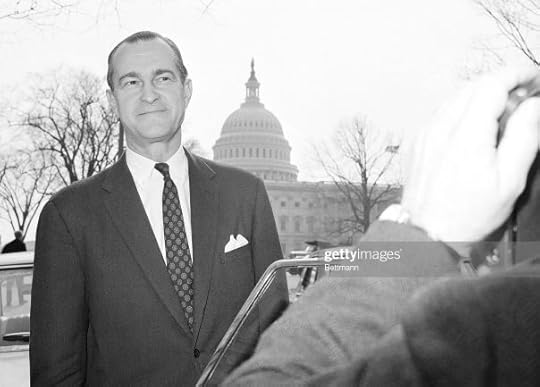
John F. Kennedy did not fully support the failed CIA-led invasion of Cuba at The Bay of Pigs, and vowed to disband the intelligence agency after the debacle:
Following JFK's shooting death on Nov. 22, 1963, his brother Robert Kennedy was poised to win the 1968 Democratic Party nomination for president of the United States; competing against Eugene McCarthy. Nolan asserts that the second Kennedy brother posed the same existential threat to the CIA and the war in Vietnam as his brother did, and needed to be eliminated as well.
Nolan lays out a brief summary of the assassinations of the Kennedy brothers early on, as well as a conclusion. These are expanded upon in later pages. I've covered them with spoilers for the sake of this review's brevity:
Robert Kennedy:
John F. Kennedy:
Nolan mentions the book: The Search for the Manchurian Candidate: The CIA & Mind Control. I've read that book, and the writing there nicely dovetails with the writing and thesis laid out here.
Some more of what is presented here by Nolan includes:
• Richard Helms, The Strategist
• The CIA's attempt at mind control. Project BLUEBIRD, Project ARTICHOKE, and Project MKUltra.
• James Angleton, The Tactician.
• Assassinations Past
• Lee Harvey Oswald, an Unwitting Patsy
• November 22, 1963, the Assassination of President John F. Kennedy
• Sirhan Bishara Sirhan, an Involuntary Pawn
• The Assassination of Martin Luther King, Jr.
• The June 5, 1968, Assassination of Sen. Robert F. Kennedy
I did have a few criticisms here. Firstly, from the writing laid out in the aforementioned book The Search for the Manchurian Candidate, Project MKULTRA ultimately failed. Despite destroying the psyches of many dozens (if not hundreds) of people, agency efforts to create a programmed assassin did not bear fruit. Despite throwing everything they could at the problem of mind control, including powerful psychoactive drugs, electroshock therapy, sensory deprivation, and other psychological means; the human spirit provided to be too big of an obstacle to overcome. The subjects were either too unpredictable or turned into catatonic drugged-out zombies.
The author does affirm the above here, but asserts the case that Oswald and Sirhan were set up by the agency to be "patsies," or "fall guys."
Secondly; much of the proof for the case laid out here hinges on a bit of ballistic technology called "neutron activation." The author says that this "proves" his case. Unfortunately, the technology and its specific findings in relation to these cases are not thoroughly explored in these pages; and are only given a cursory summary.
Finally; Nolan also tries to remotely and posthumously diagnose former CIA director Richard Helms with sociopathy in chapter 2. That's not how that works... As per the Goldwater rule; a proper psychological diagnosis can only be made by a doctor after an in-person consensual assessment.
***********************
I'm not a forensic historian, so I'm not sure what to make of the veracity of the thesis presented here... However, the case was laid out well by the author, and the book is also very heavily notated; with some ~1,500 footnotes.
It was also an interesting read; all around. However, it was a pretty long book; the audio version I have clocks in at over 14 hours. I think a decent chunk could have been edited out with no overall loss to the final presentation.
3.5 stars.
Was the CIA behind two of the most infamous political assassinations in American History? CIA Rogues and the Killing of the Kennedys attempts to make the case that they were. The author lays out a very detailed and interesting examination here.
Author Patrick Nolan is a forensic historian that has dedicated his life to uncovering truths surrounding the JFK, MLK, and RFK assassinations of the 1960s.
Patrick Nolan:
I wasn't sure what to expect from this one going in... The preface mentions that the book is a revisionist work.
Fortunately, the author has a good writing style, that I found to be both engaging and effective. Well, the first ~half, anyhow. I felt the last half was a bit slower than the first...
As its title implies, the book takes a deep look into the machinations of the CIA, and its role in the assassinations of the Kennedy brothers:
"Another legend in the nation’s capital depicts Watergate as the greatest political scandal in modern US history. Yet the break-in and its related sundry political crimes pale in comparison to the ’60s assassinations. If one takes the time to dig beyond the falsehoods of crazed lone gunmen and magic bullets, it becomes evident that the facts surrounding the murders of President John F. Kennedy and his brother New York senator Robert F. Kennedy reveal a much greater scandal, one that begs to be explored in depth..."
Nolan writes of the methodology and source material here:
"This work involves the use of the mosaic theory of intelligence gathering in which pieces of information are combined with other pieces to produce a composite. By connecting the dots, information that has been hidden from the general public for decades can emerge with force, clarity, and meaning.
Some key connections and conclusions herein have never before been published. They represent new knowledge stemming from an analysis of the available forensic evidence and an assessment of the work of several intrepid historians whose books are cited throughout. By following up their persistent investigative efforts and carefully fitting together the many pieces of the puzzle, we have arrived at a better understanding of modern American history..."
Central to the base case here is the leadership of America's premier intelligence agency by Richard Helms, who served as Director of Central Intelligence (DCI) from 1966 to 1973. The author makes the case that Helms was virulently anti-Communist, and strongly disagreed with any efforts to make peace with any country that entertained this threatening ideology. The Kennedy brothers were Democrats and opposed hawkish military action in Communist countries. Both brothers also held antiwar sentiments towards Vietnam that upset the agency brass; Nolan asserts.
The book alleges that Helms began a clandestine program of foreign political meddling, including political assassinations. Nolan writes fairly extensively on the CIA's covert involvement in many countries, including Iran, Guatemala, Indonesia, the Congo, Cuba, Dominican Republic, Iraq, and Vietnam. The author also briefly covers the assassinations of many foreign politicians; and points the finger at Helms as the man who signed off on these killings.
Richard Helms:
John F. Kennedy did not fully support the failed CIA-led invasion of Cuba at The Bay of Pigs, and vowed to disband the intelligence agency after the debacle:
"Within weeks of President John F. Kennedy’s inauguration, a CIA-trained army of twelve hundred exiled anti-Castro paramilitary forces attempted to retake the island of Cuba. In the ensuing debacle at the Bay of Pigs on April 17, 1961, the invaders were overwhelmed and soundly defeated by Castro loyalists. President Kennedy had found out about the CIA’s plan to invade Cuba shortly after coming into office in January 1961. Relying on the judgment of the elite in the US intelligence community, he had allowed the ill-conceived plan to move forward. Afterwards, the intelligence planners in charge of the invasion blamed Kennedy for not providing more support, particularly from the air. However, as General Maxwell Taylor has pointed out, even a US air strike would not have affected the outcome, mainly because Cuban antiaircraft batteries were so strong.71 In addition, Kennedy knew an aerial attack clearly would have created even more political problems both at home and abroad. The president felt that he had been grossly misled. As he struggled to negotiate freedom for the prisoners of war, he vowed to break the CIA “into a thousand pieces and scatter (it) to the winds...”
Following JFK's shooting death on Nov. 22, 1963, his brother Robert Kennedy was poised to win the 1968 Democratic Party nomination for president of the United States; competing against Eugene McCarthy. Nolan asserts that the second Kennedy brother posed the same existential threat to the CIA and the war in Vietnam as his brother did, and needed to be eliminated as well.
Nolan lays out a brief summary of the assassinations of the Kennedy brothers early on, as well as a conclusion. These are expanded upon in later pages. I've covered them with spoilers for the sake of this review's brevity:
Robert Kennedy:
John F. Kennedy:
Nolan mentions the book: The Search for the Manchurian Candidate: The CIA & Mind Control. I've read that book, and the writing there nicely dovetails with the writing and thesis laid out here.
Some more of what is presented here by Nolan includes:
• Richard Helms, The Strategist
• The CIA's attempt at mind control. Project BLUEBIRD, Project ARTICHOKE, and Project MKUltra.
• James Angleton, The Tactician.
• Assassinations Past
• Lee Harvey Oswald, an Unwitting Patsy
• November 22, 1963, the Assassination of President John F. Kennedy
• Sirhan Bishara Sirhan, an Involuntary Pawn
• The Assassination of Martin Luther King, Jr.
• The June 5, 1968, Assassination of Sen. Robert F. Kennedy
I did have a few criticisms here. Firstly, from the writing laid out in the aforementioned book The Search for the Manchurian Candidate, Project MKULTRA ultimately failed. Despite destroying the psyches of many dozens (if not hundreds) of people, agency efforts to create a programmed assassin did not bear fruit. Despite throwing everything they could at the problem of mind control, including powerful psychoactive drugs, electroshock therapy, sensory deprivation, and other psychological means; the human spirit provided to be too big of an obstacle to overcome. The subjects were either too unpredictable or turned into catatonic drugged-out zombies.
The author does affirm the above here, but asserts the case that Oswald and Sirhan were set up by the agency to be "patsies," or "fall guys."
Secondly; much of the proof for the case laid out here hinges on a bit of ballistic technology called "neutron activation." The author says that this "proves" his case. Unfortunately, the technology and its specific findings in relation to these cases are not thoroughly explored in these pages; and are only given a cursory summary.
Finally; Nolan also tries to remotely and posthumously diagnose former CIA director Richard Helms with sociopathy in chapter 2. That's not how that works... As per the Goldwater rule; a proper psychological diagnosis can only be made by a doctor after an in-person consensual assessment.
***********************
I'm not a forensic historian, so I'm not sure what to make of the veracity of the thesis presented here... However, the case was laid out well by the author, and the book is also very heavily notated; with some ~1,500 footnotes.
It was also an interesting read; all around. However, it was a pretty long book; the audio version I have clocks in at over 14 hours. I think a decent chunk could have been edited out with no overall loss to the final presentation.
3.5 stars.

November 14, 2023
Format Read: Ebook free with audible
Review: This was an interesting listen, especially for a free one. Lots of fun info on the CIA and the Kennedy assassination.
Recommended For: Those interested in true crime.

December 28, 2020
Interesting theory
August 29, 2021
Yet another key addition to the overwhelming evidence that the Dulles led CIA crew of Helms, Cord Meyer, Wm. Harvey, James Jesus Angleton, E. Howard Hunt, and a bevy of Cubans bent on killing Castro were complicit and instrumental in the assassination that effectively ended our last best chance at democracy over the Military Industrial Complex led by the Corporate Imperialist Agency CIA that has established the Hegemony over Detent US financial imperialism over reason and cooperation war over peace rule of the US over the world since 1964 From IRAN to Guatemala to Chile and here at home with JFK the DULLES SHADOW GOVT has run the foreign p0licy of the US to our great detriment.
JFK ASSASSINATION – CIA CONNECTIONS
Bay of Pigs, Operation Mongoose, Operation 40, Alpha 66
1) ALLEN DULLES
2) DAVID ATLEE PHILLIPS
3) CORD MEYER
4) RICHARD HELMS
5) JAMES JESUS ANGLETON
6) E. HOWARD HUNT
7) James Barker
8) George de Mohrenschildt
9) Ruth and Michael Paine
10) MORALES,
JFK ASSASSINATION – CIA CONNECTIONS
Bay of Pigs, Operation Mongoose, Operation 40, Alpha 66
1) ALLEN DULLES
2) DAVID ATLEE PHILLIPS
3) CORD MEYER
4) RICHARD HELMS
5) JAMES JESUS ANGLETON
6) E. HOWARD HUNT
7) James Barker
8) George de Mohrenschildt
9) Ruth and Michael Paine
10) MORALES,

January 29, 2024
I recently delved into Patrick Nolan's "CIA Rogues and the Killing of the Kennedys," and it proved to be a gripping exploration of conspiracy theories surrounding the assassinations of John F. Kennedy (JFK) and Robert F. Kennedy (RFK). Nolan's thorough research and engaging narrative style make this book a compelling read, earning it a solid 4 out of 5 stars.
What stands out most in Nolan's work is his ability to navigate through complex theories with ease, presenting a comprehensive overview of the speculations surrounding the tragic deaths of the Kennedy brothers. Even for someone not deeply immersed in conspiracy theories, Nolan's storytelling keeps the reader hooked, making the book accessible and intriguing.
Nolan's commitment to research is evident throughout the book. He meticulously cites numerous sources and interviews, building a persuasive case for the conspiracy theories he explores. The extensive bibliography adds credibility to his work, showcasing the depth of his investigation and reinforcing the book's value as a resource for those interested in alternative perspectives on historical events.
The book offers a fresh look at well-known historical events, challenging readers to question the official narratives. Nolan's exploration of controversial ideas encourages critical thinking and a more discerning approach to accepted historical truths. The narrative, while speculative at times, serves as a thought-provoking examination of the shadowy corners of history.
However, it's important to note that the book leans heavily towards presenting conspiracy theories, which might not appeal to those seeking a more traditional historical account. Some readers may find the speculative nature of the content unsettling, as Nolan ventures into territory that challenges widely accepted historical truths.
In conclusion, "CIA Rogues and the Killing of the Kennedys" is a captivating journey into the world of conspiracy theories. Patrick Nolan's dedication to thorough research and compelling storytelling makes this book a valuable addition to the shelves of those interested in alternative perspectives on the assassinations of JFK and RFK.
What stands out most in Nolan's work is his ability to navigate through complex theories with ease, presenting a comprehensive overview of the speculations surrounding the tragic deaths of the Kennedy brothers. Even for someone not deeply immersed in conspiracy theories, Nolan's storytelling keeps the reader hooked, making the book accessible and intriguing.
Nolan's commitment to research is evident throughout the book. He meticulously cites numerous sources and interviews, building a persuasive case for the conspiracy theories he explores. The extensive bibliography adds credibility to his work, showcasing the depth of his investigation and reinforcing the book's value as a resource for those interested in alternative perspectives on historical events.
The book offers a fresh look at well-known historical events, challenging readers to question the official narratives. Nolan's exploration of controversial ideas encourages critical thinking and a more discerning approach to accepted historical truths. The narrative, while speculative at times, serves as a thought-provoking examination of the shadowy corners of history.
However, it's important to note that the book leans heavily towards presenting conspiracy theories, which might not appeal to those seeking a more traditional historical account. Some readers may find the speculative nature of the content unsettling, as Nolan ventures into territory that challenges widely accepted historical truths.
In conclusion, "CIA Rogues and the Killing of the Kennedys" is a captivating journey into the world of conspiracy theories. Patrick Nolan's dedication to thorough research and compelling storytelling makes this book a valuable addition to the shelves of those interested in alternative perspectives on the assassinations of JFK and RFK.
September 30, 2021
Well this has convinced me through well presented evidence that the JFK and RFK assassinations were part of a conspiracy most likely headed by the CIA through the use of MK Ultra. And the innocence of Lee Harvey Oswald and Sirhan Sirhan must be noted in history.

June 22, 2026
If ur ever like huh that seems suspicious I wonder what is happening there ITS THE CIA ITS ALWAYS THE CIA ITS BEEN THE CIA IT WILL CONTINUE TO BE THE CIA!!

June 25, 2026
While many of the theories sound plausible, the actual support for it was very, very weak. I had too many questions that went unanswered. Great to fan the flames for some conspiracy theorists but not a solid foundation to convince me.
October 29, 2025
This read like a very well-researched and detailed offering of some abstract theories that have the potential to be true. Fact or fiction, this was definitely an interesting read.

December 27, 2021
Take the rating with a grain of salt. A long very detailed theory of the assassinations of JFK, RFK and MLK is presented with a lot of meticulously annotated research. But it is mostly speculative. It emphasizes flaws in the official explanation. Witnesses put Oswald in a break room on the first floor moment before JFK was killed and other witnesses put him on the second floor moments after the shooting. Not that he couldn't have sprinted up 5 flights of stairs, grabbed the rifle he had stashed earlier, got off three shots, ditched the rifle, sprinted down 4 flights of stairs, got a soda from the machine and positioned himself in a chair where he could be seen casually sipping his soda. But it is an unlikely scenario.
Sirhan was facing RFK and fired from about 6 feet away. The bullet that killed Kennedy struck him in the back of the head. The gun was close enough to leave powder burns around the wound. Sirhan could not have fired that shot.
Oswald's ties to the CIA don't show up in The Warren Report. The have been doled out piecemeal over the years (some relevant CIA documents were just recently released.) But was he a secret agent spying on Russia during the time he spent over there after his public defection and renunciation of his citizenship? Not all that hard to believe. If he wasn't, how was he able to come back to the US with his Russian bride and pick up life without missing a beat?
Speculation. Tantalizing speculation.
Was Oswald a covert CIA agent infiltrating the Cuban underground during his time in New Orleans?
Something funny was going on. But who knows?
Were Oswald and Officer Tippet friends who met at the strip club run by Jack Ruby?
Three months of Sirhan B. Sirhan's life are lost in darkness. Is that when he was subjected to CIA mind control indoctrination? Can you prove something else was going on?
This book is an exercise in making a case from circumstantial evidence.
You can be the jury. if you choose to read this book.
Sirhan was facing RFK and fired from about 6 feet away. The bullet that killed Kennedy struck him in the back of the head. The gun was close enough to leave powder burns around the wound. Sirhan could not have fired that shot.
Oswald's ties to the CIA don't show up in The Warren Report. The have been doled out piecemeal over the years (some relevant CIA documents were just recently released.) But was he a secret agent spying on Russia during the time he spent over there after his public defection and renunciation of his citizenship? Not all that hard to believe. If he wasn't, how was he able to come back to the US with his Russian bride and pick up life without missing a beat?
Speculation. Tantalizing speculation.
Was Oswald a covert CIA agent infiltrating the Cuban underground during his time in New Orleans?
Something funny was going on. But who knows?
Were Oswald and Officer Tippet friends who met at the strip club run by Jack Ruby?
Three months of Sirhan B. Sirhan's life are lost in darkness. Is that when he was subjected to CIA mind control indoctrination? Can you prove something else was going on?
This book is an exercise in making a case from circumstantial evidence.
You can be the jury. if you choose to read this book.
September 14, 2020
I've read a number of books on this topic and some have been interesting and close to believable while others have been obvious trash from the first page. This book is neither. It IS interesting, possibly among the more interesting ones I've read concerning this topic. Yet -- this is embarrassing to admit, but I can't adequately define or articulate what I'm about to write -- somehow this book didn't seem quite as compelling, quite as convincing and ultimately I felt left less convinced by this thesis and "evidence" than I have by quite a few competitors. It's not a bad book. It's just trying to compete in a saturated field and it's easy to get swallowed up unless you truly stand out as unique or something similar. To major conspiracy buffs, I guess this should be added to your library. For newbies seeking a little conspiracy theory action, I'd honestly go with a couple of others rather than this one.

October 6, 2023
With a little more time on my hands, and being a person of a certain age, I am reading a bit more these past few years again into three of the most disturbing murders in US history. And there are dozens of books now linking the CIA and the Mob to killing the Kennedys, JFK and his brother Robert, but these ideas were present from the very first, and have persisted not just because of conspiracy theorists and left-wing nutcases. These theories have increasingly been corroborated by forensic evidence, some of it just done better than in previous decades, some of it generally ignored by a confluence of alt-right law enforcement, CIA, mobsters and politicians. You don’t like Putin throwing people who disagree with him out of windows, or blowing them up on planes? You embrace American exceptionalism? Well, you may not want to read this book, as it will upset your sense of American perfection. We have had our own share of thuggery. And we need to know a thug when we see one, and put them in jail when we can, if we love this country.
"We have to hate this country if we are ever going to love it again"--Frioedrich Reck, in Diary of a Man in Despair, about Nazi Germany, 1936-1944
Nolan, a forensic historian (?) is not that engaging as a writer, and he and the reader reminded me of Jack Webb’s Joe Friday on Dragnet: “Just the facts, ma’am.” But I can see why they wrote and read this way; the theory they propose (and document) is going to seem preposterous to the average reader. They need a straightforward approach to counter the sensational claims of their story.
In short, I like it a lot. It connects the dots between the murders of JFK, RFK, and (more briefly) MLK, naming the names of alt-right CIA rogues who felt these three liberals undermined their anti-communist program in Viet Nam, men who advocated equality and civil rights and needed to be assassinated for their political positions. And murdered witnesses. And created elaborate cover-ups. None of what Nolan has to say here is surprising to lefties such as me who lived through those events.
I never bought the Warren Report white-washing., and I read it when it first came out.
And this is even something the right and left today seem to generally agree on: Polls reveal that a vast majority of Americans--both Republicans and Democrats--do not believe Lee Harvey Oswald was the lone gunman in the murder of JFK. In the aftermath of the killing, more than fifty-percent of witnesses in Dallas said shots were fired from the grassy knoll. Witnesses have him in the lunchroom of the Book Depository at the time of the killing. He was a terrible marksman, verified by military records, and so on. The single bullet theory is nonsense, and scores of witnesses were ignored by the Warren Report.
But when that report came out, many people seemed to calm down and agree that Oswald--supposedly a crazy Commie loner--killed JFK. But subsequent studies over time have eroded confidence. Nolan’s book came out in 2013 and makes a persuasive case that CIA “rogues,” operating covertly for decades in the fifties and sixties, working from an alt-right anti-Communist position, and possibly unhinged in various ways, assassinated people in foreign countries seen as antithetical to the US anti-Communist project, and then killed people seen as “soft” on Communism, involved (through a CIA initiative called MK/Ultra, in various drug trials, using mind control, hypnotism-induced amnesia, the creation of fake diaries, antimidating/killing witnesses, and so on.
Nolan names two principal guys--former CIA Director Richard Helms and his henchman James Angleton, but he names many others, too. Covert ops, black ops. Working with the mob. The implication is that all the bad actors of the CIA operated in the fifties and sixties, but with the continuation of alt-right ideology, are the Bad Old Days ever far away?
I had spend less time over the years on RFK’s killing than I did on JFK, but Nolan makes a persuasive case that mind-altering drugs were used on both Oswald and Sirhan (and even James Earl Ray), making them all into patsies, fall guys, depicted as crazed lone gunmen. JFK and RFK come off in this book looking more admirable to me than I have felt about them for years. Three days before he was killed in 1963 JFK wrote an executive order bringing back troops from Vietnam, upset at our assassination (without his being told about it initially) of President Diem, advocating diplomatic solutions, something the CIA at the time violently disagreed with. Four days after the death of JFK, Lyndon Johnson reversed that order and doubled down, quadrupling the number of troops to be sent to Vietnam.
RFK was the leading candidate to be President of the US in 1968. Sirhan Sirhan had a gun in his hand, facing him, but RFK was shot in the back of his head, and so on. There's less here on MLK, but it is clear these three much admired and loved leaders were murdered by the CIA, using MK/Ultra strategies, as Nolan reveals.
As i said, none of it surprised me, but I “like” the work very much, as despondent as it sometimes made me. Sure, some if it is informed speculation, as in the making of any case, but it has tons of footnotes, and plenty of sources; if you have doubts, read it yourself, or any one of dozens of books written in recent years that make a similar case. I think this is a good one.
PS: A book with a related theme: Diary of a Man in Despair, by Friedrich Reck, a journal of lowlights of the rise of the Nazi regime, 1936-1944. Mad sociopathic thugs. You don't like that comparison? Read this book and tell me it is fake news.
"We have to hate this country if we are ever going to love it again"--Frioedrich Reck, in Diary of a Man in Despair, about Nazi Germany, 1936-1944
Nolan, a forensic historian (?) is not that engaging as a writer, and he and the reader reminded me of Jack Webb’s Joe Friday on Dragnet: “Just the facts, ma’am.” But I can see why they wrote and read this way; the theory they propose (and document) is going to seem preposterous to the average reader. They need a straightforward approach to counter the sensational claims of their story.
In short, I like it a lot. It connects the dots between the murders of JFK, RFK, and (more briefly) MLK, naming the names of alt-right CIA rogues who felt these three liberals undermined their anti-communist program in Viet Nam, men who advocated equality and civil rights and needed to be assassinated for their political positions. And murdered witnesses. And created elaborate cover-ups. None of what Nolan has to say here is surprising to lefties such as me who lived through those events.
I never bought the Warren Report white-washing., and I read it when it first came out.
And this is even something the right and left today seem to generally agree on: Polls reveal that a vast majority of Americans--both Republicans and Democrats--do not believe Lee Harvey Oswald was the lone gunman in the murder of JFK. In the aftermath of the killing, more than fifty-percent of witnesses in Dallas said shots were fired from the grassy knoll. Witnesses have him in the lunchroom of the Book Depository at the time of the killing. He was a terrible marksman, verified by military records, and so on. The single bullet theory is nonsense, and scores of witnesses were ignored by the Warren Report.
But when that report came out, many people seemed to calm down and agree that Oswald--supposedly a crazy Commie loner--killed JFK. But subsequent studies over time have eroded confidence. Nolan’s book came out in 2013 and makes a persuasive case that CIA “rogues,” operating covertly for decades in the fifties and sixties, working from an alt-right anti-Communist position, and possibly unhinged in various ways, assassinated people in foreign countries seen as antithetical to the US anti-Communist project, and then killed people seen as “soft” on Communism, involved (through a CIA initiative called MK/Ultra, in various drug trials, using mind control, hypnotism-induced amnesia, the creation of fake diaries, antimidating/killing witnesses, and so on.
Nolan names two principal guys--former CIA Director Richard Helms and his henchman James Angleton, but he names many others, too. Covert ops, black ops. Working with the mob. The implication is that all the bad actors of the CIA operated in the fifties and sixties, but with the continuation of alt-right ideology, are the Bad Old Days ever far away?
I had spend less time over the years on RFK’s killing than I did on JFK, but Nolan makes a persuasive case that mind-altering drugs were used on both Oswald and Sirhan (and even James Earl Ray), making them all into patsies, fall guys, depicted as crazed lone gunmen. JFK and RFK come off in this book looking more admirable to me than I have felt about them for years. Three days before he was killed in 1963 JFK wrote an executive order bringing back troops from Vietnam, upset at our assassination (without his being told about it initially) of President Diem, advocating diplomatic solutions, something the CIA at the time violently disagreed with. Four days after the death of JFK, Lyndon Johnson reversed that order and doubled down, quadrupling the number of troops to be sent to Vietnam.
RFK was the leading candidate to be President of the US in 1968. Sirhan Sirhan had a gun in his hand, facing him, but RFK was shot in the back of his head, and so on. There's less here on MLK, but it is clear these three much admired and loved leaders were murdered by the CIA, using MK/Ultra strategies, as Nolan reveals.
As i said, none of it surprised me, but I “like” the work very much, as despondent as it sometimes made me. Sure, some if it is informed speculation, as in the making of any case, but it has tons of footnotes, and plenty of sources; if you have doubts, read it yourself, or any one of dozens of books written in recent years that make a similar case. I think this is a good one.
PS: A book with a related theme: Diary of a Man in Despair, by Friedrich Reck, a journal of lowlights of the rise of the Nazi regime, 1936-1944. Mad sociopathic thugs. You don't like that comparison? Read this book and tell me it is fake news.

March 11, 2014
This is the third Kennedy assassination book I've read. As I've stated before, either this author is on to something or totally out to lunch.
This particular book deals with the cia hypnotizing people to carry out actions except that Oswald and Sirhan didn't do it.
The author makes a compelling argument and the numerous sources is exhaustive.
Definitely worth a look.
This particular book deals with the cia hypnotizing people to carry out actions except that Oswald and Sirhan didn't do it.
The author makes a compelling argument and the numerous sources is exhaustive.
Definitely worth a look.
November 18, 2013
Parts of the book were intriguing. Other part, however, seemed pure speculation without strong supporting evidence.

February 19, 2024
Robert F. Kennedy’s assassination in 1968 saw many people crowded in a small area at Los Angeles’s famed Ambassador Hotel that fateful night and saw Sirhan Sirhan pull the trigger of a gun. Sirhan was convicted of the crime and still languishes in jail with a life sentence. However, conspiracy theorists have jumped on inconsistencies in the eyewitness testimony and forensic evidence to suggest that Sirhan was not the only shooter (indeed, may have fired blanks) in a larger conspiracy, a "patsy" for the real killers and even a hypnotized assassin who did not know what he was doing (a popular plot in Cold War–era fiction, such as The Manchurian Candidate). Nolan sees him as a hypnotized distraction and fall guy for two shooters: one at close contact leaving powder burns with the lethal shots and one firing wildly in the ceiling to cause fear and confusion. Nolan brings in such colorful characters as Tom Rathke. Rathke is the guy who interested Sirhan in the Rosicrucians. Then there is Tom Rathke. Rathke is a character who, I believe, no one has done enough work on, including O'Sullivan. Then there is William Bryan who started his career as a military psychiatrist and was involved in research for the CIA, including Project ARTICHOKE and its successor, Project MKUltra (popularly known as the CIA's mind control program), a research project into behavioral engineering of humans. As part of his work for the CIA, he developed techniques of what he called "hypno-conditioning."
Nolan presents the case that Bryan and sociopathic CIA leaders Richard Helms and James Angleton took Sirhan and Lee Harvey Oswald out of circulation for a few months each, and put them back in to be on the scene of CIA-orchestrated assassinations to fire wildly, even ineffectually, and be amnesia fall guys to be picked up by the cops and take the blame thus shielding the actual shooters. Nolan implies the MLK assassination and Wallace's attempted killing may have been similarly constructed.
I have two problems with the argument.
1) Is the premise possible?
2) Are the facts presented sufficiently indisputable?
First, I am not convinced such a "long con" of post-hypnosis is possible. That is, programming a person to perform so many actions as being at a certain place, holding (apparently) contradictory beliefs (Sirhan was a non-Islamist Christian, Oswald, anti-Communist), and operating a firearm at a specified time and place. Is all this possible? Maybe part of the argument is the two are especially susceptible and this appears to be a case made from psychological analysis of Sirhan.
When I take the time to research some of Nolan's facts as stated, I am left in doubt. For instance, the video of the Texas School Book Depository 6th floor window from the 8mm color home movie filmed by Robert Hughes. It shows the motorcade travelling through Dealey Plaza before shots were fired. There seems to be a moving shape in the windows of the Book Depository on the Sixth Floor, but what it is exactly is hard to determine. Not hard to determine for Nolan who just states it shows two people, period.
Nolan presents the case that Bryan and sociopathic CIA leaders Richard Helms and James Angleton took Sirhan and Lee Harvey Oswald out of circulation for a few months each, and put them back in to be on the scene of CIA-orchestrated assassinations to fire wildly, even ineffectually, and be amnesia fall guys to be picked up by the cops and take the blame thus shielding the actual shooters. Nolan implies the MLK assassination and Wallace's attempted killing may have been similarly constructed.
I have two problems with the argument.
1) Is the premise possible?
2) Are the facts presented sufficiently indisputable?
First, I am not convinced such a "long con" of post-hypnosis is possible. That is, programming a person to perform so many actions as being at a certain place, holding (apparently) contradictory beliefs (Sirhan was a non-Islamist Christian, Oswald, anti-Communist), and operating a firearm at a specified time and place. Is all this possible? Maybe part of the argument is the two are especially susceptible and this appears to be a case made from psychological analysis of Sirhan.
When I take the time to research some of Nolan's facts as stated, I am left in doubt. For instance, the video of the Texas School Book Depository 6th floor window from the 8mm color home movie filmed by Robert Hughes. It shows the motorcade travelling through Dealey Plaza before shots were fired. There seems to be a moving shape in the windows of the Book Depository on the Sixth Floor, but what it is exactly is hard to determine. Not hard to determine for Nolan who just states it shows two people, period.
August 1, 2024
First, the bad: he speaks a decent amount in conclusions that seem possible but that, unfortunately, we’ll just never know. This is especially true of all the claims that the Kennedy shooters were patsies that were psychologically duped into being in the wrong place at the wrong time. I tend to believe he’s right about these claims, but I would prefer that he be more clear when he’s theorizing as opposed to stating facts.
That said, this book is packed with very suspicious information if your take is that the Kennedys were shot by lone crazies. I won’t give away much, but we all know the mysterious findings of Warren Commission, which apparently concluded that a single bullet could turn midair and do damage in the opposite direction. It seems obvious that they wanted to avoid any hint of a conspiracy, and the same is true of RFK, though his case is less well known. The behavior of investigators — including that TO THIS DAY a lot of this information is still under wraps or has been destroyed — makes zero sense if the idea was finding out the truth.
To be honest, it makes me sad to think of what happens behind closed doors, and what we’ll never know. In fact I picked up the book after seeing the media so uniformly dismissive when Trump got shot at, which happened right after they uniformly were SHOCKED to see Biden is a walking corpse (even though we all knew that for years), which was then followed by their uniform falling in love with the obviously amazing Kamala (who previously was uniformly seen as a terrible candidate w/ no chance). We’re definitely being lied to and led to whatever someone who?) wants us to see.
And I’m not very heartened by what I see on social media — most arguments are half baked at best. I see smart people on the left just lie and mislead, and I see it on the right, too, in various ways — taking quotes out of context or exaggerating. Most people don’t bother checking sources or following up, meaning there is a huge mass of angry people just following blue or red liars, depending on your basic beliefs.
So where does that lead? I have a hard time being hopeful, but I guess at least there are people like Nolan trying to clarify the truth FWIW. I’ll end w/ this pretty amazing Thomas Jefferson quote from the last chapter: if a nation expects to be ignorant and free, it expects what never was and never will be.
Uh, yes, and wow. Agreed.
That said, this book is packed with very suspicious information if your take is that the Kennedys were shot by lone crazies. I won’t give away much, but we all know the mysterious findings of Warren Commission, which apparently concluded that a single bullet could turn midair and do damage in the opposite direction. It seems obvious that they wanted to avoid any hint of a conspiracy, and the same is true of RFK, though his case is less well known. The behavior of investigators — including that TO THIS DAY a lot of this information is still under wraps or has been destroyed — makes zero sense if the idea was finding out the truth.
To be honest, it makes me sad to think of what happens behind closed doors, and what we’ll never know. In fact I picked up the book after seeing the media so uniformly dismissive when Trump got shot at, which happened right after they uniformly were SHOCKED to see Biden is a walking corpse (even though we all knew that for years), which was then followed by their uniform falling in love with the obviously amazing Kamala (who previously was uniformly seen as a terrible candidate w/ no chance). We’re definitely being lied to and led to whatever someone who?) wants us to see.
And I’m not very heartened by what I see on social media — most arguments are half baked at best. I see smart people on the left just lie and mislead, and I see it on the right, too, in various ways — taking quotes out of context or exaggerating. Most people don’t bother checking sources or following up, meaning there is a huge mass of angry people just following blue or red liars, depending on your basic beliefs.
So where does that lead? I have a hard time being hopeful, but I guess at least there are people like Nolan trying to clarify the truth FWIW. I’ll end w/ this pretty amazing Thomas Jefferson quote from the last chapter: if a nation expects to be ignorant and free, it expects what never was and never will be.
Uh, yes, and wow. Agreed.
February 1, 2020
Excellent book. I've occasionally read books on the assassinations of the 60's, especially the Kennedy brothers, but Nolan explored aspects of these 2 murders that I'd never heard of before. He showed how a tragic and violent event can happen, witnessed in front of millions, and through clever manipulation everyone ends up with a manufactured version in their heads that's accepted without question by the masses. For the longest time, I took at face value that of course Sirhan was the sole killer of RFK, because he was the one with the gun firing away wildly in the pantry at the Ambassador Hotel. That was the official bandwagon version that the media jumped on and then ran with. It's too bad that at the time "The Press" didn't stop and say "Hold it!! Some of these facts don't fit, or make sense or are missing some important explanations." It's like the "Hot Coffee" lady that was ridiculed in the early 2000's for spilling a hot cup of McDonald's coffee on herself and then suing for damages. She was the butt of jokes from late night TV all the way to 'W' during his State of the Union Message to Congress. But if you want to know the truth and see how hundreds of millions of us were manipulated in plain view, then try watching the documentary "Hot Coffee" and try not to get too pissed off. Or, you can try to find some old issues of Newsweek or Time from the early 70's. Read some of the 'real time' explanations for Watergate, while you ask yourself "Were people really that effin' stupid to believe the fantasies being spun by Nixon and his merry band of criminals?! Reading Patrick Nolan's book, I was flabbergasted by how much readily available information was withheld or shielded from the public, so like sheep, we would follow the government line on these assassinations. And I was angered by how our future was stolen from us.

August 31, 2022
7/10
I love me a good conspiracy. I wouldn’t call myself a conspiracy theorist, but I am definitely open to questioning things when the facts don’t support the explanation.
It’s why Graham Hancock is one of my favorite authors. His explanation of ancient structures that he does with such meticulous detail is entirely believable. One minute the Great Pyramids are neat objects built by slaves, the next moment you are fully convinced they were built by aliens.
But I digress, this book is about the killings of JFK and Robert Kennedy.
SPOILER TIME
More importantly, it’s about how the CIA got involved in conspiracies. It all comes down to this guy Robert Healms who was the head of the cia.
At the time the COA had connections with the mafia. Also at the time the CIA was doing the MK ultra experiments. These included drugs (lsd) and hypnosis.
The premise of this book is that each of the people that killed the kennedys (Lee Harvey Oswald and Sirhan Sirhan) were both innocent and being hypnotised.
The truth is, I can believe that with Sirhan, but I don’t think it was necessary with Lee Harvey. It also wasn’t necessary with the man who was convicted of MLKs murder.
There are definite similarities between all three. Things like:
- the guns from the supposed killers didn’t ever match the bullets that killed the victims
- the kill shots didn’t ever come from where the supposed killers were standing.
- there were deep cia and mafia connections with people involved
- lots of testimony and evidence got buried
The lawyer who orosecuted MLKs killer ended up switching sides later and defending him plus he defended Sirhan.
I’m not sure if we will ever learn the truth about these two, but I, for one, am not buying the official story.
If you like conspiracy stories, this is definitely worth it. I loved every minute.
I love me a good conspiracy. I wouldn’t call myself a conspiracy theorist, but I am definitely open to questioning things when the facts don’t support the explanation.
It’s why Graham Hancock is one of my favorite authors. His explanation of ancient structures that he does with such meticulous detail is entirely believable. One minute the Great Pyramids are neat objects built by slaves, the next moment you are fully convinced they were built by aliens.
But I digress, this book is about the killings of JFK and Robert Kennedy.
SPOILER TIME
More importantly, it’s about how the CIA got involved in conspiracies. It all comes down to this guy Robert Healms who was the head of the cia.
At the time the COA had connections with the mafia. Also at the time the CIA was doing the MK ultra experiments. These included drugs (lsd) and hypnosis.
The premise of this book is that each of the people that killed the kennedys (Lee Harvey Oswald and Sirhan Sirhan) were both innocent and being hypnotised.
The truth is, I can believe that with Sirhan, but I don’t think it was necessary with Lee Harvey. It also wasn’t necessary with the man who was convicted of MLKs murder.
There are definite similarities between all three. Things like:
- the guns from the supposed killers didn’t ever match the bullets that killed the victims
- the kill shots didn’t ever come from where the supposed killers were standing.
- there were deep cia and mafia connections with people involved
- lots of testimony and evidence got buried
The lawyer who orosecuted MLKs killer ended up switching sides later and defending him plus he defended Sirhan.
I’m not sure if we will ever learn the truth about these two, but I, for one, am not buying the official story.
If you like conspiracy stories, this is definitely worth it. I loved every minute.
This entire review has been hidden because of spoilers.
April 23, 2024
…. I don’t know. The crazy thing about conspiracy theories is that it feels like the less actual evidence someone has, or the less evidence that can be verified legitimately makes people believe the conspiracy more! The majority of the book sounded a lot like conjecture and I am not easily convinced by conjecture. I am not saying the authors are wrong in their theory, I am saying they lacked convincing evidence.
Numerous times they said, “This is well documented” but failed to cite where. Numerous times they stated “People who have interviewed CIA operatives said the Operatives told them…” and then said whatever bolstered their point. Yet they never said who it was that interviewed the operatives. They didn’t cite any paperwork or audio of the interviews nor where you could get the transcript or audio of the interviews. They definitely didn’t say who the operatives were, and so they seem to just expect the reader to take them at their word. I don’t know that I can do that.
Also. I could go for days on the Manchurian Candidate idea just minus the mind control person actually being the killer. If the mind control was as good as they said it was then why use the mind control people as decoys. Just have them commit the crime. Also…. No I will just stop there. I really could go for days on that.
As for the writing, well, I have read better. If I had to read, “…as we shall see shortly…” one more time I think I might have gone crazy. Maybe that was the authors attempt at mind control. I don’t know.
I hate giving one star reviews but I disliked the book so much that it almost became my first “did not finish” in three years. I powered through but it wasn’t ever good. It was absurd almost from page 1 and all the way to the end. Maybe other conspiracy theorists would enjoy the book, but I am just not much of a conspiracy theorists.
Numerous times they said, “This is well documented” but failed to cite where. Numerous times they stated “People who have interviewed CIA operatives said the Operatives told them…” and then said whatever bolstered their point. Yet they never said who it was that interviewed the operatives. They didn’t cite any paperwork or audio of the interviews nor where you could get the transcript or audio of the interviews. They definitely didn’t say who the operatives were, and so they seem to just expect the reader to take them at their word. I don’t know that I can do that.
Also. I could go for days on the Manchurian Candidate idea just minus the mind control person actually being the killer. If the mind control was as good as they said it was then why use the mind control people as decoys. Just have them commit the crime. Also…. No I will just stop there. I really could go for days on that.
As for the writing, well, I have read better. If I had to read, “…as we shall see shortly…” one more time I think I might have gone crazy. Maybe that was the authors attempt at mind control. I don’t know.
I hate giving one star reviews but I disliked the book so much that it almost became my first “did not finish” in three years. I powered through but it wasn’t ever good. It was absurd almost from page 1 and all the way to the end. Maybe other conspiracy theorists would enjoy the book, but I am just not much of a conspiracy theorists.
March 20, 2025
(Audiobook)
Patrick Nolan’s highly researched book explores the CIA’s involvement in the assassinations of President John F. Kennedy and his brother Senator Robert F. Kennedy. Detailing the lives and movements of both Lee Harvey Oswald and Sirhan Bishara Sirhan, the author targets the CIA’s Richard Helms and many others, who he believes took part in the plots to kill the Kennedys, as well as the killing of Dr Martin Luther King Jnr.
Like many people of a certain age, I’ve long been fascinated by the numerous theories surrounding the conspiracies linked to the assassination of the Kennedys. Narrated by Stephen Bowlby, this is an intriguing book that delves into the CIA’s MK-Ultra program which used mind control and hypnosis to set up assassins who would then remember little of their own actions. Nolan explores the idea that Oswald and Sirhan were duped into behaving in ways that made them look guilty of murder when in fact they were merely pawns in a conspiracy to get rid of men whose political achievements went against the objectives of the CIA. Disappointingly, what the book does not reveal is who was at the top of the tree in terms of the CIA’s murderous machinations – it’s hard to believe that Helms himself was the sole individual responsible for coordinating the murders.
Entertaining and fascinating – a must for all Kennedy conspiracy fans.
Patrick Nolan’s highly researched book explores the CIA’s involvement in the assassinations of President John F. Kennedy and his brother Senator Robert F. Kennedy. Detailing the lives and movements of both Lee Harvey Oswald and Sirhan Bishara Sirhan, the author targets the CIA’s Richard Helms and many others, who he believes took part in the plots to kill the Kennedys, as well as the killing of Dr Martin Luther King Jnr.
Like many people of a certain age, I’ve long been fascinated by the numerous theories surrounding the conspiracies linked to the assassination of the Kennedys. Narrated by Stephen Bowlby, this is an intriguing book that delves into the CIA’s MK-Ultra program which used mind control and hypnosis to set up assassins who would then remember little of their own actions. Nolan explores the idea that Oswald and Sirhan were duped into behaving in ways that made them look guilty of murder when in fact they were merely pawns in a conspiracy to get rid of men whose political achievements went against the objectives of the CIA. Disappointingly, what the book does not reveal is who was at the top of the tree in terms of the CIA’s murderous machinations – it’s hard to believe that Helms himself was the sole individual responsible for coordinating the murders.
Entertaining and fascinating – a must for all Kennedy conspiracy fans.

January 3, 2023
I've finished listening to The Audiobook CIA Rogues And The Killing Of The Kennedys and I rate it 3.4 stars.
This is a very interesting audiobook, this rocks everything you thought you knew about the murders of John F Kennedy and Robert F Kennedy.
The reason I rated it low is not because I didn't enjoy it but because the whole thing sounded so far fetched so unbelievable to be true, but it makes you think. all the information that is presented did Lee Harvey Oswald kill JFK or was hypnotized into believing that he killed him on order to take the blame for the murder.
the same with Sirhan Sirhan was he also hypnotized to kill RFK. I admit that it could be the case as evidence kind of leads that way but if so why the big cover up and is the whole truth about theses two murders, did they just want an open and shut case, it's left me thinking about what really happened but I don't think we will ever know what the whole truth is but I do recommend this audiobook
This is a very interesting audiobook, this rocks everything you thought you knew about the murders of John F Kennedy and Robert F Kennedy.
The reason I rated it low is not because I didn't enjoy it but because the whole thing sounded so far fetched so unbelievable to be true, but it makes you think. all the information that is presented did Lee Harvey Oswald kill JFK or was hypnotized into believing that he killed him on order to take the blame for the murder.
the same with Sirhan Sirhan was he also hypnotized to kill RFK. I admit that it could be the case as evidence kind of leads that way but if so why the big cover up and is the whole truth about theses two murders, did they just want an open and shut case, it's left me thinking about what really happened but I don't think we will ever know what the whole truth is but I do recommend this audiobook

March 10, 2024
Extremely wordy. This book could have been compressed a lot more than it was by not including detail that did not seem relevant to the story being told, or over-explaining certain content. I also felt it was full of hypotheticals and not presented with enough evidence to draw the conclusion that Oswald was a CIA agent who was set up to take the fall for the assassination. I also feel as though the author went out of his way to make Oswald look innocent to fit what he presented. The assassination of the 60s are some of the most enduring mysteries of American history and conspiracy theories abound, but they don’t mesh well. At the end of the day, only one event played out in Dallas, Memphis, and Los Angeles, not a slew of bethel. Reading this after reading The Man Who Killed Kennedy Roger Stone shows that there are too many theories out on what really happened to President Kennedy.
September 19, 2022
Good Read for Kennedy Buffs
The book makes a great case for both Lee Harvey Oswald and Sirhan Sirhan being unwitting patsies to the Kennedy assassinations, having been pre-programmed as fall-guys by the MKUltra programme. Whilst we don’t like to believe anything remotely ‘out there’ and think of these things as conspiratorial nonsense, it must be remembered that MKUltra was a real programme, studying LSD, hypnosis, the making of Manchuria Candidates, remote viewing, and all sorts of other bizarre thing - all sponsored by the CIA. Who know, maybe they were indeed, as Oswald said, just patsies…
A good read, through, pacy and intriguing. Recommended to all those who, like me, are fascinated by the two events.
The book makes a great case for both Lee Harvey Oswald and Sirhan Sirhan being unwitting patsies to the Kennedy assassinations, having been pre-programmed as fall-guys by the MKUltra programme. Whilst we don’t like to believe anything remotely ‘out there’ and think of these things as conspiratorial nonsense, it must be remembered that MKUltra was a real programme, studying LSD, hypnosis, the making of Manchuria Candidates, remote viewing, and all sorts of other bizarre thing - all sponsored by the CIA. Who know, maybe they were indeed, as Oswald said, just patsies…
A good read, through, pacy and intriguing. Recommended to all those who, like me, are fascinated by the two events.
September 21, 2022
Only just started this book, but already it has claimed that the US declared war on Nazi Germany and that the breaking of Ultra was an ‘allied’ accomplishment. Two obvious and irrefutable inaccuracies in chapter one!
Perhaps they aren’t important to the narrative, but when the whole point of the book appears to be that of exposing lies, it isn’t a great start.
….
I have now finished the book and given it a 5 star review. It was a very entertaining read. Neither Oswald nor Sirhan Sirhan were the lone gunman in their respective assassinations. That’s not news. Physical, photographic and forensic evidence has demonstrated beyond doubt that both murders were conducted by at least two gunmen, and were therefore conspiracies, long before this book was written.
The narrative of this book, that the CIA were behind both assassinations (and others), is compelling. There is impressively detailed descriptions of the lead up to each assassination, and of the chain of events immediately prior to the murders and their aftermath. Is this book an exposé of the facts, or is it a load of old rubbish told in an engaging and entertaining way? I don’t know.
I was flabbergasted to see that the author did not know who declared war on who in WW2, and was almost tempted to put the book down and leave it. I’m glad I didn’t, but it does leave me wondering how many other egregious errors have been made which are less easy to spot.
Perhaps they aren’t important to the narrative, but when the whole point of the book appears to be that of exposing lies, it isn’t a great start.
….
I have now finished the book and given it a 5 star review. It was a very entertaining read. Neither Oswald nor Sirhan Sirhan were the lone gunman in their respective assassinations. That’s not news. Physical, photographic and forensic evidence has demonstrated beyond doubt that both murders were conducted by at least two gunmen, and were therefore conspiracies, long before this book was written.
The narrative of this book, that the CIA were behind both assassinations (and others), is compelling. There is impressively detailed descriptions of the lead up to each assassination, and of the chain of events immediately prior to the murders and their aftermath. Is this book an exposé of the facts, or is it a load of old rubbish told in an engaging and entertaining way? I don’t know.
I was flabbergasted to see that the author did not know who declared war on who in WW2, and was almost tempted to put the book down and leave it. I’m glad I didn’t, but it does leave me wondering how many other egregious errors have been made which are less easy to spot.
April 21, 2026
Patrick Nolan has meticulously and exhaustively researched what seems to be every possible shred of evidence (some conclusive, some speculative) in the JFK and RFK murders.
His work isn’t necessarily meant to exonerate Lee Harvey Oswald or Sirhan Sirhan, but to clearly and undeniably show the many, many ways that the CIA - at the very least - could have (and likely did) orchestrated the conspiracy to commit both of these world-changing assassinations.
Nolan makes some assumptions, but they’re made in good faith - and any postulation on his part doesn’t detract from the conclusive evidence supporting his theses.
His work isn’t necessarily meant to exonerate Lee Harvey Oswald or Sirhan Sirhan, but to clearly and undeniably show the many, many ways that the CIA - at the very least - could have (and likely did) orchestrated the conspiracy to commit both of these world-changing assassinations.
Nolan makes some assumptions, but they’re made in good faith - and any postulation on his part doesn’t detract from the conclusive evidence supporting his theses.

November 25, 2023
As an avid JFK era reader, this book was nothing if not disappointing.
If you are not an active conspiracy theorist, the book isn’t for you. The book makes large leaps of faith in information regarding key parts in the assassination and blatantly says “if you disagree, you’ve been brainwashed”.
I almost DNF’d it but wanted to give it its fair shot of a whole read. I could not finish it any faster than I ever have so I could never pick it up again.
If you are not an active conspiracy theorist, the book isn’t for you. The book makes large leaps of faith in information regarding key parts in the assassination and blatantly says “if you disagree, you’ve been brainwashed”.
I almost DNF’d it but wanted to give it its fair shot of a whole read. I could not finish it any faster than I ever have so I could never pick it up again.
Displaying 1 - 30 of 60 reviews