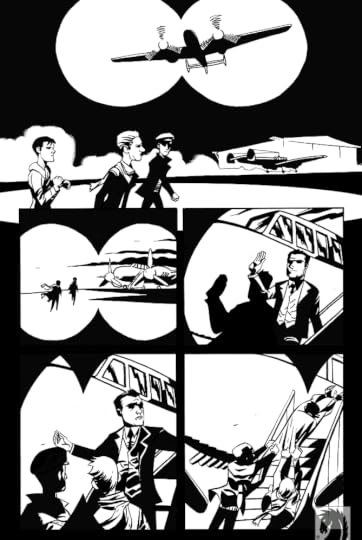
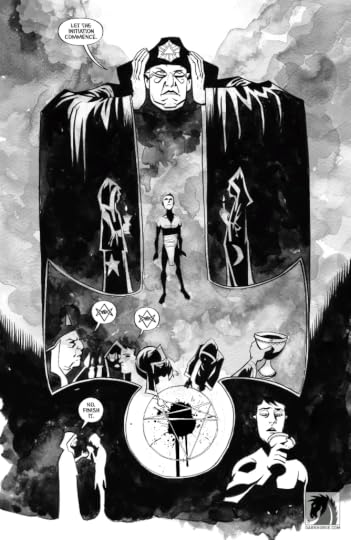
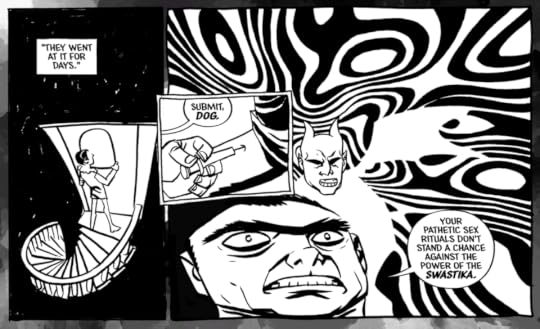
Media theorist and documentarian Douglas Rushkoff weaves a mind-bending tale of iconography and mysticism against the backdrop of a battle-torn Europe. In a story spanning generations, and featuring some of the most notable and notorious idealists of the 20th century, legendary occultist Aleister Crowley develops a powerful and dangerous new weapon to defend the world against Adolf Hitler's own war machine spawning an unconventional new form of warfare that is fought not with steel, but with symbols and ideas. Unfortunately, these intangible arsenals are much more insidious and perhaps much more dangerous than their creators could have ever conceived.
"Rushkoff is a cultural treasure and an eccentric author of big, strange ideas, never less than fascinating and always entertaining." -Warren Ellis, author of Gun Machine, Red, Trees, and Transmetropolitan
"Douglas has been one of my personal heroes, and I've been a most attentive reader of anything he cares to put between covers, knowing that his combination of a cold eye and a warm heart is guaranteed to astonish and embolden my own thinking about what's possible in the world--about what's possible to enact in the space between one human being and another. He occupies the ground of our most immediate perplexities, and his reports of what he finds are breaking news." -Jonathan Lethem, author of The Best American Comics and The Fortress of Solitude
I had no idea that Winston Churchill's V-sign actually was an idea concocted by infamous (and famous) satanist Aleister Crowley. But it was.
This book has a lot of speculative fun (if you can call it that) with the old idea that Hitler was obsessed with occultism, and how the British secret service wanted to have their own occult defenses (and offensive capabilities).
Enter: Aleister Crowley, and the power of symbols.
I thought this was quite deftly written, and I really liked the art, which seems heavily inspired by German expressionist cinema. It has made want to learn more about Crowley, as he is quite a fascinating figure.
(Thanks to Dark Horse Books for providing me with a reprint copy through Edelweiss)
I had high hopes for this, spies using Aleister Crowley to subvert Hitler through his obsession with the occult. Yes, count me in please! Unfortunately, it just turned out dull and uninteresting. It did have some interesting concepts like the Nazi's were using the swastika fueled by death magic from the holocaust to help sway the war. And the V for Victory symbol was to try and counteract that power. What this contained most was a fat, old, naked Aleister Crowley spouting a bunch of nonsensical bullshit while severely lacking a plot.
Received a review copy from Dark Horse and Edelweiss. All thoughts are my own and in no way influenced by the aforementioned.
I finished this a while ago, but didn't know what to say about it.
The premise is very interesting, but the execution leads something to be desired.
To my understanding and to my memory, Douglas Rushkoff is a media theorist with, at least later in his career, a particular focus on cyber-culture. Reading some of the titles of his work, I get a slightly conspiratorial vibe and wonder how factual his work might be. But make no mistake: I am intrigued, especially by the ideas he presents in Aleister & Adolf.
Aleister & Adolf is a graphic novel focused on the power of symbols, especially as they relate to the occult. It expands on theory that noted occultist Aleister Crowley aided the British in their World War II propaganda efforts by crafting symbols that were "more powerful" than Hitler's use of the swastika.
That, to me, is interesting in and of itself. From what I've read before, I know Crowley was not the type of magician who'd wave a magic wand. His magic was more primal. His magic focused on nature and the human psyche, and not so much on alchemy or prestidigitation. With that in mind, it strikes me as completely plausible that Crowley could have aided in the war efforts, and that the use of symbols could be an effective means of psychological warfare.
If Aleister & Adolf were just about that--occult propaganda efforts during the war--I would have been very satisfied. Again, I don't know how factual the book would have been, but I could guess Rushkoff would have had some sources to back up his theory, and it would have been interesting to see that information illustrated.
Instead, Aleister & Adolf chooses to focus on a stupid fucking United States secret fucking agent trying to infiltrate Crowley's inner circle and the whole graphic novel gets bogged down in a stupid fucking romantic subplot. By all means, introduce a skeptical character: it's a great surrogate for the reader's skepticism, I'm sure. But when that skepticism completely derails the central ideas of the book!
Jesus Christ, man, what's your goal? Do you want us to understand and believe in the power of Crowley's symbolic tactics? A prologue and epilogue suggests you want us to connect his work with our present-day culture of advertising, logos and slogan standing in for something bigger than what the products actually represent.
But at times, it feels like you're just here to take the mick out of Crowley, paint him as an old fool who had no idea what he was talking about. And the illustrator seems to confirm this! After the book is done, there's a little blurb from the illustrator, wondering if Crowley was just "trolling" everybody. Again, I can understand the skepticism, but it's disheartening to read that from someone who just spent I don't know how many months to illustrate this damn thing. It taints the efficacy of the message, I think.
Augh, frustrating. I'd still recommend this as a primer on Crowley and what he's about. And the idea of symbols as power is an important one. I just wish the narrative these two built around that idea was a little more cohesive.
Aleister and Adolf is an interesting take on what could have been happening behind the scenes of World War 2 Europe. It details a secret, occult war where Aleister Crowley creates a new weapon to combat Hitler's march towards victory. The story itself is very interesting, and has lots of little nuances that make you pause and think while reading.
As someone who has a macabre fascination with World War 2(it's what drew me to Mignola's: Hellboy) I really wanted to love this, and I can almost give it three stars. The art of is phenomenal, and the use of black and white makes the comic feel darker, but the pages feel busy. A lot of times I felt like I didn't know where to look on the page. Other than that, the story flies by. The suspense it builds is almost immediately broken because of the length of the comic.
Mainly I feel that the story works but has problems. Hitler plays almost no role in the story yet somehow generates most of the action. Rushkoff makes no effort to delve into Crowley's story. It feels as if he only took the time to skim his Wikipedia page. The story gets muddled and confused, and I found myself going back from time to time to sort out what had happened.
All in all it's a story I enjoyed but didn't get much out of. It's not something worth spending 20 dollars on.
Aleister Crowley might have been an occultist, but he also might have been the first communications/media studies professor. I guess he may have invented Churchill's V For Victory thing?
Which I didn't know about, and now V For Vendetta makes a lot more sense.
Good thing someone wrote this comic. I only know things because they were in comics. This makes me pretty good at bar trivia and pretty bad at crossword puzzles.
Douglas Rushkoff is more well-known for writing explorations on cutting edge media, and critiques on the digital economy in particular of late, but he also has an impressively growing body of work in the medium of fictional comics. Aleister & Adolf is the new graphic novel--more like graphic novella sized--that takes up powerful ideas about symbols and utilizes such to delve deeply into the occult in the World War II setting. The Beast himself Aleister Crowley (in his later years) vs the Nazis, a great premise indeed.
It should be said that the black and white art by Michael Avon Oeming is excellent, with solid storytelling in expressive cartoony stylings with an ability to get psychedelic when the need arises. No critiques there, though color would be nice but can't complain about the power of the imagery. However, this review will be more about the writing content.
Aleister & Adolf would have fit well as a classic Vertigo book, but let's be honest Vertigo isn't what it once was and it's good to see Rushkoff at publisher Dark Horse Comics. His last graphic novella formatted book Adolescent Demo Division was published by DC/Vertigo yet the science fiction plot wasn't a perfect fit. Now with the post-Karen Berger comics world Dark Horse is taking up the job.
While I do like these short books like A.D.D. that can be read in one sitting, it would be preferable to have more to read. That's the main problem of Aleister & Adolf. It's too short. Which is a good problem to have; it's a great book and it leaves wanting a lot more. The nature of the comics medium does tell the story very succinctly and everything that needs to be said is said. But one still wishes that there could have been a miniseries several chapters longer to stay in this narrative longer...
Most of all, as for the comics medium, it's perfect for getting into the power of sigil magic upon our world. That's the overall point, isn't it?
So, the plot. Told in flashbacks, an aging war photographer agent goes on a mission to recruit Aleister Crowley as part of a propaganda operation against Hitler during World War II. The ambiguity over whether the intelligence agencies believe in magick is wonderful. Is Crowley a magician pretending to be an agent or an agent pretending to be a magician? Does it matter of magick is literally "real" so long as the Nazis believe so and can be manipulated? Questions like that remain unanswered and we the readers can only speculate.
The conspiracy theory angle is also worth contemplating. Did Crowley really create the V for Victory signal in the fight against the Swastika? Were the Nazis really practicing genocidal death magic all that time (and if so, can sex magick win against that)? Was Rudolph Hess a part of this operation? Then there is the name-dropping: Ian Fleming, of course. Even Jack Parsons and L. Ron Hubbard is briefly mentioned, which is a delight to any fan of this kind of trivia.
Aleister & Adolf touches on so much, and it's a shame it ends after as a quick a read as that. The journey shouldn't be over though: After reading no doubt one will be online all night further researching the power of sigils and all the above subjects.
There's more going on in the world than we might now, and the psychic plane of ideas may yet be more worth paying attention to than we have all been told... This short comic certainly doesn't have all the answers, but it's a great starting primer for learning more.
I know I'll be lending my copy around. In this uncertain age were it seems like the good ideas are losing, I hope more people start thinking this through. I hope more people will be reading.
Hitler creates the swastika as a sigil of fascism imbued through blood magic, Crowley counters with the V for Victory, a cry of individualism imbued through sex magic, and the power of their bestial coupling through patriarchal jealousy and rage leads to modern corporate advertising, the living-death of the commodity fetish :)
I expected so much from this comic because of the praise it got from well respected authors, because of the subject-matter and because of the promising art. But somehow, all of this never coalesced and never catches the imagination.
Which is a pitty because there is so much potential in the story. You have the ambiguity that is Aleister Crowley: a modern times shaman or a very clever fraud -happily the two aren't mutually exclusive.
You have the historically correct fascination of top-ranking nazi's with the supernatural. Be it Hess' dependency to astrology to cover up his uncertainties. Be it Himmler's weird world view, he could have been 'a true believer' but he could also been trying to rewrite history so to make the German people believe in new icons or idols... but it might also have been a slight of hand to distract the audience from what was happening.
But maybe the biggest missed opportunity is the role symbols play in our lives. From a shorthand to feelings and concepts, to building blocks or just the dumbed down, superficial reduction of ideas.
The black and white art serves the story well. Sometimes the black and white catches the diametrical point of views. Sometimes they add to the confusion of the protagonist. But they fail at covering the gaps in the story.
I had high hopes for this. Conceptually, it was new and fresh. The material it draws from is interesting and had so much potential, but the execution was lackluster. My biggest complaint is the physical layout of the panels. They were difficult to follow and lacked coherent flow. The illustration is nicely done, and the black and white serves the plot well. However, it has little cohesiveness beyond that detail.
Le récit qui revisite les dessous cachés de la seconde guerre mondiale en lien avec l'occultisme m'intéressait mais cela ne fut pas une lecture facile. Tout d'abord, le format, assez petit, n'aide pas avec le graphisme touffu, que j'ai bien aimé mais qui n'est pas toujours facile surtout dans l'identification de certains personnages. Ensuite, l'histoire en elle-même est compliquée, alambiquée, saute du coq à l'âne et m'a rapidement perdue ... franchement, je crois que je suis passée à côté de cette lecture et pourtant, je connaissais déjà pas mal la vie d'Aleister Crowley !
This was really cool. The interpretation of the historical facts and the framing story were fascinating, and the art was astonishing. I got the library to buy this, but now I want my own copy.
This graphic novel has it all. Sex. Magic. Sex Magick. War. Death. Occult symbolism and rituals. Conspiracies. History. Historical fiction. Horror. Hilarity. Oh also a great story & art.
A few days ago I picked up the new graphic novel from Douglas Rushkoff and Michael Avon Oeming, “Aleister & Adolf.” I’m more familiar with Rushkoff through his reporting and expansion of ideas through nonfiction – first the excellent Program or be Programmed, and now as I read through the interesting Throwing Rocks at the Google Bus. Rushkoff has a tendency to explore the immediate and farther-reaching implications of not just technology but the way we utilize and integrate it. I had no idea, and was frankly quite excited, to see him work through an interest in sigil magic. Grant Morrison’s introduction sets the tone for the rest of the book – especially given his own sigil work – and it proceeds accordingly.
Aleister & Adolf’s premise is this (more or less): amidst World War II, a skeptical American soldier is sent to England to meet the great occultist Aleister Crowley. Crowley fancies himself locked in direct magical combat with Adolf Hitler (a not-outlandish premise as anyone who watches the “History” channel surely knows by this point). From there it gets deep into the practice and practicalities of sigil magic in the race to save Europe.
The protagonist is straight-laced but not without a history of his own. You’d expect him to be militantly opposed and disbelieving but as the book continues he follows a different path. It’s in both repeating the blueprints of our parents and trying to transcend their results that we often find ourselves – and so does Roberts.
Rushkoff’s treatment of Crowley is interesting to me – a stern man of ideas, perhaps a bit more disciplined than the man himself but not without reason. Crowley feels like a condensation of the real man for the sake of moving the story along swiftly, as does Daphne, the female support character. The pacing feels off. The book feels rushed. But it still manages to lay out some decent philosophical groundwork that comes close to rivaling, say, Grant Morisson’s Nameless.
Aleister & Adolf does have its satisfying moments. It’s an interesting and curious reframing of Crowley, World War II and some more modern elements. It doesn’t sew itself up neatly but surely does leave me wanting to know more about what happens after. I want to know more of Hugh and how he continues to manifest his change. How it and the knowledge affect him and change his approach to a life he already seems thoroughly displeased with. Maybe even a deeper treatment of corporations and occultism as well as Hugh’s client in particular.
While it felt a bit condensed Aleister & Adolf was a great and quick story that kept me entertained and left me hoping it continues in some deeper fashion. Job well done, I’d say.
There is enough interesting detail and good artwork to keep you reading this mediocre idea of a short graphic novel. The idea of Aleister Crowley being behind the scenes empowering sigils that might later become all powerful company logos is a "fantastic" old-school idea that kind of falls flat. I love Oeming's artwork in Powers, but I agree with the idea that the pages seemed cluttered.
Roberts' as an old man confessing to and influencing the newcomer was used well for good impact. The whole thing is a flashback used to deliver an idea to the young artist seeking answers, and I have to wonder how he will carry on Crowley's work, if at all.
This book is rich with historical figures that I did later research, so if the intent was to get the reader to go forth and learn, then this succeeded. Crowley is such a unique individual who had such influence over so many people that we know about, it was cool to see him being utilized in this way to stop Hitler. I think the twist on who was sacrificed was done well and was exciting for what it led to between Roberts and Daphne.
Many years ago, I read and enjoyed the four volumes of Douglas Rushkoff's Testament, so this book, with art by Michael Avon Oeming of Powers fame (another comic I enjoy), caught my attention quite a while ago. But for one reason or another, I did not get around to it till now.
Rushkoff stays true to form and presents ideas of signs and sigills as central to a struggle of ideas between Hitler's Nazi Germany and a Britain seeking the aid of the legendary occultist Aleister Crowley. It is a tale of magic, infused by sex or by death, and how these ideas ripple through time bleed into 1995 and a (perhaps sinister) online presence.
Oeming's art is perfectly suited to the narrative and the black and white visuals take us through the twists and turns of the plot as we follow Hugh's journey of discovery in the frame narrative in 1995, and Mr/Corporal Roberts' adventures with the Beast during the events in WWII.
All in all, a fascinating and enjoyable to take on the material.
Shallow and dumb. Paints crowley as a hero, doesnt mention he was a disgusting pedophile. Paints Hitler as the anti-hero, pretty boring narrative we here in the west have been fed about this controversial leader. Just Allied Propaganda.
While I found its subject matter intriguing, I ended this book feeling like this is one of those unfortunate cases where the idea is beyond what the author is capable of executing to its highest potential. I found myself thinking what an author like Alan Moore would do with this material; it’s so rich, complex, and juicy, with so many odd facts to speculate about. But, generally speaking, I found myself a little bored with the pacing and the dialogue, wishing there was more effort put into character and building the stakes on a personal level. It just doesn’t feel like a story. It’s not saying or even asking anything all that interesting ABOUT what it’s “about.”
Similarly, while the art is interesting and has some cool symbolic allusions, ultimately it felt rushed and middling and did not reach its own higher potential. It’s in a style that I’ve seen popularized over the past couple of decades and therefore it doesn’t quite feel unique, either. And that can be ok…look at manga. But there was not enough here to differentiate the artist as a distinct voice, in my view.
In sum, this is a rush job that doesn’t deliver what its fascinating subject matter promises.
You’d get a few awkward glances your way reading this in public but this comic is a perfect example of taking a premise based on historical hearsay that sounds like it would make a great film or novel on paper but fails in execution once it needs to be twisted into shape to make a story and unfortunately it’s just not that compelling. You may find some of it interesting, if you’ve not that aware of the occult or magickal concepts like sigils but it feels quite shallow and superficial.
It’s like the author rushed this out so he could just have the potential film property rights cemented before anyone else could do it as it is a great premise but unfortunately that’s all it is. Maybe that’s just me being cynical because it’s no easy feat to blend WW2,Crowley and the occult together into a satisfying cohesive story and the author, sadly, doesn’t achieve that goal.
I felt disappointed after reading it and felt a lot of it (especially the ending) was a bit exploitive and a little bit silly.
When I found out there was a comic book about Hitler and Crowley, you bet your britches I got that shit asap because so rarely does a book fulfill both of my twisted heart's desires of Nazis and Satanism. The story isn't exactly true, but it is a great yarn (I loved the contmporary frame of logos as sigils) and the art is tremendous.
I was having weird memory tinges when I looked up Douglas Rushkoff and lo and behold, I designed promotional material for when he spoke at the college where I was working (in the only job I think I managed to quit before I was fired). That soured the reading experience for me considerably, not only because it was a god-awful job, but I was under pretty strict requirements to use the university's pre-approved colors and fonts, which was almost as annoying and preposterous as claiming the swastika is the root of capitalist corporate branding strategies.