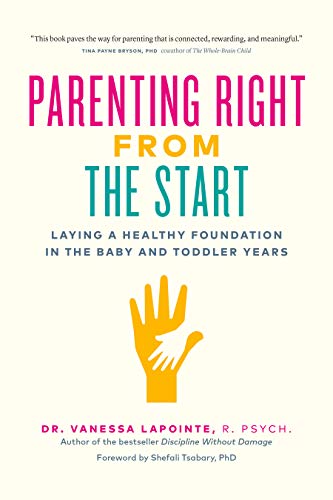
I might have given Parenting Right from the Start a higher rating had this been one of the first parenting books I'd read. It provides sensible advice:
- If you want to parent well, you've got to do the self work, figure out how your childhood experiences have shaped how you process experiences, the stories you tell yourself and your triggers.
- It's not about being the perfect parent. It's about being a "good enough parent" who connects with your child "well enough so that [your] child can receive what is needed, even if it wasn't perfectly delivered all the time"
- Attachment between parent and child is key (read Neufeld on this)
- Reframing is key as a parent: Lapointe exhorts parents to "celebrate struggle". For instance, instead of seeing your child's tantrums as a challenge, think about how these are part of normal healthy development; indeed, if your child acts up when you pick them up or return home, this is a sign of their attachment to you; instead of thinking about how to train your child to suit your routines and needs (e.g. sleep training), think about how you can adjust the things within your control that may be affecting their sleep
- the 90 second rule: when you respond to something in the environment, your body is flooded with chemicals for about 90 seconds. Any lingering emotional response after that is your choice to remain in that loop. So keep yourself in check for those 90 seconds and be intentional about how you choose to respond after that.
But honestly, having read Adele Faber (How to Talk so Kids Will Listen and Listen So Kids Will Talk; Siblings Without Rivalry) and her daughter Joanna Faber, Daniel J Siegel (The Whole Brain Child), Gordon Neufeld (Hold On To Your Kids: Why Parents Need to Matter More Than Peers) and Janet Lansbury, this book was rather....meh. It wasn't just that the book covered familiar ground (lest one be tempted to use this book as a summary of the other 5 books). I found Lapointe's writing style less engaging than the others and was constantly tempted to skim instead of doing a more attentive reading of the text.
Perhaps it didn't help that early on in the book, I felt that Lapointe was overreaching a little when she wrote about how during her divorce, she became consumed with the idea of "losing" her children. She muses that perhaps she "felt angst over potentially losing [her] children because the loss of [her] family system [was] encoded her in DNA." She cites Mark Wolynn's book It Didn't Start with You, were he argues that traumatic experiences can become encoded in one's genetic material and passed to subsequent generations. Lapointe concludes she inherited traumatic experiences in her family's history - her great grandmother being separated from her Indigenous tribe when she married a European settler who came to Canada, her children being farmed out to relatives and orphanages after she suffered multiple mental breakdowns and was sent to an asylum - through her DNA. I confess I did not read the source material for Lapointe's assertions to assess their scientific merit, but it did sound like Lapointe was grasping at circumstantial evidence in a relatively new field (epigenetics) to make sense of and validate her own experience.
Bottom line: Lapointe makes reference to Siegel and Neufeld and an example that I'm pretty sure is drawn from How to Talk so Kids Will Listen and Listen So Kids Will Talk - go read those books instead.