

What do you think?
Oxford Studies in Early Empires
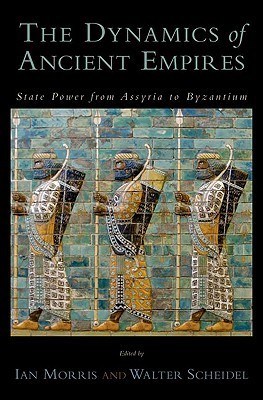
The Dynamics of Ancient Empires: State Power from Assyria to Byzantium
The world's first known empires took shape in Mesopotamia between the eastern shores of the Mediterranean Sea and the Persian Gulf, beginning around 2350 BCE. The next 2,500 years witnessed sustained imperial growth, bringing a growing share of humanity under the control of ever-fewer states. Two thousand years ago, just four major powers--the Roman, Parthian, Kushan, and Han empires--ruled perhaps two-thirds of the earth's entire population. Yet despite empires' prominence in the early history of civilization, there have been surprisingly few attempts to study the dynamics of ancient empires in the western Old World comparatively. Such grand comparisons were popular in the eighteenth century, but scholars then had only Greek and Latin literature and the Hebrew Bible as evidence, and necessarily framed the problem in different, more limited, terms. Near Eastern texts, and knowledge of their languages, only appeared in large amounts in the later nineteenth century. Neither Karl
Marx nor Max Weber could make much use of this material, and not until the 1920s were there enough archaeological data to make syntheses of early European and west Asian history possible. But one consequence of the increase in empirical knowledge was that twentieth-century scholars generally defined the disciplinary and geographical boundaries of their specialties more narrowly than their Enlightenment predecessors had done, shying away from large questions and cross-cultural comparisons. As a result, Greek and Roman empires have largely been studied in isolation from those of the Near East. This volume is designed to address these deficits and encourage dialogue across disciplinary boundaries by examining the fundamental features of the successive and partly overlapping imperial states that dominated much of the Near East and the Mediterranean in the first millennia BCE and CE.
A substantial introductory discussion of recent thought on the mechanisms of imperial state formation prefaces the five newly commissioned case studies of the Neo-Assyrian, Achaemenid Persian, Athenian, Roman, and Byzantine empires. A final chapter draws on the findings of evolutionary psychology to improve our understanding of ultimate causation in imperial predation and exploitation in a wide range of historical systems from all over the globe. Contributors include John Haldon, Jack Goldstone, Peter Bedford, Josef Wiesehöfer, Ian Morris, Walter Scheidel, and Keith Hopkins, whose essay on Roman political economy was completed just before his death in 2004.
Marx nor Max Weber could make much use of this material, and not until the 1920s were there enough archaeological data to make syntheses of early European and west Asian history possible. But one consequence of the increase in empirical knowledge was that twentieth-century scholars generally defined the disciplinary and geographical boundaries of their specialties more narrowly than their Enlightenment predecessors had done, shying away from large questions and cross-cultural comparisons. As a result, Greek and Roman empires have largely been studied in isolation from those of the Near East. This volume is designed to address these deficits and encourage dialogue across disciplinary boundaries by examining the fundamental features of the successive and partly overlapping imperial states that dominated much of the Near East and the Mediterranean in the first millennia BCE and CE.
A substantial introductory discussion of recent thought on the mechanisms of imperial state formation prefaces the five newly commissioned case studies of the Neo-Assyrian, Achaemenid Persian, Athenian, Roman, and Byzantine empires. A final chapter draws on the findings of evolutionary psychology to improve our understanding of ultimate causation in imperial predation and exploitation in a wide range of historical systems from all over the globe. Contributors include John Haldon, Jack Goldstone, Peter Bedford, Josef Wiesehöfer, Ian Morris, Walter Scheidel, and Keith Hopkins, whose essay on Roman political economy was completed just before his death in 2004.
400 pages, Hardcover
First published December 12, 2008
Ratings & Reviews
Friends & Following
Create a free account to discover what your friends think of this book!
Community Reviews
Displaying 1 - 5 of 5 reviews

May 11, 2012
Writing reviews of books which assemble articles by a variety of authors is difficult, thorough treatment requiring coverage of each piece. This volume, arising from “a series of conferences sponsored by Stanford University's Social Science History Institute,” brings together several academic disciplines and seven authors in seven essays broadly covering the dynamics of states and empires in the ancient world. The entities focused upon are the Neo-Assyrian, Achaemenid, Athenian, Roman and Byzantine Empires, with substantial excurses into Sparta and the early Islamic Caliphate—a range of about 1500 years. Rather than discussing each contribution in detail, I shall list each and their authors in order, providing short descriptions of their contents.
The introductory essay, “Ancient States, Empires, and Exploitation: Problems and Perspectives” by Jack A. Goldstone (George Mason, Global Policy) and John F. Haldon (Princeton, Byzantine History), is a very broad overview of the topics covered by the conference papers, topics such as state- and empire-formation and consolidation, class composition, ideology and evolutionary theories as regards such polities. The authors promise—and they generally deliver—at least tentative answers to four questions: (1) How did empires come to be? (2) How did they survive? (3) How were they structured? (4) How did their economies function? This introduction is short—only twenty-seven pages—and almost intimidatingly dense. This should not put off the reader. What follows it is easier to assimilate. Indeed, digestion of the material will be served by a re-reading of this essay upon completion of the collection.
Peter R. Bedford's (Union College, Religion) treatment of the Neo-Assyrian Empire follows. The period covered here, ca. 934-ca. 605, represents “the most durable empire seen until then in Western Asia,” a polity with significance in reference to contemporaneous and subsequent formations.
Josef Wiesehöfer's (University of Kiel, Ancient History) discussion of the Achaemenid Empire covers a shorter range, ca. 550-323, but is better sourced. The sources, discussed in enlightening detail, are, however, mostly non-Persian. Indeed, so far as literary sources are concerned, most are Greek, many of them being hostile. Given the proximate cause of Persian collapse being Alexander of Macedon, this slant has its merits and leads, neatly enough, to the next essay.
Ian Morris' (Stanford, Classics and History) piece is unique in that Athens—and Sparta and Syracuse, both treated at some length—was never an empire. This allows the author grounds for a substantive discussion of state—as opposed to empire—formation. Similarly, this essays covers a much narrower range of time, the height of the Athenian mercantile expansion from 478 to the disaster of 404.
Keith Hopkins (Cambridge, Ancient History) concentrates on his specialty, economics, as regards the Roman Empire, focusing on the Principate of 31 B.C.E. through 235, but frequently ranging further afield. I found his critical dismissal of many Roman literary sources in favor of such objective evidences as Greenland ice core samples (used in estimating silver coinage rates) most refreshing.
Haldon's second contribution is misleadingly titled “The Byzantine Empire.” It is actually as much a treatment of early Islamic expansion, the movement which led to the loss and absorption of what had, ca. 330 to 1453, been a major imperial player. Like Hopkins, Haldon concentrates on economic factors, particularly the inability of the Greeks to compete with the rising mercantile republics of Venice, Genoa and Pisa.
The collection ends with an eye-opening piece by Walter Scheidel (Stanford, Classics) entitled “Sex and Empire: A Darwinian Perspective.” Reminiscent of popular works like those penned by primatologist Desmond Morris and much beholden to Sociobiology, this essay focuses on functional viability, sexual exploitation being handled as the original and paradigmatic mode of that dynamic which created civilization and accompanies virtually all modes of sociopolitical aggrandizement. While controversial, this angle is certainly provocative and, as Scheidel amply demonstrates, heuristically productive.
All-in-all this collection is worth study. While the topics and questions mentioned in its introduction are irregularly treated by the contributors, they do run throughout, giving this volume a greater thematic coherence than many such conference-based assemblages. All the essays are intelligent, informed and well-sourced. This book might serve as a primary text for courses in a variety of disciplines.
The introductory essay, “Ancient States, Empires, and Exploitation: Problems and Perspectives” by Jack A. Goldstone (George Mason, Global Policy) and John F. Haldon (Princeton, Byzantine History), is a very broad overview of the topics covered by the conference papers, topics such as state- and empire-formation and consolidation, class composition, ideology and evolutionary theories as regards such polities. The authors promise—and they generally deliver—at least tentative answers to four questions: (1) How did empires come to be? (2) How did they survive? (3) How were they structured? (4) How did their economies function? This introduction is short—only twenty-seven pages—and almost intimidatingly dense. This should not put off the reader. What follows it is easier to assimilate. Indeed, digestion of the material will be served by a re-reading of this essay upon completion of the collection.
Peter R. Bedford's (Union College, Religion) treatment of the Neo-Assyrian Empire follows. The period covered here, ca. 934-ca. 605, represents “the most durable empire seen until then in Western Asia,” a polity with significance in reference to contemporaneous and subsequent formations.
Josef Wiesehöfer's (University of Kiel, Ancient History) discussion of the Achaemenid Empire covers a shorter range, ca. 550-323, but is better sourced. The sources, discussed in enlightening detail, are, however, mostly non-Persian. Indeed, so far as literary sources are concerned, most are Greek, many of them being hostile. Given the proximate cause of Persian collapse being Alexander of Macedon, this slant has its merits and leads, neatly enough, to the next essay.
Ian Morris' (Stanford, Classics and History) piece is unique in that Athens—and Sparta and Syracuse, both treated at some length—was never an empire. This allows the author grounds for a substantive discussion of state—as opposed to empire—formation. Similarly, this essays covers a much narrower range of time, the height of the Athenian mercantile expansion from 478 to the disaster of 404.
Keith Hopkins (Cambridge, Ancient History) concentrates on his specialty, economics, as regards the Roman Empire, focusing on the Principate of 31 B.C.E. through 235, but frequently ranging further afield. I found his critical dismissal of many Roman literary sources in favor of such objective evidences as Greenland ice core samples (used in estimating silver coinage rates) most refreshing.
Haldon's second contribution is misleadingly titled “The Byzantine Empire.” It is actually as much a treatment of early Islamic expansion, the movement which led to the loss and absorption of what had, ca. 330 to 1453, been a major imperial player. Like Hopkins, Haldon concentrates on economic factors, particularly the inability of the Greeks to compete with the rising mercantile republics of Venice, Genoa and Pisa.
The collection ends with an eye-opening piece by Walter Scheidel (Stanford, Classics) entitled “Sex and Empire: A Darwinian Perspective.” Reminiscent of popular works like those penned by primatologist Desmond Morris and much beholden to Sociobiology, this essay focuses on functional viability, sexual exploitation being handled as the original and paradigmatic mode of that dynamic which created civilization and accompanies virtually all modes of sociopolitical aggrandizement. While controversial, this angle is certainly provocative and, as Scheidel amply demonstrates, heuristically productive.
All-in-all this collection is worth study. While the topics and questions mentioned in its introduction are irregularly treated by the contributors, they do run throughout, giving this volume a greater thematic coherence than many such conference-based assemblages. All the essays are intelligent, informed and well-sourced. This book might serve as a primary text for courses in a variety of disciplines.

December 8, 2024
It was an interesting book where the in-depth analytical history of the world's greatest empires- from ancient Chinese empires in the east to Incas and Aztecs in the far west- was studied from different perspectives, ranging from social, historical, and economic factors to cultural and financial one.
However, the most interesting chapter was the last chapter, Walter Scheidel's 'Sex and Empire: A Darwinian Perspective.' This chapter adds a flavour of biology into the deep historical pages and analyses the psychology of imperial apparatus in implementing their policies, especially those that are highly related to emperor(s) sexual pulses such as enslavement of female members of subjugated political entities, the legality of monogamous and/or polygamous marriages, the distribution of enslaved females among imperial dynasties and their soldiers, and the normalisation of cocumbines inside the imperial houses.
However, the most interesting chapter was the last chapter, Walter Scheidel's 'Sex and Empire: A Darwinian Perspective.' This chapter adds a flavour of biology into the deep historical pages and analyses the psychology of imperial apparatus in implementing their policies, especially those that are highly related to emperor(s) sexual pulses such as enslavement of female members of subjugated political entities, the legality of monogamous and/or polygamous marriages, the distribution of enslaved females among imperial dynasties and their soldiers, and the normalisation of cocumbines inside the imperial houses.

August 10, 2022
This was a useful book. The best chapters in my view were the ones on the Greeks and Romans, which was a little bit of a disappointment, in that I went in knowing more about them and hoped that I'd gain great new insights on the Neo-Assyrians, Persians, and so on--those sections weren't without value, but they were pretty dry. The book is pretty focused geographically--Near East and Mediterranean--I'd like to see something similar for other regions. One of the later chapters was a creative but murky "big picture" consideration of empire-building as an evolutionary strategy for reproductive success on the part of dominant men in various societies. I think the argument was a bit strained, but the observations about patterns of sexual and gender relations were interesting.

November 30, 2015
A discussion of the systems of rule and rulership in the ancient empires of the Near East and Western Europe. However, like nearly all edited academic volumes, it lacks consistency of discourse and ranges over many subjects. In particular, although the objective of the volume is to set the stage for a comparative analysis of state power in the ancient world, there is no real attempt to do so systematically across the chapters, and the individual chapter authors are left to range freely in their discussion of a particular empire with little in the way of comparison with what their co-authors have contributed. As a result, one is presented with a potpourri of material that, though individually interesting, does not lend itself to systematic comparison or end-of-tome lesson learning or knowledge building.

January 3, 2011
Thought Provoking view of the inter-workings of ancient empires.
Displaying 1 - 5 of 5 reviews