

What do you think?
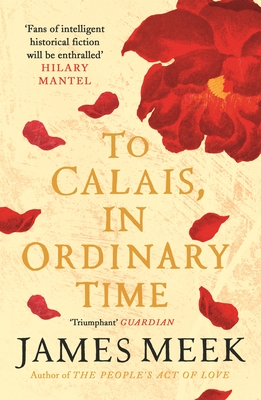
To Calais, In Ordinary Time
Three journeys. One road.
England, 1348. A gentlewoman is fleeing an odious arranged marriage, a Scottish proctor is returning home to Avignon and a handsome young ploughman in search of adventure is on his way to volunteer with a company of archers. All come together on the road to Calais.
Coming in their direction from across the Channel is the Black Death, the plague that will wipe out half of the population of Northern Europe. As the journey unfolds, overshadowed by the archers' past misdeeds and clerical warnings of the imminent end of the world, the wayfarers must confront the nature of their loves and desires.
A tremendous feat of language and empathy, it summons a medieval world that is at once uncannily plausible, utterly alien and eerily reflective of our own. James Meek's extraordinary To Calais, In Ordinary Time is a novel about love, class, faith, loss, gender and desire—set against one of the biggest cataclysms of human history.
England, 1348. A gentlewoman is fleeing an odious arranged marriage, a Scottish proctor is returning home to Avignon and a handsome young ploughman in search of adventure is on his way to volunteer with a company of archers. All come together on the road to Calais.
Coming in their direction from across the Channel is the Black Death, the plague that will wipe out half of the population of Northern Europe. As the journey unfolds, overshadowed by the archers' past misdeeds and clerical warnings of the imminent end of the world, the wayfarers must confront the nature of their loves and desires.
A tremendous feat of language and empathy, it summons a medieval world that is at once uncannily plausible, utterly alien and eerily reflective of our own. James Meek's extraordinary To Calais, In Ordinary Time is a novel about love, class, faith, loss, gender and desire—set against one of the biggest cataclysms of human history.
400 pages, Paperback
First published January 1, 2019
Ratings & Reviews
Friends & Following
Create a free account to discover what your friends think of this book!
Community Reviews
Displaying 1 - 30 of 263 reviews

December 28, 2019
It’s Cotswold. It’s Outen Green. As if no French never touched their tongues. I ne know myself sometimes what they mean. They say steven in place of voice, and shrift and housel for confession and absolution, and bead for prayer.
The People’s Act of Love by James Meek was in my top 3 books of 2005, edged out only by the first volume of Marias’s magnificent Your Face Tomorrow trilogy and Salman Rushdie’s brilliant and underrated Shalimar the Clown, but I have been disappointed by the three subsequent novels of his I have read (Museum of Doubt, The Heart Broke In and We Are Now Beginning Our Descent)
With echoes of The Canterbury Tales, Decameron and (explicitly – one of the characters carries a copy) Roman de la Rose, To Calais in Normal Times is set in the middle ages, 1348 to be precise, two years after the triumph of the English archers at the Battle of Crécy, but with another, far deadlier, invasion approaching England’s shores – the Black Death.
Meek’s intention is to draw a parallel (albeit one that is not laboured in the novel but left to the reader) with a pending 21st century catastrophe – the climate emergency. But as the novel progressed, another even more timely echo emerged – that of national identity and Brexit. He even gets in a timely, albeit perhaps not deliberate, reference to 2019’s scourge, Corbynist populism:
Here in this new sense of community it is facile to delude ourselves that universal fraternity is an inevitable consequence of a greater equalisation of social status. I suspect the majority, of required to celebrate this novel harmony of cleric, commoner and aristocrat, would consider the occasion ideal for persecution of Jews.
Meek’s greatest achievement in this novel is the innovative use of language. While making no direct attempt to reproduce the speech of the time – which modern day readers would find incomprehensible – he produces a facsimile, or rather three facsimile’s as he draws on the three key influences on English – French, Germanic and Latin – to produce three different types of speech for the main characters, aristocratic, commonfolk and clerical, respectively.
As the author has explained in two interviews:
The concept of the three different registers is innovative and etymologically fascinating. Unfortunately it is laboured to excess. The clerical Latin comes across as Sir Humphrey Appleby at his most obtuse, and Paul Kingsnorth set the bar very high for reconstructed anglo-saxon speech – in his case the 12th century after the Norman invasion, in his novel The Wake - and Meek isn’t anywhere as successful, relying rather heavily on repetition of a few key words (e.g. neb for face):
Will stood at the gate, strung his bow, nocked the arrow and shet it at a board hung over the ale-house eaves. The arrow struck the board with a mighty thock and the board span round twice on its pole before it came to rest. The arrowhead had throughshove one eye of the likeness of the moon that was wrought there.
For me, the novelty of the language soon turns to tedium. exposing the lack of a compelling story.
For almost 400 pages very little of interest happens, and what narration there is is focused on micro-level interaction between the company, and one incident in the archers' past in particular, with the novel failing, in my view, in the author's self-declared mission to recreate a world facing an imminent existential threat.
1.5 stars.
The People’s Act of Love by James Meek was in my top 3 books of 2005, edged out only by the first volume of Marias’s magnificent Your Face Tomorrow trilogy and Salman Rushdie’s brilliant and underrated Shalimar the Clown, but I have been disappointed by the three subsequent novels of his I have read (Museum of Doubt, The Heart Broke In and We Are Now Beginning Our Descent)
With echoes of The Canterbury Tales, Decameron and (explicitly – one of the characters carries a copy) Roman de la Rose, To Calais in Normal Times is set in the middle ages, 1348 to be precise, two years after the triumph of the English archers at the Battle of Crécy, but with another, far deadlier, invasion approaching England’s shores – the Black Death.
Meek’s intention is to draw a parallel (albeit one that is not laboured in the novel but left to the reader) with a pending 21st century catastrophe – the climate emergency. But as the novel progressed, another even more timely echo emerged – that of national identity and Brexit. He even gets in a timely, albeit perhaps not deliberate, reference to 2019’s scourge, Corbynist populism:
Here in this new sense of community it is facile to delude ourselves that universal fraternity is an inevitable consequence of a greater equalisation of social status. I suspect the majority, of required to celebrate this novel harmony of cleric, commoner and aristocrat, would consider the occasion ideal for persecution of Jews.
Meek’s greatest achievement in this novel is the innovative use of language. While making no direct attempt to reproduce the speech of the time – which modern day readers would find incomprehensible – he produces a facsimile, or rather three facsimile’s as he draws on the three key influences on English – French, Germanic and Latin – to produce three different types of speech for the main characters, aristocratic, commonfolk and clerical, respectively.
As the author has explained in two interviews:
I had been reading about the Black Death and was reminded of what a catastrophe it was and I had also been thinking about climate change and I saw similarities between these disasters. I was interested that this was a great catastrophe and yet humanity survived and was much changed. There was the tension and the slaughter of the plague and then this dynamism when they came out of it.https://www.thetimes.co.uk/article/ja...
As I got into the book I started seeing it in a different way and that was because the three countries in whose history I had been so bound up in — Scotland, England and the Ukraine — they had all been undergoing these convulsions: the invasion of the Ukraine, the Scottish referendum and then Brexit. It has accelerated this process that was already under way in which we question who we are.
Are we British or Scottish or English or European? Are we men, are we women or points on some gender spectrum? Is our value related to how much money we have or how old we are? And all the time that we are fretting about who we are, this cataclysmic threat to our humanity grows and draws closer. It was the same in the Middle Ages: are you a priest, a peasant, a nobleman? People were fighting even as the Black Death swept in.
When for a novel set in the 14th century I teased English out into three distinct, more or less modern idioms, using Frenchness, Germanicity and Latinness to express aristocratic, peasant and clerical worldviews, I found how naturally the neo-aristocratic French-rich idiom expressed ideas of romantic love. I hadn’t realised how deeply the ancient sense of proprietorship by the powerful over the depiction of love was embedded in literary, that is clerkly, English. What I also found was that Germanic English had its own idiom of love, more urgent and full-on: but of course it does, because it’s all around us, the language of pop, worker art. When you look at the English of hits, it’s startling how Anglo-Saxon success is. “I Will Always Love You”, “It’s Now Or Never”, “My Heart Will Go On”, “ I Want To Hold Your Hand”. Popular songs and stories of love and hurt, of gods, heroes, devils and kings, folksy slogans – “Make America Great Again”, “It’s the Real Thing” - are what’s left in English of a pre-Norman time when the power language, the abstraction language and the folk language were the same.https://www.theguardian.com/books/201...
The concept of the three different registers is innovative and etymologically fascinating. Unfortunately it is laboured to excess. The clerical Latin comes across as Sir Humphrey Appleby at his most obtuse, and Paul Kingsnorth set the bar very high for reconstructed anglo-saxon speech – in his case the 12th century after the Norman invasion, in his novel The Wake - and Meek isn’t anywhere as successful, relying rather heavily on repetition of a few key words (e.g. neb for face):
Will stood at the gate, strung his bow, nocked the arrow and shet it at a board hung over the ale-house eaves. The arrow struck the board with a mighty thock and the board span round twice on its pole before it came to rest. The arrowhead had throughshove one eye of the likeness of the moon that was wrought there.
For me, the novelty of the language soon turns to tedium. exposing the lack of a compelling story.
For almost 400 pages very little of interest happens, and what narration there is is focused on micro-level interaction between the company, and one incident in the archers' past in particular, with the novel failing, in my view, in the author's self-declared mission to recreate a world facing an imminent existential threat.
1.5 stars.

September 1, 2019
To Calais In Ordinary Time is the story of a group of travellers journeying across England at the outset of the Black Death. The entire novel is written in semi-medieval English and told from three different perspectives: that of a scribe whose language is studded with Latinate terms; that of a young noblewoman whose diction is marked by Norman French; and that of a ploughman whose vocabulary is more clearly Saxon.
James Meek depicts a world in the process of huge transformation. Social norms are being rewritten overnight as a result of the rapid and relentless progress of the plague sweeping across the country and leaving whole communities devastated in its wake. The individual travellers, whether or not they succumb to the disease, are obliged to respond to the new circumstances, to make adjustments and accommodations at an instinctive level and only retrospectively to begin to understand and articulate their new positions.
It's a challenging read but an enormously enjoyable one because the language creates and sustains the world of the narrative. Far more than description of landscape or customs, it is the melting-pot of the dialogue with its competing sets of vocabulary, and all the embedded cultural baggage that these imply, that gives the story its vitality.
Strikingly original and gloriously ambitious, To Calais In Ordinary Time is a rare treat in a publishing world too often preoccupied with copycat best-sellers.
James Meek depicts a world in the process of huge transformation. Social norms are being rewritten overnight as a result of the rapid and relentless progress of the plague sweeping across the country and leaving whole communities devastated in its wake. The individual travellers, whether or not they succumb to the disease, are obliged to respond to the new circumstances, to make adjustments and accommodations at an instinctive level and only retrospectively to begin to understand and articulate their new positions.
It's a challenging read but an enormously enjoyable one because the language creates and sustains the world of the narrative. Far more than description of landscape or customs, it is the melting-pot of the dialogue with its competing sets of vocabulary, and all the embedded cultural baggage that these imply, that gives the story its vitality.
Strikingly original and gloriously ambitious, To Calais In Ordinary Time is a rare treat in a publishing world too often preoccupied with copycat best-sellers.

August 8, 2021
The kind of historical fiction I need doesn't just give me a full immersion in another time period, but also makes me think about why we need historical fiction - that it's not just telling an engrossing story about what we've done in the world, but also digs at why, in the most elemental, anthropological, existential sense. For me, a lot of this depends on having characters with the psychological depth to evolve throughout the story, who speak to my modern understanding of the psychology of the self, while still feeling alien and archaic. I always hold up Hilary Mantel's Thomas Cromwell as my north star for this, and now I can add the main characters in this road trip novel. And even more interesting, these characters come from a variety of backgrounds, from the poorest of the peasantry to the wealthier classes, something I don't remember from the Wolf Hall novels. Others that come to mind are The King at the Edge of the World and Tell Them of Battles, Kings and Elephants.
A journey by foot, horse, and cart through plague-haunted England in 1348 is going to be mentally and physically brutal but this story also takes detours into farce, comedies of manners and even comic erotica that lessened the overall feeling of grimness for me. These interludes weren't there just to lighten the mood though - they took the characters down paths they needed to grow, in ways I didn't always expect, but were still true to character.
Some GR reviews found the archaic style of the writing boring or impenetrable, and at first I wasn't sure I wanted 400 pages of it, but within a few pages I completely adapted. After I finished, I could see that far from being clunky or difficult, it was actually amazingly subtle and supple in making the 14th century come alive, digging into the characters minds, and showing the different versions of 'English' the characters were speaking (peasant vs. upper class) and how that affected their understanding of each other - not only their words, but their very humanity.
Here's a sample of the writing that I think gets at its archaic feel, but also the pleasures of it. It's a minor moment in the story, when Will, a ploughman (and central character), visits his lord's manor, and tries to make sense of what he sees. (Tip: "out-take" means 'except'.)
A journey by foot, horse, and cart through plague-haunted England in 1348 is going to be mentally and physically brutal but this story also takes detours into farce, comedies of manners and even comic erotica that lessened the overall feeling of grimness for me. These interludes weren't there just to lighten the mood though - they took the characters down paths they needed to grow, in ways I didn't always expect, but were still true to character.
Some GR reviews found the archaic style of the writing boring or impenetrable, and at first I wasn't sure I wanted 400 pages of it, but within a few pages I completely adapted. After I finished, I could see that far from being clunky or difficult, it was actually amazingly subtle and supple in making the 14th century come alive, digging into the characters minds, and showing the different versions of 'English' the characters were speaking (peasant vs. upper class) and how that affected their understanding of each other - not only their words, but their very humanity.
Here's a sample of the writing that I think gets at its archaic feel, but also the pleasures of it. It's a minor moment in the story, when Will, a ploughman (and central character), visits his lord's manor, and tries to make sense of what he sees. (Tip: "out-take" means 'except'.)
"They went through Sir Guy's hall, through laths of sunlight that came in through the narrow windows. The hall looked sluttish still after the masons of Coventry came the year before, took Sir Guy's hearth off its old stead in the middle of the floor and set it under a brick pipe they called a chimney. A wonder gin it would've been had they fulfilled it, and two more chimney's at either end of the manor, but they went away when Sir Guy stinted the silver, to buy his daughter's gown that was stolen.
Anto bade Will leave his tools outside and led him through the new door at the west end of the hall and into a room. It hadn't no stead for bed nor dogs nor food-stuff, only a board and chair and chests and a cherrywood rood with a likeness of our maker pined by his own weight. Sir Guy called it his privy chamber, chamber being room or cot or steading, and privy being that none of his household was to go in out-take him. When we'd asked Anto why Sir Guy would make a room to be alone in, if he ne slept there, Anto said he read the leaves of books, of which he had three or more, and wrote letters, and drank wine with the priest, and played dice with the high-born, and hid him from his daughters."

March 9, 2020
England, 1348. This story is driven by three main characters. Bernadine, a gentlewoman, who flees arranged marriage. A proctor, who is returning home from England to Avignon, France, where pestilence has already reached. Therefore, he doesn’t know what awaits him there; an empty villa or his housekeepers welcoming him. Will Quate, a handsome young ploughman, who is also a skilled bowman. He volunteers as an archer, thus it takes him on the same road to Calais as the fleeing bride and returning proctor.
I got interested in this story because of the Black Death, but this story is character driven, which are interesting and language driven, which is most challenging. It is very interesting how the social status of those three characters is presented through the usage of English language, some old English, some French influence, and some Latin influence. Thus, creating a bit challenging read.
I understand the uniqueness to present social classes through language, but that creates a trial for a modern reader. It takes a great skill to write in such style; however I don’t want to be guessing what I’m reading at times. Some will appreciate it. As far as it goes for me and my personal preference in general, I like the language to be the same and smooth, no foreign language words injections. So I can understand what I’m reading.
Source: ARC was provided by the publisher via Netgalley in exchange for an honest review.
I got interested in this story because of the Black Death, but this story is character driven, which are interesting and language driven, which is most challenging. It is very interesting how the social status of those three characters is presented through the usage of English language, some old English, some French influence, and some Latin influence. Thus, creating a bit challenging read.
I understand the uniqueness to present social classes through language, but that creates a trial for a modern reader. It takes a great skill to write in such style; however I don’t want to be guessing what I’m reading at times. Some will appreciate it. As far as it goes for me and my personal preference in general, I like the language to be the same and smooth, no foreign language words injections. So I can understand what I’m reading.
Source: ARC was provided by the publisher via Netgalley in exchange for an honest review.

April 21, 2020
Have been attempting to read this book for a few months. and the only word I have to describe it is PLODDING. I feel like I am walking the road to Calais with them subject to all the slow going the travelers themselves encounter. I guess I might not be a "literary" as many other readers, but to me this book contained zero interesting characters, little interesting plot and just was a true grind to finish. I appreciate the author trying to write in 14th century vocabulary, but ne enough for me.

November 13, 2025
4.5 ⭐️
I did a litfic!
I was prompted to read this by ancientreader's glowing review -- whenever ancientreader gives 5 stars, my mission is clear. I must admit, though, that the first 100 pages were slow-verging-on-slog. It wasn't just the foreignness of the language (where Thomas and Berna were, for me, equally legible in form but challenging in terms of understanding the context and, occasionally, content; while Will and Hab/ Madlen were difficult on both counts); it was also that the characters were still (mostly) separated by the narrative, which seemed more like a series of discrete and, to some extent, obscure happenings than anything more cohesive. Once circumstances forced them together, however -- around the 100 page mark -- things started to pick up; and the last half of the book was a real page-turner.
I don't really have the bandwidth to go deep on this, and even if I did, I'm sure there are other reviews that do the book more justice. A couple of things I noted/ admired:
-- the language is, per above, a challenge, although it got easier as it went along. Either I got more used to it or I was more invested in the story and so didn't get as hung up on the difficulty; probably both. I often find it challenging to emotionally commit when I have to work hard for comprehension -- and that was definitely case for a while -- but eventually the language and corresponding characters were so fused in my mind that it hit even more powerfully. One thing that helped, though, in terms of readability and comprehension is that Thomas, in particular, is a great summarizer of what's happened, situating the reader quickly into the proper context and adding his own (uniformly insightful, if usually self-lacerating) insights. There are no chapters, per se, but a constant switching of POVs, indicated by different symbols at start of each narrative: a rose for Berna, a quill for Thomas, and a scythe for the peasants and archers (mostly Will's POV, but occasionally Hab or Madlen's, or one of the archers'). This really helped the momentum of the story; it was definitely what kept me going in the first quarter, as I probably would have dnf'ed if faced with 20-page chapters but could motivate to keep reading when it was only a page or two at a time.
-- this was way more queer and gendery than I expected. Kind of Shakespeare comedy-esque in the "boys dressed as girls dressed as boys dressed as girls" of it all, but also Berna's whole arc is really interesting about the imbrication of gender, class, and status and how this plays out in her life versus that of Cess, the queen mother, and Madlen. Staying at a hostel being the first time she's ever had the opportunity to have a door that locks, girl I gasped!
-- Berna's obsession with romance and love being only the purview of the gentry and nobility . . . yes, the gender of it all, but the class of it all was equally fascinating, and not just as it manifested linguistically. The baseline assumption among many, not just Berna, that the lower classes are no more possessed of finer feelings, sensibilities, and comprehension than beasts of burden; and Will and Hab/ Madlen's recurring acknowledgement that they don't understand Berna and Thomas's speech, while acting in ways more clever, generous, and, for lack of a better word, "noble" than their esteemed counterparts. Great stuff!
-- the whole situation with the archers and the morality/ punishment game that was being played was super interesting. Thanks, again, to our friend Thomas for spelling it out for me, because otherwise it would have flown way over my head.
This is a rare example of a book that went from "appreciating but not really enjoying it" to "must stay up past my bedtime to finish," and where my admiration for what was going on grew exponentially as it all came together. I was initially going to round down to 4 stars, on the basis of the first 100 pages being really touch-and-go. But on reflection, there's so much to chew on here and so much that's going to stay with me -- including memorable characters who, despite the barrier put up by the language, had me in knots by the end -- that I had to give it the full pot.
I did a litfic!
I was prompted to read this by ancientreader's glowing review -- whenever ancientreader gives 5 stars, my mission is clear. I must admit, though, that the first 100 pages were slow-verging-on-slog. It wasn't just the foreignness of the language (where Thomas and Berna were, for me, equally legible in form but challenging in terms of understanding the context and, occasionally, content; while Will and Hab/ Madlen were difficult on both counts); it was also that the characters were still (mostly) separated by the narrative, which seemed more like a series of discrete and, to some extent, obscure happenings than anything more cohesive. Once circumstances forced them together, however -- around the 100 page mark -- things started to pick up; and the last half of the book was a real page-turner.
I don't really have the bandwidth to go deep on this, and even if I did, I'm sure there are other reviews that do the book more justice. A couple of things I noted/ admired:
-- the language is, per above, a challenge, although it got easier as it went along. Either I got more used to it or I was more invested in the story and so didn't get as hung up on the difficulty; probably both. I often find it challenging to emotionally commit when I have to work hard for comprehension -- and that was definitely case for a while -- but eventually the language and corresponding characters were so fused in my mind that it hit even more powerfully. One thing that helped, though, in terms of readability and comprehension is that Thomas, in particular, is a great summarizer of what's happened, situating the reader quickly into the proper context and adding his own (uniformly insightful, if usually self-lacerating) insights. There are no chapters, per se, but a constant switching of POVs, indicated by different symbols at start of each narrative: a rose for Berna, a quill for Thomas, and a scythe for the peasants and archers (mostly Will's POV, but occasionally Hab or Madlen's, or one of the archers'). This really helped the momentum of the story; it was definitely what kept me going in the first quarter, as I probably would have dnf'ed if faced with 20-page chapters but could motivate to keep reading when it was only a page or two at a time.
-- this was way more queer and gendery than I expected. Kind of Shakespeare comedy-esque in the "boys dressed as girls dressed as boys dressed as girls" of it all, but also Berna's whole arc is really interesting about the imbrication of gender, class, and status and how this plays out in her life versus that of Cess, the queen mother, and Madlen. Staying at a hostel being the first time she's ever had the opportunity to have a door that locks, girl I gasped!
-- Berna's obsession with romance and love being only the purview of the gentry and nobility . . . yes, the gender of it all, but the class of it all was equally fascinating, and not just as it manifested linguistically. The baseline assumption among many, not just Berna, that the lower classes are no more possessed of finer feelings, sensibilities, and comprehension than beasts of burden; and Will and Hab/ Madlen's recurring acknowledgement that they don't understand Berna and Thomas's speech, while acting in ways more clever, generous, and, for lack of a better word, "noble" than their esteemed counterparts. Great stuff!
-- the whole situation with the archers and the morality/ punishment game that was being played was super interesting. Thanks, again, to our friend Thomas for spelling it out for me, because otherwise it would have flown way over my head.
This is a rare example of a book that went from "appreciating but not really enjoying it" to "must stay up past my bedtime to finish," and where my admiration for what was going on grew exponentially as it all came together. I was initially going to round down to 4 stars, on the basis of the first 100 pages being really touch-and-go. But on reflection, there's so much to chew on here and so much that's going to stay with me -- including memorable characters who, despite the barrier put up by the language, had me in knots by the end -- that I had to give it the full pot.
November 30, 2025
I started this book in May 2025 and I have to say that I struggled initially. So much so I read other books before coming back and then restarting and then putting down again. The excuse that ‘life got in the way’ doesn’t really wash as I had time to read other works. So what was it?
The book is an incredible story set in 1348. It recounts three main characters on the road in the south west of England to go to France. Encountering the Black Death. The characters stories weave with subheadings denoted by symbols representing them. The language can be difficult at times.
That said it picked up towards the end. I feel as if I should be rating it more and perhaps a re-read later may help. I feel for some reason like someone giving War and Peace one star😳
The book is an incredible story set in 1348. It recounts three main characters on the road in the south west of England to go to France. Encountering the Black Death. The characters stories weave with subheadings denoted by symbols representing them. The language can be difficult at times.
That said it picked up towards the end. I feel as if I should be rating it more and perhaps a re-read later may help. I feel for some reason like someone giving War and Peace one star😳

August 26, 2019
Love, Romance, Catastrophe
Bernadine, a damsel fated to an unwanted marriage, flees her father’s manor in pursuit of a romantic ideal; Will, a young herdsman, is sent to join a company of archers as part of the king’s levy; Thomas, a failed scholar, is assigned to the company of archers in lieu of a priest to take confession. All make their way together with the bowmen, battle-hardened at Crecy, to Melcombe in Dorset in order to take ships to Calais. Coming in the opposite direction is the pestilence known as the Black Death.
This is a quite brilliant novel which sets so many challenges to the reader and succeeds on so many different levels. In historical fiction it seems to me quite unique: its closest companions might be Eco’s The Name of the Rose or Hodd by Adam Thorpe. Before beginning to read you need to know that much of the novel is written in a (simplified) form of Middle English, while other sections, when Thomas is narrating, are written in an elevated form of Latinate English – indeed these sections are to be imagined as actually written in Latin. So, for example, the Black Death is the qualm among the common English speakers, but pestilence among the educated. Now I enjoyed this immensely, but I am not sure how many others will do so.
There is a lot going on in the plot also: a sustained conceit involving the mediaeval romance Le Roman de la rose, the breaking down of social hierarchies in the wake of plague, gender swapping and confusion of sexual identity, as well as a tale of retribution for a crime committed by the bowmen in France years earlier – and of course the cataclysm of the plague itself creating havoc among the certainties of the times. Is it too much to read into the arrival of the plague from Europe a foreshadowing of our own impending catastrophe at the precipice of Brexit? Certainly, despite the antiquity of its language, this novel reads surprisingly modern in so many ways.
In conclusion, I found the narrative quite outstanding, a contender for my novel of the year.
Bernadine, a damsel fated to an unwanted marriage, flees her father’s manor in pursuit of a romantic ideal; Will, a young herdsman, is sent to join a company of archers as part of the king’s levy; Thomas, a failed scholar, is assigned to the company of archers in lieu of a priest to take confession. All make their way together with the bowmen, battle-hardened at Crecy, to Melcombe in Dorset in order to take ships to Calais. Coming in the opposite direction is the pestilence known as the Black Death.
This is a quite brilliant novel which sets so many challenges to the reader and succeeds on so many different levels. In historical fiction it seems to me quite unique: its closest companions might be Eco’s The Name of the Rose or Hodd by Adam Thorpe. Before beginning to read you need to know that much of the novel is written in a (simplified) form of Middle English, while other sections, when Thomas is narrating, are written in an elevated form of Latinate English – indeed these sections are to be imagined as actually written in Latin. So, for example, the Black Death is the qualm among the common English speakers, but pestilence among the educated. Now I enjoyed this immensely, but I am not sure how many others will do so.
There is a lot going on in the plot also: a sustained conceit involving the mediaeval romance Le Roman de la rose, the breaking down of social hierarchies in the wake of plague, gender swapping and confusion of sexual identity, as well as a tale of retribution for a crime committed by the bowmen in France years earlier – and of course the cataclysm of the plague itself creating havoc among the certainties of the times. Is it too much to read into the arrival of the plague from Europe a foreshadowing of our own impending catastrophe at the precipice of Brexit? Certainly, despite the antiquity of its language, this novel reads surprisingly modern in so many ways.
In conclusion, I found the narrative quite outstanding, a contender for my novel of the year.

May 11, 2020
Warnings: discussion of rape, sexual slavery, sex, general grossness. Profanity (some my own, some direct quotes)
You know, I was so excited for this.
Novels set during the Black Death are a bit of a obsession for me and I was excited to see a critically-acclaimed novel being written about them. The small-scale premise – a group of travellers heading for Calais as the Black Death begins – was also exciting. The praise quotes from Hilary Mantel and Sarah Waters also got me excited.
And then, I read it.
Meek wanted to try and “recreate” or “reconstruct” the rhythms of how individuals in the mid-14th century would speak. Of course, a novel written in Middle English would be unreadable to all but a very select few so he’s created a Frankenstein-like language that’s mainly modern English written with pseudo-Middle English grammar (I can’t speak to this myself but I sent excerpts to my friends who can read Middle English and watched them recoil in horror) with some Middle-English words chucked in (pintle, swived, neb, ne) for fun. In all honesty: it’s neat, I guess, and James Meek can pretend he’s a linguistic genius but it did nothing for me except make the novel more difficult to read. The characters felt distant, the world totally alien.
The story itself is clearly meant to be a moralistic tale – apparently, the main point is the Black Death as an allegory for the climate crisis but the main thrust is a queer romance between Will, an archer heading to Calais, and his gender-fluid romantic interest (who… actually comes across very much like a stalker but I’ll put that down to Meek’s terrible characterisations) while a spoilt lord’s daughter runs away and gains freedom by adopting a male identity. There’s also a subplot about a French woman that’s been captured and used as a sex slave by the archer company Will’s joined and how all members must confess and repent of the part they’ve played in her subjugation. Even Will.
I admit that I’m not overly thrilled with novels or works of fiction that set out to be a “moral tale” because they tend to go a bit squirrelly. With this book, I found myself displeased that the gender subplots tended to suggest that the only freedom women can find is by adopting a male identity and disturbed that the French woman whose gang-rape and sexual slavery plays such a pivotal role in the book is barely even a character. This isn’t a case of Meek’s terrible characterisation work but just a case of her barely being in it and never a POV characeter. Maybe this was Meek trying to avoid potential criticism about being a man writing about women’s trauma and experiences. Personally, I don’t have an issue with that so long as it’s handled well but this really wasn’t. Her trauma drives much of the plot and yet she’s not a POV character or even well-characterised, she’s just an object in the story that is used to show how awful and barbaric war is.
Honestly, I never would’ve loved this but I could have appreciated it as a small, pretty weird tale. However, about mid-way through the book there’s a scene featuring the dowager queen of England, Isabella of France (‘the she-wolf of France’), and I wanted to throw this book out of the window of a 1000-storey building. So the archers’ company perform a mystery play based on The Romance of the Rose (which isn’t really a thing in the 14th century, mystery plays were religious, but hey, Romance of the Rose is super-important to the story) for some reason in front of Isabella. Will plays the role of Venus and is called to Isabella who then enacts a non-consensual BDSM scene, forces him to perform oral sex on her, and then they have (presumably) consensual sex three or four times with Isabella ordering him to “fuck the shit” out of her and teaching him how to have anal sex because that’s how Edward II liked to have sex with her (no, we don’t have evidence Edward II did, it just seems to be this homophobic trope that gay men, when forced to have sex with women, always go for the butt).
And honestly? It felt so clearly like the author had come across Isabella in his research, went “mm, I want her to step on me but I also want to fuck her up the arse” and shoved his sexual fantasies into this novel. And there’s really no need for them, no narrative value – Will is not remotely traumatised by his experience but he gets five pounds to save his lover from facing the consequences of their actions and a lesson in anal sex he gets to use with his lover later when they finally bang.
At that point, my reaction from the book went from “eh it’s weird” to “oh god this is a lot of pretentious twaddle including an overly gratuitous bit featuring the author’s sexual fantasies about a real, historical woman”. And the moment you put that sort of stuff in, your “moral tale” goes out the window too. I’m supposed to think, “ah yes war is horrible to women and rape is bad and people are all complicit” when the author has his weird rape-y sexual fantasy shoved in?
I suspect he’d say it’s to show how the upper class are always stepping (literally) on the lower classes but all I can see is an author going, “mm yes I want Isabella of France to step on me but I also really want to fuck her up the arse like the slut she no doubt was and prove that even a low-born archer can have mastery over uppity bitches”.
Nope, nope, nope, nope.
You know, I was so excited for this.
Novels set during the Black Death are a bit of a obsession for me and I was excited to see a critically-acclaimed novel being written about them. The small-scale premise – a group of travellers heading for Calais as the Black Death begins – was also exciting. The praise quotes from Hilary Mantel and Sarah Waters also got me excited.
And then, I read it.
Meek wanted to try and “recreate” or “reconstruct” the rhythms of how individuals in the mid-14th century would speak. Of course, a novel written in Middle English would be unreadable to all but a very select few so he’s created a Frankenstein-like language that’s mainly modern English written with pseudo-Middle English grammar (I can’t speak to this myself but I sent excerpts to my friends who can read Middle English and watched them recoil in horror) with some Middle-English words chucked in (pintle, swived, neb, ne) for fun. In all honesty: it’s neat, I guess, and James Meek can pretend he’s a linguistic genius but it did nothing for me except make the novel more difficult to read. The characters felt distant, the world totally alien.
The story itself is clearly meant to be a moralistic tale – apparently, the main point is the Black Death as an allegory for the climate crisis but the main thrust is a queer romance between Will, an archer heading to Calais, and his gender-fluid romantic interest (who… actually comes across very much like a stalker but I’ll put that down to Meek’s terrible characterisations) while a spoilt lord’s daughter runs away and gains freedom by adopting a male identity. There’s also a subplot about a French woman that’s been captured and used as a sex slave by the archer company Will’s joined and how all members must confess and repent of the part they’ve played in her subjugation. Even Will.
I admit that I’m not overly thrilled with novels or works of fiction that set out to be a “moral tale” because they tend to go a bit squirrelly. With this book, I found myself displeased that the gender subplots tended to suggest that the only freedom women can find is by adopting a male identity and disturbed that the French woman whose gang-rape and sexual slavery plays such a pivotal role in the book is barely even a character. This isn’t a case of Meek’s terrible characterisation work but just a case of her barely being in it and never a POV characeter. Maybe this was Meek trying to avoid potential criticism about being a man writing about women’s trauma and experiences. Personally, I don’t have an issue with that so long as it’s handled well but this really wasn’t. Her trauma drives much of the plot and yet she’s not a POV character or even well-characterised, she’s just an object in the story that is used to show how awful and barbaric war is.
Honestly, I never would’ve loved this but I could have appreciated it as a small, pretty weird tale. However, about mid-way through the book there’s a scene featuring the dowager queen of England, Isabella of France (‘the she-wolf of France’), and I wanted to throw this book out of the window of a 1000-storey building. So the archers’ company perform a mystery play based on The Romance of the Rose (which isn’t really a thing in the 14th century, mystery plays were religious, but hey, Romance of the Rose is super-important to the story) for some reason in front of Isabella. Will plays the role of Venus and is called to Isabella who then enacts a non-consensual BDSM scene, forces him to perform oral sex on her, and then they have (presumably) consensual sex three or four times with Isabella ordering him to “fuck the shit” out of her and teaching him how to have anal sex because that’s how Edward II liked to have sex with her (no, we don’t have evidence Edward II did, it just seems to be this homophobic trope that gay men, when forced to have sex with women, always go for the butt).
And honestly? It felt so clearly like the author had come across Isabella in his research, went “mm, I want her to step on me but I also want to fuck her up the arse” and shoved his sexual fantasies into this novel. And there’s really no need for them, no narrative value – Will is not remotely traumatised by his experience but he gets five pounds to save his lover from facing the consequences of their actions and a lesson in anal sex he gets to use with his lover later when they finally bang.
At that point, my reaction from the book went from “eh it’s weird” to “oh god this is a lot of pretentious twaddle including an overly gratuitous bit featuring the author’s sexual fantasies about a real, historical woman”. And the moment you put that sort of stuff in, your “moral tale” goes out the window too. I’m supposed to think, “ah yes war is horrible to women and rape is bad and people are all complicit” when the author has his weird rape-y sexual fantasy shoved in?
I suspect he’d say it’s to show how the upper class are always stepping (literally) on the lower classes but all I can see is an author going, “mm yes I want Isabella of France to step on me but I also really want to fuck her up the arse like the slut she no doubt was and prove that even a low-born archer can have mastery over uppity bitches”.
Nope, nope, nope, nope.

May 6, 2020
Rating: 2 confusing stars
Historical fiction set in 1348 Europe. That is just the type of book I normally love. However, these are not normal times, and this is not a normal book. This book valiantly attempts to tell the story of three different types of people travelling from England to Calais, France. Calais is currently besieged by the plague, the Black Death. On the road to Calais, There is a group of English archers setting out to fight the French. A highborn lady escaping an arranged marriage. A cleric returning to his home in Avignon. I drew comparisons to the group on the road together in Chaucer’s ‘The Canterbury Tales’.
The good bit of the book is written in arcane languages and language forms that were hard to decipher. Depending on the person or group being featured, there was quite a bit of either French, Anglo-Saxon or Latin used. It took a lot of work to try to figure out what was being said. I never did understand the bits about the cleric. I finally figured out that ‘neb’ means nose. I could at least find ‘neb’ in my Kindle dictionary. That’s something I guess.
I think this is the type of book that you click with and love, or you struggle with and don’t enjoy very much. Sadly, for me, I fell into the latter camp. The premise was so promising. The arcane languages were just too hard to understand for this to be an enjoyable read for me. I would love to read the story told in modern English.
‘Thank-You’ to NetGalley; the publisher, Canongate; and the author, James Meek, for providing a free e-ARC copy of this book in exchange for an honest review.
Historical fiction set in 1348 Europe. That is just the type of book I normally love. However, these are not normal times, and this is not a normal book. This book valiantly attempts to tell the story of three different types of people travelling from England to Calais, France. Calais is currently besieged by the plague, the Black Death. On the road to Calais, There is a group of English archers setting out to fight the French. A highborn lady escaping an arranged marriage. A cleric returning to his home in Avignon. I drew comparisons to the group on the road together in Chaucer’s ‘The Canterbury Tales’.
The good bit of the book is written in arcane languages and language forms that were hard to decipher. Depending on the person or group being featured, there was quite a bit of either French, Anglo-Saxon or Latin used. It took a lot of work to try to figure out what was being said. I never did understand the bits about the cleric. I finally figured out that ‘neb’ means nose. I could at least find ‘neb’ in my Kindle dictionary. That’s something I guess.
I think this is the type of book that you click with and love, or you struggle with and don’t enjoy very much. Sadly, for me, I fell into the latter camp. The premise was so promising. The arcane languages were just too hard to understand for this to be an enjoyable read for me. I would love to read the story told in modern English.
‘Thank-You’ to NetGalley; the publisher, Canongate; and the author, James Meek, for providing a free e-ARC copy of this book in exchange for an honest review.

August 3, 2019
This is a book that requires your full attention, going very slow through pretty, almost prosaic scenery filled with indepth characters and dialogue. It is set in the 1300's and the language, although proper English, follows the spoken word of that day. The chapters are extremely long.
I love historical fiction and really tried to get into the story, but in the end I couldn't find the patience to continue and thus have shelved it for now.
Thank you Netgalley and Canongate for the ARC.
I love historical fiction and really tried to get into the story, but in the end I couldn't find the patience to continue and thus have shelved it for now.
Thank you Netgalley and Canongate for the ARC.

January 20, 2020
My main takeaway is that it was possible to wear the same dress for a lot of days in a row in 1348.

March 7, 2020
All this cool work with language and etymology, and the feeling I was left with more than any other was boredom. I didn’t care about the characters and I didn’t care about their stories. I didn’t even notice the differences in the languages used by the different narrators because I never felt like I had a handle on who all the narrators were. It felt like nothing more than a bunch of really small snippets of stories copied and pasted into one document. It wasn’t like Chapter 1 – Emma and then that whole chapter would be from Emma’s point of view. No, it was a few paragraphs from one person, then switch to another for less than a whole kindle page, then on to yet another person for such a short time that you can’t get a grasp of who is narrating let alone pay attention to what they’re trying to say. This jumping from POV to POV like a caffeinated bunny became less pronounced as the book progressed. There were some longer passages dedicated to one character, but on the whole, I felt many of the sections were too short to ever get a feel for the person we were supposed to be learning about. By the time I would realize who was narrating (especially early on in the book), I would be wrenched into another characters head and the whole thing would start over again. Even once I got a hang of who all the characters were, I found the story really rather boring. It was quite a ways into the book before the journey starts, maybe because the author really wanted us to know all the reasons why the people had to go on the journey? I really don’t know. It felt like the book started too early in the story, if that makes sense. Like the author easily could have cut the first 20% and then fed bits and pieces of it back to us throughout the rest of the book. As it is, it takes way too long to get going. It’s not until about halfway that the book really starts to pick up, once the plague-ridden inns and starvation kick in. Things finally begin to happen and the pace of the story increases, but the writing style never got easier to understand and I found my mind wandering whenever the “voices” of the characters became too overwhelming. These weren’t sentences that rolled off the tongue. I constantly stumbled over passages in my mind and had to reread because I simply couldn’t understand what they were saying.
TL;DR: I applaud what the author was trying to do with language, but it didn’t make for very entertaining reading.
I received a free copy of this book through Netgalley in exchange for an honest review.
TL;DR: I applaud what the author was trying to do with language, but it didn’t make for very entertaining reading.
I received a free copy of this book through Netgalley in exchange for an honest review.

March 20, 2020
In a horrible sort of coincidence, I ended up reading the perfect book for waiting out a pandemic: a book about the beginning of another pandemic. The Black Death looms over most of To Calais, in Ordinary Time, by James Meek, until the characters run right into it on England’s southern coast in the summer of 1348. Some of the characters think that the plague is a hoax. Others think it’s a French plot. Yet other characters are so caught up in their own personal dramas that they don’t care about the plague at all until people start to sicken and die...
Read the rest of my review at A Bookish Type. I received a free copy of this book from the publisher via NetGalley, for review consideration.
Read the rest of my review at A Bookish Type. I received a free copy of this book from the publisher via NetGalley, for review consideration.

October 14, 2020
really phenomenal
the story moved me a great deal
other authors would have made this tale more grim, with more violence and cruelty on top of the black death, because Back Then everything was bad
Meek, instead, leans into what connects us to men and women of 700+ years ago: ambition, indecision, aspiration, love, and each person's distinctive moral code
I particularly appreciate the gay storyline, which is not incidental or minor but central, and believable
it takes a while to get accustomed to the language (middle English light), but once you do, the payoff is huge
the story moved me a great deal
other authors would have made this tale more grim, with more violence and cruelty on top of the black death, because Back Then everything was bad
Meek, instead, leans into what connects us to men and women of 700+ years ago: ambition, indecision, aspiration, love, and each person's distinctive moral code
I particularly appreciate the gay storyline, which is not incidental or minor but central, and believable
it takes a while to get accustomed to the language (middle English light), but once you do, the payoff is huge


August 27, 2023
Its a no from me, dog.

June 13, 2021
This book is a little bit extraordinary. It tells the stories of three characters from the same village in England; the Black Death is just about to land. Will leaves to become an archer in the English army, his friend Hab the pig boy sneaks off to follow him, and Bernadine the squire’s daughter flees an unwanted marriage under the influence of ‘The Romance of the Rose’. 'To Calais' refers only to the first half of said poem, the one by Guillamie de Lorris from the 1230s. In parts of the book the poem’s allegory comes to life and in other parts the characters hold sophisticated debates about it. I could only pick up the allusions because I happened to be reading CS Lewis’ fantastic ‘The Allegory of Romance’ at the same time (my ‘random’ picks out of my TBR often display this serendipitous synchrony).
In the characters’ interactions with each other and with the company of archers joined by Will, their leader and Bernadine’s purported love interest, and random royal personages, we are treated to a magnificently executed treatise on the nature of courage, the complexity of guilt, and the ambiguity of atonement. Although some of the interactions – especially Will’s and Hab’s – read as very modern, they are written in such a way as to show how they felt to their mediaeval participants. It’s skillfully done.
The central premise around which all the moral questions revolve is the fact that the archers
Then there’s Berna’s storyline, which is about what happens when your fine fancies about romance crash against the reality of two humans trying to make a relationship work.
“The mystery is that throughout the poem, from de Lorris to de Meun, we fail to discover the Lover’s sensibility in respect of Warm Welcome. Is he pleased or displeased with Warm Welcome’s company only so far as Warm Welcome facilitates his access to the Rose, or does he value Warm Welcome’s intelligence and accomplishments? Would he be Warm Welcome’s companion, even without the Rose?”
It's specifically interrogating the mediaeval allegory of the spotless maiden in the tower, which even though it’s defunct in its own form still informs a great deal of our thinking now.
“It may be judged a demerit of Guillaume’s Romance that Frankness is the one arrow Love chooses not to use.”
“To demand that one’s love be returned has always had the savour of ursury to me.”
The writing is obviously incredible, in the sense that Meek has gone to great lengths to craft a hybrid dialect that looks demonstrably ‘Old English’ while remaining readable in modern English. Some people have objected to its limitations, but I don’t come across this level of effort enough to chide it.
Parts of it are even funny:
“ ‘Ne speak his name,’ said Berna. ‘It’s discomfortable to me. Say ‘he’ and ‘him’.”
‘Ah. Then I suppose you refer to he-and-him.’”
“Certainly it is a great inconvenience to a man going about his affairs to have five arrows sticking out of him.”
“Best is to be certain they have not perished. But to be uncertain is better than to be certain that they have.”
And this made me cry:
“The priest shrove us all. He knew his end came and he said we were a heap of foul sinners, but he would see us all right with the Redeemer.”
Then there’s the bits of philosophy that could apply to the 2020s as much as to the 1340s:
“After they are fourteen you may introduce them to Canterbury, Oxford, Paris, Rome, romance, power, law, but the magnificent social structures, the captivating possibilities of ideas, will be invisible to them; they will only be stupefied by magnitudes of gold and ornament.”
Sick burn.
“The first will be tormented by the notion that they, the survivors, are less deserving than those who perished. ‘My children were innocent,’ parents who have lost sons and daughters will say. ‘They were punished for my sins. I should have died in their place.’ The second will take their survival as confirmation that they are God’s favourites. Whatever doubts they may have had over their own conduct will disappear; their every action will be validated. The definition of virtue becomes their own gratification. To be is to be good.”
I’m fascinated by the implications of the last line here, and how it calls back to the earlier debates about the nature of culpability. In this context, where survival bestows moral rectitude, what then of the archers’ guilt?
A fascinating and thought-provoking read.
In the characters’ interactions with each other and with the company of archers joined by Will, their leader and Bernadine’s purported love interest, and random royal personages, we are treated to a magnificently executed treatise on the nature of courage, the complexity of guilt, and the ambiguity of atonement. Although some of the interactions – especially Will’s and Hab’s – read as very modern, they are written in such a way as to show how they felt to their mediaeval participants. It’s skillfully done.
The central premise around which all the moral questions revolve is the fact that the archers
Then there’s Berna’s storyline, which is about what happens when your fine fancies about romance crash against the reality of two humans trying to make a relationship work.
“The mystery is that throughout the poem, from de Lorris to de Meun, we fail to discover the Lover’s sensibility in respect of Warm Welcome. Is he pleased or displeased with Warm Welcome’s company only so far as Warm Welcome facilitates his access to the Rose, or does he value Warm Welcome’s intelligence and accomplishments? Would he be Warm Welcome’s companion, even without the Rose?”
It's specifically interrogating the mediaeval allegory of the spotless maiden in the tower, which even though it’s defunct in its own form still informs a great deal of our thinking now.
“It may be judged a demerit of Guillaume’s Romance that Frankness is the one arrow Love chooses not to use.”
“To demand that one’s love be returned has always had the savour of ursury to me.”
The writing is obviously incredible, in the sense that Meek has gone to great lengths to craft a hybrid dialect that looks demonstrably ‘Old English’ while remaining readable in modern English. Some people have objected to its limitations, but I don’t come across this level of effort enough to chide it.
Parts of it are even funny:
“ ‘Ne speak his name,’ said Berna. ‘It’s discomfortable to me. Say ‘he’ and ‘him’.”
‘Ah. Then I suppose you refer to he-and-him.’”
“Certainly it is a great inconvenience to a man going about his affairs to have five arrows sticking out of him.”
“Best is to be certain they have not perished. But to be uncertain is better than to be certain that they have.”
And this made me cry:
“The priest shrove us all. He knew his end came and he said we were a heap of foul sinners, but he would see us all right with the Redeemer.”
Then there’s the bits of philosophy that could apply to the 2020s as much as to the 1340s:
“After they are fourteen you may introduce them to Canterbury, Oxford, Paris, Rome, romance, power, law, but the magnificent social structures, the captivating possibilities of ideas, will be invisible to them; they will only be stupefied by magnitudes of gold and ornament.”
Sick burn.
“The first will be tormented by the notion that they, the survivors, are less deserving than those who perished. ‘My children were innocent,’ parents who have lost sons and daughters will say. ‘They were punished for my sins. I should have died in their place.’ The second will take their survival as confirmation that they are God’s favourites. Whatever doubts they may have had over their own conduct will disappear; their every action will be validated. The definition of virtue becomes their own gratification. To be is to be good.”
I’m fascinated by the implications of the last line here, and how it calls back to the earlier debates about the nature of culpability. In this context, where survival bestows moral rectitude, what then of the archers’ guilt?
A fascinating and thought-provoking read.

June 28, 2020
I thought this was an engaging story, but it was a masterpiece of linguistic history. I've always been fascinated by the history of English; it's a mutt of a language, pieced together from the Germanic languages of the Anglo-Saxons, Norman French, Latin, and bits of Gaelic and Viking Norse thrown in for good measure. While all that borrowing has been murder on the consistency of our spelling and ability to form the past tense of verbs with any accuracy, it has given us such a fabulous vocabulary to play with. Meek definitely appreciates the fun, and has produced a living and breathing picture of a language in flux as well as a society in the midst of the unthinkable upheaval wrought by the Black Death.
The author uses three character groups to stand for the three basic components of modern English. Will and the Cotswold bowmen represent the Germanic Middle English of the common people and pre-1066 England. Berna and the other nobles speak the heavily Frenchified English of the Norman Conquest. Thomas, the proctor, writes in the almost satirically florid Latinate English of the law and Church. The mutual incomprehension of the serfs and aristocrats is both literal and used as a metaphor for how little they nobles comprehend the common people to be fully human and not simply glorified beasts of burden. In the reverse, Berna's obsession with the stylized and hypocritical chivalric ideal of courtly love is, perhaps rightly, such utter nonsense to Will as to render it alien.
There is a lot more going on in the story than just language, and it's all an interesting peak into a rather wretched time in history. 2020 is basically trash, but I'll take it compared to 1348.
The author uses three character groups to stand for the three basic components of modern English. Will and the Cotswold bowmen represent the Germanic Middle English of the common people and pre-1066 England. Berna and the other nobles speak the heavily Frenchified English of the Norman Conquest. Thomas, the proctor, writes in the almost satirically florid Latinate English of the law and Church. The mutual incomprehension of the serfs and aristocrats is both literal and used as a metaphor for how little they nobles comprehend the common people to be fully human and not simply glorified beasts of burden. In the reverse, Berna's obsession with the stylized and hypocritical chivalric ideal of courtly love is, perhaps rightly, such utter nonsense to Will as to render it alien.
There is a lot more going on in the story than just language, and it's all an interesting peak into a rather wretched time in history. 2020 is basically trash, but I'll take it compared to 1348.

June 2, 2020
I thought this was amazing. I finished it in a mere two cart-journeys on the road to the port, metaphorically. Physically I was safe in my village all the time, far from the pestilent airs of this troubled world. It really appealed to me from the beginning, and I found the mild puzzlement of reading the refracted language(s) highly entertaining rather than a barrier. Because I tend to notice things, I appreciated the sigils that announced each of the protagonists' worlds: Will's sickle, Berna's rose and Thomas' quill.
There are three books in here (as well as the three levels of narrative, each with their own linguistic decor).
There's the Boy/Girl meets Girl/Boy drama, in which our hero/ine must work out who they really are before they can be united with the objects of their desires. Will, Berna and Thomas all have a version of this romantic quest to deal with.
Then there's a reflective essay on who we are, why we live, how we cope with our past and future, why we die, and all that sort of thing. Each of the main characters faces this existential challenge.
And we are taken on a tour of the past, mixed up with the present. There was a mission to another land (Calais), and each of actors had their own reasons to go, or to stay.
All three of these were driven along by all three of the modes of storytelling, so that's nine, or is it 27, books altogether. All those dry leaves, all those book-staves, all those bones ...
There are three books in here (as well as the three levels of narrative, each with their own linguistic decor).
There's the Boy/Girl meets Girl/Boy drama, in which our hero/ine must work out who they really are before they can be united with the objects of their desires. Will, Berna and Thomas all have a version of this romantic quest to deal with.
Then there's a reflective essay on who we are, why we live, how we cope with our past and future, why we die, and all that sort of thing. Each of the main characters faces this existential challenge.
And we are taken on a tour of the past, mixed up with the present. There was a mission to another land (Calais), and each of actors had their own reasons to go, or to stay.
All three of these were driven along by all three of the modes of storytelling, so that's nine, or is it 27, books altogether. All those dry leaves, all those book-staves, all those bones ...

August 16, 2020
I could not finish this pretentious, plodding, awful book. It should be interesting and entertaining but it really makes my head ache and I also didn’t give a flying f about any of the characters it’s just awful. The writing is atrocious and the quote at the front from Hilary Mantel is just plain rude and insulting. Sorry but this author is trying to big himself up by saying that if we stick to the olde English as close as possible no one will see how crap my story is. It’s boring and dull and I am really disappointed by it.
I am not going to change it but I will soften it by saying that though I didn’t enjoy this, if you are looking for something different and historical then maybe this one will catch your interest and I hope you will enjoy it.
I am not going to change it but I will soften it by saying that though I didn’t enjoy this, if you are looking for something different and historical then maybe this one will catch your interest and I hope you will enjoy it.

November 9, 2019
Really very good. A mixed bunch of people heading to Calais with the Black Death imminent in 14th century England.
You have a group of archers off to fight the French, a noble lady fleeing an arranged marriage and a cleric returning to his home in Avignon.
What I found interesting was the variants of English used by these 3 sets of people. The nobles pepper their vocabulary with French words,the cleric in a similar manner but in his case it's Latin whilst the common folk use a more basic version.
Some very touching scenes. I don't normally read Historical fiction but would read more if it were like this
You have a group of archers off to fight the French, a noble lady fleeing an arranged marriage and a cleric returning to his home in Avignon.
What I found interesting was the variants of English used by these 3 sets of people. The nobles pepper their vocabulary with French words,the cleric in a similar manner but in his case it's Latin whilst the common folk use a more basic version.
Some very touching scenes. I don't normally read Historical fiction but would read more if it were like this

September 30, 2026
This novel has been on my wishlist for ages, and Nicola and Deborah’s reviews finally prompted me to get hold of a copy. They are right, it’s a cracker. I seem to have rabbited on with a load of random thoughts about this book. It’s brilliant: a third excellent historical novel in the wildly different trio of Gillespie and Iand Glorious Exploits, read in rapid succession. It’s bound to be a contender for my books of the year.
James Meek’s choice of language for this book seems to be a bit of a Marmite issue. With characters from three different backgrounds, he uses starkly different language for each one. A lot of people seem to get het up by how Will Quate and the other peasants speak. “That’s not Middle English!” snort some. While others who don’t happen to have studied English at a posh university find it too difficult. Just imagine how narrow the market for this novel would be if he had written it in Middle English! I enjoyed the cadence, and the oddness yet familiarity of Will’s language, drawing heavily on Germanic roots, plus words like “neb” still used in slang today. Meanwhile noblewoman Berna speaks a language with strong French inflections from her Norman roots. And cleric Thomas never uses an Anglo-Saxon word: he can always find one drawn from Latin, however obscure. Having to work to understand these alien characters and their worldview is not necessarily a bad thing.
Full disclosure: I may be the ideal target audience for this book. I got straight As in French, German, and Latin at A-level and I love exploring languages. I appreciated drawing out the links to languages I know, and by and large could easily understand it. It’s not just a gimmick either. It gives the book a wonderful strangeness: yes, the past really is another country; they do things differently there. It also differentiates the classes, with the nobles and peasants often unable to understand each other, on both linguistic and emotional levels. Berna and Laurence, with their elevated and flowery language think the peasants little better than farm animals, with no capacity for romance or philosophical thoughts. Yet Will is the most moral and loyal character in this story (perhaps with the exception of Thomas). And Berna’s fixation on chivalric love probably seems ridiculous to him.
Hilary Mantel provided a cover quote: she says “Meek shows the era as alien, which it is, and doesn’t falsify it by assimilating it to ours. But his characters are recognisably warm and human.” Spot on. And it could describe her historical novels too. No wonder she enjoyed this, as did I. Meek’s capacity to create a world is almost equal to hers.
The journey of this motley crew of characters towards the approaching plague is grim, and gets grimmer. But there is delightful humour too. Will’s confusion of Berna and Madlen, and the further ambiguity of Hab/Madlen. Thomas’s dry advice to Berna that “Suicide as a method for the restitution of a lover’s attention had significant disadvantages.” The antics at the joust/pageant. Then there are the grotesque sex scenes, perhaps best passed over in silence.
It does seem slightly ironic that Meek had the idea of the plague in the story being a metaphor for climate change. But by the time the novel was published, there was an actual pandemic. And that’s obviously what we think of when we read it now. There are people who think it’s a hoax or a French plot. Various methods for fending it off are discussed. Others are so wrapped up in their own personal concerns that it doesn’t seem to register till people near them start dying. The difference from today: the fear of approaching death is dwarfed by the fear of dying unshriven, hence the constant search for a priest or at least a close equivalent (Thomas). There are poignant moments as characters who have been unremittingly bad face the end.
But there’s perhaps another theme that’s been overlooked by many. An interesting review on Goodreads points out the number of times Cess’s rape and capture is discussed. And the question of complicity of all the archers (including Will) and their captain is repeatedly raised. There are strong female characters in this book, but it’s also about their vulnerability in a culture where they are powerless. There are so many social themes raised in this book, not all of them obvious in a medieval context (cross-dressing, identity, and gender confusion for example). Yet it doesn’t seem contrived or overdone. And there’s a story here too. It may lose its way a little in the middle, but it gallops to a conclusion as the travellers approach the port where a boat waits to take them to Calais. Will any of them make it?
James Meek’s choice of language for this book seems to be a bit of a Marmite issue. With characters from three different backgrounds, he uses starkly different language for each one. A lot of people seem to get het up by how Will Quate and the other peasants speak. “That’s not Middle English!” snort some. While others who don’t happen to have studied English at a posh university find it too difficult. Just imagine how narrow the market for this novel would be if he had written it in Middle English! I enjoyed the cadence, and the oddness yet familiarity of Will’s language, drawing heavily on Germanic roots, plus words like “neb” still used in slang today. Meanwhile noblewoman Berna speaks a language with strong French inflections from her Norman roots. And cleric Thomas never uses an Anglo-Saxon word: he can always find one drawn from Latin, however obscure. Having to work to understand these alien characters and their worldview is not necessarily a bad thing.
Full disclosure: I may be the ideal target audience for this book. I got straight As in French, German, and Latin at A-level and I love exploring languages. I appreciated drawing out the links to languages I know, and by and large could easily understand it. It’s not just a gimmick either. It gives the book a wonderful strangeness: yes, the past really is another country; they do things differently there. It also differentiates the classes, with the nobles and peasants often unable to understand each other, on both linguistic and emotional levels. Berna and Laurence, with their elevated and flowery language think the peasants little better than farm animals, with no capacity for romance or philosophical thoughts. Yet Will is the most moral and loyal character in this story (perhaps with the exception of Thomas). And Berna’s fixation on chivalric love probably seems ridiculous to him.
Hilary Mantel provided a cover quote: she says “Meek shows the era as alien, which it is, and doesn’t falsify it by assimilating it to ours. But his characters are recognisably warm and human.” Spot on. And it could describe her historical novels too. No wonder she enjoyed this, as did I. Meek’s capacity to create a world is almost equal to hers.
The journey of this motley crew of characters towards the approaching plague is grim, and gets grimmer. But there is delightful humour too. Will’s confusion of Berna and Madlen, and the further ambiguity of Hab/Madlen. Thomas’s dry advice to Berna that “Suicide as a method for the restitution of a lover’s attention had significant disadvantages.” The antics at the joust/pageant. Then there are the grotesque sex scenes, perhaps best passed over in silence.
It does seem slightly ironic that Meek had the idea of the plague in the story being a metaphor for climate change. But by the time the novel was published, there was an actual pandemic. And that’s obviously what we think of when we read it now. There are people who think it’s a hoax or a French plot. Various methods for fending it off are discussed. Others are so wrapped up in their own personal concerns that it doesn’t seem to register till people near them start dying. The difference from today: the fear of approaching death is dwarfed by the fear of dying unshriven, hence the constant search for a priest or at least a close equivalent (Thomas). There are poignant moments as characters who have been unremittingly bad face the end.
But there’s perhaps another theme that’s been overlooked by many. An interesting review on Goodreads points out the number of times Cess’s rape and capture is discussed. And the question of complicity of all the archers (including Will) and their captain is repeatedly raised. There are strong female characters in this book, but it’s also about their vulnerability in a culture where they are powerless. There are so many social themes raised in this book, not all of them obvious in a medieval context (cross-dressing, identity, and gender confusion for example). Yet it doesn’t seem contrived or overdone. And there’s a story here too. It may lose its way a little in the middle, but it gallops to a conclusion as the travellers approach the port where a boat waits to take them to Calais. Will any of them make it?

April 24, 2020
I thought it'd be interesting in this time of our modern pandemic to read a novel about another. In this historical novel set in the 14th century it's the bubonic plague or Black Death, called the pestilence or qualm by the novel's characters. It's a novel about a journey and as the characters approach the English Channel it looms over the horizon. The pest is rumor to them, but we readers know how real it was and know that as this small band moves east they'll meet it sweeping west like a weather front.
The year is 1348. It's 2 years after the decisive battle at Crecy in France where the new English longbow shooting arrows with hardened steel points easily decimated the flower of French knighthood before the English King Edward moved to Calais where he allowed his army to be besieged. Calais is where our travelers are bound. They include a lady escaping an impending marriage of convenience, a young archer assigned to a company of longbowmen who'd fought at Crecy, and a clerical proctor carrying documents to the Papal authorities at Avignon. Many others come and go as they travel the road to the coast. Adventures come and go, too.
It's also a romance, an important notion to the characters. Romance is a goal and a guide to their conduct. They're inspired to the heroic qualities in deed and emotion romance teaches them through music, literature and the social mores of the 14th century. And they believe it's intricately seamed with their Christian faith. This is all part of the culture Meek writes for us. It's an alien culture presented all-inclusively without any translation to ease the modern reader's comprehension of it, as noted in Hilary Mantel's cover blurb. We're tossed into the 14th century world, and we're on our own.
An important element in this experience is the language. We're familiar with Elizabethan English. The dialogue is a couple of hundred years earlier and I suppose the syntax approaches Elizabethan. Many of the words, though, are unfamiliar. If Meek had provided a glossary, it would've been a big one, but without it one has to kind of learn how to read the novel as you go. It's difficult, learning how the strange words and usages carry the strange sensibilities of the characters. I can't be sure that in the time it took me to achieve a certain proficiency that I didn't miss or misunderstand some critical information. For example, I was slow to realize one female character is male, a role similar to some members of Plains Indians people where some males not desiring a warrior life functioned within their society as women. Meek's character is referred to as she throughout the novel in her society's acceptance of a role that's not in any way a confusion of gender as in a Shakespearian play.
This is a sort of road novel that provides adventure, romance, the pageantry of a fair and joust, and humor as well as violence and superstition and death. I hoped it might turn into a novel of ideas. But Meek would've had to connect in some way the thinking of 14th century England to our philosophical and literary conventions 600 years later. The attempt to combine them might have diluted, even falsified, the authenticity of his reconstruction. What we have in common with them is a shared Christian morality. The moral weight of the novel is carried in the thoughts of Thomas the proctor who writes a kind of journal intended for acquaintances or family in Avignon. In this way the journey is both physical and moral. Traveling by foot and horse and cart, the band moves from peace toward war, from innocence toward carnality, from clear English air into a dark air of plague that's recently jumped the Channel. Through all this, Calais beckons like redemption.
I enjoyed this. I'm looking forward to it again in a few years because, as I said, learning to read it takes time, and I found the early going confusing. A reread will be fun. That alone, just the wish to reread, says positive things about this interesting, imaginative novel.
The year is 1348. It's 2 years after the decisive battle at Crecy in France where the new English longbow shooting arrows with hardened steel points easily decimated the flower of French knighthood before the English King Edward moved to Calais where he allowed his army to be besieged. Calais is where our travelers are bound. They include a lady escaping an impending marriage of convenience, a young archer assigned to a company of longbowmen who'd fought at Crecy, and a clerical proctor carrying documents to the Papal authorities at Avignon. Many others come and go as they travel the road to the coast. Adventures come and go, too.
It's also a romance, an important notion to the characters. Romance is a goal and a guide to their conduct. They're inspired to the heroic qualities in deed and emotion romance teaches them through music, literature and the social mores of the 14th century. And they believe it's intricately seamed with their Christian faith. This is all part of the culture Meek writes for us. It's an alien culture presented all-inclusively without any translation to ease the modern reader's comprehension of it, as noted in Hilary Mantel's cover blurb. We're tossed into the 14th century world, and we're on our own.
An important element in this experience is the language. We're familiar with Elizabethan English. The dialogue is a couple of hundred years earlier and I suppose the syntax approaches Elizabethan. Many of the words, though, are unfamiliar. If Meek had provided a glossary, it would've been a big one, but without it one has to kind of learn how to read the novel as you go. It's difficult, learning how the strange words and usages carry the strange sensibilities of the characters. I can't be sure that in the time it took me to achieve a certain proficiency that I didn't miss or misunderstand some critical information. For example, I was slow to realize one female character is male, a role similar to some members of Plains Indians people where some males not desiring a warrior life functioned within their society as women. Meek's character is referred to as she throughout the novel in her society's acceptance of a role that's not in any way a confusion of gender as in a Shakespearian play.
This is a sort of road novel that provides adventure, romance, the pageantry of a fair and joust, and humor as well as violence and superstition and death. I hoped it might turn into a novel of ideas. But Meek would've had to connect in some way the thinking of 14th century England to our philosophical and literary conventions 600 years later. The attempt to combine them might have diluted, even falsified, the authenticity of his reconstruction. What we have in common with them is a shared Christian morality. The moral weight of the novel is carried in the thoughts of Thomas the proctor who writes a kind of journal intended for acquaintances or family in Avignon. In this way the journey is both physical and moral. Traveling by foot and horse and cart, the band moves from peace toward war, from innocence toward carnality, from clear English air into a dark air of plague that's recently jumped the Channel. Through all this, Calais beckons like redemption.
I enjoyed this. I'm looking forward to it again in a few years because, as I said, learning to read it takes time, and I found the early going confusing. A reread will be fun. That alone, just the wish to reread, says positive things about this interesting, imaginative novel.
August 8, 2020
I was really looking forward to this. I loved James Meek's last historical novel, the Booker long listed The People's Act of Love, which is set in the midst of the Russian revolution. This book took its place in my Want to Read list as soon as I heard of it. So actually reading To Calais, in Ordinary Time was a crushing disappointment.
It's set in 1348, a period when England had briefly annexed Calais as its own, and also a time of plague. Potentially an interesting time, made more so reading just as the UK begins to reset after the 1st onslaught of coronavirus.
James Meek has made a decision to write in a semi-invented version of the dialect of the time, apparently halfway between the English written then and modern day English. This means adopting the French 'ne' for not, and swapping frequently used words for historical equivalents, but leaving the rest untouched. He also makes great play of the different styles of speech; the proctors letters home and way of speaking are totally different to the style of the nobles; who in turn are often asked by their servants and soldiers to explain their 'French' words. As an achievement in writing it's staggering, for this reader it was hard work. For example:
'I ne like his steven, I wrath the look of his neb.'
That is forgivable if what you are reading is drawing you in. But it didn't. An interesting description of how the authors research imagines life to have been like is let down by the lack of story. A ragtag group of people who don't like one another on a journey having unusual occurrences is a pretty fair summary of the plot. If that rocks your boat, go for it. It works if you are drawn into the characters, their thinking and morals, but the language puts a barrier up. This is a book that maybe better filmed.
One last comment. For a few years, there was an award in the UK called the Bad Sex Award, given to the most cringeworthy love scenes in novels. I haven't heard of it in a while, but if it's still a thing then this book is a shoo-in for this year's prize. There aren't many, but they are awful.
It's set in 1348, a period when England had briefly annexed Calais as its own, and also a time of plague. Potentially an interesting time, made more so reading just as the UK begins to reset after the 1st onslaught of coronavirus.
James Meek has made a decision to write in a semi-invented version of the dialect of the time, apparently halfway between the English written then and modern day English. This means adopting the French 'ne' for not, and swapping frequently used words for historical equivalents, but leaving the rest untouched. He also makes great play of the different styles of speech; the proctors letters home and way of speaking are totally different to the style of the nobles; who in turn are often asked by their servants and soldiers to explain their 'French' words. As an achievement in writing it's staggering, for this reader it was hard work. For example:
'I ne like his steven, I wrath the look of his neb.'
That is forgivable if what you are reading is drawing you in. But it didn't. An interesting description of how the authors research imagines life to have been like is let down by the lack of story. A ragtag group of people who don't like one another on a journey having unusual occurrences is a pretty fair summary of the plot. If that rocks your boat, go for it. It works if you are drawn into the characters, their thinking and morals, but the language puts a barrier up. This is a book that maybe better filmed.
One last comment. For a few years, there was an award in the UK called the Bad Sex Award, given to the most cringeworthy love scenes in novels. I haven't heard of it in a while, but if it's still a thing then this book is a shoo-in for this year's prize. There aren't many, but they are awful.
August 22, 2020
This is an extraordinary attempt to build a medieval world. It was an immersive experience. It took a while to get used to the language - neb for nose, steven for voice etc - but after 100 pages it felt like a natural way to distinguish between the different classes of people. It literally meant that they couldn't understand one another.
It tool some time to engage with the characters. I struggled to care about them initially - perhaps the language hing was acting as a barrier - but in the end I was invested in the Will - Hab/Madlen story and had developed some sympathy for Bernardine. Thomas had the role of confessor to expose others' stories, but I didn't really feel I'd got to the bottom of his.
I am left wondering at the title. Ordinary time might have referred to the part of the church year in which they travelled but of course the circumstances were anything but ordinary.
It tool some time to engage with the characters. I struggled to care about them initially - perhaps the language hing was acting as a barrier - but in the end I was invested in the Will - Hab/Madlen story and had developed some sympathy for Bernardine. Thomas had the role of confessor to expose others' stories, but I didn't really feel I'd got to the bottom of his.
I am left wondering at the title. Ordinary time might have referred to the part of the church year in which they travelled but of course the circumstances were anything but ordinary.
April 4, 2021
I was very keen to read it as the subject of three characters journeying to France at the the time the plague came to Britain was interesting and in a way current in terms of a populace dealing with an epidemic. I found the cod Anglo Saxon really annoyed me. Having read the Canterbury tales for A level in Chaucer’s language I felt this was a poor imitation. However, as the book proceeded I found more to dislike. Firstly, I would have liked to have some indication on the cover blurb that this book contained a great deal of homoerotica, S&M and graphic sex generally.
The author brings in current mores and concepts I don’t think a person from that period would have particularly around their relationship with God so it all felt a bit out of its time but with daft difficult to read pretend old English. All in all very disappointed.
The author brings in current mores and concepts I don’t think a person from that period would have particularly around their relationship with God so it all felt a bit out of its time but with daft difficult to read pretend old English. All in all very disappointed.

November 6, 2019
To Calais, In Ordinary Time, is as glorious as it is imaginative.
The story centres around a woman who flees an arranged marriage. A young man searching for his freedom. And a proctor on his way to Avignon. These disparate characters all come together on the road to Calais.
However, they must face the Blackdeath. Eventually, all the characters must face the past they're fleeing, in the hope of a future.
This book is an amazing feast of language and it summons all kinds of emotions whilst you're on this reading journey. This is a book about, love, loss, gender, desire, faith and class.
A highly enjoyable read that will stay with me for a long time.
The story centres around a woman who flees an arranged marriage. A young man searching for his freedom. And a proctor on his way to Avignon. These disparate characters all come together on the road to Calais.
However, they must face the Blackdeath. Eventually, all the characters must face the past they're fleeing, in the hope of a future.
This book is an amazing feast of language and it summons all kinds of emotions whilst you're on this reading journey. This is a book about, love, loss, gender, desire, faith and class.
A highly enjoyable read that will stay with me for a long time.

June 21, 2020
Nearly incomprehensible. I'd suffered through 100+ pages of supposedly authentic 14th century English language ("neb" instead of face, "steven" for voice, etc.), but when I reached this sentence I knew it was time to set this book aside:
"A warrener hucked brad hare."
Yes, if you take the time to puzzle it out, you CAN roughly figure out what that means. I, however, prefer to read more than a sentence at a time without cracking open a glossary.
"A warrener hucked brad hare."
Yes, if you take the time to puzzle it out, you CAN roughly figure out what that means. I, however, prefer to read more than a sentence at a time without cracking open a glossary.

November 1, 2020
Quite honestly, appalling. I tried to immerse myself in the story, acquaint myself with the characters, familiarise myself with the bizarre language and vocabulary; but to no avail - I began losing interest quite early on and any lingering enjoyment dissipated into nothingness around the time of the joust that wasn't a joust. I somehow trudged on to the end, ne wanting to give up - by the end I felt I had succumbed not to the black death but the black boredom.
Displaying 1 - 30 of 263 reviews