

What do you think?
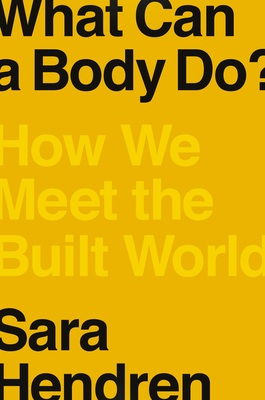
What Can a Body Do?: How We Meet the Built World
Named a Best Book of the Year by NPR and LitHub
Winner of the 2021 Science in Society Journalism Book Prize
A fascinating and provocative new way of looking at the things we use and the spaces we inhabit, and a call to imagine a better-designed world for us all.
Furniture and tools, kitchens and campuses and city streets—nearly everything human beings make and use is assistive technology, meant to bridge the gap between body and world. Yet unless, or until, a misfit between our own body and the world is acute enough to be understood as disability, we may never stop to consider—or reconsider—the hidden assumptions on which our everyday environment is built.
In a series of vivid stories drawn from the lived experience of disability and the ideas and innovations that have emerged from it—from cyborg arms to customizable cardboard chairs to deaf architecture—Sara Hendren invites us to rethink the things and settings we live with. What might assistance based on the body’s stunning capacity for adaptation—rather than a rigid insistence on “normalcy”—look like? Can we foster interdependent, not just independent, living? How do we creatively engineer public spaces that allow us all to navigate our common terrain? By rendering familiar objects and environments newly strange and wondrous, What Can a Body Do? helps us imagine a future that will better meet the extraordinary range of our collective needs and desires.
Winner of the 2021 Science in Society Journalism Book Prize
A fascinating and provocative new way of looking at the things we use and the spaces we inhabit, and a call to imagine a better-designed world for us all.
Furniture and tools, kitchens and campuses and city streets—nearly everything human beings make and use is assistive technology, meant to bridge the gap between body and world. Yet unless, or until, a misfit between our own body and the world is acute enough to be understood as disability, we may never stop to consider—or reconsider—the hidden assumptions on which our everyday environment is built.
In a series of vivid stories drawn from the lived experience of disability and the ideas and innovations that have emerged from it—from cyborg arms to customizable cardboard chairs to deaf architecture—Sara Hendren invites us to rethink the things and settings we live with. What might assistance based on the body’s stunning capacity for adaptation—rather than a rigid insistence on “normalcy”—look like? Can we foster interdependent, not just independent, living? How do we creatively engineer public spaces that allow us all to navigate our common terrain? By rendering familiar objects and environments newly strange and wondrous, What Can a Body Do? helps us imagine a future that will better meet the extraordinary range of our collective needs and desires.
240 pages, Hardcover
First published August 18, 2020
About the author
Sara Hendren
2 books55 followersSara Hendren is an artist, design researcher, writer, and professor at Northeastern University in Boston. Sign up for her newsletter at: http://sarahendren.substack.com. Her book What Can A Body Do? How We Meet the Built World explores the places where disability shows up in design, an inventive tradition of remaking our everyday tools and environments that carries the highest human stakes. It was named one of the Best Books of 2020 by NPR and LitHub. Her work has been exhibited in museums worldwide and is held in the permanent collections at MoMA and the Cooper Hewitt. She has been a National Fellow at the New America think tank, a National Endowment for the Humanities Public Scholar, and a Logan Nonfiction Fellow at the Carey Institute for Global Good.
Ratings & Reviews
Friends & Following
Create a free account to discover what your friends think of this book!
Community Reviews
Displaying 1 - 30 of 126 reviews

June 4, 2021
I've never read a book quite like this; it excels at challenging the reader to rethink assumptions, not just about disabled people but about our own discomfort and unrealistic/idealistic/romanticized psychological relationship with ability, disability, adaptability, and that at some point, we transgress between these worlds or will eventually. My years working with additional needs students was a direct education in grasping that the disabled were being far more patient with the neurotypical and able-bodied teachers, aides, and support staff than even the most patient, compassionate and benevolent of us could be to them; they constantly lived in a world that could but refused to make enough room and adjustments for them. They were always evolving and waiting. Anywho, this reading experience was hard to rate. I got 5+-star reflection from a 4-star reading experience with some rare 3-star sections/approaches. I'll consider this more of a launchpad into disability research and, of course, checking my own standardized physical and intellectual privilege (though ain't nobody really ever "standard" in the sense we so desperately strive to be or emulate). I knew that before reading this too, but a kick-in-the-ass reminder is still appreciated.

August 25, 2020
4.5 stars. I love this book, and I'd love to see expansions of her ideas on disability, bodies, and infrastructure by disabled people.

March 29, 2021
This is a nice primer on disability studies! A number of foundational ideas are explored wrt design, padded with a range of interesting real life examples. It felt more surface level explorations than in-depth treatments, it's not terribly intersectional, and it didn't get loudly anti-capitalist until the last chapter, but u know, pretty good pretty good.

October 21, 2020
Any one who has a body and is curious should read this book! It discusses how we interact with the world and how we adapt to it. This book isn’t about disabilities but is about abilities and adaptations. It opened my eyes to so many new perspectives. Should be required reading for all humans!

October 5, 2020
I heard the audible version as I did not want to wait for the Kindle version to release in India.
I have worked with Sara briefly in the past and I know she has a very wholesome approach to both design and diability but in her book she takes it several notches up. A well researched book which asks some very pertinent questions- what does disability mean? Each one of us becomes disabled at some point whether due to a temporary injury or old age. What does it mean in terms of the built world then?
I particularly liked her discourse on Eugenics and Prosthetics as artifacts. I would like to know more about Interrogative design and the Accessible Icon Project- made me think about how it takes design to the next level from a simple user oriented design philosophy.
I have worked with Sara briefly in the past and I know she has a very wholesome approach to both design and diability but in her book she takes it several notches up. A well researched book which asks some very pertinent questions- what does disability mean? Each one of us becomes disabled at some point whether due to a temporary injury or old age. What does it mean in terms of the built world then?
I particularly liked her discourse on Eugenics and Prosthetics as artifacts. I would like to know more about Interrogative design and the Accessible Icon Project- made me think about how it takes design to the next level from a simple user oriented design philosophy.

December 30, 2020
This is a remarkable book. It offers a smart contribution to the political theory of disability, but unlike so much academic work, it's beautifully and accessibly written. One of its many contributions is the discussion of the unavoidable tension between universal accessibility (e.g., the idea of universal design) and varied specificities of bodies' needs. Hendren isn't the first one to recognize that tension, of course, but her way of writing about it feels novel and eye-opening even for someone who has spent a lot of time studying the politics of embodiment. Definitely one of the most remarkable books of 2020 for me.

October 21, 2025
As an engineer working in the private healthcare sector, I have developed what can only be described as a calcified shell of cynicism and distaste towards tech as a general concept. What Can a Body Do? offers a refreshingly optimistic take on assistive technology as it discusses disability from the perspective of the author, Dr. Sara Hendren, a professor with years of expertise in design and engineering. Dr. Hendren highlights how assistive technology, especially when truly built by and for the people using it, is able to not only bridge the gap between the body and the world, but also broach the question: Who is the world built for? As much as I love to joke about being a Luddite (is it still a joke?? idek), Dr. Hendren offers a compelling view of the world that urges me to remember that technology is a tool that can be as helpful or harmful as the wielder permits. Basically fuck capitalism, love community.

November 26, 2023
The book is a good compilation of how design and technology can build for accessibility and disability. There is rarely anyone who would not have some disability in their life either at birth or due to circumstances such as broken bones or just growing old. How does the built world with it's design and technology both respond to this and engage with the human body and intellect. The book has several anecdotes ans studies on the various ranges of both intellectual and physical disabilities that one might encounter in the world. It asks and provokes one to think deeply about the built world (technology, design, architecture) and how it interacts with the human body whether it is something as simple as navigating the streets or sitting on a chair. The lessons in the book are profound and useful as a start of an exploration of the topic. Much of the book is the learned experience of the author specifically working in this area for decades. I highly recommend this book to anyone who is interested in deign, technology, accessibility and architecture. This book will provoke you to think outside the comfort zone and make you see the world with new eyes. An exceptional read.

October 3, 2025
The kind of book that, for me, thrillingly, builds on some of my own deeply held intuitions and thought fragments, thoughtfully articulating the things I haven’t taken the time to develop. In college I discovered that almost every otherwise brilliant thinker failed this one very simple test: does their thinking (even tacitly) acknowledge the existence of babies? I now call it the No-babies fallacy and it’s sort of like the Bechdel Test, but instead of testing for anti-female bias it tests whether the thinker falls victim to the myth of human individual autonomy or self-sufficiency. Any line of thinking that does not (at least tacitly) acknowledge that we begin our existence utterly dependent on others is misguided. Hendren, in What Can a Body Do, refreshingly aces the baby test, exploring what it means for every human to live along a continuum of dependency. The book is built on the topic of disability studies and design for disabilities but it ends up being so much more than that; it is a potent corrective to our ubiquitous and flawed way of thinking about ourselves and each other.
It is also the type of book that had my neurons lighting up wildly with related pet intellectual associations and people I want to buy the book for. One particularly delightful line of thinking had me mentally cross-referencing the work of Krzysztof Wodiczko, only to find out a few chapters later that Wodiczko is Hendren’s mentor!
5 stars. Highly recommend to almost anyone, but especially if you are interested or invested in design, engineering, architecture, history, language, disability, activism, dependency, community, etc., etc.
It is also the type of book that had my neurons lighting up wildly with related pet intellectual associations and people I want to buy the book for. One particularly delightful line of thinking had me mentally cross-referencing the work of Krzysztof Wodiczko, only to find out a few chapters later that Wodiczko is Hendren’s mentor!
5 stars. Highly recommend to almost anyone, but especially if you are interested or invested in design, engineering, architecture, history, language, disability, activism, dependency, community, etc., etc.
December 10, 2021
A very solid book for those new to disability studies/the disability justice movement(s). That said, it was definitely written with abled people explicitly in mind, and I wasn’t a fan of the subtle Othering of potential disabled readers throughout.

March 27, 2021
Delightfully well written, this book offers a glimpse at what a wide variety of bodies - from those with hearing impairment, ALS, prosthetics, or cognitive impairment - can do. Beyond it's many vignettes that reveal a world not often considered, its strength is how it humanizes all of us in the same reality: we all currently or will someday face the limitations of our bodies. That loss of physical function and how we embrace or cope with it, is a defining part of the human experience, and one that connects all of us, despite the multitude of ways our different bodies encounter the world.
October 16, 2025
This is such a fascinating book about how disability and the built environment intersect. I’m lucky enough to be in Professor Hendren’s class and I’m so glad our class gets to discuss the book together. I’d recommend this book to anyone interested in disability, design, architecture, and diversity.

October 18, 2023
Please, everyone read or listen to this book. I've never learned more in such a concise period of time.

August 6, 2024
really interesting book that challenges what a “normal” world, or built-environment is. who decides how we build rooms, chairs, streets? is all change brought by protest? how does a missing arm affect how you change your kid’s diaper, and how do you support a child in a chair in which they can’t support themself? how do deaf people communicate on a university campus, and how do people with ALS live with independence? questions that are answered in this book. the rating reflects that this book was clearly written by someone in academia, and that’s just not my preferred reading style. I truthfully didn’t finish the book but that’s only because I checked it out from the library and kept going on summer trips. it was getting kinda ridiculous that I hadn’t returned it yet.

September 30, 2022
3.5, reads like a long episode of 99% invisible. This was good for me because it’s palatable and easy to follow. very decent primer on the concept of design for/of disability for (mostly) white people. the author is white and seems to specifically only talk to other white people with reasonable to great access to resources. she makes a very specific point to inform the reader that audre lorde is black, but then doesn’t identify the race of any of her interviewees. idk maybe I’m the weird one but I feel like race is an important concept to consider or at least mention when talking about disability and accessibility.
she writes well and had a great editor. there are some very thoughtful questions and statements. In the beginning, she suggests we accept all objects as assistive/adaptive tools: birth control, a knife, a chair, etc. people take these things for granted because they assist the visible majority.
I’d recommend this most to people are aren’t disabled (yet) or anyone who wants to hear some cool examples of adaptive design. the author is not disabled but her son has downs. she’s a professor of engineering so she goes into some theory (donna haraway - cyborg manifesto, baudrillard - simulacra and simulation +more.) h and b plus a few of the others i looked up are all white. i don’t think white people shouldn’t be allowed to write or have opinions, but I think there are better, more critical, more transparent ways to do it.
The closing line wraps things up nicely. It references the impact of COVID and the elevated presence of disabled people: “The designs in this book, together, pose an enduring question newly augmented by crisis, perhaps, but it was there all along with disabled people right out in front asking, which tools for assistance will we agree to owe each other?”
she writes well and had a great editor. there are some very thoughtful questions and statements. In the beginning, she suggests we accept all objects as assistive/adaptive tools: birth control, a knife, a chair, etc. people take these things for granted because they assist the visible majority.
I’d recommend this most to people are aren’t disabled (yet) or anyone who wants to hear some cool examples of adaptive design. the author is not disabled but her son has downs. she’s a professor of engineering so she goes into some theory (donna haraway - cyborg manifesto, baudrillard - simulacra and simulation +more.) h and b plus a few of the others i looked up are all white. i don’t think white people shouldn’t be allowed to write or have opinions, but I think there are better, more critical, more transparent ways to do it.
The closing line wraps things up nicely. It references the impact of COVID and the elevated presence of disabled people: “The designs in this book, together, pose an enduring question newly augmented by crisis, perhaps, but it was there all along with disabled people right out in front asking, which tools for assistance will we agree to owe each other?”

Read
August 5, 2022Overall this was a nice book and I liked the way it was organized into chapters that had an idea and usually some physical examples.
Things I liked:
* The perspective of disability not being a property of a person, but a property of the relationship between a person and the world, misfit
* How that perspective can broaden the scope of assistive technology from prosthetics to almost everything
* How all technology is assistive technology anyway
* The specific examples from the history of design / disability rights: DeafSpace, Audrey Lorde, curb cuts, the Capitol Crawl, medical dorms
* Stephen putting tape on everything
Things I didn't like:
* Brings up a couple of serious questions re: abortion and what level of honesty is owed to people with mental disabilities, and I feel in both cases kind of skates over them
* The sentence: "I glimpsed, at least, the face of a different clock unfolding to a time somewhere out there, somewhere ahead of now." and friends.
Things I liked:
* The perspective of disability not being a property of a person, but a property of the relationship between a person and the world, misfit
* How that perspective can broaden the scope of assistive technology from prosthetics to almost everything
* How all technology is assistive technology anyway
* The specific examples from the history of design / disability rights: DeafSpace, Audrey Lorde, curb cuts, the Capitol Crawl, medical dorms
* Stephen putting tape on everything
Things I didn't like:
* Brings up a couple of serious questions re: abortion and what level of honesty is owed to people with mental disabilities, and I feel in both cases kind of skates over them
* The sentence: "I glimpsed, at least, the face of a different clock unfolding to a time somewhere out there, somewhere ahead of now." and friends.

January 23, 2021
I did not anticipate how compelling this book would be. This book is a love letter to the author's disabled son, a primer on disability and design theory, and an exploration of the high and low tech tools that are essential for any human to adapt to their environment. I've been finding these kinds of practical utopian books quite appealing as of late. We need new and better ways to imagine a more just future and this book is certainly a step in the right direction.

July 18, 2020
This book looks at the ways the built environment can be reimagined and made accessible, and some of the creative people who are doing so. Bodies shift and change and move in and out of abilities. An accessible and creatively built environment helps everyone (but also, even if it only helps a minority it would be worth it, because everyone has the right to be a part of society).

August 25, 2020
Really lovely book on disability, design, and public infrastructure. Sometimes parents of disabled kids do excellent work.

October 5, 2020
I can't say enough good things about this book. The intro alone knocks it out of the park. Urban planning, engineering, art—it has it all.

October 20, 2020
An interesting intersection on design and disability, new ways to look at the world, and new questions to ask around bodies and the world that surrounds us.
December 4, 2020
Enlightening! At its best, I think, when the work connects the technologies and designs back to philosophies of why we have them in the first place.

April 8, 2022
Excellent read for any designers (or really anyone) who wants to get their feet wet/learn more about disability studies and inclusive design.
The stories were engaging and palpable. I particularly appreciated Hendren's reflexive approach; the brief snippets of their own thoughts and feelings mixed in while telling the rich, contextual misfit experiences provided me a safe space and encouraged me to reflect, break down my own ableist assumptions, and build humility.
The history on eugenics and our society's obsession over being "average" illuminated the harmful realities of what I would normally assume to be a "normal" practice. It questioned what I learned in early career as a designer working in an industrialized, capitalistic world: build fast and fit as many people as possible. We obsess over finding the "average" humans to design for, but there isn't an "average" human being in the first place. Hendren points out the obvious - but not easily realized for those who are able-bodied and entrenched in values of productivity - creative value in learning from lived, misfit experiences. There is so much value in designing for one (which also asks the question of how we make others - particularly those in the industry - realize this?).
Another part that was particularly striking was what I interpreted as the false dichotomy between independence and dependence. By shedding light on how some disabled people would define independence as "self-determination" rather than "self-sufficiency," Hendren touches on what periodically came up and I interpreted as the complexly fluid and compelling thoughts and essence of disabled experiences. I was also enlightened by Crip Time, and how cultural and industrialized meaning of time can be weaponized to discriminate others.
Overall, I learned a lot from reading, and so many stories from the book were engaging, rich, and heart-touching. It provided me with many insights into my own positionality as a designer wanting to work in inclusive design spaces. I will most definitely refer back to this reading, and I hope others get a chance to read this wonderful book.
The stories were engaging and palpable. I particularly appreciated Hendren's reflexive approach; the brief snippets of their own thoughts and feelings mixed in while telling the rich, contextual misfit experiences provided me a safe space and encouraged me to reflect, break down my own ableist assumptions, and build humility.
The history on eugenics and our society's obsession over being "average" illuminated the harmful realities of what I would normally assume to be a "normal" practice. It questioned what I learned in early career as a designer working in an industrialized, capitalistic world: build fast and fit as many people as possible. We obsess over finding the "average" humans to design for, but there isn't an "average" human being in the first place. Hendren points out the obvious - but not easily realized for those who are able-bodied and entrenched in values of productivity - creative value in learning from lived, misfit experiences. There is so much value in designing for one (which also asks the question of how we make others - particularly those in the industry - realize this?).
Another part that was particularly striking was what I interpreted as the false dichotomy between independence and dependence. By shedding light on how some disabled people would define independence as "self-determination" rather than "self-sufficiency," Hendren touches on what periodically came up and I interpreted as the complexly fluid and compelling thoughts and essence of disabled experiences. I was also enlightened by Crip Time, and how cultural and industrialized meaning of time can be weaponized to discriminate others.
Overall, I learned a lot from reading, and so many stories from the book were engaging, rich, and heart-touching. It provided me with many insights into my own positionality as a designer wanting to work in inclusive design spaces. I will most definitely refer back to this reading, and I hope others get a chance to read this wonderful book.

July 29, 2026
“How do you make a charismatic thing—not just a thing that works, but a thing that has elegant presence or pleasure in its handling, some kind of draw, a thing that pulls you in or makes you think while also being handy, modest, even garden-variety in its value? This combination is what makes design so interesting to so many people. It’s not just the quest for a better mousetrap, and it’s not just a free-form experiment, and it’s not just a slick new color scheme for a mobile phone case or a toaster oven. Design calls for all of those things together: trade-offs and opportunities for mixing utility and significance. It’s a mix that’s hard to get right.”
A genuinely beautiful book about the vitality, joy, and hopefulness of creative design for all kinds of bodies. Through sharing specific examples, from a cardboard chair for a toddler to a student union design at a Deaf university, Sara Hendren invites us to imagine a world with more charismatic design solutions for all people, with applicable advice for designers in any practice, to move beyond the chill of universalism to local collaboration. (Big added bonus is that Hendren is also a fantastic writer, which is rare in the field of visual design!) Warmly recommend this to all designers and all those in design-adjacent fields. Your imagination will be refreshed.

March 13, 2021
“Disability studies identifies two mental models that serve as useful contrasts for understanding these relationships between the body and the world. In a purely medical model, the body is the location of impairment, which suggests that the person with the impaired body bears the responsibility for it… A social model of disability, by contrast, invites you to widen the scenario from the body itself to include the stuff around it: the tools and furniture and classrooms and sidewalks that make it possible or impossible for the body, however configured, to do its tasks… In a social model, it’s the interaction between the conditions of the body and the shapes of the world that makes disability into a lived experience, and therefore a matter not only for individuals but also for societies...The condition of disability is present whenever a body finds itself in what scholar Rosemarie Garland-Thomson has called a pointed “misfit” relationship with the world...a disharmony that runs both ways, body to world and back. "
This is one of the most interesting books I’ve read on design. I particularly loved the chapter about the Adaptive Design Association. I found everything from their ethos to the design and fabrication process to be extremely compelling.
This is one of the most interesting books I’ve read on design. I particularly loved the chapter about the Adaptive Design Association. I found everything from their ethos to the design and fabrication process to be extremely compelling.

March 24, 2024
This book ties together themes of disability justice, design principles and accessibility. The author did a great job of presenting the reader with opportunities to reflect on your own privilege and assumptions about different bodies. I liked that she points out that all the “tools” we use are essentially assistive devices and the way she frames “bodies meeting the built world”. It made me think of something as simple as myself needing a stool because that shelf simply wasn’t designed for a person less than average height. She described many fascinating examples of how design of spaces, objects and services plays a key role in people’s experiences of the entire world and how this can be leveraged in both big and small ways. The book definitely lacked an intersectional perspective and I was surprised only took on an anti-capitalist stance towards the end. At times I felt the key points were being lost amidst anecdotes and wordiness but overall very interesting primer on these topics.

February 19, 2021
I thought I was decently aware of implicit design assumptions because of my engineering background but this book further opened my eyes to the bodies the world is designed for. The author took items like podiums, chairs, and clocks and gave examples of people who cannot use them the way they are designed and the workarounds and innovations they use instead. She mixed stories of individuals with larger history and context in a way that kept my interest as a reader. It helped to have individual stories to remember that each end user is a unique person affected by the product in unique ways. At the same time, the context shows how widespread the issues can be and where progress has been made. This is a book for everyone - not just designers/engineers - because we can all play a part in designing the world.
This book is a great introduction to the interfaces of design and disability with the aim of an inclusive good life for everyone. I am excited to read more about these issues in the future, especially (as the author recommends) from those with firsthand experience.
This book is a great introduction to the interfaces of design and disability with the aim of an inclusive good life for everyone. I am excited to read more about these issues in the future, especially (as the author recommends) from those with firsthand experience.

August 20, 2025
Ahh how grateful I am to have read What Can A Body Do?: How We Meet The Built World. How grateful I am to Sara Hendren for writing it and for all the listening and learning and intentional living at it's foundation. Hendren artfully systhesyses perspectives and illustrates complex concepts in a consistently engaging, open and compassionate manner. Not only did I learn much, but the book also invited deeper curiosity about both the structures I interact with on a daily basis as well as the many ways of being a body in this world. I certainly have more I now wish to read and seek. What a gift!

May 3, 2023
This book is such an important work on how design can be really important in how ALL our bodies meet the world. The book focuses on tangible objects, but through the objects and their role as mediators between bodies and wider world, so much culture, theory and deep concepts we live by, are explored. A rich easily read book to put disability into its proper context and help you start exploring further.

August 3, 2022
A really interesting book that spoke to some of my favorite topics - engineering, health, and social justice. I found the chapters on autism and city planning (e.g. desire trails and crosswalks) to be the most interesting.
Displaying 1 - 30 of 126 reviews