Tommaso Landolfi, Italy's most extraordinarily idiosyncratic storyteller, has been compared to Kafka, Joyce, Borges, and Poe; his fictions are a striking blend of fact and fantasy, the disturbing and the playful. This wonderful collection of twenty-four stories is unpredictable, funny, bizarre, and, especially, imaginative: a writer innocently brushes his teeth and out spill dozens of mutinous words, demanding new meanings; a man pursues a perverse fantasy inspired by the sight of a woman's breast; a struggling poet discovers, to his horror, that he has been composing in a nonexistent language. Sharply observed details, startling whimsy, and a subtle seriousness inform these tales that test the boundaries of language and invite us to view existence in a different light.
Titles within: - Introduction: Precision and Chance, by Italo Calvino - The Labrenas - Chicken Fate - Two Wakes - The Kiss - Gogol's Wife - The Werewolf - The Provincial Night - Maria Guiseppa - Uxoricide - The Test - The Ampulla - A Woman's Breast - The Eternal Province - Prefigurations: Prato - Literary Prize - The Grace of God - Prize in Spite Of - Rain - The Eclipse - The Gnat - An Abstract Concept - Personaphilologicaldramatic Conference with Implications - Dialogue of Greater Systems - Words in Commotion - Translators Afterword
Tommaso Landolfi was an Italian author, translator and literary critic. His numerous grotesque tales and novels, sometimes on the border of speculative fiction, science fiction and realism, place him in a unique and unorthodox position among Italian writers. He won a number of awards, including the prestigious Strega Prize.
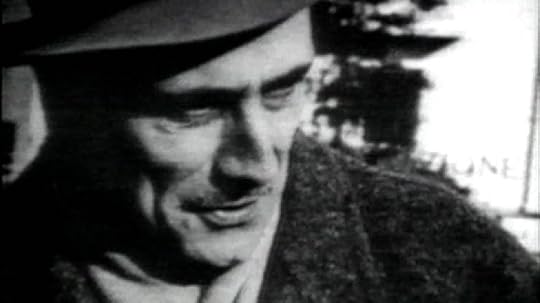
Born into a family of nobility, Tommaso Landolfi was an erudite man of letters - novelist, teller of tales, translator of Russian and French literature as well as a literary critic at large. He was also a reclusive, eccentric, peculiar gent addicted to gambling at the casinos.
This collection contains a most informative introductory essay written by Italo Calvino, a personal friend of Landolfi. Calvino's essay provides ample historical, cultural and literary context for Landolfi's writing.
The twenty-four stories in this collection may be read on many levels of meaning and analysis, or simply read for sheer enjoyment, enjoyment because these stories, which can be as fantastic, obsessive or horrific as the tales of Poe or Borges, are accessible and lots of fun. Personally, I'm always up for highly literary fiction that's also fun.. Thank you, Kathrine Jason, for your clear, easy-to-read English translation.
To give a taste of what is to be found in this collection, I offer the following comments on five of my favorite:
CHICKEN FATE Told with tongue-in-cheek humor, this tale begins with a strong sense of foreboding as two chicken farmers, Ted and Joe, talk about how their new hormone-rich chicken feed is causing some serious changes in their chickens.
Joe begins by reporting how a chicken even looked at him as if the chicken was a human and not a chicken. The story moves along apace and Ted and Joe find out just how huge and how human-like their chickens turn out to be having eaten all those high-power hormones.
THE KISS A tale of horror, where a notary and bachelor who is "hopelessly timid with women" is visited by a incorporeal creature who gives him kisses.
The story becomes progressively more fantastic, reaching a crescendo as we read, "On the last night, a gigantic, overturned chasm opened before his eyes - his body and soul - a grayish whirlpool like a matrix or a conch; it loomed, and from the apex of its spiral, it beckoned to him."
What is really beckoning to the notary? Is it his own sexuality? His own fear of women? His fear of death? --- Or, perhaps all of these. This story reminds me of a number of scenes from Fillini's film - City of Women.
THE WEREWOLF A short-short story about two werewolves and their relationship to the moon told in first-person by one of the werewolves, a story that is something of a spoof on a traditional werewolf tale. The werewolf narrator tells us how his friend returns to their house one night carrying a bright round object, an object which turns out to be the moon. The werewolves refer to the moon as "she," a disgusting and an evil thing. They go ahead and stick the moon under the hood of their chimney. The moon immediately attempts to pass up through the flue. "Perhaps she had to compress and deform her flabby little body to pass through; foul droplets of liquid hissing into the fire." But this is the moon, after all, and the universe ultimately gets its own way. At every step throughout the story we are given the werewolf-narrator's running philosophy about fate and freedom. What a treat!
UXORICIDE "Murdering people is easy. I have never understood all the fuss murderers make, or why they still haven't brought off or perpetrated the perfect crime; it must be simply that they haven't studied their victims closely enough." So Landolfi begins this story with tongue even deeper in his ironic cheek. The author's narrator goes on to tell us how he bound and gagged his wife before proceeding to verbally attack her in ways that would surely bring on her heart attack. Told with the panache of an aristocrat, every line of this story is laugh-aloud funny.
WORDS IN COMMOTION One morning, after brushing his teeth and spitting out the mixture of toothpaste and saliva, the narrator relates what he sees, "I don't know how to explain this: not only were they words, but they were alive and darted this way and that in the sink, which, luckily, was empty."
He then has a running dialogue with a half dozen squiggly words before trying to gather them up. We read, "They didn't want to cooperate and put up a struggle, trying to befuddle me, but I forced them to explain themselves point by point. But they didn't want to be caught, to say the least, and fled every which way, so I caught and squeezed them in my cupped palm. Now it is one thing to live as a member of the decaying aristocracy, it is quite another to have the toothpaste and saliva you spit out transform into talking, unruly words right there in your very own sink, providing you with first-hand experience of decaying reality."
Ever since I read this outrageous story I have always wondered how I would react if my toothpaste transformed into a string of unruly words right there in my sink.
Twenty-four short stories divided by the publisher into fantastic, obsessive, dialogues, horrific, etc., so we can quibble about how each should be a different category. Some are Poe-like, and some are science fiction in a style that reminds me of Twilight Zone.
The Labrenas (a type of lizard) is a Poe-like story in which a man who is terrified of the creatures gets one in his mouth and dies. Actually he goes into such a comatose state that he is presumed dead and given a funeral. Now he’s alive but inert, trapped in his coffin. The good news is that he gets out. The bad news is that the horror is just beginning.
Chicken Fate is science fiction, a kind of Twilight Zone story of over-hormoned chickens turning the tables on the poultry breeders.
In Two Wakes, a man truly loved his dead wife. But when she comes back as a mouse he decides he’s gotten used to having her dead and takes appropriate action.
In the Kiss a timid bachelor is visited nightly by the ghost a beautiful spirit who starts sucking the life out of him with her kisses.
Gogol’s Wife is perhaps the best-known story because that is the title story of another collection of his shorts. A man has invented an inflatable woman with a Stepford-wife personality. But she starts evolving from there. This doesn’t end well.
Some stories I’ll call Alfred Hitchcock-like. For example, in The Provincial Night, a kids’ game at a small town party results in a real murder. In Maria Giuseppa, a crazy man can’t stop himself from abusing his unattractive, simple-minded servant woman. In The Eternal Province a man uses his prosthetic leg almost as a weapon to humiliate women.
Some of the stories are entirely dialog. Several are low- or no-plot literary stories in which the author takes shots at the foolishness of literary prizes, literary conferences and critics. In the title story, a man starts spitting words out into the sink with his toothpaste.
As you might expect, these stories are very mixed in tone and quality. From what I’ve read about the author, he was a loner, an eccentric and a borderline misanthrope. I guess that gives you an edge in writing stories like these.
(photo from a blog for the course AAD 250 at blogs.uoregon.edu)
Some real clunkers in here, alongside a few interesting stories. He’s funny and extremely capable ... just seems he had a hard time focusing his energies.
good, but seems like b-side collection alongside his two other collections(these stories personally selected by Italo Calvino who also writes the intro), dark, obsessive fabulism from the obscure italian master...