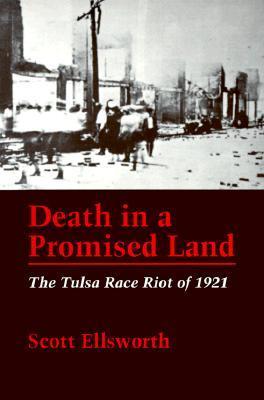
Widely believed to be the most extreme incident of white racial violence against African Americans in modern United States history, the 1921 Tulsa Race Massacre resulted in the destruction of over one thousand black-owned businesses and homes as well as the murder of between fifty and three hundred black residents.
Exhaustively researched and critically acclaimed, Scott Ellsworth’s Death in a Promised Land is the definitive account of the Tulsa race riot and its aftermath, in which much of the history of the destruction and violence was covered up. It is the compelling story of racial ideologies, southwestern politics, and incendiary journalism, and of an embattled black community’s struggle to hold onto its land and freedom. More than just the chronicle of one of the nation’s most devastating racial pogroms, this critically acclaimed study of American race relations is, above all, a gripping story of terror and lawlessness, and of courage, heroism, and human perseverance.
Scott Ellsworth is the bestselling author of several books, including The Secret Game, which was the winner of the 2016 PEN/ESPN Award for Literary Sports Writing. He has written about American history for the New York Times, the Washington Post, and the Los Angeles Times. Formerly a historian at the Smithsonian Institution, he is the author of Death in a Promised Land, his groundbreaking account of the 1921 Tulsa race riot. He teaches at the University of Michigan.
Things I learned in history class as a student in Oklahoma: how to fold a paper map; the first governor of Oklahoma was an eccentric man who preferred to work in a log cabin.
What I should have learned in history class as a student in Oklahoma: the Osage murders; the Tulsa Race Riot.
This should be required reading for Oklahoma students, and for anyone wanting to learn more about race relations throughout American history. This would honestly be a good curriculum supplement for anyone teaching To Kill a Mockingbird.
The importance of this slim volume of history far exceeds its page count. With an introduction by noted historian John Hope Franklin and based on many interviews and much archival research, native Tulsan and scholar Scott Ellsworth chronicles the factors that led to the Tulsa Riot of 1921, the events of the riot itself, and the salt-in-the-wound aftermath from a city that outwardly promised to rebuild Greenwood but in fact left it to the black Tulsans who had been burned out of their homes and businesses. With a historian's accuracy, he describes what is known and what is unknown about this terrible event.
From his research in the late 1970s Ellsworth limns the difference in black and white narratives about the riot fifty years later and how at the time of the riot black citizens of Greenwood fought back to defend their neighborhood against white attackers. He doesn't mince words in laying blame at incendiary columns published by the Tulsa Tribune, a paper published from 1919-1992. And in particular, he notes, as I reference in my end-notes for STRIKE PRICE, that all copies of the May 31, 1921 issue with these columns have disappeared, in the style of an Orwellian 1984 memory hole. No paper copies of the columns, no microfiche, nothing.
Quoting from Death in Promised Land: "It is clear that the single most important precipitating ingredient in the Tulsa race riot was the manner in which the Tulsa Tribune "covered" the Rowland page incident. Indeed, the newspaper's specific coverage, and not what actually transpired in the Drexel building, is THE incident."
Last year (2021) was 100 years since the Tulsa Massacre occurred, and as such, a lot of people like me learned about it for the first time. (Which in itself is a damn shame, and why I have been reading books like these to educate myself... or at least try.) I had previously read The Burning: Massacre, Destruction, and the Tulsa Race Riot of 1921 last year, and added this book around the same time.
I'm glad that I waited a year before reading this one though, because I think I would have been disappointed by this one had I read it closer to the time I finished The Burning. That's not to say that this BOOK was disappointing, because it wasn't. It was just a different experience.
I think part of that was due to when these were written. Death in a Promised Land was originally written in 1982, and revised/rereleased in 1992; The Burning was originally written in 2001 and revised/rereleased in 2021 - just before the centennial anniversary of the massacre.
Where The Burning was more novelized and written to tell a compelling character-based story, Death was more fact and event based. And both absolutely have merit, and I would argue that Death ticks the boxes I prefer in non-fiction a bit more for not embellishing and tweaking the heartstrings as much - but we are human, and humans love a story.
This book focused a lot on the culture of lynchings, and the complicity - if not active involvement - of the local politicians, judiciary, and law enforcement in them. There were exceptions, like the guards at the jail who tried to prevent the accused "attacker" from being taken and lynched, but they half-assed it and didn't take opportunities that were given them to really be effective in their goal.
I admit to being a little confused at the beginning of this book as to where the author was going with this. From it being subtitled with "race riot" (which I refuse to use, because it was the narrative used to make this seem like it was the Black community's fault, and I'm not contributing to that), and him delving into the authorities' positions on Greenwood and justifications for lynchings and so on, I was a little concerned that this was going in the wrong direction, but not long after that, I realized that he was just laying groundwork for what would happen.
I definitely recommend both books, but it is worth noting that they feel like very different reads. They both cover much of the same ground, but in different ways.
Shocking account of Black Wall Street, one of America's most prosperous communities in 1921 and target of the worst race riot in U.S. history. Of the 5 books I’ve read on the topic, this one is the slimmest volume. It’s also the first book written on the massacre, and the one subsequent authors cite the most. The book's 2 most outstanding features are a map of Central Tulsa from 1917-21, and a comprehensive chart of Greenwood's black-owned businesses and social fraternities. Ellsworth was former lead consult to the Oklahoma commission on the riot, and still considered its foremost historic authority… so for anyone interested in this event, this short book is not to be missed.
This is the first book I’ve read on the 1921 Tulsa Race Massacre. It is an excellent introduction to the subject - short (about 100 pages), compelling, and includes important information about events preceding and following the massacre itself. Written by a historian who grew up in Tulsa, and first published in 1982, it holds up very well. I highly recommend it to anyone who wants a starting point to learn about the massacre.
This is also an excellent introduction to how white supremacy works in the United States - through formal and informal power structures.
Some key takeaways for me were:
- a basic overview of some of Tulsa and Oklahoma’s history that I knew nothing about. For example, the attempts, starting in the 1880s, to make it an all-Black state.
- the vigilante violence against socialist union organizers that set some of the ground work for the massacre was fascinating and horrifying/demoralizing
- Ellsworth makes it clear that the white power structure in Tulsa was not only responsible for the massacre itself, but also for trying to further exploit Black Tulsans following it: by interning them, blocking aid from outside Tulsa, and then passing a law to make it illegal for them to rebuild (in an effort to steal their land). This made me so so angry
- I want to learn much more about the history of Black Tulsans and Black Oklahomans. This book briefly mentions some specific figures who I really want to learn more about.
Reading this book this weekend, during the 100th anniversary of the massacre, really messed me up. I was so incredibly moved by reading this.
I really don’t understand how anyone who reads this book and has a basic understanding of the events of the race massacre can, in good faith, oppose reparations for the Black Tulsans who lived through this and their descendants.
I read two books about the same event simultaneously (the other being The Burning: Massacre, Destruction, and the Tulsa Race Riot of 1921) because I felt this was such an interesting and horrifying piece of American history that I had to learn as much as I could. Sadly, there aren't too many books about the events of this day in 1921. Luckily both books I read were excellent. This book was shorter and not as personal, but it was the first account of book length to be written (1984) about the race riot in Tulsa (it took FAR too long for these stories to be told thanks to KKK influence, fear of retribution from riot survivors, and fear of prosecution for those who committed the atrocities that day). Therefore, it makes sense that it wouldn't have all the possible stories and the greatest amount of details. I read it before "The Burning", and it gave me a great basic understanding of what Tulsa was like in the early 1900s as well as the basics of what happened, preparing me to continue learning about this important topic.
Should be required reading for all Oklahoma high school students - I know it’s more useful than Cold Sassy Tree or The Old Man and the Sea, and would easily pair with To Kill a Mockingbird.
death in a promised land (sick title btw) offers a brief overview of the tulsa riot itself and instead focuses more heavily on the before and after: the socioeconomic situation in the city & the racist incidents from prior years that allowed it to happen, and the (also racist) reaction of the white community & the municipal powers in the aftermath. really, ellsworth is here trying to explain that the tulsa riot wasn't some isolated random act of terrible violence, but a culmination of the american racism.
plus propaganda. ellsworth is very clear that if a right-wing newspaper wrote about the incident which sparked the riot differently, the whole thing might have been avoided. (miraculously, we have zero printed copies of the newspaper from that specific day...)
My boyfriend bought this, but I ended up reading it. It was infuriating and unsurprising, but I am glad I have the knowledge now to discuss this with a more full understanding should it come up, and to bring it up if it ever seems wise. The way that black people were mistreated here goes well beyond even what has come up about it in recent years. As the riots broke out, as their homes were looted and burned to the ground, they were rounded up and put in various detentions camps throughout Tulsa, unable to even protect their own property. Then, they were kept in the detention camps until a white person vouched for them, some of them for up to a week, at which point they were able to return to find their home destroyed. Then, they were blamed for the riot. The councils of Tulsa publicly proclaimed that they would take responsibility for what had happened and rebuild black Tulsa, and used this proclamation of personal responsibility as a means to turn away any proffered help. They never did help rebuild, of course. They instead passed a city ordinance proclaiming that buildings re-built in the black section of Tulsa would need to be two stories and made of brick. The black citizens had lost everything and did not have the means to do this; the white citizens wanted to instead buy the land off them and build a new railway depot, essentially kicking the black citizens out to the outer bounds of the city. By the time the black citizens won a legal case denouncing this ordinance, it was too late for most of them to rebuild before winter, so a large collection of black citizens had to spend the winter in tents. They were failed in every single way by the city, its police force, and the people in charge, and blamed for this. Utterly infuriating. I recommend this book.
3.5 stars. Audio book. Yet another history book that looks closely at yet another horrible race incident in the United States. I continue to struggle with history books as I will never remember all the facts, figures, names etc. I also can’t figure out how an historian can remain so dispassionate about what transpired in Tulsa in 1921. The fear, human carnage and travesties that occurred those 24 hours was not truly conveyed imho. What was interesting about this book is that it did address the aftermath and reconstruction of the Greenwood Ave neighborhood and the continued injustices that White Tulsa enacted in this Black neighborhood. I wish there would be an update to this book that looks at what has happened in Greenwood through today. That area has become a trendy business district and I wonder - Is it White or Black owned?
A scholarly (and relatively brief) history of the Tulsa massacre on June 1, 1921. I read this book after “The Burning” by Tim Madigan, but in hindsight would recommend reading this first as it’s drier and more factual versus Madigan using some creative license to make The Burning a more enjoyable read. This book was also published decades before Madigan’s book and provides solid groundwork on the massacre before being added upon by the more recent research undertaken by Madigan.
One note: as a scholarly book, the notes (partially a bibliography) and listed sources of this book are fantastic and have led me to numerous other books I plan to read.
My third recent read on the 1921 Tulsa race riot that leveled the Greenwood section of that city over the course of two days. Scott Ellsworth was among the first to critically research the events and bring them to light through this book. It's a wonderful complement to "Riot & Remembrance" by Hirsch and "The Burning" by Madigan, and more brief than either for those who are interested in the subject but want a quick survey. Meticulously researched and footnoted, it illuminated the roots and the impact of a sad piece of American history.
Ellsworth’s book is a tremendously researched and reported account of the Tulsa Race Riot of 1921, tracing the prelude, incident, and aftermath of the titular affair. It’s a very quick read, as well. Highly recommended.
Like many people my age, I did not learn about the Tulsa massacre when I was growing up. I tucked Dr. Scott Ellsworth’s book, Death in a Promised Land on my reading list and it seemed like a fitting choice during Black History Month. Dr. Ellsworth is a history professor at the University of Michigan, but he approaches the subject of Tulsa’s Greenwood District like a journalist, unpacking layer after layer to unfold the story. The result is a quick yet informative pace, and I recommend Death in a Promised Land for anyone who is looking to learn more about Tulsa’s 1921 tragedy.
Here are some of the points I learned and found interesting from Dr. Ellsworth’s book:
Ellsworth gave a helpful blend of personal stories accompanied with a historian’s description of the Greenwood District in Tulsa. 1,000 homes were destroyed in the 1921 riot, including the entire Greenwood District. Further, Ellsworth noted that Tulsa was not a unique occurrence, and similar attacks happened from coast to coast with a heavy concentration in 1919 (known as Red Summer). The two year stretch from 1917 to 1919 brought some of the largest and most widespread race riots in U.S. history. Lynchings, burning at the stake, and other barbarisms occurred against black Americans. Tulsa was a culminating event.
Tulsa experienced incredible growth in conjunction with the oil boom. The city’s 1909 business directory listed 126 oil companies in the city. The combination of oil and agriculture prompted the city to became one of the largest in the southwest in a staggeringly short amount of time. When statehood arrived in 1910, the black population was 10% and the city included black Tulsans worked in fields throughout the entire city. Despite the growth and elements of integration, the strength of segregation led to a concentrated area known “Black Tulsa.”
In addition to describing race-based attacks across the United States, Ellsworth described three events that set the stage for the 1921 race riots. They were:
The 1917 bombing of the home of J. Edgar Pew, a wealthy oilman, which was pinned on the Industrial Workers of the World (IWW). The IWW was a labor union with anarchist branches within its ranks. The Tulsa World claimed the bombing was part of an IWW plot, and the paper responded by encouraging vigilantism to flush out the culprits. This helped normalize violence by the citizenry.
The March 17, 1919 shooting of iron worker O.W. Leonard led to his death but also a dying statement that two black men had shot him. Three black men were arrested, and after the funeral, rumors circulated of a mob converging to lynch the defendants. A group of armed black men went to the jail to confirm their safety and tensions briefly faded. Yet soon after, a white armed group was threatening black Tulsans. No violence erupted, but Ellsworth points to this event as an indicator on how tense race relations were.
Event #3 occurred on August 1, 1920 when a white cabbie, Homer Nida, was hired and clubbed on his head, then shot and robbed. Before dying, Nida identified Roy Belton, a white man, as his murderer. The police then stood by and oversaw a lynching of Belton as a large crowd of hundreds watched the event. The events combined to normalize mob law.
Dick Rowland was a 19-year-old shoeshiner, whose arrest prompted the race riot. Rowland was riding up an elevator that was operated by a 17-year-old girl, Sarah Page. The record of what happened is conflicting. A clerk said he observed Rowland assaulting Page. Rowland claimed he tripped and fell into Page. Page declined to prosecute, but Rowland’s arrest began a chain of events that culminated with the destruction of the Greenwood District.
Rowland was arrested the next day, and a white crowd gathered at the jail where he was being held. This mob prompted a rumor that they had lynched Rowland, which led to a black mob gathering. Shots were fired, and everything spiraled with a group of rioters invading the Greenwood District. The results were total devastation.
Death estimates range from 27 to 75 to 175+. Here is the evidence for higher numbers. Funeral we’re banned in the city after the riot because churches were being used for homeless shelters. Further, gravediggers hired in the subsequent days billed for 120 graves for buried victims and further records of people incinerated during the numerous fires in Greenwood. The property estimates include figures from the Tulsa Real Estate Exchange, which tallied $1.5 million, with a large percentage in the Greenwood business district. They also estimated $750k in personal-property losses. Irrespective of the estimates, even the most conservative estimates should shock the conscience. As David French once wrote, we should undoubtedly remember the greatness in American history—the courage and virtue of our heroes. Yet “if it is right to celebrate, it is also right to mourn…Unless we remember our worst moments, we simply can’t truly understand our own nation, nor can we relate to all its people.” History let us connects us to the past and helps us understand today, but it also helps us shape the future. The Tulsa Massacre is a history we should not forget.
One of the most frustrating elements of the Tulsa Race Riot is how skeletal the story is. There is a clear record of devastating evil, by any estimate. Yet the details are surprisingly murky. Alva J. Niles, President of the Tulsa Chamber of Commerce, made the following statement after the riot: “Tulsa feels intensely humiliated, and standing in the shadow of this great tragedy, pledges it’s every effort to wiping out the stain at the earliest possible moment and punishing those guilty of bringing the disgrace of disaster to this city.” Niles also promised to make proper restitution and order to the city, yet the nature of the history and its decades of the story remaining a veritable secret of American history suggests the focus was more on alleviated the humiliation and stain rather than healing the wound. There are records of relief offers pouring in from across the country, and the city instead set a policy that “Tulsa was responsible for the disaster and Tulsa would bear the burden.” Thus outsiders largely stayed outside during the riot aftermath. This meant no outside oversight as the city moved forward. One can’t help but suspect that moving forward in such a manner left Tulsa’s victims in a far lesser place.
Death in a Promised Land is an excellent primer by Dr. Ellsworth, and I recommend the book as a quick and informative read. Too often when I read about the early 20th century, the focus is on WWI, but the beauty of history is that there is always more to explore, and this subject is one that deserves grappling. To continue David French’s theme, remembering both the greatness and the evils of history “gives us the motivation and the inspiration necessary to repair our land.”
40 years after its initial publication as the first book-length history of the 1921 Tulsa Race Massacre, Death In A Promised Land remains a great example of concise and highly-readable history.
Ellsworth deftly presents a wealth of information about what happened before, during and after this tragedy into this single volume.
If you're looking for a good starting point for learning about the 1921 Tulsa Race Massacre, Death In A Promised Land is highly recommended.
This book on the most tragic time in the history of Tulsa was intriguing to me. I enjoyed reading about how one little racial incident in a department store elevator drew a crowd of black people who wanted to seek justice for the way white people were treating them. It was black pride which caused the black neighbourhood of Tulsa to be utterly destroyed in 1921. The black community would rebuild after this tragedy. This book was well-written, which pleases me.
In depth look at the race riot in Tulsa and the events in Tulsa and the general atmosphere in the U.S. and particularly Oklahoma leading up to those events. Growing up just a couple hours from Tulsa we learned nothing about these events in my U.S. history courses.
If you never knew that Tulsa, Oklahoma experienced racial strife, then you need to read Scott Ellsworth's book, Death in a Promised Land: The Tulsa Race Riot of 1921. Ellsworth provides details about the racial tension between black and white Tulsans, which eventually led to the 1921 riot. But before this infamous upheaval, Tulsa's black community was extremely successful. This is evident as there was not one but two churches that served this population: "Vernon African American Methodist Episcopal Church and Macedonia Baptist Church" (Ellsworth 12). Moreover, Black Tulsa, as it was known, had prominent citizens and successful businesses. Black Tulsa was rapidly growing, "and by 1921, there were almost 11,000 blacks and the community counted two black schools, Dunbar and Booker T. Washington, one black hospital, and two black newspapers, The Tulsa Star and the Oklahoma Sun. Black Tulsa at this time had some thirteen churches and three fraternal lodges--Masonic, Knights of Pythias, and I.O.O.F.--plus two black theaters and a black public library" (Ellsworth 14). Due to this success, Tulsa's black business district became known as the 'Negro's Wall Street'" (Ellsworth 15). Unfortunately, the looming destruction of this thriving community was swiftly approaching. Find out what happened to this once successful district. However, as you read this book, be prepared to experience feelings of disgust, sadness, and anger.
Consisting of only five chapters, this book is not difficult to read. However, it is the content that makes this book challenging to read. Simply put, Ellsworth does not sugar coat this information. In addition, after reading Death in a Promised Land: The Tulsa Race Riot of 1921, I am motivated to learn more about this tempestuous period in Tulsa. Hence, I will read some of Ellsworth's listed sources that I recorded in my "to be read" list and other published books about this topic. Lastly, remember that it is important to learn about and understand our history so that we, as American citizens, can improve the country in which we live.
A huge thank you to Stace for recommending this topic to me. Love you much!!!
First read this book in the civil rights class I took in the fall of 2017 (best class I’ve ever taken, btw). I had never heard of the Tulsa riot before, but in subsequent years I was glad my professor had introduced me to this book (and many others). Revisited it for the 99th anniversary of the riot and amidst the current wave of protests against police brutality. Ellsworth does an incredible job telling the story of Tulsa circa 1921, from the (numerous) factors which led to the riot, the day of June 1st itself, and the Black community’s revival in the years that followed. Clear and exhaustive, it’s another one of those books that makes me a better writer and historian just by reading it.
I believe Mr. Ellsworth did a very commendable job documenting a terribly difficult subject. I found his closing essay on resources to be nearly as interesting as the subject narrative. He did a great deal of research. I believe every Tulsan should learn more about the Tulsa Race Massacre.
I began this book well before the current unrest, and finished it today by coincidence. Still find it fitting considering the anniversary.
A real eye opener. I grew up in and around Tulsa. The riot was never mentioned in school that I recall, but I heard background noise about it. I had no idea of its scope. Ellsworth does a great job of setting the background, then presenting and evaluating the available evidence of what happened. The black community included quite a few veterans of WWI who fought back effectively.
This was not a part of the American History courses I took
Thesis book furthered my personal exploration of an American history I'd not been aware of. Our nation is repeating mistakes of the past. The author makes painfully clear that we have not learned from our mistakes but instead trudge forward in the murk of racist ideologies remaining steadfast in our ignorance.
Well written and researched book about one of the darkest moments in Oklahoma history. Read the book while conducting research on a paper I wrote as an undergraduate history student and it had some great details! Short and easy-to-follow read!
Ellsworth, Scott. Death in a Promised Land: The Tulsa Race Riots of 1921. Louisiana State University Press: Louisiana, 1982. Scott Ellsworth’s Death in a Promised Land: The Tulsa Race Riots of 1921argues that the Tulsa race riots resulted in overlooked implications for the development of African American societies in Tulsa and Oklahoma. It establishes that many narratives of the riots disarm the multifaceted and cataclysmic culmination of racial tensions in Oklahoma by observing them solely in a Tulsan context, despite their being a reflection of American society overall. This ideal is utilized to create a narrative regarding how the past can yield itself to being a framework for identifying and tackling societal inequities when it is accepted and studied (7). Ellsworth linked early Tulsa to the political, economic, and social stressors that molded the United States, touching on the dangers of historical malleability to conclude that the precedent set forth by the perspectives of Tulsa’s past race riots speaks towards society’s cognitive dissonance (98). Death in a Promised Land traces the gradual degeneration of Tulsa into paradox as its promises of opportunity wane for the African American community with the immigration of White Americans and the importation of segregation. Tulsa’s boom, the development of industry, and its burgeoning infrastructure exasperated the growth of accessible opportunity, but ironically diminished the capacity of African Americans to pursue said opportunity as they were forbidding from patronizing white establishments (14). This leads to a volatile racial climate that strengthens the narrative through its detailed depiction of the spread of segregation and racial tensions into Oklahoma as they became entrenched in its government and society (17). The description of Tulsa’s racial climate also strengthens Ellsworth’s work through its depiction of the African American responses to growing racial violence, illustrating their political and economic agency through their resistance towards the loss of civil rights and socioeconomic power. This resistance consisted largely of the preservation of a separate black Tulsa, which supplied the needs of African-Americans (19). The scope of racial climate also allows for the identification of nuanced factors that led directly to the Tulsa riots, including the following: the resurgence of violent white supremacy, White Americans invading Black neighborhoods, African Americans reacting according to the doctrine of self-defense, aspects of mob rule, and how unjustified lynching escalated racial tensions to an intolerable state. (52). Ellsworth maintains bias, but is justified as it is directed against racial inequality and injustice. Still, the narrative he creates is weakened by the comparison made between the methods of slavery and racial treatment of black individuals by Native Americans and White Americans because of the inability to accurately gauge acculturation (19). Ellsworth draws from numerous primary and secondary sources, utilizing newspaper articles and eye-witness accounts to depict the reality of Oklahoman, Tulsan, and American society in the 1920s. Reference sources are also utilized to trace aspects related to political injustice, trade, and relief efforts. The first sentence that peaked my attention in Ellsworth’s narrative was “opportunities for young black men in Tulsa in 1921 were severely circumscribed, regardless of education (45).” This sentence attracted my attention because of its potential impacts on black society. It poses the historical question of what implications do past circumscriptions of opportunities for African Americans have on America today. The second sentence that attracted my attention was that of “the 1917 IWW incident revealed how disastrous the consequences could be for a group of Tulsans if the power of an influential newspaper, the city government, and the local courts and police was brought to bear against them.” I chose this sentence because of its description of a situation where all legal routes of defense have been exhausted. This prompts the historical question of where does one turn whenever all proper and just routes of justice have been wielded unfairly against ones position (33).
Publisher's Description: When a crowd began to gather outside the jail in Tulsa, Oklahoma, on the evening of May 31, 1921, the fate of one of its prisoners, a young black male, seemed assured. Accused of attempting to rape a white woman, Dick Rowland was with little doubt about to be lynched. But in another part of town, a small group of black men, many of them World War I veterans, decided to risk lives for a different vision of justice. Before it was all over, Tulsa had erupted into one of America's worst racial nightmares, leaving scores dead and hundreds of homes and businesses destroyed. Exhaustively researched, Death in a Promised Land is the compelling story of racial ideologies, southwestern politics, and yellow journalism, and of an embattled black community's struggle to hold onto its land and freedom. More than just the chronicle of one of the nation's most devastating race riots, this critically acclaimed study of American race relations is, above all, a gripping story of terror and lawlessness, and of courage, heroism, and human perseverance.