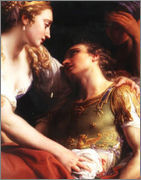
All for Love or, The World Well Lost is John Dryden's 1677 adaptationof the tragedy of Antony and Cleopatra into a neo-classical quintetwith supporting After Cleopatra's desertion of Antony at thebattle of Actium, not only his wife Octavia but also his generalVentidius and his friend Dolabella strive to win him over to theirside. Antony, torn between the claims of duty, friendship, dignity andlove, despairs when he hears the rumour of Cleopatra's death, which isnot, as in Shakespeare's version, spread by the queen herself but byher deceitful eunuch. This edition includes Dryden's dedication of theplay to the Earl of Danby and his preface, in which he defends againstFrench neo-classicist strictures the liberties he took with hissources; it further discusses the play's austere power in the theatre,which is unjustly considered to be inferior to Shakespeare's quitedistinct version of the story.
John Dryden was an English poet, literary critic, translator, and playwright who was made Poet Laureate in 1668. He is seen as dominating the literary life of Restoration England to such a point that the period came to be known in literary circles as the Age of Dryden. Walter Scott called him "Glorious John."
Comparing poor Dryden with Shakespeare , definitely shakespeare is going to shine in contrast . If you want to read about sentimental love and romance this is the play for you BUT if you want to read an open debate then surely Shakespeare is your right guy.
Neo-Classicism prevailed during the restoration age when Dryden wrote this play in 1667. At this time new theatres were built completely different from Shakespeare’s time .
In Shakespeare’s time the most famous stage was The Globe Theatre it was a bare stage , round and surrounded by all the people which created this intimacy and interaction between the audience and the actors , they didn’t need lots of settings it was enough for an actor to jump on the stage saying to the audience: I am in Athens .
In contrast , the new theatre which is called Proscenium Arch where the audience face it only from one side , So they had to draw something in the background , they would create settings and tableaus on the stage , this somehow limited the dramatist in the way they wanted to move the action from one place to the other . Therefore, they preferred to narrow the focus as much as they could because it was difficult to change the background every while from Athens to Syria to Egypt back to Rome as in Shakespeare’s play.
[image error]
[image error]
This play is supposed to be a Heroic Tragedy which deals with : 1- Ideal subject matter which is flexible to idealize like love , honour .so u find the main characters glorified as a god almost unlike Shakespeare where he shows you for example Antony as someone who has fraility , weakeness and points of strength.
2- Its purpose is teaching the corrupt upper classes and monarchies also to please them. He wanted to show them that women can be beautiful and loyal , because women in the Resoration age were not loyal because it is easy to have virtue when you are not beautiful .
3- It should have Heroic couplet and rhymed poetry , Dryden deviated from that and he wrote his play in free verse otherwise it would be to the extreme boring .
4- It has the 3 unities A -->unity of place : Only Alexanderia . B -->unity of time : Ten days to a week . c -->unity of action : Only the Love between Antony and Cleopatra .
In Short, this play has narrow focus while shakespeare does not care about place and time his focus is on the panoramic history , it is a panoramic story where you are allowed to have different judgments . On the other hand Dryden’s focus was on the ideal love where you should admire Antony and Cleopatra whether you like it or not !
"Let those, who took us, blush; I would love on, With awful state, regardless of their frowns, As their superior gods"
Okay so I came into this with low expectations, since I had never heard of John Dryden and from what I had read All for Love was basically an imitation of Antony and Cleopatra by Shakespeare. That said, I was pleasantly surprised! Dryden’s writing is excellent, and his portrayal of antony and cleopatra was really well done.
p.s. Dolabella is the main character in my eyes and didn’t deserve that treatment. ;-;
All for love by John Dryden one of the best plays I've read . it's a heroic play written in blank verse . all for love is an imitation to Antony and Cleopatra by Shakespeare . they say it surpass the one by Shakespeare but i think only in love . the main theme is the conflict between love and duty . love was every where in the play . Cleopatra's love was true but Antony was fickle , he left her many times but she loved him the same way . i was confused all along the play between Cleopatra's love and Octavia 's love , Octavia his wife and Cleopatra his mistress sure i didn't know who deserve him more but true love can't be explained . it was obvious the Cleopatra loved him more . the tragic end was so sad . i enjoyed the play . ♥
What a terrific dramatic representation of the story of Antony and Cleopatra! I loved it! Dryden’s writing is superb—he conveys both character and action so effectively through the dialogue.
Dryden states in his preface to the play that “our passions are, or ought to be, within our power,” and seeks to balance the virtues and vices of both Antony’s and Cleopatra’s characters so that they simultaneously receive the due consequences of their choices while remaining sympathetic to the reader/audience. He does a great job of this. Not once does he excuse or sugarcoat the undeniable reality that both Antony and Cleopatra were traitors to their countries—but neither does he make them helpless victims of the overwhelming strength of their love for each other. They remain consciously in control of their choices and actions, which ultimately made them both less than likeable or heroic to me—particularly as we see Antony abandon his wife and children. (On that note, I found Octavia the most fascinating character of the whole play! She is a force of patriotism, integrity and loyalty.)
A wonderful play that I would absolutely love to see live in theatre!
Reading for book group. We are also looking at Shakespeare's Antony & Cleopatra as well as Plutarch's Life of Antony.
It's obvious how Plutarch is the grandfather, Shakespeare the child and Dryden the grandchild.
I found the differences between the two plays interesting. Shakespeare's is sprawling with high-flown emotion and intense character study, as you would expect. The Dryden looks to the tradition of Shakespeare but it is all toned down in its attempt to have the play observe the classic unities. The play really rockets forward to its climax and I imagine it would be very effective in live performance. Shakespeare's play is one of his greatest but it often strikes me as a great play to read and not a great play to see. The few performances of it that I have seen or heard have borne that out.
Dryden's Cleopatra is a much diminished figure from Shakespeare's mercurial, emotional Queen. Both Antonys are men acknowledging the doom of their fate, but Dryden puts up more of a fight.........
I'm glad to have had the opportunity to read all three pieces together.
(3.5) Tragedia de 184 páginas en la edición en español "Todo por amor o El mundo bien perdido", publicada en 1677. Nos narra una versión de la historia de Cleopatra y Marco Antonio más famosa, hasta la primera mitad del XIX, que la de Shakespeare. Con un lenguaje ornamental muy clásico y hermoso, he disfrutado de esta versión, diferente a la que todos conocemos por su adaptación cinematográfica. Recomiendo su lectura para los amantes de la historia.
Read this with Critical Readings podcast and it was another great one. The play features Antony and Cleopatra. A different take on their story and I highly enjoyed reading it even though it’s hard to root for a love that leave wives and empires on the wayside.
I fail to understand why someone who clearly doesn't respect women would write a play about one of history's most impressive women. Cleopatra, in Dryden's rendering, is a simpering, pathetic excuse for a person. Antony isn't much better, and any mention of their mutual affection violates the old writing rule of "show, don't tell."
Octavia, too, falls short of the paragon history tells us she was. She's instead a harridan. No wonder Antony choose to leave her, although why he'd go to such a lackluster Cleopatra remains a mystery.
I loathed this play. Two stars instead of one only because he does take Shakespeare's unwieldy cast of 50+ down to a manageable dozen or so. But maybe Shakespeare had so many characters to give his play scale, a quality Dryden's weak imitation hasn't considered.
In form and style Dryden's play is almost impeccable, adhering to Aristotlean conventions quite to the letter (whether that is for better or worse is rather for the individual reader to decide). But though in this coherent, thoroughly theatrical play there is much to be admired, particularly by actors and directors, it lacks the violent, irrepressible soul in Shakespeare's telling of this same story. In Dryden's measured scenes there are not the garishly bright lines of blank verse which, in Shakespeare, so fully express the essences of Antony and Cleopatra. In comparison to Shakespeare, Dryden cannot help but pale, though he pales in tasteful, clear style.
he has nothing on shakespeare but if i specifically had to rate the scene where octavia and cleopatra fight like they’re on a version of real housewives i’d give it 5 stars
Dryden's goal was to write this version of Antony and Cleopatra in the style of Shakespeare, and I think he approaches the mark. He writes an incredible dialogue between Octavia and Cleopatra, something other writers made sure to avoid. Ventidius, Mark Antony's General, is a solid presence throughout the play.
Great quotes from the play:
Prologue: Half-wits are fleas; so little and so light, We scarce could know they live, but that they bite.
Ventidius: She has left him The blank of what he was. I tell thee, eunuch, she has quite unmanned him.
Antony: They tell me, 'tis my birthday, and I'll keep it With double pomp of sadness. 'Tis what the day deserves, which gave me breath.
Vent.: How sorrow shakes him! [Aside. So, now the tempest tears him up by the roots,
Ant.: Of all forsaken, and forsaking all;
Ant.: Fate could not ruin me; till I took pains, And worked against my fortune,
Vent.: Behold, you Powers, To whom you have intrusted humankind! See Europe, Afric, Asia, put in balance, And all weighed down by one light, worthless woman! I think the gods are Antonies, and give, Like prodigals, this nether world away To none but wasteful hands.
After Antony calls Ventidius a traitor: Vent.: Pray, kill me; yet you need not, your unkindness Has left your sword no work.
Cleo.: Is that a word For Antony to use to Cleopatra? O that faint word, respect! how I disdain it! Disdain myself, for loving after it! He should have kept that word for cold Octavia. Respect is for a wife: Am I that thing, That dull, insipid lump, without desires, And without power to give them? Alex.: You misjudge; You see through love, and that deludes your sight; As, what is straight, seems crooked through the water.
Vent.: Hell, death! this eunuch pander ruins you.
Vent." O women! women! women! all the gods Have not such power of doing good to man, As you of doing harm.
Ant.: There's no satiety of love in thee: Enjoyed, thou still art new; perpetual spring Is in thy arms; the ripened fruit but falls, And blossoms rise to fill its empty place; And I grow rich by giving.
Vent.: And sure the gods, like me, are fond of him: His virtues lie so mingled with his crimes, As would confound their choice to punish one, And not reward the other.
Ant.: and what am I? Vent.: What you have made yourself; I will not flatter.
Ant.: The hearing gave new pleasure to the sight; And both to thought.
Octav.: But your Octavia, your much injured wife, Though banished from your bed, driven from your house, In spite of Cæsar's sister, still is yours. 'Tis true, I have a heart disdains your coldness, And prompts me not to seek what you should offer; But a wife's virtue still surmounts that pride. I come to claim you as my own; to show My duty first; to ask, nay beg, your kindness: Your hand, my lord; 'tis mine, and I will have it. [Taking his hand.
Octav.: I love your honour, Because 'tis mine;
Ant.: Octavia, I have heard you, and must praise The greatness of your soul; But cannot yield to what you have proposed: For I can ne'er be conquered but by love; And you do all for duty.
Octav.: Would you triumph o'er poor Octavia's virtue? That pride was all I had to bear me up; That you might think you owed me for your life, And owed it to my duty, not my love. I have been injured, and my haughty soul Could brook but ill the man who slights my bed. Ant.: Therefore you love me not. Octav.: Therefore, my lord, I should not love you.
Ant.: O Dolabella, which way shall I turn? I find a secret yielding in my soul; But Cleopatra, who would die with me, Must she be left? Pity pleads for Octavia; But does it not plead more for Cleopatra? Vent.: Justice and pity both plead for Octavia; For Cleopatra, neither. One would be ruined with you; but she first Had ruined you: The other, you have ruined, And yet she would preserve you. In everything their merits are unequal.
Octav. I need not ask if you are Cleopatra; Your haughty carriage— Cleo. Shows I am a queen: Nor need I ask you, who you are. Octav. A Roman: A name, that makes and can unmake a queen. Cleo. Your lord, the man who serves me, is a Roman. Octav. He was a Roman, till he lost that name, To be a slave in Egypt; but I come To free him thence. Cleo. Peace, peace, my lover's Juno. When he grew weary of that household clog, He chose my easier bonds. Octav. I wonder not Your bonds are easy: you have long been practised In that lascivious art: He's not the first For whom you spread your snares: Let Cæsar witness. Cleo. I loved not Cæsar; 'twas but gratitude I paid his love: The worst your malice can, Is but to say the greatest of mankind Has been my slave. The next, but far above him In my esteem, is he whom law calls yours, But whom his love made mine. Octav. I would view nearer [Coming up close to her. That face, which has so long usurped my right, To find the inevitable charms, that catch Mankind so sure, that ruined my dear lord. Cleo. Oh, you do well to search; for had you known But half these charms, you had not lost his heart. Octav. Far be their knowledge from a Roman lady, Far from a modest wife! Shame of our sex, Dost thou not blush to own those black endearments, That make sin pleasing? Cleo. You may blush, who want them. If bounteous nature, if indulgent Heaven Have given me charms to please the bravest man, Should I not thank them? Should I be ashamed, And not be proud? I am, that he has loved me; And, when I love not him, Heaven change this face For one like that. Octav. Thou lov'st him not so well. Cleo. I love him better, and deserve him more. Octav. You do not; cannot: You have been his ruin. Who made him cheap at Rome, but Cleopatra? Who made him scorned abroad, but Cleopatra? At Actium, who betrayed him? Cleopatra. Who made his children orphans, and poor me A wretched widow? only Cleopatra. Cleo. Yet she, who loves him best, is Cleopatra. If you have suffered, I have suffered more. You bear the specious title of a wife To gild your cause, and draw the pitying world To favour it: the world condemns poor me. For I have lost my honour, lost my fame, And stained the glory of my royal house, And all to bear the branded name of mistress. There wants but life, and that too I would lose For him I love. Octav. Be't so, then; take thy wish. [Exit with her Train.
Cleo.: Lead me, my Charmion; nay, your hand too, Iras. My grief has weight enough to sink you both.
Cleo.: Can I do this? Ah, no, my love's so true, That I can neither hide it where it is, Nor show it where it is not. Nature meant me A wife; a silly, harmless, household dove, Fond without art, and kind without deceit; But Fortune, that has made a mistress of me
Vent.: Even I, who hate her, With a malignant joy behold such beauty; And, while I curse, desire it.
Ant.: Not Cleopatra? Vent.: Even she, my lord. Ant.: My Cleopatra? Vent.: Your Cleopatra; Dolabella's Cleopatra; every man's Cleopatra.
Octav.: So, take my last farewell; for I despair To have you whole, and scorn to take you half. [Exit.
Ant.: Why was I framed with this plain, honest heart, Which knows not to disguise its griefs and weakness, But bears its workings outward to the world? I should have kept the mighty anguish in,
Cleo.: And thus one minute's feigning has destroyed My whole life's truth.
Ant.: Avoid my sight! I would not kill the man whom I have loved, And cannot hurt the woman; but avoid me: I do not know how long I can be tame; For, if I stay one minute more, to think How I am wronged, my justice and revenge Will cry so loud within me, that my pity Will not be heard for either.
Char.: Be juster, Heaven; such virtue punished thus, Will make us think that chance rules all above, And shuffles, with a random hand, the lots, Which man is forced to draw.
Alex. O that I less could fear to lose this being, Which, like a snowball in my coward hand, The more 'tis grasped, the faster melts away.
Serapion: And fame to late posterity shall tell, No lovers lived so great, or died so well. [Exeunt.
The title of this book sounds a bit corny and hokey. And indeed, it is about the well-worn theme of illicit love that is doomed from the beginning. Nevertheless, the inherent lessons are timeless, and if the tale itself is well-worn it is also true that it has the same satisfying feeling as putting on a well-worn shoe. It somehow appeals to those longings of the human soul that have the capacity to bring a body to ruin.
It is actually a play that takes place after the catastrophic defeat of Marc Antony's navy at the hands of young Gaius Octavius (later Ceasar Augustus). Marc Antony has retreated to the last safe haven of Cleopatra's Alexandria. What occurs in these last days and hours is a series of conversations between Marc Antony, Cleopatra, and various friends, family members, and servants as they all try to influence the course of action. Each player is compelling in dialogue, but as one reads the play, he gets the impression that fate will have its way regardless of the influential forces at work. Marc Antony plays the part of the doomed fool, and ultimately pays the doomed fool's price.
In my humble opinion the greatest dialogue of the play happens between Cleopatra and Octavia - Antony's estranged wife. They finally meet in an intense standoff - a battle for possession of a man. It has all the buildup of tension that one might expect from two armies about to come to blows. Here is a brief excerpt:
Octavia: I need not ask if you are Cleopatra; Your haughty carriage- Cleopatra: Shows I am a queen; Nor need I ask you, who you are. Octavia: A Roman: A name, that makes and can unmake a queen. Cleo: Your lord, the man who serves me, is a Roman. Octav: He was a Roman, till he lost that name to be a slave in Egypt; but I come to free him thence. Cleo: Peace, peace, my lover's Juno. When he grew weary of that household clog, he chose my easier bonds. Octav: I wonder not your bonds are easy: you have long been practised in that lascivious art: He's not the first for whom you spread your snares...
And on it goes. Octavia and Cleopatra are the real characters to follow in this play. If you hope for greatness from Marc Antony you will only find its potential and a lot of indecision. It makes the determination and certainty of Cleopatra and Octavia all the more heartbreaking since the object of their mutual affection is such a sadsack.
I enjoyed this play. Perhaps I enjoyed it more than the average reader as I gave it four out of five stars and the average is only three out of five stars. But I like melodrama and I was certainly entertained by the read. I would love to see this play performed. So there's my two cents.
"I have been a man," declares, laments Dryden's Mark Antony. I read this with excitement; it seemed to re-illuminate Shakespeare's characters. But the mawkish fourth act made a soap opera of the old tragedy.
Still, there's plenty to learn from the comparison. Dryden loosens his iambs, gives to speech a little more vernacular. He varies line lengths to rhetorical, not poetic, effect. In Shakespeare, the dramatic oddity of characters and situations require unpacking; in Dryden, prosaic simplicity does injustice to the speakers.
To Dryden's favor, he grants Octavia voice and dignity, which Shakespeare failed to do:
But the conditions I have brought are such, You need not blush to take: I love your honour, Because 'tis mine; it never shall be said, Octavia's husband was her brother's slave. Sir, you are free; free, even from her you loathe; For, though my brother bargains for your love, Makes me the price and cement of your peace, I have a soul like yours; I cannot take Your love as alms, nor beg what I deserve. I'll tell my brother we are reconciled; He shall draw back his troops, and you shall march To rule the East: I may be dropt at Athens; No matter where. I never will complain, But only keep the barren name of wife, And rid you of the trouble.
Dryden romanticizes the tragedy of Antony & Cleopatra, casts them as innocent Adam & Eve, tempted by dissemblers in their ranks. It has an interesting effect, but sacrifices personality, especially Cleopatra's sophistry and wiles, which made her attractively human.
DOLABELLA: Men are but children of a larger growth; Our appetites as apt to change as theirs, And full as craving too, and full as vain; And yet the soul, shut up in her dark room, Viewing so clear abroad, at home sees nothing; But, like a mole in earth, busy and blind, Works all her folly up, and casts it outward TO the world's open view: Thus I discovered, And blamed the love of ruined Antony; Yet wish that I were he, to be so ruined.
All For Love is an interesting retelling of Shakespeare's Antony and Cleopatra, but not nearly as good.
"Although John Dryden the poet is best known for his alexandrine epics, John Dryden the playwright is most honored for this blank verse tragedy. The summit of Dryden's dramatic art, All For Love (1677) is a spectacle of passion as felt, feared, and disputed in the suspicious years following the English Civil War."
This is, as Dryden mentions in his introduction to the play, a reworking of Shakespeare's Antony and Cleopatra , which, I'll admit, I prefer. Dryden's Antony is a bit of a winy poop, though his Cleopatra is perhaps more sympathetic than Shakespeare's. To step away from the rather unavoidable Shakespeare comparison, Dryden avoids a distracting subplot (which also, I think unfortunately, eliminates any levity) and much of his language is romantic and beautiful.
I haven't read Shakespeare's variant, but I enjoyed this one so much that it truly made me curious about the original one. It's funny how the end of the play made me think about Romeo and Juliet, same kind of tragedy... I liked the fact that Cleopatra is seen different from the perspective of the other characters and makes the reader wonder how the author actually wanted to picture her...good or bad? Anyway, really good play :).
A much more focused tale of the last days of Mark Antony & Cleopatra than the Shakespeare play. At least as melodramatic as the Bard's version, but "All for Love" offers a lot of great acting moments that would be fun to perform, John Dryden's Restoration-era English is both florid and precise, beautiful and almost mathematical, nearly on-par with Milton.
tremendous love story and a struggle of a hero between honour and love. a woman who has been able to dominate wold's most powerful emperor and politician julius caesar can't resist her true love towards mark antony the play is composed in a better way than antony and cleopatre written by the magician william shakespeare
An interesting retelling of Shakespeare's Antony and Cleopatra with an attempt to follow the dramatic unities. It's interesting mostly for comparison - it doesn't work nearly as well as Shakespeare's version.
A powerful tragedy - very interesting to contrast with Shakespeare's 'Antony and Cleopatra'. I seem to be enjoying tragedies more than comedies during my current stint of play-reading - probably because the tragedies are the ones with the great poetry.
Beautiful and dignified play about Antony and Cleopatra's tragedy. Though much inferior to Shakespeare's , it is a very interesting complement to it (the two plays used to be played alternately by the same company)
It was/is held up as one of the purest examples of neo-classical writing., and I found it to be one of the worst pieces of 'official' British canon writers I've ever read. My university prof was a huge fan of the book, and I didn't do well in that course.
I feel in love with Cleopatra and was annoyed at the wimpy Marc Antony. Dryden added his own style to this classic story and it was wonderful. A little hard to get through at points, but worth it.