Since its first appearance in 1901, John C. Van Dyke's The Desert has been considered one of the classics of American nature writing. Before its publication, Americans thought of deserts as scorpion-infested wastelands―with names like Devil's Domain and the Lands That God Forgot. All this changed as The Desert drew attention to the extraordinary beauty that existed in the American rolling sand dunes, golden vistas, vibrant sunsets, and remarkable plant and animal life. Van Dyke's book captured the nation's imagination at a time when attitudes about the land were changing. It provided a vocabulary that continues to be used as appreciation of deserts increases and ever greater pressures lead to new calls to protect these fragile environments. With a critical introduction by Peter Wild, this edition offers new insights―and reveals some surprising truths―about this legendary author and his best known work. Van Dyke was not, it seems, the "plaster saint of the desert." He was not entirely honest with his readers about the journeys that inspired the book, and his natural history includes serious errors. But in this more informed reading, Wild notes, Van Dyke "emerges as all the more fascinating a writer and his famous book becomes far more intriguing than most readers have imagined through the decades." As the centennial of its publication approaches and the complex story behind its long success is finally told, this new edition of The Desert reveals an equally complex and dramatic our changing relationship with the American landscape. "Van Dyke came at just the right time... No sooner had Americans conquered the wilderness, cut down the forests, and slaughtered the buffalo than the romantic nation began sentimentalizing the past, longing for what it had just destroyed."―from the Introduction
John Charles Van Dyke (1856–1932) was an American art historian and critic. He was born at New Brunswick, New Jersey, studied at Columbia, and for many years in Europe. He was admitted to the New York State Bar Association in 1877, but never practiced law.
In 1878, Van Dyke was appointed the librarian of the Gardner Sage Library at the New Brunswick Theological Seminary, and in 1891 as a professor of art history at Rutgers College (now Rutgers, The State University of New Jersey). With his appointment, the Rutgers president's residence was converted to classroom and studio space for the college's Department of Fine Arts. He was elected to the National Institute of Arts and Letters in 1908.
Van Dyke wrote a series of critical guide books: New Guides to Old Masters. He edited Modern French Masters (1896); Old Dutch and Flemish Masters (1901); Old English Masters; and a series of histories covering the history of art in America.
Van Dyke was the son of Judge John Van Dyke, and great grandson of John Honeyman, a spy for George Washington who played a critical role at the battle of Trenton. He was also the uncle of film director W.S. Van Dyke.
John Van Dyke's book is THE seminal book on desert writing. He is specifically talking mostly about the Mojave, Colorado, and Sonoran deserts his observations can be applied to most deserts around the world. He is by profession an art critic, and brings that critical eye to the experience of being in and traveling through the desert. This is the second time I've read this book revisiting it after a couple of decades and am still amazed at the power it has. It is referenced in other "desert writers like Edward Abbey and Joseph Wood Krutch. I recommend The Desert to anyone who loved arid lands but also to those who are seeking a new way of viewing things.
I enjoyed this book a lot more than I expected I would, despite Van Dyke's predictable and troubling attitudes towards Native Americans. He writes beautifully about all aspects of the deserts of southern California, southern Nevada, and Arizona. My favorite thing about his writing is how he sometimes widens his focus from the small and tangible to the cosmic and nearly incomprehensible. I don't know for sure, but I suspect this book was an influence on Barry Lopez.
This is a beautifully written book, more like a volume of poetry, that extolls the exquisite landscape, flora, and fauna of the desert. There are chapters and sections devoted to geography, weather, fata morganas, clouds, and even dust. What's charming to me is that this book is over 100 years old so it's a real treat to read about the same land and what it was like back then. For example, Mr. Van Dyke discusses in detail the Salton basin and how it became, through mankind's stupidity, the fabulous Salton Sea resort town. It's now a ghost town full of dead fish.
It's not a book to read quickly, but rather in small snippets to appreciate the use of language and love of the land. If you've never seen the desert, this book will fill the void until you can see it for yourself.
I had no idea that a jackrabbit is actually a jackass rabbit, named for the large ears that resemble the adorable long ears of donkeys.
Here are some memorable quotes:
"If we could but rid ourselves of the false ideas, which, taken en masse, are called education, we should know that there is nothing ugly under the the sun, save that which comes from human distortion. Nature's work is all of it good, all of it purposeful, all of it wonderful, all of it beautiful."
(I'll have to use that as a response the next time sometimes rolls their eyes and says "Hmph, I could never live there, ew" when they learn I live in the desert.)
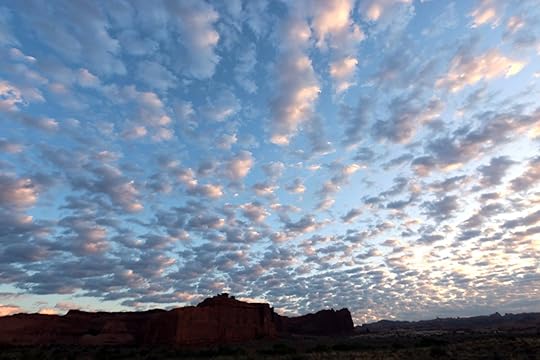
Even as I watch the tallest tower of all is struck with a bright fawn color. It is the high point to catch the first shaft of the sun. Quickly the light spreads downward until the whole ridge is tinged by it, and the abrupt sides of porphyry begin to glow under it. It is not long before great shafts of light alternating with shadow stretch down the plain ahead of me. The sun is streaming through the tops of the eastern mountains and the sharp pointed pinnacles are cutting shadows in the broad beam of light.
That beam of light! Was there ever anything so beautiful! How it flashes its color through shadow, how it gilds the tops of the mountains and gleams white on the dunes of the desert! In any land what is there more glorious than sunlight! Even here in the desert, where it falls fierce and hot as a rain of meteors, it is the one supreme beauty to which all things pay allegiance. The beast and the bird are not too fond of its heat and as soon as the sun is high in the heavens they seek cover in the canyons; but for all that the chief glory of the desert is its broad blaze of omnipresent light.
I love when someone who is a poet or art historian enters the temples of nature and describe what they are seeing, I am sure I was one in a past life. The author was a theological librarian and art historian before his desert travels, and that gives him the vocabulary I love that inspires us to see differently, as Annie Dillard did in Pilgrim at Tinker Creek. Before his writings, it was more common to call a desert a wasteland or desolate and evil.
My first desert was Las Vegas, and flying over the red canyonlands of Utah changed my life, but more tangibly it was the scrublands of Texas as we drove west, and camping in Austin, where the West Texas Chihuahuan Desert meets an isolated forest of loblolly pines. I saw some of it as a wasteland, but I also saw its cacti as wonders, its sunsets as wonders, its open views and skies as freedom. This book opened eyes and minds and stands the test of time with exquisite descriptions.
One can almost fancy that behind each dome and rampart there are cloud-like Genii-spirits of the desert-keeping guard over this kingdom of the sun. And what a far-reaching kingdom they watch! Plain upon plain leads up and out to the horizon—far as the eye can see—in undulations of gray and gold ; ridge upon ridge melts into the blue of the distant sky in lines of lilac and purple ; fold upon fold over the mesas the hot air drops its veilings of opal and topaz. Yes; it is the kingdom of sun-fire. For every color in the scale is attuned to the key of flame, every air-wave comes with the breath of flame, every sunbeam falls as a shaft of flame.
There is not a thing about it that is "pretty," and not a spot upon it that is "picturesque" in any Berkshire-Valley sense. The shadows of foliage, the drift of clouds, the fall of rain upon leaves, the sound of running waters-all the gentler qualities of nature that minor poets love to juggle with~ are missing on the desert. It is stern, harsh, and at first repellent. But what tongue shall tell the majesty of it, the eternal strength of it, the poetry of its wide-spread chaos, the sublimity of its lonely desolation! And who shall paint the splendor of its light; and from the rising up of the sun to the going down of the moon over the iron mountains, the glory of its wondrous coloring! It is a gaunt land of splintered peaks, torn valleys, and hot skies.
And at every step there is the suggestion of the fierce, the defiant, the defensive. Everything within its borders seems fighting to maintain itself against destroying forces. There is & war of elements and a struggle for existence going on here that for ferocity is unparalleled elsewhere in nature.
To speak about sparing anything because it is beautiful is to waste one's breath and incur ridicule in the bargain. The asthetic sense-the power to enjoy through the eye, the ear, and the imagination-is just as important a factor in the scheme of human happiness as the corporeal sense of eating and drinking; but there has never been a time when the world would admit it. The " practical men," who seem forever on the throne, know very well that beauty is only meant for lovers and young persons —stuff to suckle fools withal. The main affair of life is to get the dollar, and it there is any money in cutting the throat of Beauty, why, by all means, cut her throat. That is what the "practical men" have been doing ever since the world began. It is not necessary to dig up ancient history; for have we not seen, here in California and Oregon, in our own time, the destruction of the fairest valleys the sun ever shone upon by placer and hydraulic mining? Have we not seen in Minnesota and Wisconsin the mightiest forests that ever raised head to the sky slashed to pieces by the axe and turned into a waste of tree-stumps and fallen timber?
van dyke didn't actually take the brutal desert trip he writes about in this book. he wasn't a rugged frontiersman but an aesthete. his brother owned a ranch that bordered the mojave and van dyke relied on info from him and from books to write the desert. in other words, he dreamed it all up in his head. which made it all the more special for me.
This interesting book provides a sensory perspective on the southwestern deserts from an artist's point of view, the author was professional art critic. Much of the book covers the interplay of light, shadow, color, perspective, mirage, reflection, refraction and how they along with the lay of the land affect desert vistas, birds, bugs, mammals and reptiles and plant life. In addition to the visual there are also other sensory aspects touched on a bit, sounds and feelings. There is some natural history and geology as well, some of it useful, but often the author becomes speculative, fanciful, and sensory as he weaves his own philosophy of nature into his description of the desert.
One of the things I appreciated was the author's viewpoint of nature's beauty: "We may prefer the sunlight to the starlight, the evening primrose to the bisnaga, the antelope to the mountain-lion, the mocking-bird to the lizard ; but to say that one is good and the other bad, that one is beautiful and the other ugly, is to accuse nature herself of preference-something which she never knew. She designs for the cactus of the desert as skillfully and as faithfully as for the lily of the garden."
There are few stories or long in-depth detailed scientific descriptions as there are with other desert writers but the author shares a common philosophy with many of them, the prime quote from the book is probably "The desert should never be reclaimed."
A beautiful aesthetic work. As is pointed out in the introduction, Van Dyke was not a biologist and gets many facts about the plants and animals he describes wrong. I also found his brief descriptions of Native Ameicans to be a bit dehumanizing, as if they animals part of the landscape. However Van Dyke's background in art history shines through by describing the various natural scenes with a poets eye. If you're looking for an accurate description of the wildlife of the desert go somewhere else, but if you want beautiful descriptions of desert scenery there's probably not a better book from this era.
Published in 1901, The Desert is one of the first books that wrote about, and espoused the beauties of, (you called it) the desert. Traveling through the American Southwest, and specifically the Mojave, (an experience that probably augmented his post as art advisor to industrialist Andrew Carnegie), Van Dyke points out the vivid and stark beauty of his surroundings, or what he calls “the sublimity of the waste.”
The stark beauty of the desert is brought to life by this extremely talented author. While written over 100 years ago it couldn’t be more contemporary in it’s timeless poetic prose. This offers the reader a literary as well as learning treat. You need not travel to the desert to feel the heat, see the beauty, and find the magic from the comfort of your favorite reading spot.
Van Dyke understood the desert. He took the time to really see it. Most of what he experienced is gone now. There are precious few dry places you can visit now only on horseback where your reach is limited by the water you can carry. John C. Van Dyke can still take you there.
Ok book considering it was written in 1901 and the author did not even visit most of the places he describes and got some things just plain wrong--e.g. Gila monsters are harmless. But an interesting, lyrical description of the Arizona desert and canyon country.