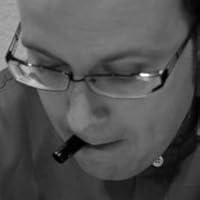
John Milo "Mike" Ford was a science fiction and fantasy writer, game designer and poet.
Ford was regarded (and obituaries, tributes and memories describe him) as an extraordinarily intelligent, erudite and witty man. He was a popular contributor to several online discussions. He composed poems, often improvised, in both complicated forms and blank verse, notably Shakespearean pastiche; he also wrote pastiches and parodies of many other authors and styles.At Minicon and other science fiction conventions he would perform "Ask Dr. Mike", giving humorous answers to scientific and other questions in a lab coat before a whiteboard.
Ford passed away from natural causes in 2006 at his home in Minneapolis.
This is Tor Double #25, of a series of 36 double books published from 1988 to 1991 by Tor Books. It contains two novellas, bound together tête-bêche in mass market paperback – back-to-back, inverted, with two front covers and both titles on the spine. The novellas are listed here alphabetically by author; neither should be considered “primary.”
second read – 8 August 2010 - ****. I re-read this because I had checked out from the library, and started reading, an anthology that began with "The Death of Doctor Island". I decided not to finish the anthology, but to finish the story in this Tor Double that I already owned.
Fugue State, by John M. Ford (1987) - ***. A shorter version was originally published in Under the Wheel, edited by Elizabeth Mitchell, and was nominated for 1988 Nebula in the novella category. This was the first publication of the expanded version. It raises the question of what is memory. It's structured as three nested short stories involving the same characters in different roles and different settings. Unfortunately, the three stories are unrelated in almost every way, and none serve to really answer the original question, except to suppose that memory doesn't really exist in our brains, but rather our brains serve as access points to some sort of cosmic memory pool (Karl Jung?).
The Death of Doctor Island, by Gene Wolfe (1973)- *****. This was originally published in Universe 3, edited by Terry Carr, and was winner of the 1974 Nebula Award and 1974 Locus Award, as well as nominated for the 1974 Hugo Award in their novella categories. It concerns a space-faring autonomous therapy environment known as Dr. Island, experienced by its patients as a tropical island, and whose ethical scruples may allow the sacrifice of one patient for the benefit of another. Into this environment is introduced a troubled young teen-aged boy for whom the island may provide an essential lesson.
first read – 2 September 1990 - ****. When Tor Doubles were first released, I reliably purchased and read most of them. I had already read The Death of Doctor Island elsewhere. My thoughts about them from the time have been incorporated into the reviews I wrote for my second read, above.
Lo que nos cuenta. Nicholas es un muchacho con ciertos trastornos y de unos catorce años que vive en una isla en la que tanto plantas como animales le hablan, incluso las propias olas. Nicholas creció en una colonia espacial y no tiene muy claro qué hace en la isla, aunque pronto descubrirá que ni es una isla exactamente ni está solo en el lugar.
¿Quiere saber más de este libro, sin spoilers? Visite:
I love Ford, and I love Wolfe, but this is a minor effort from both of them. The Ford story in particular ends without any resolution (or even forward narrative movement).
I find it difficult to review two books by two of my favorite authors as if this is one book, and more so because neither of these writers offers a narrative work that lends itself well to easy understanding. I will be revisiting each of these, one day.
I read The Death of Doctor Island in an anthology, but I'm not seeing it listed separately. The island setting was well drawn (I particularly liked the way the AI personality of the island spoke to the main character through environmental sounds. There was also clearly an attempt to wrestle with some deep philosophical meanings relating to trauma, rehabilitation and free will