Jump to ratings and reviews
Rate this book

Tightrope: Americans Reaching for Hope

Rate this book
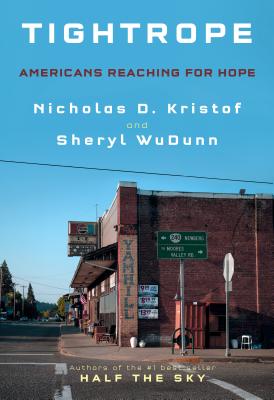
With stark poignancy and political dispassion, Tightrope draws us deep into an "other America." The authors tell this story, in part, through the lives of some of the children with whom Kristof grew up, in rural Yamhill, Oregon, an area that prospered for much of the twentieth century but has been devastated in the last few decades as blue-collar jobs disappeared. About one-quarter of the children on Kristof's old school bus died in adulthood from drugs, alcohol, suicide, or reckless accidents. And while these particular stories unfolded in one corner of the country, they are representative of many places the authors write about, ranging from the Dakotas and Oklahoma to New York and Virginia.

But here too are stories about resurgence, among them: Annette Dove, who has devoted her life to helping the teenagers of Pine Bluff, Arkansas, as they navigate the chaotic reality of growing up poor; Daniel McDowell, of Baltimore, whose tale of opioid addiction and recovery suggests that there are viable ways to solve our nation's drug epidemic. Taken together, these accounts provide a picture of working-class families needlessly but profoundly damaged as a result of decades of policy mistakes. With their superb, nuanced reportage, Kristof and WuDunn have given us a book that is both riveting and impossible to ignore.

304 pages, Hardcover

First published January 14, 2020

1364 people are currently reading
18974 people want to read

About the author

Nicholas D. Kristof

19 books1,039 followers
Nicholas Donabet Kristof is an American journalist, author, op-ed columnist, and a winner of two Pulitzer Prizes. He has written an op-ed column for The New York Times since November 2001 and is widely known for bringing to light human rights abuses in Asia and Africa, such as human trafficking and the Darfur conflict. He has lived on four continents, reported on six, and traveled to 160 countries and all 50 states. According to his blog, during his travels he has had "unpleasant experiences with malaria, wars, an Indonesian mob carrying heads on pikes, and an African airplane crash".

Ratings & Reviews

What do you think?
Rate this book

Friends & Following

Create a free account to discover what your friends think of this book!

Community Reviews

5 stars
4,101 (45%)
4 stars
3,657 (40%)
3 stars
1,087 (11%)
2 stars
190 (2%)
1 star
65 (<1%)
Displaying 1 - 30 of 1,421 reviews
Profile Image for Book of the Month.
317 reviews17.3k followers
Read
January 2, 2020
Why I love it
by Dave Eggers

In a country that purports to root for the underdog, too often we exalt the rich and we punish the poor. This is an unflinching book that illustrates that central, confounding American paradox. With thorough reporting and extraordinary compassion, Kristof and WuDunn tell the stories of those who fall behind in the world’s wealthiest country. In the most vulnerable regions, they find not an efficient first-world safety net created by their government, but merely a patchwork of community initiatives, perpetually underfunded and run by tired saints. It’s not enough, and those who fall through the cracks fall precipitously.

Kristof and WuDunn focus on Yarnhill, Oregon, a blue-collar town where Kristof grew up. Though he got out and rose up, too many of his classmates succumbed to the opioid scourge—driven entirely by Big Pharma greed—or fell behind on medical payments that left them broke and broken. Common to all the stories is the resilience of these families in the face of system that can be indifferent at best and punitive at worst.

And yet amid all the tragedy and neglect, Kristof and WuDunn conjure a picture of how it could all get better, how it could all work. That’s the miracle of Tightrope, and why this is such an indispensable book. In concise, lucid chapters, we see humanity at its most desperate, its most rugged, but perhaps its most heroic. A reader comes away from Tightrope full of outrage but not without hope.

Read more at: https://bookofthemonth.com/tightrope-616
Profile Image for Lisa (NY).
2,138 reviews824 followers
February 11, 2020
A comprehensive book covering many of the issues confronting Americans: homelessness, inequality, drug addiction, poverty, limited education and access to health care and more. Kristof and WuDunn write in an approachable, empathetic manner, personalizing these topics with stories.

One of the problems I have with some non-fiction books is they are sometimes padded magazine articles that are too repetitive. That was not a problem here! But it also didn't feel condensed. I like the authors point that looking at poverty and drugs through the lense of personal irresponsibility is not helpful. There is choice involved - but often it is in the lopsided policies the U.S. has chosen.
Profile Image for Camille.
127 reviews208 followers
January 10, 2020
When I saw this book on BOTM, I prepared to bore myself with a "textbook like" analysis of the state of America today. I was presently surprised at how personal the author made the book to his hometown and life, by delving into specific family members and friends. I found this to be a quick read, with well thought out scenarios and extensive research.
Profile Image for Roy Lotz.
Author 2 books9,051 followers
August 24, 2020
Something is wrong with America’s tax structure when the working poor pay taxes so the federal government can make a payment to an e-commerce giant owned by the world’s richest man.

This book was timely when it was released, and it has only grown timelier since the pandemic struck. Normally, Americans are typified by high levels of patriotism and pride in our country—the unshakeable conviction that we are the greatest. (Indeed, as the authors note, while Americans students are not especially strong by international standards, they are most likely of all to think they have mastered the subject-matter.) But now, as the virus comes roaring back, with unemployment soaring and systemic racism undeniable, this illusion is difficult to maintain. Indeed, the pandemic may have been the perfect crisis to expose the underlying weaknesses in our society. With every country responding to the same challenge, we can compare successes and failures; and at the moment the US response is not inspiring.

The premise of this book is that the United States is falling behind its peer countries in many respects—high-school enrollment, healthcare, child mortality, incarceration—largely as a result of a governmental philosophy embraced in the 1970s. In a nutshell, this was the philosophy of extreme individualism: that every person is wholly responsible for themself. Put another way, this was a kind of radical, economic meritocracy—the belief that the distribution of wealth was a perfect reflection of people’s worth. Thus, the wealthy deserved their wealth and should not be taxed or regulated, while the poor deserved their poverty and should not be helped.

The effects of this mentality can be seen in all sorts of places. The IRS is much more likely to audit someone making less than $20,000 than someone making a thousand times that. White collar crimes are rarely prosecuted, and if so with a fine or a light sentence, while a shoplifter can face serious jail time. After irresponsibly marketing OxyContin—and contributing to a heroine epidemic that cost many lives—Purdue paid a fine that was a mere fraction of their profits, while there are many poor individuals serving life sentences for drug possession. Two zip codes in the same city, one rich and one poor, correspond with life expectancies that differ by twenty years. Income bracket is a stronger predictor of college success than SAT scores (and income partially predicts SAT scores, too). The list goes on.

One irony of American life is that the excuse given for not having welfare programs is always the same: How will we pay for it? When it comes to helping out poor Americans we suddenly become extremely penurious. Thus, we wring our hands about Section 8 housing assistance but not tax breaks for mortgages, and we knit our brow at public healthcare but rarely discuss the tax breaks for employer-based healthcare. We underinvest in social services, rehab facilities, education, and housing, but we do not bat an eye at the expense of cycling the poor through shelters, emergency rooms, and jails. When it comes to police, prisons, and the military, there is never any discussion of affordability.

What makes this book worthwhile is not for this information, however, as it can be found in many places, but for the stories from Nicholas Kristoff’s life. The son of Yamhill, a small town in Oregon, Kristoff has watched many of the kids he grew up with succumb to deaths of despair over the years. The most memorable case may be the Knapp family. After growing up with an abusive, alcoholic father, the five Knapp children all died before their sixtieth birthday. One died of liver failure, one of hepatitis from injecting drugs, one of a heroin overdose, one of an explosion in a drug lab, one of a fire while inebriated and unconscious. In fact, when the book was published one of the siblings, Keylan, was still alive, but died last March.

While in any individual case you can make an argument about bad choices, the mere fact that a quarter of the children on Kristoff’s school bus died points to a deeper problem. In the authors’ opinion, the fundamental shift is the disappearance of decent, blue-collar work—particularly for men. By now, the story is familiar enough. Whereas, in the past, a person without a high school diploma could work a unionized job in a factory and afford a house, that is simply not the case nowadays.

The disappearance of jobs has a kind of domino effect: people deal drugs to make money, take drugs to ward off boredom, get arrested, lose custody of children, have their driver’s license revoked, get evicted—in short, the cycle of poverty.

Now, as Kristoff and WuDunn repeatedly point out, it is far too easy to write this off as a series of irresponsible choices. And it is true, many poor people make bad decisions. Being impoverished does not inculcate saintliness or enlightenment. But to ascribe the failure to individuals is, I think, both illogical and unfair, though that is so often how we choose to see it in America. Indeed, this sort of individualistic thinking can be quite compelling, such as in the case of Tanitoluwa Adewumi, a Nigerian immigrant who won the New York State K-3 chess championship at the age of eight while living in a homeless shelter. His tale attracted attention and Tani is now living in a real home, thanks to the generosity of many strangers.

Stories like this are intensely inspiring, since they seem to validate our belief that real merit will always get rewarded in the end. But arguably the more socially important fact of Tani’s story is that all the children he was competing against were from well-off families, with private chess tutors. And this underscores the essential point: that chess ability—like so many things—is not normally the product of raw talent and individual drive alone, but also the result of resources and environment.

For me, the best way of thinking about the competing influences of environment and individual merit is that they conflict only at their extremes. Here is what I mean. The environment is akin to the menu in a restaurant, and the individual chooses from these pre-set options. Only rarely, in extreme cases, does the diner get to switch restaurants and look at a new menu.

Just so, when a child is born into a family of a certain economic class, there is a certain range of likely economic outcomes. A child of a middle-class family has a decent chance of becoming, say, a doctor, while the child of a wealthy family has a fair shot at becoming a CEO. In the United States, at present, most children will not radically change the economic class they were born into. It is even more unlikely that a child of a billionaire will end up homeless than that a homeless boy will win a chess championship. But a small number of people, through a combination of luck and skill, will succeed in radically raising themselves (or, in some cases, lowering themselves). In these cases, individual factors will seem to have trumped environmental influence.

To continue the metaphor, just as it is the responsibility of the individual to choose wisely from the menu, it is the responsibility of the society to make sure that nothing on the menu is poisonous. Too often, however, people are born into circumstances that make it extremely difficult to choose correctly. And in the case of the poor, one bad choice can be disastrous. This is the meaning of the book’s title: the least advantaged have the least room for error—one mistake, and society brands them a criminal, a junkie, or a welfare queen—while those from wealthy backgrounds can make any number of mistakes without facing catastrophic consequences. To use the book’s metaphor, then, it is the individual that has to walk, but it is society that choses whether they will walk on a tightrope or a promenade.

How can we change this situation? The book ends with a series of policy suggestions—universal health care, jobs programs, child credits, maternity leave—which I suspect will not be terribly surprising. But if we are going to adopt any of these, we must first throw off the perspective of seeing every person as wholly responsible for their fate, our belief that the market is a faultless reflection of personal merit—which is the perfect excuse for inaction. We say of poor kids like Tani that they “beat the odds,” and they do deserve accolades. But these stories should motivate us to change those very odds, so that they are not stacked so heavily against the poor.
Profile Image for Ginger.
477 reviews344 followers
January 11, 2020
I’m a writer in the margins but I don’t think I have EVER written in the margins more than in this book—arguments, agreements, questions.

I picked this on a whim from BOTM, and I’m glad I did. I devoured it, despite its difficult subject matter. The authors are fantastic storytellers which helps underline and illustrate their points.

I disagree with the authors on a lot of their conclusions, but I found them balanced and thoughtful. They made neither victims nor villains of their subjects. There were times when I quibbled with the logic and language (they often slipped into passive voice when contending that they insisted on personal responsibility or resorted to light ad hominem attacks, assigning motives without support and calling policy “mean-spirited” when it’s possible the other side just has a different perception of what’s best long term, at times painted motives with broad strokes, attributing choices to luck and vice versa, and occasionally conflated correlation with causation without support), but overall, they leaned heavily on the bipartisan three-pronged fact that people who finish high school, get a job, and marry before having children, in that order, have a literal 98% avoidance of poverty rate, along with all that entails.

They stress the government component of education yes, but refreshingly don’t ignore personal responsibility of work, and family responsibility of the roles of marriage, home, and children.

Many times proposed solutions lean too hard to one side—forgetting that government does have a role to play—or to the other—that people’s choices and families are key in preventing problems that stem from and accompany poverty. It’s both, together. Forget any one component and you’re still likely fighting a losing battle.

They offer plenty of solutions throughout the text, but one of the most useful parts of a Kristof/WuDunn book is they leave readers at the end with ten steps you can take to make a difference. Not every one will be applicable to every person, but I underlined about half that I can likely do (one time actions like calling state representatives to petition for diversion programs for drug offenders, or repeat measures like volunteering at some of the most high-impact initiatives). I also appreciated that the vast majority of the suggestions did not involve the government. As a conservative, I want government doing less, and individuals doing more, especially at the local level. Systems are made up of people, after all. Government can’t best fix what government didn’t break.

But in a partisan era, we need each other. The authors quote Ray Dalio saying, “The problem is that capitalists typically don’t know how to divide the pie well and socialists typically don’t know how to grow it well.”

I want to hand this to every pastor, teacher, neighbor, veteran, doctor, politician, law enforcement officer, economist, parent I know. My heart was moved, but just as importantly, my mind was moved.

[This really does do a fantastic job of being bipartisan, but it does lean left, championing causes that are typically partisan in the US—universal heath care, a child allowance, sex education in schools. For another take on a middle ground work that leans slightly right, try Rod Dreher’s Crunchy Cons. Both these works together do much to inform what initiatives we can easily come together on.]
Profile Image for Yun.
636 reviews36.5k followers
March 6, 2020
DNF - Not learning anything new from this book. The writing feels superficial. I wanted in-depth look at each of these people, but instead we just get a paragraph or two, followed by an info dump of facts and are then told what to think, which isn't my preferred style for this type of subject. I want showing, not telling. And a great book should lead me on a journey to figure out what it wants me to learn, not just straight up tell me how I should think and feel.
Profile Image for Rachel.
9 reviews303 followers
February 28, 2020
I wholeheartedly recommend this book. If ever you wanted an upgrade in your ability empathize, and understand your fellow humans, or insight into how to be of better help, particularly in the United States, please read this book, and if you've never thought you needed either of these things, perhaps it is more crucial that you read it. I truly hope this wakes many Americans up to how we can better care for one another. Grateful this was written.
Profile Image for JEN A.
217 reviews189 followers
January 29, 2020
This book was extremely eye-opening. It gave me a lot to think about with regards to poverty, drugs, obesity, etc in America. I would highly recommend that everybody read this book before the next election.
Profile Image for Cheryl S (book_boss_12).
534 reviews10 followers
January 25, 2020
This book landed itself in my DNF pile at page 81 at halfway down the page. I do not feel this book is about Americans reaching for hope at all. This book is written by 2 authors who are wanting the US government to coddle and hand out hope to those less fortunate.

Possible indirect spoilers.....


I overlooked the sly remarks blaming President Trump. Co-Authors were discussing and placing blame of the demise starting in the 60s and 70s. It is ok to not like Trump and this did not affect my rating but the blaming did. How can he be responsible for or even have a hand in the pot if the problem happened prior to 2016?
In one part about welfare and needing a computer but those poor people cant afford them and internet so how could they possibly get what is owed to them from the government? This annoyed me too because every public library, school, ect has free internet access with computers.
Now to page 81 where it was just over for me....... a heroin addict is not to blame, its the system. All further reading of this book ceased then and there.
Profile Image for Malgorzata (szczodrość ryb).
59 reviews134 followers
October 14, 2025
Jak mnie takie społeczne tematy grzeją, to wiem tylko ja. 5 gwiazdek bez większych wątpliwości.

Bardzo angażujący i przekrojowy reportaż, poruszający chyba wszystkie aspekty życia publicznego. Świetne połączenie historii pojedynczych osób, w dużej części znajomych autorów ze szkolnego autobusu, dzięki którym łatwo się tematem przejąć z szerokim ujęciem zapewniającym wiedzę na temat mechanizmów społeczno-gospodarczych. Momentami aż się oderwać nie można, a momentami wręcz trzeba, żeby "rozchodzić" emocje.

"Talent występuje powszechnie, możliwości nie".
Profile Image for Lorna.
1,051 reviews734 followers
August 14, 2020
Tightrope: Americans Reaching for Hope by Nicholas Kristoff and Sheryl WuDunn was the most sobering and depressing account of where this country is today and why. Nicholas Kristoff went back to the farming community of Yamhill, Oregon to follow up with all of the children on the Route Number 6 School Bus that he had grown up with. These were the children with whom Nicholas Kristof rode to and from school each day on the Number 6 bus, his friends. What he found was harrowing, depressing and discouraging; almost one-third of his classmates had succumbed to the ravages of drug addiction, alcoholism, and suicide.

But in spite of the harrowing accounts of so many lives in peril, there were also many threads of hope throughout this book even in the midst of suicides, drug addiction, alcoholism, domestic violence, poverty, homelessness and despair. It makes one wonder why there was such a sharp and drastic discrepancy in their childhood. Nicholas Kristoff was brought up in this same area but in his home there were books as well as an intact and loving family, and what a difference it proved to be. Certainly, that was a factor but perhaps there were other factors as well. The importance of access to education, child care, and affordable health care is explored. As the authors researched the prevalence as well as the history of these societal ills, there were solutions put forth, but we all must first recognize the problems before we can fully address the possible solutions to them.

"But increasingly, for those from the lower socioeconomic spectrum, life resembles a tightrope walk. Some make it across, but for so many, one stumble and that's it. What's more, a tumble from the tightrope frequently destroys not only that individual but the entire family, including children and, through them, grandchildren. The casualties are everywhere in America, if we only care to notice."
Profile Image for Jenny (Reading Envy).
3,876 reviews3,709 followers
Want to read
December 17, 2020
I'm not sure I'll read this, so this is not a review but a comment... it looks like Kristof focuses on Yamhill, Oregon, which is where my Dad grew up, but he was 15 years older than Nicholas. 15ish. In my Dad's generation, he wouldn't go to high school reunions because most of his classmates died in Vietnam, so, you know, maybe being poor isn't the worst thing.

My entire family is from Yamhill County, and my college degree is from a liberal arts school in Yamhill County... I believe my Dad's cancer (which he died from) is a side effect either of Agent Orange (Vietnam) or all the chemicals used in the agricultural jobs he had to work before he was able to get a degree in electrical engineering. He was raised by a single mother and had four siblings so I'm pretty proud of where they all are now. I guess it depends on what you value.

And these days Yamhill County does better than ever thanks to the wine industry...
Profile Image for Holly Allen.
148 reviews4 followers
February 18, 2020
This was a huge disappointment. The book focuses on poverty and inequality and the lack of access to education, healthcare, and other resources in America that are often found free and accessible in other first world countries. The problem is two fold- One is that the book tries too hard to appear moderate or else slightly liberal which means much of the discussion about capitalism and classism is shallow at best. Two is that much of the word choice is so poor it often simply comes off as offensive or else thoughtless and unpolished. The book quotes people like Woodie Guthrie and James Baldwin for flair without acknowledging their communist or anti-capitalist leanings. In fact, the book does nothing to critique capitalism, simply suggesting taxes be directed toward programs but not critiquing too deeply the economic system that so clearly continues much of the suffering the book aims to tear down. The book in one sentence says that America’s problems have inspired/ brought about support of “extreme” sides like Trump and Bernie Sanders. The book just casually drops this in and while it makes an effort later in to explain how/why Trump and his policies are extreme, it does nothing to explain why Sanders is mentioned not why is an apparent opposite end of the spectrum. This is either ignorance or a weak attempt at appearing centrist but those that read a lot of political theory will know that on a worldwide scale, Sanders doesn’t even register on the far left side of the spectrum. The book also continues the incorrect but often used idea that “America is a democracy” despite the fact that America is a republic and not a pure democracy. These errors built up and annoyed the hell out of me- if you’re well read on political theory it may bother you too. As for word choice- this book uses offensive and outdated terms like “g*psy” and “obese” despite modern Romani activists and fat lib activists making it clear since 10 years back that those terms are associated with discrimination. The book has many other word choice issues beyond these and even, at times, placed commas haphazardly. I had so much hope for this book but it came off as pandering to centrists with no regard for political accuracy or deep investigation. What a disappointment.
Profile Image for Jeść treść.
364 reviews712 followers
September 21, 2024
Idealne panaceum na "w Stanach jest lepiej, moglibyśmy mieć taki system opieki zdrowotnej jak w USA i wszystkim żyłoby się lepiej"

yeah right
Profile Image for Gale.
149 reviews3 followers
January 12, 2020
“If you’re not outraged, you’re not paying attention.” - Heather Heyer, 2017

Pay attention, America. That’s what this book is telling us. I may not agree with Kristof and WuDunn’s politics and recommendations at times, but that does not change the fact that they have laid out harsh and painful truths in this book. It is not a perfect book, and some people may be turned off by the authors’ obvious left-leaning biases. Why the 5 stars? Because this is NECESSARY. I feel privileged to have the chance to read it.

It talks about topics that we typically shy away from - poverty, drug addiction, healthcare, lack of quality education, mass incarceration, the erosion of our society as a whole, and our failure as a nation through a history of poor policy making that has been continually anti-poor and anti-working class. They further argue that yes, personal responsibility is a factor in an individual’s outcomes in life, but that our failure to be empathetic, to see beyond invidual choices, and acknowledge that we as a society is also partly responsible for a person’s future, further compounds social problems.

It is very painful to read about past and present policy failures and how it has trickled down to America’s poor, children in particular. It is painful to know that here in America, millions still do not have access to quality healthcare, mental health counseling, and basic quality education. It is even more painful to know that research continually shows that only the top 1% has truly benefited from the economic boom but the rest at the bottom 90% has continually done worse. And it seems like politicians, both from the left and right, have failed to listen and keep up with the times. The book calls for drastic action if we are to remain the superpower that we claim to be.

Regardless of your political views, every American should be involved in the conversation about how we can improve the quality of life in this country, invest more in human capital, and create fair opportunities for everyone. At the end of the day, issues like jobs creation, access to quality healthcare, quality education, and drug policies will affect all of us in some way.

This is required reading for every American as far as I am concerned - lawmakers, mentors, educators, businessmen, students, and ordinary people like me who care. Kudos to Kristof and WuDunn for such engaging writing in terms that are easy to understand.
Profile Image for Jamie Smith.
521 reviews113 followers
March 3, 2020
How do you successfully raise children in these troubled times? A stable home environment seems to be a major factor, increasing the likelihood that they will graduate from high school, avoid drugs, stay employed, and keep out of trouble with the law. Children who grow up in chaotic homes with drug and alcohol abuse, violence, and single parents who have trouble keeping jobs have vastly increased chances of ending up on a downward spiral of poverty, drugs, unemployment, and prison.

This book looks at these factors using individual interviews, many of them with the people one of the authors grew up with in rural northwest Oregon. After World War II the soldiers came home to good, steady jobs with benefits that allowed them to move into the middle class and become homeowners. And then, starting in the 70s, it all began to unravel. Manufacturing went overseas, factories closed, and jobs – and the sense of self respect that went with them – were lost. Alcoholism and depression followed, and many families fell back into the lower classes.

Some children from these damaged families absorbed the wrong lessons about life. Completing high school had not helped their parents keep jobs, so many of them dropped out. Without a high school diploma work, when they could find it, was often minimum wage dead end drudgery with no benefits, so alcohol and drugs eased the pain. The authors repeatedly make the point that we all bear responsibility for our decisions, and no one forced these people to make the choices that derailed their lives. They also note, however, that it is a lot easier to avoid those catastrophic decisions when children come from orderly, supportive two-parent families.

The book weaves its individual case studies around observations about social and economic policies, and the authors’ research is very though. Unfortunately, at some point in the development process someone – author, agent, or publisher – made the decision that using standard footnotes would be a bad idea, probably thinking they would scare some readers away. Instead, they use an annoying and inefficient method where their notes are not identified in the text, but may appear in the back of the book identified by text snippets followed by formal citations. If a reader wants to see if something is the authors’ opinion or from a published study he or she would have to make note of the words around the observation, such as “every seven minutes,” then go to the back of the book and scan the citations to see if there is a note attached to this text. There might in fact be one, but the authors chose different key words to lead into it. It is confusing and wastes time, diminishing the reference value of the book.

Despite the problem with its sources, Tightrope is insightful and clearly written, and the authors provide recommendations for dealing with the problems. All of the solutions, however, require money and sustained commitment, both of which will be in short supply as long as the government’s top priority is tax cuts for billionaires.

There is more that I could say, but I will let the authors speak for themselves. Following are some of the observations they made which I found insightful and often troubling.


“every seven minutes, another American dies of a drug overdose, and one American child in eight is living with a parent with a substance use disorder.” (p. 20)

“of people who follow three traditional rules – graduate from high school, get a full-time job, and marry before having children – only 2 percent live in poverty.” (p. 28)

“for every man aged twenty-five to fifty-four who counts as unemployed, three more don’t have jobs but aren’t looking for work.” (p. 37)

“almost half of prime-age men not in the workforce take pain pills every day, and the majority say that they are disabled or otherwise unable to hold a job.” (p. 37)

“77 percent of kids in the top quartile of incomes graduate from college, compared to 9 percent of kids in the bottom quartile.” (p. 46)

“the broadest challenge in prevention is to recognize that addiction is a symptom of a deeper malaise and that a strategy also has to offer jobs, education, and hope...drug use is often not just a trip but also an escape from a place that has become unendurable.” (p. 97)

“since 1970, life expectancy has improved in the United States, but much less than in other countries. From a bit above the middle of the pack, we’ve tumbled to number 27 out of 35 OECD countries. We’re now behind Chile in life expectancy and just ahead of the Czech Republic and Turkey. Life expectancy in the state of Mississippi, were it a country, would rank second to last, tied with Mexico. Children in America are 55 percent more likely to die than kids in other affluent countries. (p. 143-144)

Members of Congress opposed to a public option don’t seem to object to the government covering the cost of medical services for themselves: in addition to receiving a 72 percent subsidy – paid by taxpayers – on premiums for a gold-level [Affordable Care Act] plan, they can use the navy-run Office of the Attending Physician and get free outpatient services at military facilities in the Washington area.” (p. 146)

“The reason we have a single-payer health-care system for the elderly (Medicare) but not for children is simple: seniors vote, and children don’t. So while American children die at 55 percent higher rates than children in other advanced countries, Americans who make it to age sixty-five and qualify for Medicare then have a remaining life expectancy similar to that of our peer countries.” (p. 147)

“We’ve learned more in the last decade about how to solve housing problems. It’s tricky to address only locally, however, because a community that provides good services tends to attract homeless people from other areas that ignore the problem. So, nationwide or statewide strategies are more effective.” (p. 160)

“the federal government has poured huge sums into mobile-home parks for low-income renters, yet the money went not to the renters but to private-equity firms. Fannie Mae, the government-sponsored lender, provided $1.3 billion to Stockbridge Capital, a huge private-equity firm, to buy existing parks – and Stockbridge then raised rents to achieve a 30 percent return.” (p. 161)

“The American military performs an indispensable role in creating opportunity for working-class kids. It is particularly good at building discipline and teamwork, at inculcating basic social skills and technical training and especially at creating career paths without discrimination for African Americans and Latinos. It invests in the human capital of young people, with an emphasis on learning, management and leadership.” (p. 169)

“private prisons lobby for harsher sentences to increase their occupancy rates and improve their profitability. The two largest for-profit prison companies have devoted $25 million to lobbying.” (p. 175)

“America should remember Dostoyevsky’s observation: ‘The degree of civilization in a society can be judged by entering its prisons.’” (p. 176)

“The United States Sentencing Commission found that blacks get sentences 19 percent longer than whites do for the same offense, even after controlling for criminal history and other variables. The darker an African American’s complexion, the longer the sentence, researchers found. Blacks are also more likely to be found guilty and sentenced to death: in Louisiana, a black person is 97 percent more likely to receive the death penalty than a white person.” (p. 178)

“The economist Isabel Sawhill calculates that the rise in single parenting since 1970 has increased the child poverty rate by 25 percent. Growing up with just one biological parent on average is also associated with a 40 percent lower chance that a child will graduate from high school.” (p. 188)

“Three-quarters of married parents are still together when their child turns twelve; fewer than one-third of unmarried couples are.” (p. 189)

“when children are born in the bottom wealth quintile to parents who stay married throughout their childhood, they do well: only 17 percent remain at the bottom, while 19 percent achieve the top wealth quintile in adulthood. But for kids born in the bottom quintile to parents who never marry, 50 percent remain at the bottom as adults, and only 5 percent rise to the top quintile.” (p. 191)

“Foster care costs about $26,000 per child per year, yet outcomes tend to be poor: only 58 percent graduate from high school. One-quarter are incarcerated within two years of graduating from foster care at age eighteen, and they are about six times more likely to end up homeless as to end up with a college degree.” (p. 193)

“More children die each year in the United States from abuse and neglect than from cancer. For every child who dies, thousands are injured, raped or brutally abused. We shrug as millions of children undergo trauma in ways that harm them and unravel our social fabric – and then we blame the kinds when things go wrong. Some species eat their young; it turns out that we are one of them.” (p. 204)

“One of the most infuriating elements of American myopia about investing in at-risk kids is that politicians often insist that they don’t have the funds to pay for social services – but they somehow find the resources to pay for prisons later on. Republican lawmakers don’t want to pay for $500 IUDs for low-income women, so they pay $17,000 for Medicaid births.” (p. 205)

“The United States has about 13 million children living in poverty. Of those, about 2 million may live in ‘extreme poverty’ by global definitions (in households earning less than $2 per person per day), when looking at their cash incomes. These kids would be considered extremely poor if they lived in Congo or Bangladesh, yet they’re here in the United States. We don’t want to overstate the comparison – Congolese kids can’t typically access food stamps, hospital emergency rooms or church pantries and soup kitchens – but it is still staggering that by formal definitions some American children count as extremely poor even by Bangladeshi standards.” (p. 213)

“The presence of extremely poor children in America...is partly a consequence of the 1993 welfare reform that eventually cut off benefits for some families: it was meant to hit deadbeat adults but has been devastating for their children as well.” (p. 214)

“the United States for years was, embarrassingly, the only country in the world besides Somalia and South Sudan that had not ratified the Convention on the Rights of the Child. That has now changed: the United States is the only nation that hasn’t bothered to ratify it.” (p. 214)

“America doesn’t pay enough attention to the fact that even now, about 14 percent of Americans don’t complete high school. Those kids are typically destined to hold marginal jobs, endure difficult lives and die early.” (p. 232)

“today Americans are more likely to drop out of high school than in most other advanced countries, and completion of high school doesn’t necessarily signal mastery of basic skills. About one-fourth of those who graduate from high school cannot pass the American military’s qualifying exam.” (p. 232)
Profile Image for Camie.
958 reviews242 followers
June 18, 2022
This is an extremely readable book published in 2021 and written by Pulitzer Prize winning authors about how America is failing it’s working class big time.
It tells the stories of families who are walking the “ tightrope “ between hope and despair due to stagnant wages, poor education, poverty, neglect, drug and alcohol addiction, lack of healthcare, and a completely broken justice system.
Being able to pull ones self “ up by their boot straps” is a myth to many who have virtually no support system, and studies have shown that the best predictor of the chance you have to make your life a success is usually largely dependent on the situation that you are born into.

It’s a very insightful read and will be appreciated by those who liked Nickel and Dimed: On (Not) Getting By in America by Barbara Ehrenteich, or Evicted: Poverty and Profit in the American City, by Matthew Desmond.
5 stars
Profile Image for Ed.
Author 68 books2,712 followers
January 8, 2022
I found this readable nonfiction book on America's poverty and the different policies to fix it fairly interesting. It's well written and brings in lots of facts, examples, and quotes. I'd already read some books about the opioid crisis, which I still find disgusting. Some of the kids discussed growing up in poverty reminded me of the kids I went to school with. I guess all of us have known families trapped in such reduced circumstances. Fortunately, there are some success stories, so it's not all bleak, grim, and depressing. The authors try to present their premise as a societal problem and not a red state v. blue state issue. What hit me the hardest was the lack of affordable healthcare, mental and physical. Anyway, I'd recommend it for anybody who might want to read a different take.
Profile Image for Erin Cataldi.
2,536 reviews63 followers
January 12, 2020
This book should be required reading. It's insightful, depressing, yet still ultimately hopeful. Pulitzer Prize winning couple write a gut wrenching account of how America has ultimately failed it's people in the last half century through the lens of author Nicholas D. Kristof's hometown, Yamhill and a few other US locations. From a broken education, prison, health system and more; the authors explain how the system used to be, how it is now, and what can be done to fix it to bring the United States back up to speed with the rest of the industrialized first world countries. There are lots of personal stories and photos that really hammer down HOW these policies really affect many Americans. It is very depressing but at the same time the authors make sure to highlight social programs that people have started to combat issues of addiction, homelessness, and college education. It's an enlightening and ultimately inspiring book. Do yourself a favor and read this book before you vote! Then pass on this book to everyone you know!!!!
Profile Image for pola.
98 reviews137 followers
January 15, 2023
Książka dla każdego kto dalej wierzy w „amerykański sen”; o zmarnowanym potencjale i zasobach ludzkich, i powodach takiej sytuacji. Rozdział o narkotykach i służbie zdrowia - bardzo bardzo dobre. Plus za emocjonalny i personalny wymiar, nie jest to tylko suchy reportaż, czuć emocjonalne zaangażowanie autorów (chociaż wiem, że dla niektórych może być to minus)
Natomiast, był tutaj straszny chaos. Tematy niby były rozdzielone, a jednak wszystko się ze sobą mieszało, brakowało mi lepszej, bardziej zorganizowanej struktury. Momentami nie wiedziałam jaki jest cel danego rozdziału, co autorzy próbują przekazać. Prawdziwe historie jak najbardziej na plus, ale znowu - za bardzo przeplatały się z faktami i argumentacją, po prostu się gubiłam. Niektóre rozdziały były tez zbyt ogólne, generyczne (np ten o pracy). Brakowało mi też większej ilości źródeł, niektóre wnioski przychodziły z niczego i bez źródła, wydawały mi się lekko przesadzone.
Dalej polecam, ale nie jest to najlepiej zredagowana książka
Profile Image for Kim Loves Reading!.
309 reviews58 followers
May 28, 2022
I recently shifted working from corporate world to nonprofit. When you work in nonprofit people tell their stories, some so unbelievable it is hard to imagine this is happening in the US and not some small country. What I thought I knew about what was going on, however between this book and the people I work with everyday I ashamed to say I was dead wrong.
I grew up in poverty, my father Vietnam vet, who never talked about his time there, I know now he suffered from untreated PTSD. During my childhood he worked in a factory, and for a time everything was fine then he lost his job and he just checked out and alcohol became his addiction. His life short lived due to his addiction to alcohol. When I married my husband also coming from poverty, we determined it would end with us and our kids would be raised differently. It was hard, for what seemed like forever we lived paycheck to paycheck, we basically crawled our way out of poverty.
But what I have learned with the help of this book, not everyone makes it. This book was a huge eye opener for me, and I have opened my eyes. I see people differently now because I don't know their story. If we don't take care of our own, then what are we doing as nation? If we don't change a current broken system it will just keep rolling on to future generations. If this book doesn't shake you then you are not getting the full message.
Profile Image for Katy Schneberger .
3 reviews1 follower
February 5, 2020
It’s difficult to tackle the heart wrenching topics introduced in this book and I applaud the authors for shedding insight on them but this was an extremely painful read for me. There were many points throughout that I felt I was reading a middle schooler’s research paper filled with irrelevant quotes and random studies that did not support the argument the writers were trying to make. There were countless over generalizations and was overall extremely unorganized. I agree with many of their arguments but the writing was so awful I had to skim through some parts. If you are politically literate stay away from this book, it’s economical analyses are trash.
154 reviews
January 17, 2020
Political & 1-sided....thereby hindering honest, open dialogue as a country to find solutions for bettering America's challenges.
313 reviews
December 30, 2020
I chose Tightrope: Americans Reaching for Hope as one of my January 2020 Book of the Month selections. There were no advance reviews for me to read, but the synopsis sounded promising.

Tightrope is an important book for our times. It is thoroughly-researched and compassionately written.

The authors interview people in an attempt to put a face on problems stemming from poverty, including drug addiction, unemployment, poor health, lack of education, abuse. Problems are multi-generational, with each future generation often having it worse than the one before.

Some interviewees are people that one of the co-authors, Nick, grew up with in Yamhill, Oregon. Nick's household was stable. His parents were educated and promoted reading, the arts, and learning. He later went to Harvard, has written several best-sellers, won awards, and is a columnist with The New York Times. Until reading this book, I'd been unfamiliar with his work.

Some of Nick's Yamhill friends have a starkly different life. They spoke with Nick and his wife and co-author, Sheryl, vulnerably hoping they could help humanize the struggles that so many people face. I felt so much empathy and compassion in reading their stories, and it helped me to have a better understanding of how for some, it's like they're navigating their life on a tightrope with no safety net.

The author team also interviewed people in Baltimore, Arkansas, Oklahoma, and a few other places.

Themes:

1. "Working-class communities have collapsed into a miasma of unemployment, broken families, drugs, obesity and early death" and much of this is going unnoticed by privileged Americans (p. 17). Jobs are vital not only for income, but for dignity and purpose. The authors spend quite a bit of time examining the poor white male experience. Women and racial minorities are also a focus, but it felt less so.

2. Current policy is harmful, and in some cases cruelty is the point. "...suffering in working-class America was not inevitable but rather reflects decades of social-policy mistakes and often gratuitous cruelty..." (p. 18). There is widespread system failure, and it's appalling.

3. There is hope. Policy change and improvement from both government and nonprofits can ease suffering and enable positive change. Some like to complain about the government subsidizing food stamps, Medicaid, etc, but those people don't seem to have a problem with the subsidies well-off and wealthy people have -- tax savings that are a far larger dollar amount.

In examining policy differences in places where they have far better outcomes in education, health, life expectancy, etc., the authors point to many ways we can make changes to improve the lives of others, save money, and have a stronger society for us all. We are failing so many children and other vulnerable populations. For those who only care about the financial bottom line, it's far more expensive to incarcerate people than it is to support policies that strengthen individuals and families.

Not surprisingly, this book is politically progressive. What frustrates me is so many of the interviewees in the book support policy and politicians that are very much acting against their personal interests.

Some readers will want to support widespread change; others will continue to implore poor people to "pull themselves up by their bootstraps." The authors point out that the phrase originally meant to do something impossible, because hi, you cannot actually pull yourself up that way. What are you going to do, levitate? Ah, maybe flying is better than walking the tightrope.

Of course personal responsibility is important. But in our lack of empathy, we're ignoring critical breakdowns in society that make it impossible for vulnerable people to improve their lot.

I'm one privileged white woman, and if I was born into some of the families mentioned in the book, I doubt I would have any measure of personal success. I'd be lucky to be alive.

Read the book. Talk about it. Contact your representatives. Vote.

TW: language, descriptions of abuse (verbal, physical, sexual), mentions of suicide, death, drugs, alcoholism, anger issues, homelessness, violence. Possibly missing some.

Rating Tightrope a 9/10 or 4.5*, going to round it up to 5 on GoodReads.
Profile Image for Robyn.
2,370 reviews131 followers
October 9, 2020
I wasn't sure what this book was going to be, but having worked with society in one form or the other for over 40 years, I wanted to see if what I thought about many issues I saw were factual. Much of the information in this book is devastatingly sad, nobody wants to hear that the country they love is not as great as you want to believe. But I have no doubt that education is what is going to separate those that will succeed from those who will not... but I am heartbroken that our country is 61st in high school graduation in the world.

I appreciated that the book was light on political views (there were some) but was really more factually stated so that conclusions were not required for most of the book, the facts actually speak so loudly that you don't need someone to tell you.

I am a fact person, I love statistics and how they work, but it is hard to deny that opioids are killing many of our country's potential resources, that education is a dividing line, that too many children, regardless of race are living in poverty, that jobs for the middle class are disappearing, and that America is falling behind. I don't think we can wait for God to save our country.

5 Stars

Happy Reading!
Profile Image for Jennie S.
348 reviews28 followers
February 15, 2020
This book is incredibly well researched. The author touches upon many societal issues that are plaguing modern day America, including but not exclusive to 1) the lack of family planning that contributes to unplanned pregnancies that inevitably led to broken careers and child poverty, 2) the systematic way pharmaceutical companies conduce medical professionals to prescribe massive amount of pain medications that turn normal hardworking people to addicts, and 3) the expensive medical, legal, and administrative systems that only tax the poor and trap exactly those who need the resources the most in a never-ending kafkaesque, punitive, repetitive state of reality.

The title of the book is very fitting to the author's main argument: society keeps poor Americans in a precarious state of perpetual poverty because its social systems are punitive instead of supportive, and sometimes the prices are so high that one wrong choice in life can lead to a downward spiral, not unlike taking a plunge after a misstep on a tightrope.

Overall, the book is very relevant in today's social climate. The social issues mentioned originate from the U.S., but the underlying problems can be seen around the world. It is a great book for readers to take a step back and look at our social systems from a different perspective, one that could lead to some positive and productive changes for the greater good.
Profile Image for Mal Warwick.
Author 29 books492 followers
February 26, 2020
If you wonder what’s gone wrong in America and why our society is so deeply divided, you’ll find a lot of the answers in Nick Kristof and Sheryl WuDunn‘s brilliant new book, Tightrope. You’ll also find a litany of possible solutions to the problems they expose. Tightrope could be the playbook for an activist Secretary of Health and Human Services in a progressive future administration. Like the couple’s earlier bestseller, Half the Sky, the book pairs deeply entrenched social problems with imaginative experiments undertaken by nonprofits and the private sector as well as government — and in the process delivers a hopeful message about poverty in America.

Poverty in America hits home for the authors
Tightrope is a profoundly personal book for Kristof and WuDunn. Many of the stories in their account of the impact of poverty and drugs on American society involve Kristof’s boyhood classmates, friends, and neighbors in the small farming community of Yamhill, Oregon. Kristof and WuDunn have been married for more than thirty years and frequently visit the farm where his parents still live, so it’s personal for her as well. And clearly the experience of reporting for this book was wrenching for both, as they witnessed how the lives of so many people they’ve known have unraveled in the grip of forces they cannot control.

Poverty in America compared to the Third World
Since I’ve traveled extensively in poor countries (as Kristof and WuDunn have done to an even greater extent), I’ve long known that poverty wears a different face in the Global South than it does in the United States of America. And the authors address this disparity. “While poor Americans may have color TV and access to hospital emergency rooms,” they write, “they also have a life expectancy similar to that of Mongolia, a homicide rate higher than that in Rwanda and an incarceration rate that is the highest in the world. What we found everywhere in our journey, in white communities or black ones, in cities or rural areas, was that the defining ethos of life in the homes of kids like [those they’ve profiled] is disorder, dysfunction, despair and danger.”

How has this happened?
Why? How has American society degenerated to this appalling extent? “These difficulties have been driven partly by technology, trade and automation, it is true,” Kristof and WuDunn conclude, “but mostly they have been driven by policy mistakes and by a distorted obsession with personal responsibility.” The solution they advocate involves reframing the argument about poverty and opportunity and enacting a host of policies designed to address the roots of the problem.

A hopeful message about poverty in America
In Tightrope, Kristof and WuDunn travel the back roads of America, studying private and local programs, often undertaken by philanthropists, to address the problems they observe. And they find a great deal of hope in what they find. However, the roots of those problems lie in the wrong turn that the federal government has taken over the past half-century. Instead, they advocate a host of progressive reforms:

** High-quality early childhood education
** Universal high-school graduation, including expanded vocational education
** Universal health coverage
** Elimination of unwanted pregnancies
** A monthly child allowance
** An end to homelessness for children
** Baby bonds to help build savings
** A right to work, including national service
** Reversion to the tax rates of the mid-to-late 1990s
** Closing the loopholes that allow the ultra-wealthy to avoid paying taxes

Obviously, this list is aspirational. But the experience of small-scale local experiments has shown that reforms of this sort are essential if we are ever to come to grips with the true dimensions of poverty in America.
Profile Image for Nancy.
1,903 reviews475 followers
March 11, 2020
I am a long-time reader of Nicholas Kristof's articles in the New York Times and I have read Half the Sky by Kristof and his wife Sheryl WuDunn. I was interested in their newest book Tightrope. A few weeks ago while waiting for a talk at a local library, I picked up Tightrope from the new books shelf and started reading. The next day, I went out to a local bookstore and bought the book.

Yet those kids ended up riding into a cataclysm, as working-class communities disintegrated across America, felled by lost jobs, broken families and despair.~ from Tightrope by Kristof and WuDunn

Tightrope is a deeply personal book; Kristof writes about the kids who were on the bus he took to school, people who were his neighbors and friends, and what became of them. One of out four died from drugs, suicide, alcohol, recklessness, drugs, and obesity. One is homeless and one is in prison for life. And yet Kristof left that bus and became a Pulitzer Prize winning journalist. Their stories become the vehicle to ask the hard questions about what has happened in America.

What went wrong? What goes right for the kids who end up successful? Who, or what, is to blame? And most importantly, what can we do prevent people from falling off the narrow tightrope?

After breaking my heart, and reading the lofty goals that could change the lives of Americans, I was pleased the Appendix shared "10 Steps You Can Take in the Next Ten Minutes to Make a Difference." Political and social change takes time. But these steps are within our personal control.

We have blamed the poor for their poverty, criminalized addiction, threw troubled kids out of school, allowed health care and sound education to become an option only for the wealthy, watched children grow up with food insecurity, and punished people rather than give them the tools to be contributing members of society.

Americans need to change their minds and their policies. Kristof and WuDunn share success stories of successful local programs that have changed lives and which could be adopted on a larger scale.

"Pull yourself up by your bootstraps," after all, originally meant "do the impossible."

Some of us were lucky with parents who offered a firm foundation, teachers who took an interest and encouraged us; some of us had opportunities for education, vocational training, or qualified for the military. When a child has none of these advantages--no boots with straps to pull--their chances of success are slim.

Americans need to shrug off the paradigm of blame.

The paramount lesson of our exploration was the need to fix the escalators and create more of them to spread opportunity, restore people's dignity and spark their ingenuity.~from Tightrope by Kristof and WuDunn
Profile Image for Mehrsa.
2,245 reviews3,580 followers
January 23, 2020
I think we can make a whole library now of books about "forgotten Americans" in the "heartland." This one is better than most because it is cross-racial and they actually do both stories and stats well. The only issue I had with it was that it felt like it was trying to convince the right that poverty was not a result of bad decisions. If you already do not think that, these arguments seemed really patronizing to the people. The solutions sections was also not great in my opinion--they just put out a list of ideas and none of them included real structural changes.
Displaying 1 - 30 of 1,421 reviews

Can't find what you're looking for?

Get help and learn more about the design.