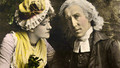
An epic yet intimate portrait of two theatrical dynasties, which takes us from the Victorian stage to the modern age.
Ellen Terry was a natural actress who filled the theatre with a magical radiance. The Times called her the “uncrowned queen of England,” but behind her public success lay a darker story. The child bride of G.F. Watts, she eloped with a friend of Oscar Wilde’s at the age of twenty-one and gave birth to two illegitimate children.
But her greatest partnership was on stage with Henry Irving. At the Lyceum Theatre in London, the two of them created a grand Cathedral of the Arts. Their intimately involved lives exceeded in plot the Shakespearean dramas they performed on stage — and indeed were curiously affected by them. They also influenced the life and work of their remarkable children, Ellen’s children in particular. Edy Craig founded a feminist theatre group, The Pioneer Players. Her brother, Edward Gordon Craig, the revolutionary stage designer who collaborated with Stanislavski is revealed by this book to be the forgotten man of modernism. He had thirteen children by eight women. He is, perhaps, the most extraordinary man Michael Holroyd has ever written about.
Michael Holroyd is the author of acclaimed biographies of George Bernard Shaw, the painter Augustus John, Lytton Strachey, and Ellen Terry and Henry Irving, as well as two memoirs, Basil Street Blues and Mosaic. Knighted for his services to literature, he is the president emeritus of the Royal Society of Literature and the only nonfiction writer to have been awarded the David Cohen British Prize for Literature. His previous book, A Strange Eventful History, won the James Tait Black Memorial Prize for biography in 2009. He lives in London with his wife, the novelist Margaret Drabble.
I’ve been reading biographies of these people since I was in college and obsessed by Victorian and Edwardian England. Ellen Terry was the most famous and revered actress of her day; Henry Irving was the actor-manager of the Lyceum Theatre, the great Victorian classical theatre. They lived unconventional, artistic lives and crossed paths with everybody of their age. Bram Stoker was the state manager. Terry had a long correspondence with George Bernard Shaw. Her son Gordon Craig was involved with Isadora Dun¬can, another of my youthful heroines. This chatty biography smoothly moves through each of their lives, stopping to tell the stories of various people involved with them and with the theater. It also follows their children, particularly Gordon Craig who became an influential figure in the theater as a designer. It had many reminders of A.S. Byatt's The Children's Book, which covers the same period of theater history. Not profound, but an entertaining, gossipy read. I particularly liked the scene in which Henry Irving's first wife says to him, as they're riding home from a night he triumphed in the theater, "When are you going to give up this nonsense??" He caught the cabdriver's attention, stepped out of the cab, and walked away across the park, never to see his wife again.
Ellen Terry and Henry Irving were icons of the Victorian theatre world. She, like Lillie Langtry, was known as a famous English beauty: a pillar of grace and style. He, with his tacklings of great Shakespeare roles, was the man who single-handedly dragged the theatrical world into almost respectability (though he was also reputed to be the model for Dracula, whose author, Bram Stoker, was his business manager). While they were perceived as a great stage couple, they were never actually married. Both had complex and encyclopedic sex lives and their individual offspring formed a theatrical dynasty which continues even into the more modern world with figures like John Gielgud.
Michael Holroyd tackles the fantastically complex family story in this brick of a book (620 pages) which, while long, is never boring. It has all the drama and intrigue of a soap opera and the spice and daring of the worst scandals. To put it mildly, the Terrys and The Irvings were sexually unconventional and made no bones about it, though like most Victorians they painted a thin veneer of respectabilty over the details.
Holroyd's research reveals most of the facts and paints both a dramatic portrait and sometimes a wryly humourous one. For this reader, two of the most intriguing, if exasperating, figures are the brother and sister duo of Edith Craig and Edward Gordon Craig, Ellen Terry's children by E.W. Godwin. She was a costumer, writer, producer, director who was also a pioneering political theatre figure and suffragette, an intimate of Radclyffe Hall and Vita Sackville-West. He was a radical theatrical designer and theorist and also a womanizer, irresponsible cad, and something of a fraud. Although the book is vastly entertaining, all the characters are treated with respect, insight, and historical accuracy. It truly is "a strange and eventful history." A wonderful read. - BH.
Curiously slow to start, partly because Holroyd starts with Ellen Terry, who is very hard to describe - at least hard for him. But when he introduces Henry Irving, it all comes together, because the two must be seen against one another to be understood. And I get the weird sense that in the pairing - the sunny Ellen Terry, an effortless actress from a stage family, who falls in and out of love easily, who feels deeply but transiently, and the dark, depressive, self-made, self-invented man from the provinces, I see the reflection of Holroyd and his wife Margaret Drabble - only Holroyd is Ellen Terry and Drabble, dark, angry, bitter, more than a little insane with her anti-Americanism and passion for justice - as Henry Irving. "Her innocence was as mysterious to Irving as were his motiveless black moods to her," as Holroyd writes. I have a passionate interest in Henry Irving, and this book, despite its learning and charm and graceful writing, is a little distant from him for my taste - but again Holroyd and Drabble have the luxury as a married couple of always having lived (I think this is right) in separate London houses. more tk
This group biography may be Holroyd's finest achievement. His subjects are hardly neglected figures, but the weaving together of their stories over several generations is new and profound. The world of the stage becomes a metaphor for a changing culture--in this case, the transition from the Victorian to the Edwardian epoch, when Ellen Terry became the most beloved actress of her time and Henry Irving the most successful and innovative theater manager in London and abroad. Although Holroyd makes deft use of the copious secondary literature on these figures, he has done considerable research in primary sources. And rather than relying on the conventional endnotes, his "Outline of Sources" serves as an especially valuable introduction to the period and its personalities. Quite aside from offering an engrossing narrative, Holroyd has a point to prove: "Despite alterations in the law, in accepted social and moral habits, and in our methods of recording history, the configurations of family life today still echo and reflect the concealed lives of a hundred years or more ago."
Lots of detail about a group of not particularly pleasant people. Family trees would have helped a lot, particularly as many of the subjects changed names, gender etc.
Two and a half stars. By the end I was skipping long sections.
The first part of this book was quite interesting and taught me a lot about Ellen Terry and Henry Irving, actors who were among the biggest stars of the late Victorian stage. Had the author only written about these two, I'd have given the book a much higher rating, but far too much of the book describes the life of Terry's children, and in particular her son, Gordon Craig, whose claim to fame must be that he brought cruel, exploitative insanely selfish behavior to a level few other people will ever achieve (fortunately.)
In theory, he was an important stage designer, or at least the author wants you to believe that, citing his biographers and scholars who write about him through the chapters on this disgusting man. But Holroyd's text gives no hint as to how Craig might have earned his reputation, as he spends most of his life lazing about, doing a bit of this, and a bit of that, proclaiming to anyone who will listen what a genius he is and living off money he extracts from his famous mother, his famous girlfriend, Isadora Duncan, and the the various other women he seduces, impregnates and abandons. I lost count after his ninth illegitimate child by his fifth--or was it sixth--victim.
As painted here, Craig sounds like a textbook case of "Borderline personality" which is a dull sounding term for a kind of psychopathic personality type where the person sees the entire world as revolving only around their needs and feels entitled to do anything to anyone as long as he gets what he wants. Craig's hostility to the women he seduced, exploited, and abandoned with children he wouldn't support is typical of that kind of personality.
But really, I have no desire to read about such people, nor to glorify them with long biographies.
Craig's sister Edy and her circle of repellant lesbian friends are similary described at far-too-great length. The description of how they manage Terry's last years, when reading through the lines it appears she was suffering from advancing dementia, is quite confused, The author presents without comment many quotes from letters from Terry in her old age that sound like demented paranoia and demonize her caregivers. Having been in the position of caring for an old person with dementia I saw a quite different explanation for the behavior of the caregivers than what we get from the snippets of letters the author presents.
But that may just be the problem with the whole second half of the book--a failure of the author to shape the materials. I know that Holroyd was very ill during the time he worked on this book and that may explain why the second half is the way it is, as he is usually a very talented (though a bit too prolix) biographer.
Whatever the explanation is, I can't recommend this book to anyone save those with an intense interest in theater in the late 19th and early 20th century and a tolerance for a very long, annoying meandering bios that bring to life characters who would do better left to languish in obscurity.
Ellen Terry and Henry Irving dominated the Victorian stage in ways that are difficult to imagine today, in a pre-cinema, pre-Twitter age. As disciplined and determined as these two performers were, their personal lives were chaotic and devastating to their partners, lovers, children, friends, and hangers-on. A bit of trivia -- Bram Stoker, the author of Dracula, devoted his life to making Henry Irving's life possible, only to be snubbed cruelly by him near the end, a snub he never recovered from and never forgave.
Where Terry was fleeting emotions and shifting sensibilities, the classic evanescent performer, Irving was solid, solitary, and grim. Where Terry was never without admirers, hangers-on, and children looked after by a bewildering array of lovers, consorts and admirers, Irving spent half of his life virtually alone, and certainly isolated, learning his craft. And yet thousands thronged the streets upon his death, for a last look at the dour colossus of the stage.
Holroyd's book is always fascinating, but frequently frustrating, because he has a hard time not mirroring the chaos of the two principal's lives in the structure of his book. And characters come and go at speed, each requiring a paragraph or page of introduction to be placed in the Terry or Irving world, only to disappear and never come up again. Holroyd was apparently keen to show the lives of Terry and Irving's families and especially their children, each of whom struggles to follow in the footsteps of these monstrous people and each of whose lives takes one tragic turn after another. As such, he sometimes takes the children's own descriptions of what they're doing at face value -- presumably because the only documentation comes from their own letters -- and that's a mistake, because their own 'takes' on their lives are not defensible. Several were mini-monsters themselves, and what they say about themselves needs to be taken with a huge dose of salt.
A brilliant, chaotic book about how 2 brilliant, chaotic families intertwine.
'Ellen Terry as Lady Macbeth' by John Singer Sargent, currently hanging in Tate Britain, is my favourite picture. However I didn't know a lot about the life of Terry, nor of Henry Irving who she is inextricably linked with. Michael Holroyd is this country's premier literary biographer (producing multi volume lives of George Bernard Shaw as well as Lytton Strachey & Augustus John all of which I've enjoyed) so this has been on my 'should read list for a number of years. Sadly after reading this 'group biography' (as it covers both their lives plus the lives of their children) it didn't grab me as much as his other books. Certainly you understand that Terry & Irving were - I suppose - the 19th century theatrical equivalent of Laurence Olivier & Vivien Leigh (although there is some dispute as to whether they were actually lovers). That being said the biography is more interested in there offstage life than an analysis of their career on stage. Their lives bisect with a large cast of characters include Bernard Shaw, Queen Victoria & Isadora Duncan but bizarrely you never got the impression that either was a truly great actor. There were sections that didn't really grab my attention but in hindsight the biggest issue I had was the fact that he also decided to take in the lives of the children. A slightly shorter book just on Irving & Terry with more emphasis on the acting I probably would have enjoyed more.
Michael Holroyd's latest starts out as a biography of the legendary British actress Ellen Terry, until it reaches the point when she begins collaborating with the equally iconic Henry Irving--Holroyd then circles back to tell HIS story, and then the story of their long and illustrious partnership, and THEN the stories of their children (not, we should be clear, their children together, because the evidence that they were even lovers is largely circumstantial). Terry's son and daughter dominate the back half of this story, and with good reason: Gordon Craig counted Isadora Duncan among his many lovers, while Edy Craig's longtime female companion had a momentary fling with Vita Sackville-West, and then late in life a massive fight broke out over their mother's correspondence with George Bernard Shaw.
Holroyd has a LOT of material to sift through here, and he does an admirable job of teasing out a coherent and compelling narrative out of all the parallel biographies.
In this group biography of Ellen Terry and Henry Irving, the queen and king of 19th-century English theater, Michael Holroyd -- well known for his lives of Lytton Strachey and Shaw -- has produced the most completely delicious, the most civilized and the most wickedly entertaining work of nonfiction anyone could ask for. I have no particular interest in theatrical history, but Holroyd's verve -- his dramatic sense for the comic and the tragic -- is irresistible. The book's chapters are pleasingly short, its prose crisp and fast-moving, and every page is packed with bizarre doings, eccentric characters, surprising factoids and a stream of lively and scandalous anecdotes.
The first half of this book, full of striving and change and the pursuit of Art (and sometimes artists' pursuit of each other) had me fascinated. After Irving's death, however, the remaining lives seemed to circle around fractious romantic attachments and family relationships-- "circle" as in going round and round and never ending up anywhere new. Gordon Craig reached some sort of high point in egocentric, selfish behavior. I still found some interest in descriptions of stagecraft of the Victorian era, but lost interest in these particular individuals. So: first half of this book: a treat! Second half, not so much.
An interesting if odd book that covers a wide array of people who had relationships with one of the families. But I was obsessed with Edward Craig's being a cad through the whole second half of the book. Impregnating women and going about his way as if "genius" was an excuse. Abandoning his children and growing indignant when demands were made on him on their behalf. I don't think Holroyd was as judgmental as he could have been (I would have raked him over the coals). He does occasionally throw a sarcastic aside. Anyway, I would say it is a book for people who love the theater and know something about it. I think they probably would have gotten more out of it than I did.
Great fun. Holroyd's tone is that of someone knowledgeable about & fascinated by Victorians & theatre people, but never sags into worship. They're all admirable & reprehensible at the same time, as most of us humans are in the long run, so he just lets them run on with only the occasional sly implication that "she's laying it on a bit thick here" or "he remained a spoiled infant all his life, clearly" without so many words.
Reading this while doing a summer of repertory Shakespeare adds doubly to the pleasure. Makes one want to misbehave more extravagantly, because apparently it used to be expected of us...
My mother in law gave this to me. Don't know why. Felt compelled to finish this hefty tome. Admire writing. Admire scholarship. Began to feel like the people involved were all candidates for People magazine or a psych ward or both.
If you are an anglophile, dramaphile, history buff this could be for you.
I can understand why Holroyd chose to write of the several families featured in this book--their lives were intertwined to an extreme degree, but it does make for very dense reading. Good if you have any interest in English theater.
No one in the Terry/Irving connection came off as a very nice person, especially Irving himself and Terry's son Gordon Craig. And while Holroyd keeps telling us what charisma Terry had, somehow it doesn't come off on the pages of this book. I slogged through it, but I'm not sure why I did.
There seems to be no end to my appetite for theatrical/literary gossip. V. well written and completely fascinating to someone with my People Magazine mind.
Reading Challenge, Week 19: book based on a true story.
An interesting book but and awful lot of information to cover. Can see why Ellen Terry and Henry Irving were tackled together, but could almost have been two, or even three, books!
Found the bits about Henry Irving most interesting because of my personal connection to him.
Didn't feel all the bits about their children were necessary, particularly about Gordon Craig. I didn't like him much either.
Surprised at all the illegitimate children and same sex relationships considering the time period. Very modern people!