Pre Metabarona postojale su Kastake, klan razbojničkih pirata – i ovo je njihova priča.
Metabaroni su pripovedali izuzetnu sagu o genealogiji najvećeg ratnika galaksije. Ali i njegovi preci su imali pretke. Ispostavlja se da oni nisu bili časni ratnici posvećeni strogom kodeksu, već nelojalni, osvetoljubivi pirati, iznikli iz brutalnosti i rata.
Od čuvenog Alehandra Žodorovskog i crtača Das Pastorasa, za sve koji su sanjali o nastavku priče o Metabaronima, stiže priča o njihovom najstarijem pretku, Dajalu od Kastaka.
„Evo šta, zapravo, delo Žodorovskog čini briljantnim: njegova sposobnost da istovremeno pripoveda o brutalnom i prekrasnom, o ružnom i veličanstvenom – sve to u jednoj sveobuhvatnoj priči koja vas uvlači u sebe, koja je zanimljiva i napeta.“ – Figures.com
„Preselio sam se u univerzum pun tragedije i nade, u univerzum i porodična stabla koja su u tolikoj meri ostvarena, toliko puna i složena da svakim sledećim čitanjem otkrivam nove stvari i menjam sliku o tome kako se sve mogu stvarati stripovi.“ – 9th Blog
Better known for his surreal films El Topo and The Holy Mountain filmed in the early 1970s, Alejandro Jodorowsky is also an accomplished writer of graphic novels and a psychotherapist. He developed Psychomagic, a combination of psychotherapy and shamanic magic. His fans have included John Lennon and Marilyn Manson.
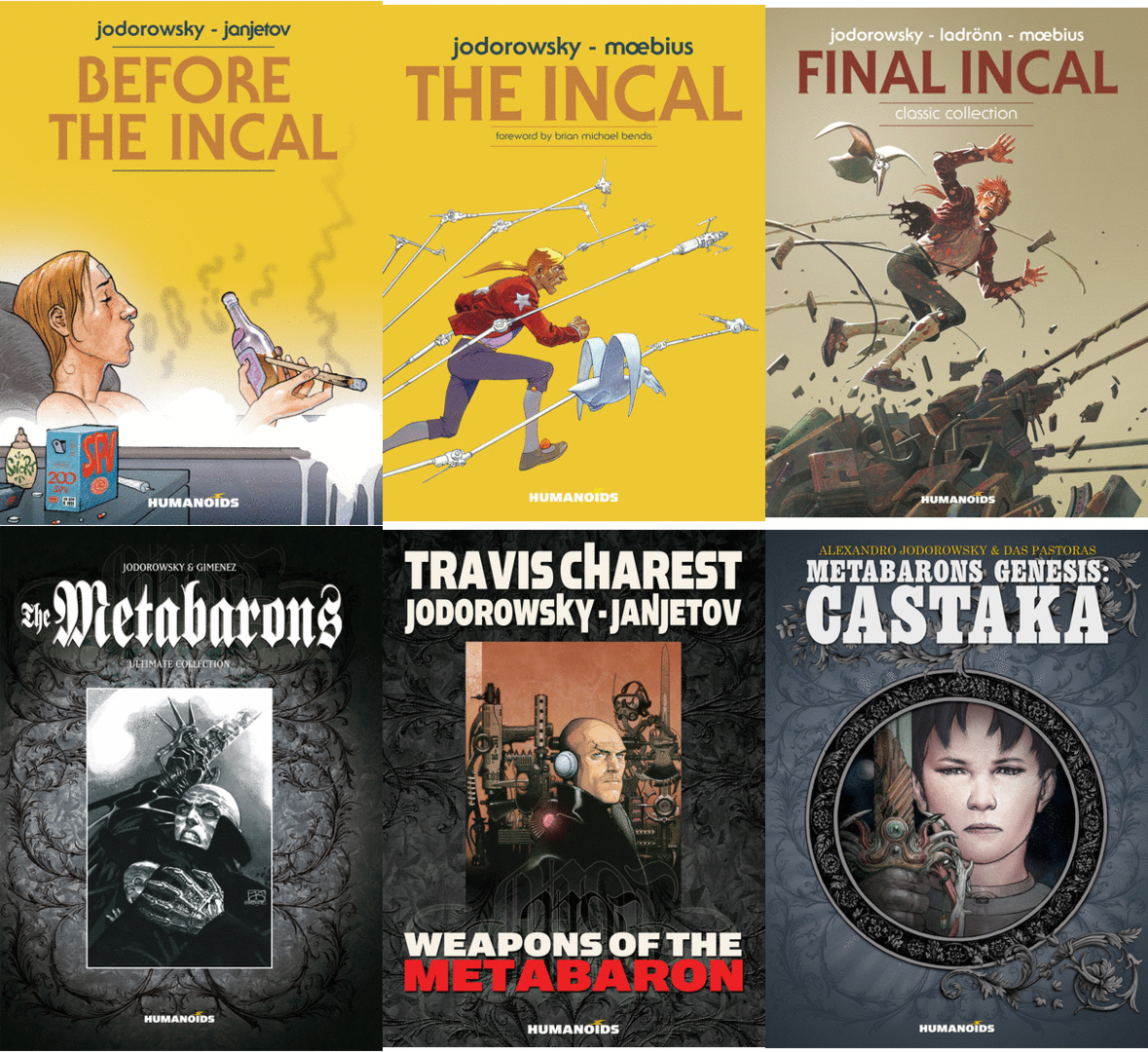
[3.5 STARS/5] If you've got no clue what 'The Jodoverse' is, that's okay. Your chances of finding a way to muddle through life without that particular scrap of knowledge are about the same -- and probably better, now that I think about it -- than someone who knows what the fuck a Metabaron is. For an idea of the 30-years-or-so of fancy painted Euro-comics that make up the Jodoverse, these hardcovers collect Alejandro Jodorowsky's mega-epic, averaging about 250-pages a piece, 2000-pages total; given the story-density and much larger page-size of BD, that's the equivalent of a 3500-page American epic, and a 5000-page manga... roughly: What BD occasionally lacks in story, it makes up for in art. Over the last decade, the cross-pollination between American, European and Japanese comics has yielded a wider range in artistic styles, diverging from the Metal Hurlant archetypes. Despite the advantages and vast improvements in quality offered by digital art, there are brilliantly talented young artists still creating the vividly painted work that the masters of SF BD made famous. Even if you're not a fan of Euro-comics, you've probably still seen their art: Jean 'Moebius' Giraud, Milo Manara, Francois Schuiten, Geof Darrow, Vittorio Giardino, Liberatore, Juan Gimenez, Enki Bilal, Georges Bess, et al.
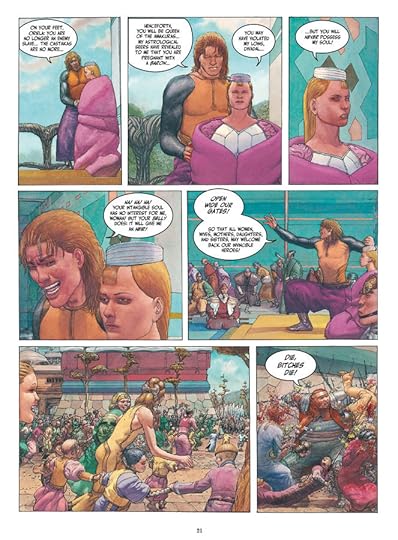
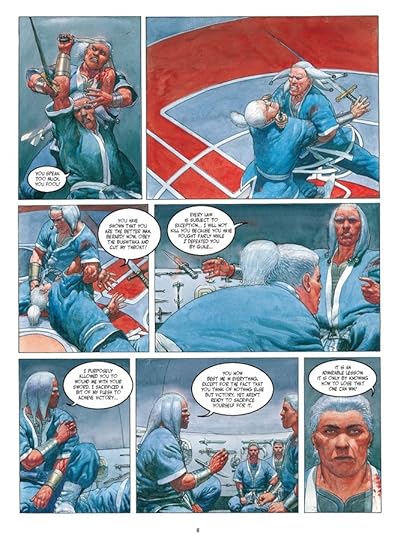
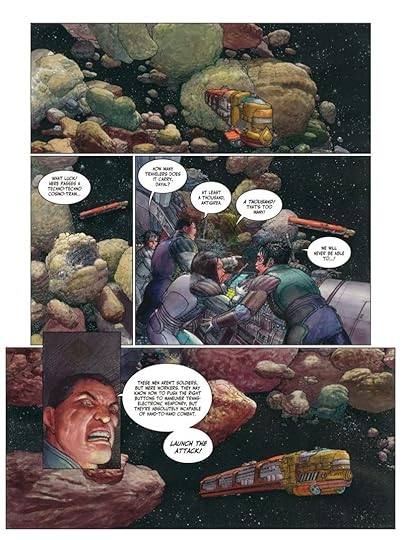
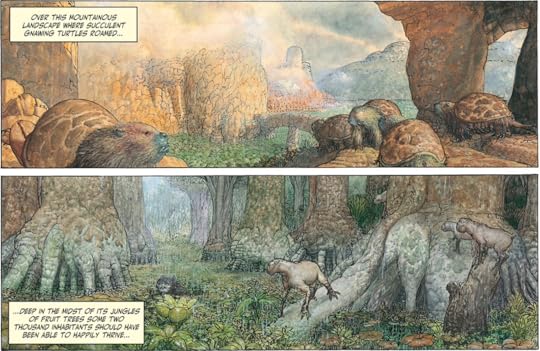
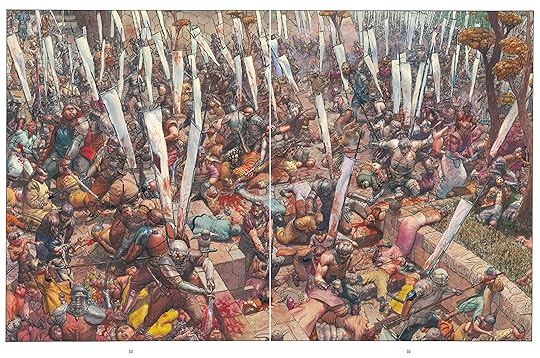
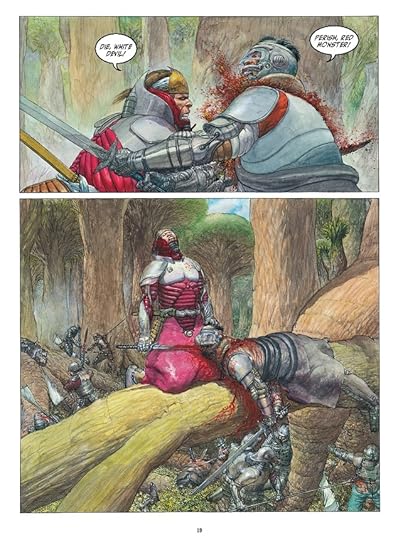
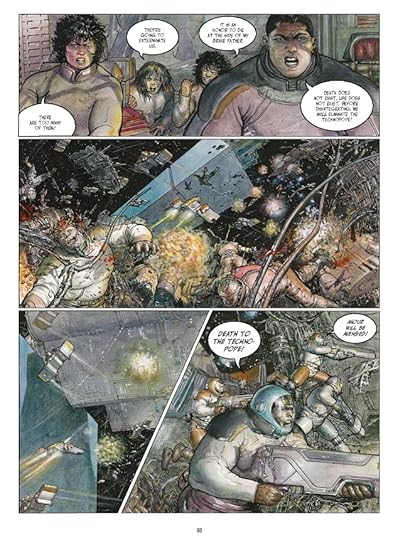
The painted coloring, texturing and delicate line-work of Das Pastoras is immediately recognizable, with an originality that is rare: The subsequent generations of BD masters have produced painted art that is just as impressive; at least one artist has managed this feat with digital paint. At the forefront is the man who was the natural choice to follow Juan Gimenez on the Metabarons prequel, Castaka: Das Pastoras. Just as Ladronn accomplished the impossible by matching and then transcending a Moebius masterpiece with Final Incal, Pastoras significantly improves upon the solid artwork of The Metabarons with Castaka, matching even the blinding flash of genius provided by Travis Charest*(See Spoiler Below) with Weapons of the Metabarons.
Below are two double-page spreads from Castaka, followed by two more individual pages of gorgeously painted art by Das Pastoras: *('Who the Fuck is Travis Charest?' Spoiler-gression... not really a spoiler, just a way of protecting readers from my reckless and slightly radioactive enthusiasm, manifesting itself on the Goodreads-plane as oblique, long-winded digressions; it's stuff I find interesting, but not directly related to the book being reviewed...)
The 3.5-star rating is for the art; as for the story... I'm a long-time reader of Jodorowsky's work, and I've learned to forgive appreciate his eccentricities, and tolerate the repetitive characters, terrible questionable humor, and painfully cornball dialogue. Beyond the artwork, there's not much to recommend 'Castaka'. It's identical to the fucked-up epic that preceded it, with nothing new to add. I get tired of all the 'techno' this and 'paleo' that, personally. It's all quite dumb.
Intense spiritual Sci-fi comic from Jodorowsky. Great world-building, brutal but compelling story, interesting characters. I like how he mixes medieval swordplay with futuristic technology. The family clans fighting each other while following a strict codex reminds me of Japanese Bushido.
The drawing/painting style is astonishing. Lots of details, incredible facial expressions and uniforms, spaceships and monsters. The characters tend to look ugly and gritty, but I believe that's part of the style.
I can highly recommend the story if you're an adult. Warning: the story features rape and cruel violence, including decapitation and lots of blood.
If you like Dune, you will love the Metabarons. (Alejandro Jodorowsky almost filmed Dune. Check out the documentary "Jodorowsky's Dune" which tells the creative journey of his failed dream)
La precuela me ha gustado incluso más. Traiciones y matanzas a lo Juego de tronos, personajes carismáticos, unas gemelas asesinas y el genial dibujo de Das Pastoras. 10 points.
La casta de los Metabarones: Castaka (2007) es una edición posterior a La Casta de los Metabarones (1998-2003) de Jodorowsky, pero donde las aventuras narradas son anteriores a éstas, es decir, se trata de una precuela donde conocemos el origen de la dinastía de los Metabarones y nos explica cómo han llegado a convertirse en lo que son y el porqué de su peculiar tradición. La calidad del entretenimiento continúa siendo muy buena. En este caso se trata de dos entregas con texto de Jodorowsky, aunque las ilustraciones corren a cargo de Das Pastoras. También se disfruta mucho.
Nem todos os antepassados do Metabarão foram grandes guerreiros Castaka. Neste volume conta-se como os Castaka foram cruzados com uma tribo de piratas que aniquilou a totalidade da semente masculina dos Castaka, deixando, apenas um bebé, Dayal, resultado da mistura de ambos os povos.
A mãe de Dayal, a rainha Castaka terá sido raptada e violada por um chefe pirata. Por vingança os Castaka atacam e são assim contaminados com um poderoso produto que os torna estéreis. Dayal é o fruto desse cruzamento.
Os Castaka, sem outras possibilidades para se poderem perpetuar usam o jovem para fertilizar as jovens até à idade adulta, altura em que o Rei revelou a sua repulsa pelo jovem mestiço e o exilou. Treinado como um grande guerreiro e encurralado, irá juntar-se à filha do homem que o educou para formar a sua família.
A repulsa do Rei por Dayal continua a crescer e chega o dia em que decide aniquilá-lo e à família. Sabendo de antemão, estes escondem-se num esconderijo estanque do território de caça. Simultaneamente, o Rei Castaka hostiliza uma civilização de tecnologia bastante avançada que decide destruir o planeta. Como resultado salva-se apenas o componente estanque onde se encontra Dayal e a restante família. A partir daqui segue-se a história de como esta pequena família enriquece e acede a tecnologia bastante avançada, lançando assim as sementes para o Metabarão que já conhecemos.
Esta história possui os elementos clássicos da restante saga Metabarão, com lutas honradas e desonradas, carregadas de sangue e pedaços de corpos, onde não falta a nudez e a sexualidade em bruto, mais como forma de perpetuar uma herança do que como forma de prazer. Os guerreiros que a família enfrenta são impiedosos e convencidos das suas capacidades, não esperando que as jovens sejam capazes de grandes feitos.
Preface: I'm done with Jodorowsky after recently find out he raped someone during El Topo and has displayed a nonchalant attitude it since. I'm not intending to buy any of his future work (but had owned all his prior books) but am doing a final reread of the Jodoverse before I begin liquidating my collection of his stuff. It's hard to separate the art from the artist, the the rape is literally the art in this instance.
So this felt like a good place to start--in many waves this serves as the entrance point for the Jodoverse, the seeding of the Metabarons who were basically Jodorowsky's re-purposed Dune script.
This is somewhat of a short story that doesn't quite delve as deeply as I'd like into the rituals and traditions of the Metabaron clan. It's just hints and glimpses, which is fine--but Jordorwsky is never know for subtlety so I feel this is one of his most restrained works.
Scratch that--literally five pages in the comic is a rape...and Penis weapons that spew acid. So in actuality, it's as crass as anything else he's done, but without any of the spirituality or meaning that often accompanies his work.
It's almost got the epic feel of a Wagnerian play. Yet keeps the incest. It's about how lawless space pirates (survivors of a disgraced clan) become the honor-bound Metabaron dynasty. 2.5 Stars
This is the prequel to the Metabarons epic saga - leading to the marriage of Otto Von Salza (where the Metabarons starts) - We learn the secret of the Castaka clan, how they get the bird spirit and discover Epyphite. So this one takes us back even further, giving 3 more generations in the metabaron lineage - It is an epic tale of war, rape, patricide, space piracy set against a backdrop of a bigger conflict (Technopriests vs the technologically backward, warring clans)
Another great installment, widening the scope of Jodorowsky's epic (a saga to rival that of Dune and Game of Thrones). This gives us more generations and backstory, but it is very much 'more of the same' - Not necessarily a bad thing, I love the metabarons! But it doesn't give me anything 'new' or original. It also lacks the satire and humour that peppers much of the Jodoverse. Still good and a nice addition to the metabaron mythos but not amazing. Das Pastoras artwork is the same, its solid, fits the story (and thank heaven we are spared Janjetov's eyebrows!) but nothing here made me breathless as some of the other artwork in the Jodoverse.
Castaka should serve as prequel and describe history of Metabarons, and how this great caste emerged. It does it in a way, but... Jodorowsky wants a conflict, so he creates one, just like that, from thin air. So we are watching two groups fighting each other, long forgotten why it all started, unable to escape their fate... There are some things from past explained, but nothing that significant. So another not really necessary piece from Jodowerse... And yeah, character faces are quite ugly , which doesn't helped either. 2,5*
Jednom kad se imuna reakcija na njegovo preterivanje smiri, za šta mi je trebalo da pročitam (i preživim) "Metabarone" i "Oružje", Žodorovski može da postane prilično prijatno čitalačko iskustvo. Das Pastorasova olovka deluje umerenije i "ziheraškije" od Himenezove, da li zbog urođenog stila ili zbog stišavanja scenarija (ili scenariste), nemam pojma. Ipak, orgijanja u bojama, anatomijama i iznutricama ima napretek.
This one had a lot of good/crazy ideas put into it. The Metabarons comics make me feel like I'm reading some sci-fi ish Greek Mythology and I often feel like I should read what's going on between the lines.
I also strongly believe it wouldn't be as good to read without the amazing art because its all over the place at times. But hey, as far as I know, that's how it is with most comic books and it works.
Me encantan los comics de Jodorowsky, no se con que penes va a salir (literal). Fantasias, ciencia ficción, jaladas. Todo eso que te gusta. Esta es la segunda vez que lo leo.
This entire review has been hidden because of spoilers.
This is the story of how the Castakas, feudal family that will give birth to first Metabaron, survived the onslaught brought to their home planet by the invading forces and finally settled on the remote planet, planet equivalent to Herbert's Dune in so many ways that it holds a mysterious ore that cannot be found anywhere else in the galaxy.
Story itself is nothing more than a filler - a prequel - to original Metabarons story. It is an epic story but not without faults - while you read it feels a little bit ... incomplete would be the word I guess. Few times I had to check page numbers to make sure I haven't missed anything (Castaka decides to create pirate fleet - that fleet does not does not exist on one page while on next page first frame we see a fully organized fleet storming a convoy - wait, what? When, how?).
Again for those that have read original Metabaron we have everything that Jodorowski seems to be obsessed with - rape, incest (this time it did not get as far as in Metabarons), lots of blood and gore and heads and limbs flying around, perverse characters and massacres, lots and lots of these. And did I forgot to mention sex? Yes, you get a lot of sex too. Way these things were presented annoyed me (as they did in original Metabarons). Unlike original Metabarons all these elements are little bit more contained (different times maybe - maybe readers are slightly saturated with similar themes) but as always they are present for that artistic shock effect. I guess this all comes from author's opinion that Metabaron cannot be a product of nothing more than completely perverse society. But again there are ways of handling it much much better - in regard to number of deaths, rapes and overall sadism of ruling classes Game of Thrones is on similar grounds but manages to show this in much more interesting way.
Art is good, not on par with original Metabarons but good.
All in all if you like an idea of revenge driven knight wanderer strolling through perverse feudal space empire, earning his bread fighting across universe as an ultimate mercenary this is a book for you. Highly recommended for any fan of space opera - just make sure that after this you read the original Metabarons.
Alejandro Jodorowsky's builds more into his universe, as explored more directly in Metabarrons and Incal, and this is does set-up a classic Greek tragedy style origin for the Meta-barrons. High on concept, low on characterization, but it is fascinating nonetheless. The wooden dialogue of much of Jodorowsky's futuristic work mars the piece as the lack of characterization, but the deep symbolism and art holds it together beyond that.
In classic Jodorowsky story, Metabarons Genesis is told. Cataka clan goes on through the difficulties of greatness. Baron Castaka is yet come to be great and important character in Jodorowerse but here we can see how his story began.
Wonderful book with a lot of sex, incest, honor and revenge as with all books of Jodorowsky. Recommended if you already know his work.
A pretty good story but it felt mostly like a rehash of things that had been covered already in the original series, with some extra padding. I am also a bit ambivalent about the art... while interesting and thematically suitable, something about it feels unfinished. After the excellence of The Metabarons, though, I think any followup was bound to seem at least somewhat disappointing.
The origin of the metabarons is explained in this two part comic of war, betrayal and gore. It was preposterous but not as bad as the rest of the franchise.