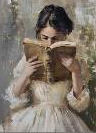
Dwight Macdonald (March 24, 1906 – December 19, 1982) was an American writer, editor, film critic, social critic, philosopher, and political radical. Macdonald was a member of the New York Intellectuals and editor of their leftist magazine Partisan Review for six years. He also contributed to other New York publications including Time, The New Yorker, The New York Review of Books, and politics, a journal which he founded in 1944.
My long history with this book, first purchased in Minnesota, a couple years after attending fellow-grad student parties with Garrison Keilor, who was a couple years older, and in Journalism, not English. Memorized completely "You are old, Father William," Lewis Carroll's spoof on the Poet Laureate Southey's preacherly "In the days of my youth I remembered my God,/ And He has not forgotten my age." (280) I had learned some by heart at age 7, lying on the couch listening to my older brother practice it for his Elocution lesson. Of course, I knew it before he did, to show off. But what a great choice that Elocution teacher in Springfield MA made (around 1950). I celebrated my brother's retirement with an imitation of Carroll's parody: "You are old, Brother David," young Alan proposed, "Yet you look just as dapper as ever. It can't be from jogging, or picking your nose; It's those sermons that you deliver."
"You lie," Brother David replied to the youth, In your subtle and nuanced suggestion. You know I stopped jogging, I swear it's the truth, When I attained to the age of discretion."
This Parodies tome I claim to have read fifty years ago, but I have found hidden interstices in the last couple weeks off my shelf, aloudreading on morning walks. [I walkread all of Paradise Lost two Springs ago, 30 minutes a morning -- 300 to 400 lines--, mostly aloud: Got to "Through Eden took their solitary way" in less than a month. Seemed shorter than the half dozen times I had read it before. Fave line this time, "To sit in hateful Office, here confined"--Sin guarding the Gates of Hell.] But back to Parodies: Never knew of Keats's parody of Wordsworth, "On Oxford": "…The plain Doric column / Supports an old Bishop and Crosier…There are plenty of trees,/ And plenty of ease,/ And plenty of deer for the Parsons;/ And when it is venison, / Short is the benison,--/Then each on a leg or thigh fastens."(80) Delightful discoveries: Mrs John Milton's diaries, as "Housekeeping not so much fun as I thought it would be. John is very particular. John cannot eat any kind of hashed meats. He compares the cooking here unfavorably with that of Italy." Also, John Galsworthy, Browning galore, and various Whitmans, but also Dickinson and Frost, "Mr Frost Goes South to Boston," with "That's the way with buildings and with people."(230) Of course, I read with heightened attention as I bring out my new book, Parodies Lost, with my versions of Ashbery, Angelou, Dickinson, Dylan Thomas, Bob Dylan, Wilbur and many more.
Editor, correction, Compiler Dwight Mcdonald is very serious about Parody. In his mind Parody is a defined thing. Burlesque need not apply. He is certain about the word even if the afterword fails in demarking the exact limits of Parody. His taste is decidedly high brow and perhaps so exclusionary that by the end he includes material that he admits does not fit his exacting limits for the term. I had expected to spend my time reading laughing and smiling. Most of the time I was straining a memory, never that well trained in poets and vaguely remembering one great writers’ style from another. This book will succeed for the classically trained, European centric, English literature grad student. For the more self-taught or casual reader it will be hit and miss. As much a challenge to remember the inspiration for the parody as a relaxing delight for perusal.
I fully agree with the Compiler that a parody that goes too far, his term over- the top, can be too easy and rarely worth republishing. What I think he misses is that otherwise apt parody can also run beyond the joke. Funny in one stanza or page can be tiring after 5 of either.
For me the best of the classic Parodies were in the rare cases of a single phrase that nails the pretention of the targeted author: Page 263 Felicia Lampost as she “Cozened”: Henry James “I was with a parking ticket slapped” Page 342 Wolcott Gibb Pronging the Henry Luce (Time, Fortune, Life) editorial style “Backward ran the sentences until reeled the mind”
Glorious misconstruction, but notice how many pages apart.
Sorry this one is just stand alone brilliant: Page 366 Walter B. Scott essay on the failing literary scene in Chicago: "Nowadays one encounters, at best-and it simply is not good enough some Northwestern Univ pendant's cynical and barren: "Smile when you call me Ishmael"
For me a grand exception to this was a lengthy, and entirely justified spoof on several institutions and academic writing: Paul Jennings Report on Resistentialism, Pg 394-404 This is a philosophy based on the notion “les choses sont contre nous” Things are against us. It is proven beyond all debate that seemingly innocent inanimate objects represent a threat to all humans. Myown experience is that all things digital can sense adrenaline so that they can pick the most effective time to fail. What makes this essay work as 10 pages of humor is that Jenning refreshes the joke with new aspects and variations. It is not just about having fun with a particular style.
Towards the end Macdonald gets around to mentioning Punch Magazine. Mostly too low brow for him. However he enumerates the number of times especially obvious targets for parody were in fact parodied. The Raven: 60 times, The Charge of the Light Brigade -21. Can we read a few? Marcel Proust’s pastiche: The Lemoine Affair is extensively reproduced, in the original French only, and this time back to original English large portions of Ulysses and a wonderful comic essay by Mark Twain, (Though Twain is not allowed the term Parody). I suppose the times would not have support quotes from Soviet Russia’s Crocodile.
For the right audience wonderful, for me uneven and BTW out of print.
This is one dense book. If you’re not at all familiar with the authors of the source material—novels, essays, criticism and poetry, etc.—then the parodies of their styles make no sense. Most of the time, they’re not particularly funny, especially when the original works deal with contemporary issues of the day such as long-dead political members.
This book is clearly meant for the more erudite reader, someone well versed in the works of Joyce, Wordsworth, Tennyson, Byron, Twain, Whitman, Shelley, Donne, Dickens, Dickinson, Updike, Lamb, Stein, as well as more obscure names like Twiss, Tynan, Traill, De Quincey, Gibbs, Douglas, Howitt, Highet, et al. There is even one extended passage in French with no English translation. If your reading tastes tend to contemporary authors and poets from the later 20th to 21st centuries, this book will be a struggle to wade through and will leave you baffled and frustrated.
For the scholarly reader who might enjoy whimsical introductions to authors s/he was planning to read, this book might prove to be a mountain worth climbing. You might even be intrigued enough to go pick up works by the original authors and see what was so special about them. However, for those who prefer much lighter fare, skip it and delve into books you might actually like by authors you prefer and respect. Life is too short to wade through Dickens or Melville just because you think you should.
It's a shame this book seems to be out of print, since Dwight Macdonald's Parodies: an Anthology from Chaucer to Beerhohm -- and after is a classic which has never been surpassed in its genre. This isn't a "humor" book but a definitive collection of serious parodies (if that's not a contradiction in terms), written by and about famous and obscure authors in English over five centuries. Anyone familiar with the great traditions of English language literature will find it both hilarious and invaluable. It's not a volume to read straight through, but one of those books you keep around to dip into occasionally throughout life. Every serious reader should have a copy.