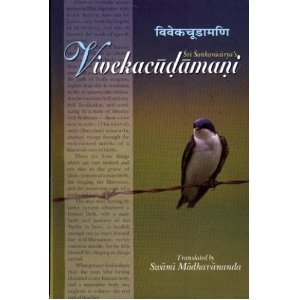
Adi Shankaracharya was born in or around the year 686 A.D.(Researchers do claim different timelines) of learned Brahmin parents, at Kaladi, Kerala in southern India. By the age of ten, he was already read and memorized all the scriptures, and had held discussions with famous scholars who came to him from every part of the country. Since the society, he lived in was materialistic and pleasure-seeking, India is on the path of spiritual decline. He went on to renounce everything in his search for the meaning of existence and the truth behind it. Though he has not preached new doctrine, added a new blaze to the spiritual volcano. He has produced rich commentaries on Upanishad, Bhagavadgita, and Vedanta sutras. and he has also produced major Advaita philosophical works like "Viveka Chudamani" and "Upadesashasri".
This is not a review of this book and I do not have direct experience to comment on this philosophical work. This review is only about my understanding of Adavith's philosophy. So anyone can refer to it before reading this work.
Adi Shankara sees Brahman or Govinda as the state of bliss or the ultimate truth. Obtaining human birth is not easier. However, even if we get human birth with body and mental strength, Most humans waste their life by clinging to unreal projected as real through our ego. Only when we realize we are part of Atman, will be liberated. According to Shankar renunciation and self-discipline by giving upon on external pleasure is the path to realization. By approaching the right guru, Under their guidance through the discriminatory mind and self-disciplined nature, one can be in a union with brahman.
Below shloka sums up the entire Advaitha philosophy of Shankaracharya.
'' BRAHMAN-the absolute existence, knowledge, and bliss are real. The universe is not real. Brahman and Atman (man's inner Self) are one."
Shankara also layout four qualifications for attainment.
===============================================
1. Discrimination between real and unreal
2. Renunciation from the enjoyment of fruits of action
3. Tranquility(detachment from an unreal thing, directing attention towards brahman is the pathway to attainment), self-control, self-surrender, forbearance.
4. Intense Longing for liberation
Now let's understand the core Advaita philosophy explained in Viveka Chudamani.
1. The spirit of Shankara's philosophy
According to Shankara, reality is something that is permanent and does not cease to exist. Anything that is prone to change is not real for Shankara. Deep consciousness is the reality in Advaita, once we attain that mystical experience everything that is shadowed by mind and matter can be negated as unreal.
2. The word appearance
Shankara is not rejecting the world and thoughts as nonexistent. He is saying they cease to exist when you realize the brahman. Humans experience the personal illusion and worldly illusion, but when they realize the Brahman it will become nonexistent.
3. Maya
If we believe the finite as the absolute reality of its own or it emerged from infinite, Then infinite cease to exist. If we think god transforms himself into something, ceases to exist. If something is prone to change, It is not absolute reality. So universe we believe is a superimposition on brahman like layers of a soap bubble. The inside space is an absolute reality that is infinite, not prone to change. The outer layer is our ignorance.
Maya is a collection of memory superimposed on our inner self and it finds an expression outside later on. Maya is an ego ideal. For example, if we do not have the memory of a snake, we will not perceive a rope as a snake in distress. Maya is like a tree and brahman is the seed. It always exists, but it ceases to exist when we realize higher consciousness
4. Brahman and Ishwara
Brahman cant create or destroy. So it amalgamates with Maya to become Ishwara of attributes. He is the creator, one who is liberated will have all power the Ishwara possess except the creation of the universe. Each liberated soul will have individual consciousness and will, but all will be under the control of Ishwara.
5. The problem of evil
In an absolute sense, There is no existence of evil and goodness. Both are the illusion of Maya. Mays is the ego-ideal that we impose on brahman. Even ethical goodness, It's driven by selfish motives.
6. The supreme goal
The supreme goal in Advaita Vedanta is the realization of Brahman. The direct experience of brahman is possible with spiritual practice and discrimination practices of what is real and unreal. Through discrimination, we try to remove the layer of ignorance from the divine nature of ourselves. Freeing ourselves from the Maya. We are divine.
7. Method and means
According to Shankara Jnana yoga is the supreme path to remove ignorance. However he also acknowledges Karma, Raja, devotional yoga is the alternative path to enlightenment
These are the notes and my understanding of Advaita based on commentaries and shlokas.
Must read for everyone if you are on a spiritual path.
mano buddhi ahankara chittani naaham
na cha shrotravjihve na cha ghraana netre
na cha vyoma bhumir na tejo na vaayuhu
chidananda rupah shivo'ham shivo'ham
I am not the mind, the intellect, the ego, or the memory,
I am not the ears, the skin, the nose, or the eyes,
I am not space, not earth, not fire, water, or wind,
I am the form of consciousness and bliss,
I am the eternal Shiva...
na cha prana sangyo na vai pancha vayuhu
na va sapta dhatur na va pancha koshah
na vak pani-padam na chopastha payu
chidananda rupah shivo'ham shivo'ham
I am not the breath, nor the five elements,
I am not the matter, nor the 5 sheaths of consciousness
Nor am I the speech, the hands, or the feet,
I am the form of consciousness and bliss,
I am the eternal Shiva...
na me dvesha ragau na me lobha mohau
na me vai mado naiva matsarya bhavaha
na dharmo na chartho na kamo na mokshaha
chidananda rupah shivo'ham shivo'ham
There is no like or dislike in me, no greed or delusion,
I know not pride or jealousy,
I have no duty, no desire for wealth, lust, or liberation,
I am the form of consciousness and bliss,
I am the eternal Shiva...
na punyam na papam na saukhyam na duhkham
na mantro na tirtham na veda na yajnah
aham bhojanam naiva bhojyam na bhokta
chidananda rupah shivo'ham shivo'ham
No virtue or vice, no pleasure or pain,
I need no mantras, no pilgrimage, no scriptures or rituals,
I am not the experienced, nor the experience itself,
I am the form of consciousness and bliss,
I am the eternal Shiva...
na me mrtyu shanka na mejati bhedaha
pita naiva me naiva mataa na janmaha
na bandhur na mitram gurur naiva shishyaha
chidananda rupah shivo'ham shivo'ham
I have no fear of death, no caste or creed,
I have no father, no mother, for I was never born,
I am not a relative, nor a friend, nor a teacher nor a student,
I am the form of consciousness and bliss,
I am the eternal Shiva...
aham nirvikalpo nirakara rupo
vibhut vatcha sarvatra sarvendriyanam
na cha sangatham naiva muktir na meyaha
chidananda rupah shivo'ham shivo'ham