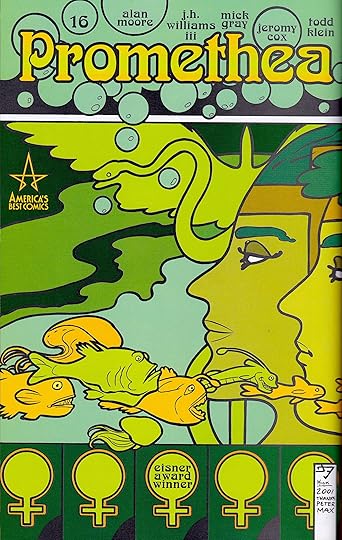
Alan Moore's entrancing fantasy masterpiece continues in an all-new Deluxe Edition hardcover format featuring the spectacular art of J.H. Williams III.
A cosmic road trip, this volume finds Promethea and Barbara traveling an unlikely path. Their wanderings take them through the many realms of Heaven and Hell, visiting manifestations of great visions and visionaries. Meanwhile, back on Earth, Stacia is the acting Promethea--protecting and serving the people of New York while Promethea is away. Is she up to the task?
Complete with character sketches, variant covers and other bonus material, this new hardcover collection is perfect for any fan of this incredible series. Collects issues #13-24.
Alan Moore is an English writer most famous for his influential work in comics, including the acclaimed graphic novels Watchmen, V for Vendetta and From Hell. He has also written a novel, Voice of the Fire, and performs "workings" (one-off performance art/spoken word pieces) with The Moon and Serpent Grand Egyptian Theatre of Marvels, some of which have been released on CD.
As a comics writer, Moore is notable for being one of the first writers to apply literary and formalist sensibilities to the mainstream of the medium. As well as including challenging subject matter and adult themes, he brings a wide range of influences to his work, from the literary–authors such as William S. Burroughs, Thomas Pynchon, Robert Anton Wilson and Iain Sinclair; New Wave science fiction writers such as Michael Moorcock; horror writers such as Clive Barker; to the cinematic–filmmakers such as Nicolas Roeg. Influences within comics include Will Eisner, Harvey Kurtzman, Jack Kirby and Bryan Talbot.
Continued graphic esoterica from Alan Moore and JH Williams III, who seem to have built this whole project around a desire to push the limits of what comic books can do. In these issues (#13–#23), our ingenuous heroine Sophie Bangs heads off on a complete tour of the Kabbalistic universe, exploring the sephiroth one by one on a quest that attempts to unite all kinds of religious, artistic and metaphorical visions in one complete system of interpretation. The intriguing alternate-reality New York story recedes into the background here, as the comic disappears into the realms of the metaphysical, or, less kindly, up its own backside.
You do need a fairly high tolerance for long-winded occult theorising here, but the rewards are not inconsiderable. This is mostly thanks to the ridiculously extravagant art style, whereby every sephira is associated not just with its own tarot card, classical deity, animal etc., but also with its own colour scheme and art style. The visual variety is awesome (click to enlarge):
There is a constant awareness of the form, too, which is played with in a variety of ways to enhance the themes – as on this double-spread, which can be read either clockwise or anticlockwise:
Part of me was longing to get back to some actual story, but narrative clearly features low on the list of Alan Moore's priorities. The point of Sophie/Promethea's journey – and ours, if we follow her – is to teach the importance of metaphorical thinking, and to demonstrate that dreams, symbols and fictions are just as real as ‘real life’ – indeed in some cases, they've never been more real. It's an appealing message for such a lavishly designed and illustrated project, which no one else in their right mind would ever have come up with, let alone put into practice with such uncompromising verve.
Visually, this is a masterpiece, although I don't care for some of the font choices. The story is pretty out there with Sophie and Barbara exploring the afterlife looking for Barbara's husband Steve. Is the eleven issue detour navigating the tree of life necessary? I guess I'll find out.
Entering volume 2 of Promethea, Alan Moore basically dumps any pretense that this series is going to feature anything like a "story," and leans whole-hog into straight up explaining his own mystical, philosophical beliefs via two characters just talking about them out loud at each other. There is almost zero narrative drive, no sense of stakes or rising tension, it is just two people walking through various levels of the afterlife and talking about where they are and what they're seeing. Should be boring as all hell, right?
Well, somehow, it isn't. I think J.H. Williams art is probably 95% the reason this book rises above the theological slog it should be, but I also have to give credit to Moore for introducing the ideas via well-written dialogue (expository though it is) and introducing various new characters along the way, giving this a sense of wonder and joy and exploration that feels like wandering through a dream. This absolutely should not work, and yet, I blew through it in no time.
There are small hints Moore drops at a more superhero-based plot brewing back home while Promethea and, um, Promethea (it's a long story) wander through the Kabballic afterlife, which, by the end of this volume, seem to be picking up steam. This at least gives the illusion of a larger plot, and I'm excited to see if this pays off or not. Honestly, even if it doesn't, I think Williams has gone so far above and beyond artistically here that I doubt I'll care.
It's wild to think this is one of Williams' earlier works. I've read quite a bit of his stuff over the years (Batwoman, Sandman: Overture, a bunch of other stuff that's slipping my mind), and I have to say, this might be the best work I've ever seen from him. It's so deeply imaginative and beautiful. Every single issue expresses a new artistic idea and carries it out almost perfectly, and the fact that he's able to do it over and over without seeming to slow down is beyond impressive. His work alone is worth the price of admission.
So, if you haven't read this, I definitely recommend it. Strap yourself in for a lot of explaining, but otherwise, I think you'll find it charming and mysterious and magical all the same.
A really great journey, but one you should take your time with. It takes a bit to get used to the sheer amount of information about myths and religion that he put into these pages, so much so that I ended up taking months reading this one book. In doing so I never lost interest nor did I forget what happened before which really is a statement to the quality of his writing. 4.5 out of 5 stars
This second volume of Promethea covers her trip through the solar system to the Godhead. It's pretty much issues #11-12 to the nth power, with all that entails.
What does that mean? We get a huge chunk of Moore's philosophy about the connections of the planets, emotions, the Tarot, and all the rest. It's interesting, but not dramatic. (There is some drama, in what's going on on Earth, but that's the minority of each issue.) Nonetheless, the last two pages just about pay it out.
We also get Williams offering a very distinctive look for each different planet, and that's stunningly, amazingly gorgeous. Possibly his best work ever.
So, it's not five stars, because there's so much philosophic meandering, but still it remains pretty interesting and the art makes it worthwhile.
9/10 El viaje a través del árbol de la cábala me ha parecido genial. Creo que tendré que hacer una relectura para entender mejor muchos conceptos (como pasa a menudo con la obra de Moore), pero me ha parecido una maravilla. Dependiendo como acabe sube a mi podium personal de la obra de Moore. A ver qué nos depara el tercer tomo.
And this is the volume where you kiss the plot goodbye. Promethea tromps off into a metaphysical representation of...heaven and hell? alternate planes of existence? a mishmash of eastern philosophy and the occult? all of the above? Who knows. Still enjoyed the ride.
Unbelievable, life altering stuff. Like a kaleidoscopic mapping of symbols, the world and the self, all interconnected and perfect. Also pure visual ecstasy, a lesson on maximalism. I wouldve never guessed comic books could hold this much power but i was dead wrong. One of my favorite pieces of art ever already, cant wait for part 3.
In diesem zweiten Sammelband liegt der Fokus komplett auf der Reise durch die zehn göttlichen Emanationen im kabbalistischen Lebensbaum. Von der irdischen, materiellen Welt Malchuth bis hinauf zur göttlichen Krone der Einheit Kether, durchlebt die Protagonistin eine initiatorische Entwicklung durch die Sphären und ihre Repräsentationen. Ein Durchschreiten aufeinanderfolgender Bewusstseinsebenen, ein Emporklimmen über die Stufen der Erkenntnis, auf welcher sich jeweils mit einem bestimmten Aspekt des Selbst auseinandergesetzt wird. Moore nutzt diesen Pfad, um eine strukturelle Allegorie des menschlichen Geistes zu erschaffen, eine spirituelle Bildungsreise, in welcher man alle Illusionen von Realität, Moral und Identität abstreift und an dessen Ende sich die Auflösung des Ichs sowie die Erkenntnis finden lässt, dass Vorstellung die alleinige schöpferische Kraft ist.
Oft fühlt es sich jedoch wie eine okkulte Unterweisung an, überladen mit weiteren Symbolsystemen aus Tarot, Astrologie, Semiotik oder Mythologie und gespickt mit Auftritten von Personen aus diesen Feldern. Lehrbuch, metatextuelle Reflexion, erkenntnistheoretische Abhandlung. Inhaltlich viel, mit dem ich persönlich wenig anfangen kann. Meine dominant rationale Seite schreit, diesen ganzen Eso-Scheiss von mir wegzustossen, da ich sonst Gefahr laufe, mir einen Hildegard Orgonakkumulator auf den Küchentisch zu legen.
Die visuelle Umsetzung ist aber wieder unfassbar grandios, ist stark mit dem Text verwoben und zentral für dessen Verständnis. Jede Sphäre hat ein eigenes grafisches Konzept – Farbgebung, Stil, Komposition, Schrift, Ornamentik folgen der jeweiligen Symbolik, sind aber durch gewisse immer gleichbleibende Elemente verbunden. Auch besonders hervorzuheben ist die Seitenstruktur, die viel mit Kreisformen, Spiralbewegungen oder Spiegelungen arbeitet und so die dargelegten Konzepte trägt und erweitert.
Das Ganze erweckt Parallelen an die Kindheit. Auch wenn ich nicht lesen konnte, hab ich mir doch gerne die Bilder angeschaut.
Es probable que este segundo tomo de Promethea te haga explotar la cabeza. Su infinito simbolismo con metáforas que intentan dar forma a lo que somos y como lo somos no lo convierte en lectura fácil, pero si uno se sienta con paciencia a desgranar sus capas, el viaje al corazón de la imaginación promete hacer valer cada segundo invertido en él.
La mitología del universo, de la vida, de la creación, de lo trascendental, de lo celestial, de lo espiritual se mezclan en esta historia más allá de toda definición. Siento no poderlo explicarlo mejor, pero este viaje por las esferas más alta de la existencia y la creación solo se puede entender si se ve. Y vaya si se ve. Los lápices de J.H. Williams III fuerzan el poder de las viñetas al máximo, rompen cualquier estructura preconcebida y son capaces de plasmar el abstracto. ¿Cómo dibujarías a Dios? No me refiero al señor con barba en una nube sino a su esencia, su concepto. ¿Cómo dibujarías la sabiduría? ¿El conocimiento? ¿La piedad?
Ova knjiga djeluje pomalo filozofski orijentirano. Nešto nalik Danetovoj "Božnastvenoj komediji". Graike i crtežu su ponovno predivni da ostavljaju bez daha i vrlo lijepo su uklopljene u priču Iako ima malo teksta crteži govore sami za sebe i razbijaju taj dojam dosade i monotonije koji možda filozofska orijentacija stripa ima.
Ako želite čitati nešto novo i drugačuje, a usput volite grafičke romane ovo je pravo štivo za vas.
Just incredible. Book 2 is a journey, and an incredible vehicle to explore Moore's belief system. It's wonderfully imaginative and Williams' art adds so much depth to the narrative. I mean c'mon a mobius strip comic strip, amazing!
I think this story offers a lot to learn, if you choose to take it in, especially in book 2. A story of imagination and truth.
I can't put these down and look forward to revisiting them many times.
A beautiful walk through the tree of life that evokes all of your senses. The art is gorgeous and story was captivating throughout. This series is a perfect read for someone with an understanding of occultism or esotericism.
if I ever become an extremely successful writer and then pivot in my 40s towards exclusively writing about my very specific religious beliefs you have my permission to [REDACTED]
En realidad 4.5/5, pero a pesar de su indudable calidad no puedo redondear hacia arriba porque es una obra excesivamente densa y porque quien se meta en este segundo libro buscando cómo continua la trama del primero, que al fin y al cabo esto es una narración, se llevará un chasco: es un tercio de toda la historia, pero la trama apenas avanza.
Sin embargo, esto no significa que al final del volumen sigamos en el mismo punto que al empezar; la trama no avanza mucho, pero el personaje de Sophie ha dado varios saltos hacia delante, tras un viaje junto con Bárbara a lo largo del árbol de la vida que es lo que ocupa prácticamente todo el libro. Así, emulando lo que ya hizo al final del volumen anterior en un capítulo con el Tarot, Moore riza el rizo y nos embarca en la Cábala a capítulo por esfera, con una abrumadora cantidad de información que emplaza a varias relecturas. Realmente, más que un cómic, lo que tenemos delante es casi un libro de texto de un curso de filosofía oculta escrito en viñetas.
Pero por encima de todo destaca el dibujo de J.H. Williams III, quien ya venía desatado del primer volumen pero que aquí ya entra en una especie de frenesí, con más y aún mejores composiciones de doble página (a destacar una que se puede leer en ambos sentidos) y auténticas virguerías, dando un toque propio a cada esfera ya sea con un estilo psicodélico, impresionista, o de únicamente lápiz, por nombrar sólo algunos.
I don't know what I think about Promethea. As a story, it's only OK. The characters are bare bones and the dialogue is occasionally stilted. Characterisation and dialogue are usually pretty important to me, but Promethea isn't about the story. Alan Moore has basically admitted that the book is more of philosophy lecture, and I don't disagree. There's a whole issue outlining the major arcana of the Tarot and how they're connected to the Hermetic Kabbalah. Issues 13-24 are a journey through the Kabbalah's Tree of Life, featuring appearances from Hermes, Jesus, Aleister Crowley, and other spiritual figureheads.
As an educational/informative text, Promethea is fascinating. The art is breathtaking, and Alan Moore's approach to philosophy is extremely appealing. Promethea is like the opposite of a Chick Tract.
Uważacie, że „Promethea” nie może być dziwniejsza? Tym razem Sofie Banks wyrusza wraz z Barbarą Shelley (ostatnio umarła) na własną katabazę (podróż w zaświaty) poprzez kabalistyczne drzewa życia. Krótko mówiąc – wymyślną podróż w głąb siebie.
Na wstępie powiem, że wychodzimy tutaj mocno z tropów superbohaterskich. Drugi tom to bardziej życiowa i zamknięta historia niż choćby pierwszy, ale jednocześnie to podręcznik do kabały żydowskiej. W tym względzie jest on miejscami bardziej do przebrnięcia, ale jego ogólny przekaz okazuje się bardziej satysfakcjonujący niż droga do oświecenia Sofie z poprzedniej części przygód „Promethei”.
Jeśli nie zniechęciliście się tym ostrzeżeniem, to tak jak „Promethea” zaczniemy od poziomu Ziemi. Od tego też zaczyna się sam komiks, ale trwa w tym planie dość krótko. Gros akcji dzieje się w podróży, ale nie bójcie się. Sofie nie zostawia Ziemi bezbronnej – jej najlepsza przyjaciółka Stacie zostaje starą i nową tymczasową Prometeą. Co to znaczy? Lepiej przekonać się samemu.
Opowieść Stacie kontynuuje wątki z poprzedniego tomu, ale z racji na ich miejsce toczą się wolno. Nie oznacza to, że nie mają swojego impaktu na podróż Sofie, czy po prostu nie są ciekawe. W pewnym sensie w dominacji szaleństwa immaterium czeka się tylko na coś bardziej przyziemnego. W dodatku nasza nowa i stara tymczasowa Prometea przechodzi bardzo ciekawą ewolucję – a wszystko zaczęło się od żartu z Xeny Wojowniczej Księżniczki.
Główna historia jest tylko trudniejsza. Jak to stwierdził Moore w „Egomania 2” Eddiego Campbella (tłumaczenie własne): „Na półkach jest tysiąc komiksów bez filozoficznego wykładu i jeden z. Czyż nie ma miejsca na ten jeden?” W tym tomie scenarzysta podchodzi do tego stwierdzenia dużo poważniej i w ramach tego wykładu dużo więcej niż kabałę. Spotkamy takie postacie jak: Lukiana z Samostaty – autora „Historii prawdziwej” uznawanego przez Jamesa Gunna (nie tego od filmów) za jedno z najstarszych źródeł fantastyki naukowej, czy jeszcze wiele innych nieznanych nawiązań do historii i kultury. W końcu „wiesz, trochę to dziwne. Zwyczajne życie jest pełne starożytnych symboli, a nikt nie zwraca na nie uwagi”.
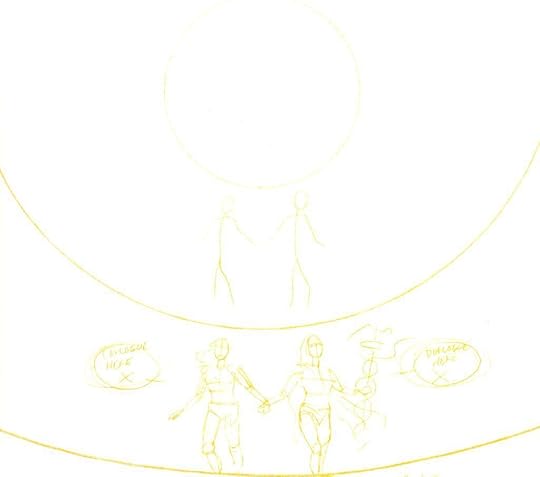
Ta trudna podróż oczywiście przedstawiana graficznie jest równie eksperymentalnie i onirycznie, jak poprzedni tom „Promethei”. Tym razem opowieść jest bardziej spójna, ale w ramach spójnych zeszytów dostajemy szaleństwa porównywalne z pierwszym tomem. Poszczególne przystanki w podróży są spójne kolorystycznie i stylowo, ale dostajemy szaleństwo, jak nieskończoną pętlę, czy elementy szkicu postaci. 1. strona 23. zeszytu „Promethei”
Ten fragment jest lepiej widoczny w papierze. Ale „dialogue here” w dymkach jest zwyczajnie piękny i zabawny. Jeśli chodzi o wspomniana, pętla nie jest zbyt wygodna do czytania. Razem z pętlą zakręca tekst dymków. Na komputerze nie dałoby się tego czytać bez obracania obrazu, a w papierowym wydaniu zbiorczym jest to równie wygodne i przyjemne. Nie umieszczę jednak pierwszej strony lub kadru (jak ostatnio w Chainsaw manie), bo to drugi tom, trudno czytać bez pierwszego (ogólny kierunek stylu znany) i na pierwszej stronie jest zwyczajnie strasznie dużo tekstu.
Sam komiks ostatecznie jest o relacjach. Barbara poszła w zaświaty, by spotkać swojego męża. W tej podróży towarzyszy jej Sofie i ona także odkrywa coś dla siebie. W filozoficznej otoczce wchodzimy w głąb człowieczeństwa, czasem wręcz obrazoburczo, ale ostatecznie wychodzimy z bardzo osobistą historią. Czasem, by zrozumieć tych najbliższych, trzeba zwyczajnie zrozumieć cały świat. Też, by zrozumieć siebie, potrzebujemy właśnie zrozumieć tych wokół nas, którzy nas kształtują. To właśnie ten osobisty i naturalnie wynikający z filozofii aspekt drugiego tomu sprawia, że ostatecznie jest przyjemniejszy niż pierwszy.
Można pewnie kontynuować o humorze, więcej o kontynuowanych i powracających wątkach, ale core drugiej „Promethei” przekazałem. Może nie każdemu, kto przebrnął przez pierwszy tom, spodobają się zmiany w komiksie, ale rdzeń pozostaje taki sam. Trzeci tom z pewnością też zaskoczy swoim kierunkiem, ale w tym szaleństwie jest metoda.
Komiks przeczytany dzięki życzliwości Miejskiej Biblioteki Publicznej w Z.
Alan Moore, Alan Moore. Everything that is great, and also vaguely disappointing about his fascinating and exemplary career in comics is here in this book, and the two other volumes.
Promethea collects a series of 32 monthly comics published during the late 90s and early Aughts under his own imprint, ABC Comics. ABC was a breath of fresh air during the "Grim and Gritty" era of mainstream comics that featured violent, slickly airbrushed, misogynist superhero comics in murky colors and hackneyed storylines. Promethea starts in a somewhat dystopian near future NYC, and is about a teenager who accidentally channels a superhero/goddess of the creative imagination. The humor, world building and metafictional invention is thrilling. Moore, a practicing magician, makes a compelling argument that storytelling is actual magic, and creates a character to exemplify its power in our lives.
In the middle of this storyline, Moore sends his characters on a quest to explain the Kabbala, stopping one chapter each on the branches of the Gnostic Tree of Life, with the characters in dreaded documentary mode, talking through his metaphor. The story becomes quite didactic, a pastiche leavened only by clever art by J.R.Williams III and the artistic team, and Moore's love of allusion and revivification of comics and pulp history. For example, one discussion takes place on a Mobius strip, and is done in a homage to the great comics artist Moebius, making it a feast for the eyes, and a clever use of the medium.
Perhaps too clever by half? Somewhere after that point, I stopped reading the original comics, and did not finish the story until years later when it was collected in these three volumes, where the thread is easier to follow. After the Tree of Life exegesis is finished, the tale ends in Moore's typically apocalyptic fashion, mirroring his own career in ABC comics, most of which are worth seeking out for their originality and humor and sheer innovative use of the medium. Moore is now out of comics, having burned every bridge and reinterpreted every major mainstream character, including (here ) Wonder Woman. I do miss him, but there are Matt Fraction, and Kelly De Connick and others to carry on.
Not sure when I read exactly. Summer I read Promethea forever ago when it was first coming out (single issues) - maybe when I worked at the comic book store in college so like, early 2000s. I had the softcover trade paperbacks and at some point upgraded to the hardcover three-volume "Deluxe" editions - which are... not what this is, but are somehow not on Goodreads as editions I can enter? I WISH I had the Absolute editions, which usually include more supplemental materials and footnotes and things.
I mainly decided to re-read Promethea because I have been reading stuff about chaos magick and other sort of occult themed things and I recalled the amazing adventure the main character takes along the Kabbalah tree of life and how interesting that part was. That bit still REALLY holds up - even if it's just a comic book tour of Alan Moore's personal belief system, it's really interesting.
I read all 3 volumes, and I love the concept and story of Promethea a lot, but the first volume is still the best, in my opinion. The second has some interesting twists and gets into some history of the characters in a way that reminds me of Watchmen, like they had the bare bones and the world is so rich that there are all these cool things you can fill in or flesh out later - the Little Margie stories, heck EVERY previous Promethea's life could be a whole comic series - I would read the hell out of the Grace Brannagh stories AND a comic about her life - and also the new pop culture stuff like Weeping Gorilla, etc. There's more action, if I remember the split of events correctly, and a bit less on the "Alan Moore's personal magic system" but, it's still cool.
This review is for Promethea Book Two, which contains volumes 7-12.
Several characters in the story are writers and artists who've written about a character named Promethea in the past. I originally thought these were historical figures, real people, but I think I was mistaken. Their stories do feel historical though, like legends at the least.
I love the aesthetic of this book. The immateria (a world of collective unconscious) is surreal and beautiful, floral and busy and bursting. The real-world city is a neon future noir. It's the perfect backdrop for this whirlwhind adventure! I also love the aspects of tarot and magic that the story is structured around. I was super impressed by the epic poem about the history of the universe as it corresponds to the tarot deck, but my favorite part was when the art got all photoreal. It was so unsettling!
Parts are dark, but a lot of it approaches the superhero-esque story with irony and humor. The characters are intriguing and they feel real, although they have some written-by-a-man-itis. The art is absolutely gorgeous, especially as it progresses. The book is broken up into very convenient chapters.
Warning for some gendered slurs and light cultural appropriation. Some of the female character design is also pretty dated in terms of sexualization and gratuitous implied-nudity. There's a pretty long and detailed sex scene that somehow manages not to be super gross, even though Promethea is coerced into having sex. I definitely wouldn't recommend it for kids.
In this second book we follow Promethea all the way up the tree of life, searching for the long-gone husband of her Promethea-friend, Barbara, while leaving another Promethea in charged, teamed up with her best friend, Stacia. I took a mental note to look more into this Kabbalah and tarot cards thing, since those are a big part of the action of the book.
Meanwhile, back in the real plane (or... is it the real plane?) the, Promethea second-in-command wreaks havoc in NY by kicking the deranged mayor's ass and also beating the "5 swell guys" (If you ever played a video game, I think this is known as a "chaotic good" attitude). Also, they kind of fall in love with one another, which is completely weird when you think about it - here you are kicking the mayor's ass for being possessed by a bunch of demons (and a multiple personality disorder pacient) and you start a relationship with the woman that posses you. The weirdness is brushed off with the "they are our demons, we don't need to fight them, we need to accept them". Mrrright...
Anyways, great read, great imagery, loved the whole tree of life stuff. The ending of the "tree of life" arc was pretty satisfying, as for the second-in-command Promethea... well, for that I'd have to read book 3
Promethea ascends the tree of live with a friend and learns the secrets of the universe. One has to applaud Alan Moore for the balls it must have taken to put this out there, although, I guess, it wasn't the Victorians anymore and we can do what we want in our society. Anyway, I wonder how many of the readers will grasp only the basest of concepts shown herein, or will just understand that Moore actually doesn't tttsci-fi here, but the very basics of real magic, drinking from a literally ancient fountain. I love this series for the over the top education in magic, for the wonderful imagery of JWIII. In the end, although I'm very much magically and esoterically occupied, my views differ radically in how the world is structured. That's the other thing they probably won't see: How that's most of all Occultism from a certain perspective, somewhere between the overblown correspondence-charts of the turn of the last century and the overblown psychologism of the turn of the next. What I'm gettig at: Although basic concepts are very true here and that is way more than one can hope with such a text, things are equally misunderstood and out of proportion. But then again, aren't we all seekers?
This might be some of the most passionate and beautiful storytelling I've ever read. There really is a lifetime of personal research and beliefs that went into this entire series. Each issue taking it one step at a time analyzing what each world/realm means and represents as the characters travel through them. And everything is being conveyed in the most stunning way. I adored the art changes from issue to issue to fit with the unique tone of that world. It's really a showcase of the expertise of JH Williams III and his vast range as an artist. Alan Moore also went above and beyond in terms of structure. There are several sections that are intentionally really confusing in the order of the panels, repeatedly circling around the page or in some abstract order. This might seem like a bad thing at first but as you go through the page you understand that it's literally a representation of the timelessness. The panels work in almost any order you approach them with. Alan Moore is taking advantage of comics as an art form that can get abstract about how they convey time and how time is perceived in very clever and meaningful ways. The last issue in this collection made me cry it was a really comforting thing to read.
"Gods used to be in tapestries, but now they're in strips."
Very difficult to put this volume into words because it's such a visual experience, very well executed by J.H. Williams who deserves a huge amount of praise for visualising the planets and the kingdoms of Heaven in a unique way every time.
The story of this volume is typical of Moore's kayer work which is the exploration of Mythology and correlating multiple cultures together to create a unique mythos; I can confidently say I've never seen the Jewish Kabbalah used as a central plot point. That being said the ascent through the worlds of the Kabbalah is comparable to The Divine Comedy, and for all Moore's writing, he is not Dante Allegiri.
The amazing visuals are compromised by the absolute info dump on every page as Moore explains the visuals already presented on the page.
Hopefully the next volume gets back to the neo-futuristic New York I came to love in volume 1.
So, first things first, there's a lot of casual homophobia right at the outset of the series that makes it clear that Alan was trying to aggressively communicate how edgy his characters are. Then there's the awkward halting approach to one character being essentially trans, but isn't... but is... that reminds us all that this is set in the late 90s, and was written earlier.
All that being said, the story is pretty good, and the artwork is truly spectacular. There are a LOT of long digressions into chakras, tarot, and neo-pagan mysticism that get really esoteric and I had to double check that it wasn't published by Llewellyn for how far down that particular rabbit hole it goes. I don't necessarily think this is for everyone, not even fans of Alan's other works, but I certainly enjoyed it.
What a wild, wonderful, & mythical journey. Top notch!
“Promethea Volume 2” by Alan Moore “Ha ha! Real life, nova’s fiction for you! What’s it made from? Impressions? A sequence of pictures, a scattering of half-recalled words... disjointed hieroglyphic comic strips, unwinding and our recollection...language. To perceive form... even the form or shape of your own lives... you must dress it in language. Language is the stuff of form.”
“Y’know earlier? That rough current, until we stopped fighting it? That’s how my emotions always used to be. Always fighting. Always reacting. I’d get scared, or angry, or depressed. All reactions. I hardly got time to find out what my own real feelings were...”