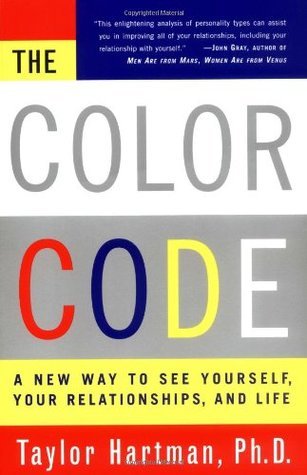
DISCOVER YOUR TRUE COLOR(S) WITH THE COLOR CODE -- AND UNLOCK YOUR POTENTIAL FOR SUCCESS AT WORK AND AT HOME Go ahead, take the test, and find out what makes you (and others) tick. By answering the 45-question personality profile, you will no doubt gain insight and illumination that will start you out on a thrilling journey of self-discovery while * Identify your primary color * Read others easily and accurately * Discover what your primary motivators are * Identify and develop your natural strengths and transform your weaknesses * Improve your relationships with yourself and others * Enhance your business performance The Color Code will, quite simply, change your life. It is guaranteed to make a difference in every relationship you have, starting with the relationship you have with yourself.
I don't consider this a cure-all, understand-all guide for each personality & relationship, but I do think it helps me understand better why some people act & say what they do & how I can better relate to them. I'm making more friends than offenses when I apply this knowledge. Some people read personality books like scripture & others have a hard time being pigeon-holed. I'm somewhere in the middle in that I appreciate any influence for good a book may teach me, but I don’t consider of myself as being stuck-in-a-rut either. Partly this could be due to what Taylor Hartman taught our UVU college class in private that he didn't teach in the book – following Christ's words & actions throughout the scriptures; Hartman recognized that Christ had only the good attributes & a balance of each color. Our goal, to become like Christ, is to train ourselves to focus on replacing a negative attribute for a positive & seeking knowledge of how to emulate the good from each color. In this way, we can better serve & assist others around us. His personality test is a potential guide, not a stagnant chart, to see where one's strengths may be so one can begin improving life step by step.
Agressive poeple are really pushy? Wow... thanks for that one captian obvious!
Truth be told I couldn't stomach finishing this filth. Pigeon-holing billions of individualities into four basic, color coded, types is the most stupid and irresponsible things i have ever heard of.
The next person who says "I'm a red personality, with a little bit of yellow in there!" is going to get punched in the face!
It was OK. I was not crazy about it though. First off, I thought there would be more colors to choose from! And also, beyond that, some of the descriptions are very general and more then a little vague. I really do like the concept. But I wasn't really wowed by the book.
This book is great for understanding what makes different people tick, and how you can interact with all different personalities. I pick it up and read different parts of it all the time, and it really helps me understand how my personality can better relate to someone else and how they are perceiving a situation. It's also lots of fun to take the color test with family members!
I was reading this book when I started dating Tony! I loved it. I totally gave him the color code quiz-it was awesome. I think that's what really made him think I was the one. ;)
Before you begin to read this lengthy collection of thoughts, just let me forewarn you that I am Canadian, but this book is American, so my mind was discombobulated and my consistency in spelling the word as either colour or color may be lacking. I tried my best, but I can't be bothered to go back and check.
I decided to read this after reading George J. Boelcke's "Colorful Personalities", which is a similar take on what is presented in this book. There are some differences, though.
In Boelcke's book, there are four colours: Gold, Green, Blue, and Orange. To break it up really, really, really simply, Gold people are black & white, traditional, and extremely organized, Green people are very smart, love research, and are inexpressive emotionally, Blue people are compassionate and emotional, and Orange people are adventure-seeking, expressive and always looking for a good time. Boelcke says that we each have all of the colours to some measure, but we mostly operate in our two highest colours. I am Gold/Green, according to the test outlined in his book.
Now, in Taylor Hartman's book, four colours are presented as well: Red, White, Blue, Yellow. I quickly realized as I started reading that I had to discard my previous notions of colour profiling, and stop trying to line up the colours from the two books. The only colours that really line up are Yellow and Orange, and Blue and Blue (and there are still differences between Boelcke's and Hartman's Blues). In his book, Hartman tells us that each colour is impelled by a different core motive: Red desires power, White desires peace, Blue desires intimacy, and Yellow desires fun.
I really wasn't sure that I agreed with a lot of the stuff when I started reading, but I decided to keep going and just take it all with a grain of salt. Some it was explained, and some of it I just don't take very seriously. I've taken the test three times now, twice online and once from the book, and I've gotten Red twice and Blue one time. I don't know that I agree that personality is innate, and I really found it hard to answer the questions from a childhood point-of-view. I don't really remember how I responded to certain things as a child, I don't think I act the same way that I did when I was a child, and I think that's why I got differing answers when I took the test more than once. I believe, after reading the rest of the book, that I'm probably Red with a high secondary Blue. I think that part of my confusion about my personality comes from the fact that my mom is most likely Blue, my dad is probably White, and my sister is Yellow, so I've grown up learning how to respond to a rainbow of colours. I know I've consciously practised what Hartman would call "Blue" personality traits, such as sensitivity and compassion, and I related to a lot of White traits as well. I haven't practised Yellow traits as much... which is probably the biggest source of contention between my sister and I! She is open-minded and adventurous, and I'm not as much that way. I tend to want to control everything.
Another reason there was confusion for me was that you have to pay very close attention, read between the lines, and figure out what Hartman means when he uses certain words or phrases. For example, I didn't initially connect at all to any of the descriptions of the personalities. Reds come off as belligerent, unemotional control freaks, Blues are perfectionistic, over-emotional and sensitive, White people are lazy and non-committal, and Yellows are directionless rebels that can't focus their lives. I really didn't connect at first to the Red "power" motive. As time went on, I began to realize that I think what he meant by power was more a description of a desire to control. He also said that Reds are very vocal. I'm not a very vocal person unless I know you well or feel very strongly about something. BUT, I'm introverted, and I don't think I've ever had a a platform to to really practice Red traits. I do know that when I'm in a situation where I've been alone and/or had to take charge of running something, I act like a Red person. I also grew up with certain people saying I was extremely controlling, I could confront friends if I felt their behaviour was unacceptable, and I got called a "drill sergeant" a few times throughout my life.
One thing I thought was pretty ridiculous was Hartman's statement where he declares that if people want to get married without first taking the color quiz and determining their compatibility, it's their funeral. I'm paraphrasing, of course, but to me that statement has almost zero merit. People have been getting married, working together, building friendships and getting along for thousands and thousands of years without the Color Code, and they will continue to do so for as long as there's human relationships to be had. Yes, I believe that when applied correctly, it can help ease major tensions between people who don't understand one another, and it's probably saved many marriages and other relationships, but let's not overstate its importance here.
I really believe the most important statement was made near the end of the book. I've had to send the book back to the library so I don't have it here to quote exactly, but it addressed the biggest problem I had before I started learning about personality profiling. Hartman basically says that the Color Code should never be used to limit another person or pigeon-hole them, and you should never use it to justify your own limitations. I've known people who, when they've found out their color, decided to just say "This is who I am, I'm never changing, and screw you if you have a problem with it." It's unhealthy, it destroys relationships, and it's just wrong to respond that way. Just because I'm Red doesn't mean I shouldn't constantly be working towards being a compassionate, open person, or that I shouldn't work on my Yellow traits so that I understand where my sister is coming from.
Ultimately, it's an interesting concept, but take it with a grain of salt. Make sure you read and understand everything, and don't just pick and choose what parts you're going to listen to, i.e. don't learn your colour and decide that everybody else needs to work around you. Start building your character so you can work well with everyone.
The Color Code is one of the very few books that I've read cover-to-cover multiple times. It's a fantastic read, unfortunately I have found that the majority of people who claim to have "taken the test" either skip the instructions and take it incorrectly and/or misinterpret the results because they failed to grasp concepts which are critical to understanding the theory and your results.
It's okay. I did the same thing at first.
In fact... I would say that it wasn't until I had read the book twice, cover-to-cover, that I was able to fully embrace and understand the color code in its entirety.
This is because there are a number of easily overlooked concepts and examples sprinkled throughout the book which I found crucial to recognizing how the color code applies in a variety of situations and relationships.
Too often, people flip to the quiz, don't read the instructions, answer the questions, then skip to their color's chapter without reading the rest of the book. Then they attack the theory for being too simplistic, inaccurate, not accounting for change in personality over time, or trying to pigeonhole people into particular boxes. These individuals either haven't read the entire book or failed to understand it.
On the other side of the spectrum, you have those who love their result and then use it as an excuse for not developing their personality or working on their weaknesses.
All of these are issues that are specifically addressed in the book; in particular, make sure that you fully understand the role of secondary colors in providing a uniquely nuanced personality, including weaknesses and strengths from other colors (Chapter 9), and the role of character in developing your personality as you age (Chapter 4).
All that being said, this is a great book which helped me to understand my extremely complicated (Blue/Red) personality and the inner conflict I so frequently experience in swinging between the extreme opposites of compassion and indifference, altruism and selfishness, timidity and boldness. I've had a number of psychological profiles presented to me, but this is the only one that was able to help me understand WHY I'm so conflicted and how to better manage that conflict.
This is the only one that actually told me who I am.
My advice? Read it carefully. Twice.
Then start changing yourself, your relationships, and your life for the better.
I read this book years ago when it first came out - 1987? I may have listened to some lecture by the author or someone else, about the concept, and thought I would like it. I picked it up recently because a friend told me she had attended a class with the same title and was she was so intrigued about what she was learning. That got me thinking about what I had learned previously, (through a 45 question Personality Profile Test) that I am mostly a "blue" personality with some "white" mixed in and my husband is a definite "red" personality with a little "yellow" added.
This is what the author says about a red/blue combination relationship: "No other combination of personalities must work as hard for successful compatibility as Reds and Blues. Both want to be in control. They are equally strong and determined individuals. Unfortunately, this is about all they innately share in common. Their motives, needs, wants and behaviors are most opposite. Theirs is a difficult union regardless of the various roles they may play in the relationship."
Thankfully, I discovered I have enough White traits to make things workable.
Each personality has important strengths and annoying weaknesses but our "character" can be developed to override any negative, innate programming. Developing our character is a process whereby we can balance our personalities. I also have a follow-up book called "The Character Code" that I will read soon. I assume I read that before also, but I don't really remember it like I did this first one.
Ideally, we can develop a "rainbow" of personality/character traits. That is our earthly challenge....
Craig and I initially explored this title together, several weeks ago, but it didn't take long for him to get discouraged and lose interest. Now that I finished on my own there are some excellent highlighted sections that I can share with him to reveal what we can do in our lives to improve and grow.
A book focused on seeing and understanding yourself in a different way. Dr. Hartman uses his research and knowledge to reaffirm and reinvent the way you see yourself. Diving into the strength and limitations of each color, he paints a path to a better you. While I read this book for a class on Student Success, I would reccomend anyone on a betterment journey, pick up this book. It taught me a lot about how my own personality affects the relationships in my life; how all colors can be healthy and benefit from other color traits. This is a great read that delves deep into what makes us who we are and how to be the best us. If you are looking to be the best, strongest you, pick up this book.
My favorite color is purple. My college colors, by lucky coincidence, happened to be purple and gold. Though I didn’t pick it because of its colors, my sorority happened to use purple, green, and silver. My one-time pseudonym on the internet, murasaki, means purple.
When a friend suggested I read The Color Code, I was hoping to find my personality cast as a Purple. Unfortunately, Taylor Hartman limits his categorization of personality to four colors: Red, Blue, White and Yellow. Not a single splash of purple.
Forget your astrological sign, that you were born in the year of the dragon, even the Meyers-Briggs personality profile. The Color Code is a simpler and better way to determine one’s own personality and the personalities of the people around us. Hartman theorizes that personality is innate, is a code of behavior and consists of four basic personality types determined by one’s overriding motivation in life. Every personality type has good characteristics and every personality type has limitations.
Set-Up
The book has four parts: Personality in Perspective, The Colors, The Color Connections, and Building Character.
Part I, Personality in Perspective, takes the reader through a 45-question quiz to determine one’s personality “color.” The first thirty questions of the quiz are lists of four qualities per question. The reader must choose the quality among the four qualities for the one that best describes them. An example of one question is:
a) demanding b) unforgiving c) unmotivated d) vain
The remaining fifteen questions cover reactions to situations such as:
For me, life is most meaningful when it a) is task-oriented and productive. b) is filled with people and purpose. c) is free of pressure and stress. d) allows me to be playful, lighthearted and optimistic.
Part I also explores the core motives behind the personalities and the behaviors they tend to exhibit.
In Part II, The Colors, Hartman goes in depth through each color, listing strengths and limitations in bullet format as well as discussing certain characteristics. Hartman explains how a personality type tends to act as an individual, as a child, as a parent, in their careers, and much more. I find the lists serve well as a quick reference guide when attempting to identify the personality-color of someone I know. In this section, Hartman also addresses secondary colors or personality types. Most people who have dominant characteristics of one personality type are rather easy to identify. People who have a strong secondary color or “mixed” personality are a little more difficult to identify but still have a core motive. Hartman also acknowledges that, sometimes, outside influences also make it difficult to correctly identify a personality type such as theological or cultural biases, abuse, or an autocratic family life “where express attitudes and behaviors were determined solely by one or both parents” (p. 134).
Part III explores the dynamics of relationships between various colors (a Red personality with Blue personality, Yellow with White, Blue with Blue, etc.). Hartman delves into conflicts created by opposing personality characteristics as well as how some of these opposing characteristics can complement each other. He also states up front that while some color combinations may be more conflicted than others, all combinations can have successful relationships (whether professional or personal) and offers ways of dealing with the various personality types. Hartman does this in essay format and with lists for quick reference.
Part IV discusses character-building. Hartman believes that each person, with their good and limiting traits (he’s very careful to never say “bad” characteristics or “weaknesses”), can become a charactered personality that incorporates good characteristics from each of the personality types and replaces a limitation from one’s core personality.
Hartman goes into some life principles that he believes are necessary for achieving a charactered personality such as “Charactered people actively love themselves and others” and “We must stretch and risk personal discomfort in order to make alien attitudes and behaviors become natural.” Hartman also discusses the role of free will in changing an innate personality and emphasizes that one’s color (and core motive) should never be used as an excuse for one’s shortcomings. However, among my friends that have read this book, knowing one another’s colors has helped us to be more accepting of each other and not take someone’s shortcomings personally. When one friend flaked out on going out with the group one evening we could attribute it to “she’s just being Yellow” and enjoy our evening without worrying about her.
The Colors
After taking the quiz and identifying one’s core motive, the reader is in for some brutal truths about themself. Each personality has good, limiting, and downright ugly characteristics that are not easy to own up to possessing. I am a mixed personality so I received a double dose of nasty-tasting medicine to swallow. However, I’ve kept you in suspense long enough.
Red: The main motive for a Red personality is power. Reds want to be in control. They tend to be good, productive leaders that are also selfish and insensitive to the needs of others.
Blue: The core motive for a Blue personality is intimacy. Blues want to love and be loved by others. They tend to be nurturing and altruistic but also perfectionistic and controlling.
White: The primary motive for a White personality is peace. Whites want harmony and peace and for everyone to just get along. While Whites are amiable and diplomatic, they tend to be lazy and bottle up grievances until they explode.
Yellow: The core motive for a Yellow personality is fun. Yellows want life to be fun and exciting. While Yellows tend to be the life of the party and easy going, they are also irresponsible and emotionally shallow.
What if I’m a Purple?
I am a mixed personality: Blue is my dominant color along with the core motive of intimacy. Red is a close second with the core motive of power. When I took the Hartman Personality Profile quiz, my answers were 24 Blue traits, 20 Red traits, 0 White traits, and 1 Yellow trait. Hartman states unequivocally, “The most difficult color combination within one individual is the mixture of Red and Blue.” The reason a Blue-Red combination is such a difficult personality is that the Red and Blue core motives are in direct conflict. The example Hartman used is that a Blue-Red will delegate a task and be cutthroat about getting the job done (Red characteristic), only to feel guilty about it later (Blue characteristic).
Hartman discusses some characteristics of mixed personalities. Blue-Whites and Red-Yellows are the most comfortable blends. Blue-Yellows and Red-Whites tend to vacillate between core motives from one moment to the next. White-Yellows have good people skills. My main gripe with this book is that not enough time is devoted to the topic of mixed personalities. Though I can read the sections on Blues and Reds to get a general idea, and the characteristics of each often apply to me, I would have liked more information about dealing with other mixed personalities (such as my husband who is a White-Blue).
The way I have naturally compensated for my mixed personality is I’m primarily a Red in my profession, in which Red characteristics are admired and encouraged, and I’m a Blue in my personal relationships, where commitment and sharing feelings are more critical.
All the Colors of the Rainbow
Hartman believes that each of us, no matter our core motive(s), should strive to be a rainbow by becoming a more charactered person who replaces our limitations with the best traits of other colors. I heartily agree, and reading this book can help one do that. I have gained insights into the personalities of people in my life, become more tolerant of their innate personality flaws and discovered how to deal with them in ways that are more empowering for them and gratifying for me without being manipulative.
The Color Code is an interesting read and has something for everyone, even if you’re a Purple.
Such a fascinating book! I loved learning about this in my Student Success class. You learn about four main personality types; Red, Blue, White, and Yellow and what they're main motives are. It helps you better understand those around you and why they make the choices they do. Because of this you can help grow your relationships, have better workmanship and helps in deciding a career choice. I'd highly recommend this book if you're looking for a new way to look at the world around you:)
skimmed through this. Kinda seems a little outdated, but it was recommended to me by my therapist. I’m a yellow with a lot of blue and a few red tendencies. It’s interesting to think about the people we are attracted to and their colors/qualities and whether or not that’s good for us.
When I first started reading the Color Code, I thought it would be like every other educational book that I have read, boring and not a page turner. This book caught me by surprise because I caught myself relating to the book, and I ended up learning so much about myself. This book has four main colors (personalities) that it brings to light. You have Red, Blue, Yellow, and White. Each of these colors has different personalities and core motivations. I ended up taking the test to find out which color I was, and turns out I am a yellow mixed with blue. I learned about why I act the way I do, as well as learning about different colors and how to work with them. I found this helpful because my Dad is a red, and now I have a better understanding as to why my dad wants everything to be perfect or expects a lot from me. I really loved reading this book, especially when I was reading about my colors. If you want to have a better understanding of yourself and others, I will definitely say this is the perfect book to read.
Another good perspective on personalities. My favorite part was at the end where he talked about our natural personalities but how we should all strive to develop character, which is having the best traits. I am still a toss up on which color I am. Most likely I'm blue with a lot of red.
Within the genre of personality assessments this book is possibly the best in the breed. I really appreciate the effort of the author to keep his readers down to earth in their approach to his book. He admits that just because you are primarily one color, doesn't mean that you don't or can't have traits from all colors. Although the test included in the book is designed to determine your innate personality, he suggests using the new found self-awareness as a spring board for the development of desired positive traits, as well as handling and/or overcoming undesirable traits.
In a nutshell, the author endeavors to put responsibility and control of self into the hands of the reader, instead of giving them excuses or scapegoats. This aspect of the book is of course only to be had if one actually reads it instead of using as a reference guide.
What a silly book. It's claims that every member of the human race fits into one of four categories. It lays out many human characteristics and insists that if you do any of these things then you fall under a category and will be forever labeled. Reds want power, Blues want love, Whites want peace, and I can't remember what Yellows want. I think it was something like friends. Anyway, every time I take the test I'm a different color and I'm always about three away from another color. Basically I'm all of the colors. Hate to break it to ya Hartman but I want Peace, power, love, and friends. All of it! Silly book. I don't recommend it.
Quite insightful both about myself and within my relationships. I need to echo what many other reviewers have said. This isn't meant to be your Bible. It's a resource to help create general insight into how different folks view the world and interact with one another. It can give you a reference point for speaking about personality. I think the relationship section near the back is the most helpful area- it certainly helps make some sense of relationships in my life.
This is my second time reading Dr. Hartman's Color Code. I'm a true blue core personality. "Passion cannot be forced. It must be genuine and flow from one's very being. No one can develop your passion. It is like breathing. You must do it on your own or you will die. Sadly, we live in a society where far too many people die years before they are buried."
This was actually VERY helpful to my family when my brother and I were teenagers, and helped us get along better with our parents. I always really enjoyed it and we still make comments to this day about what color our kids are now! :)
The Color Code: A New Way to See Yourself, Your Relationships, and Life is a book that gives methods and advice on how to analyze your own personality and behavior. It talks about how to understand the people around you in all environments. Something I really liked about this book is it was very intriguing and was very good at using real life examples. It shows how each “colour” or personality interacts with things. This book covers and goes over all the personalities. Something I didn’t really like about this book is the author seemed to have a “favorite colour” or personality. He would talk with a very loving tone towards certain “colours” compared to how he would write about other “colours” in what felt like a tone of dislike. I would give this book a 6/10. This is a good book for readers who are in highschool and older. This is also a good book for readers who like to read psychological nonfiction books. This book, The Color Code: A New Way to See Yourself, Your Relationships, and Life by Taylor Hartman, is a very good non-fiction book and as a lot of things that support what it says. I prefer to read books that are written to improve the understanding of our peers and the people around us. This book started out by just introducing what the colours are and what they connect to. This book emphasizes non-fiction because it doesn't talk about any fairy's or things that are made up. The plot gets bigger over time by having there be more and more information given to the readers about the colour personalities.
The Color Code assigns different personalities to four different colors. At the beginning of the book, it gives you a quiz based on your qualities. The rest of the book covers the different color's strengths and weaknesses, and things that are common for each color.
The Color Code is an amazing book. I started reading the book in a student success class, thinking it was just going to group people to different traits, but it does much more than just that. After taking the quiz that consists of situation based questions, it assigns you to a color. Throughout the rest of the book, it tells you what your strengths and weaknesses most likely are, several of your traits, some of your best and worst qualities, and the strengths and weaknesses of different marriage combinations. One of my favorite things about this book is how it clarifies throughout the entire book that the qualities mentioned, whether good or bad, are not guaranteed to be YOU and are just based on common characteristics of each color. The Color code is not only helpful, but can be used to identify the colors of others, and help you communicate with them better. A few weeks after reading the book I have already started understanding people a lot better. I could see this book used in a communication class because of this. The Color Code can be used in many ways, and I would recommend it to anyone.
The book The Color Code, by Taylor Hartman, is about four distinct personality types and how they react to the world around them. Dr. Hartman explains that personalities can be categorized into red, the power-hungry ones, blue, the intimate ones, white, the peaceful ones, and yellow, the fun ones. Understanding different colors and personalities can help the reader to understand others, themselves, and their relationships. The The Color Code is an extremely interesting book. As Hartman explains the meanings and personalities of different colors, the reader may become more and more interested in learning about who they are. However, Hartman warns against justifying behavior and asks the readers to use the book's information to better themselves even further. While the book is very informative, it can also be quite dull. Much of the book is spent explaining the behaviors, strengths, and weaknesses of different color personalities, which can become repetitious. This book, while it can be uninteresting at points, is ultimately a very informative and important book that should be read by all those who want to understand themselves, the people around them, and how to become better.
The Color Code by Taylor Hartman talks about the different "colors" that people are, and their core motives: Reds like power, Blues like intimacy, Yellows like fun, and Whites like peace. Hartman explains that each color has strengths and weaknesses and how to talk to each color. It has quizzes and short stories from the author, which make applying it to your own life easy. It also gives clear tips, like give Reds clear goals, tell Blues you appreciate them, let Yellows be creative, and give Whites time to think. For example, Hartman says Reds like to be in charge and that reminded me of Paris Geller from Gilmore Girls because she acts bossy and is very driven and sometimes insensitive to others' emotions. My main problem is Hartman sometimes puts people in a fixed box because many people are a mix of colors, so it felt like it simplified the nuances of human personalities and behaviors. Still, it helps with understanding why some people act the way they do and gave helpful ways to talk to different people. I'd give this book a four out of five stars and recommend it to anyone who has a general interest in basic psychology and get a different perspective of how people work and how to get along better with friends and family as well as themselves.
This book starts by having you take a type of personality test that reveals what "color" you are. Each color represents a different "core motive", or the main thing that motivates you. After that, it explains how each color acts, what they're like, and how they feel.
I really enjoyed the parts of this book that talked about my color (Yellow). The chapters and sections that talked about how Yellows work and think resonated with me, and I thought they were fascinating. My favorite chapter was "What Makes You Hot? What Makes You Not?" because not only was the wording of this chapter hilarious, but it talked about some of the things about each color that people liked and what bothered them, and I could see why people would think some of my Yellow tendencies are annoying. It gave me a lot of insights on what I can work on, and how I can understand other people better. My only problem with the book was that the sections about the other colors were not as interesting as the Yellow and Red sections, so I got bored with them easily.
I would recommend this to anyone who wants to find out more about themselves or the people that are in their lives.
I really enjoyed this book and was surprised that something published nearly 30 years ago held up so well. It was surprising that the quiz in the beginning did such a good job of figuring out and describing who I am. I think the other personality types were also very accurate and I was able to categorize the people I’m close to in life into the 4 personalities.
The start of the book talked about how the reader would learn about how strong secondary personality colors affected each individual, but the book did not give it nearly as much attention as I expected. It becomes a bit of a slow, redundant read once you get halfway through because it uses the same format to describe every single personality pairing and some feel very irrelevant or repetitive.
Overall, I learned a lot about myself and my relationships with others while reading this book. The examples of personalities in the workplace, romantic relationships, and friendships were all helpful and gave the book life. I’d definitely recommend this book to get a better idea of who you are and areas where you can continue to grow and improve.
This book had a surprisingly accurate depiction of personality traits and their inherent flaws. It begins with a quiz, and tests your responses to specific situations, and ordering each response a color. The entire rest of the book describes the importance of the colors and their significance in our lives. For example, I was very heavily the color red, signifying power and desire to be efficient. They are abrasive, as they are incredibly goal oriented. However, my secondary color was blue, signifying that the want for intimacy and support. I believe that I was all red, until I got depression in my life, making me very contemplative and desperate. The book also described these combinations with astonishing accuracy. It described red, with as secondary of blue, as abrasive, but then felt bad for their actions. This perfectly describes me and my views of the world. I would recommend this book to anyone wanting to more accurately understand the personality traits and inherent flaws of themselves and others.
"The Color Code" is a fascinating book by Dr. Taylor Hartman. The book delves into the concept of the "people code," which explains a person's core motive similar to the Myers-Briggs Type Indicator. According to the color code theory, each individual has a specific color that describes their core motive. These colors are Blue, White, Red, and Yellow.
"The Color Code" is one of the best ways to gain a deeper understanding of yourself and others. Dr. Hartman has done an exceptional job of providing insights into the meaning of colors, giving real-life examples to illustrate his ideas. I highly recommend this book to anyone who wants to improve their view of people around them. The theories presented in the book can be applied to various aspects of life, such as communication, business relations, motivation, relationships, commitments, and self-improvement. Overall, it was a fantastic and short read.