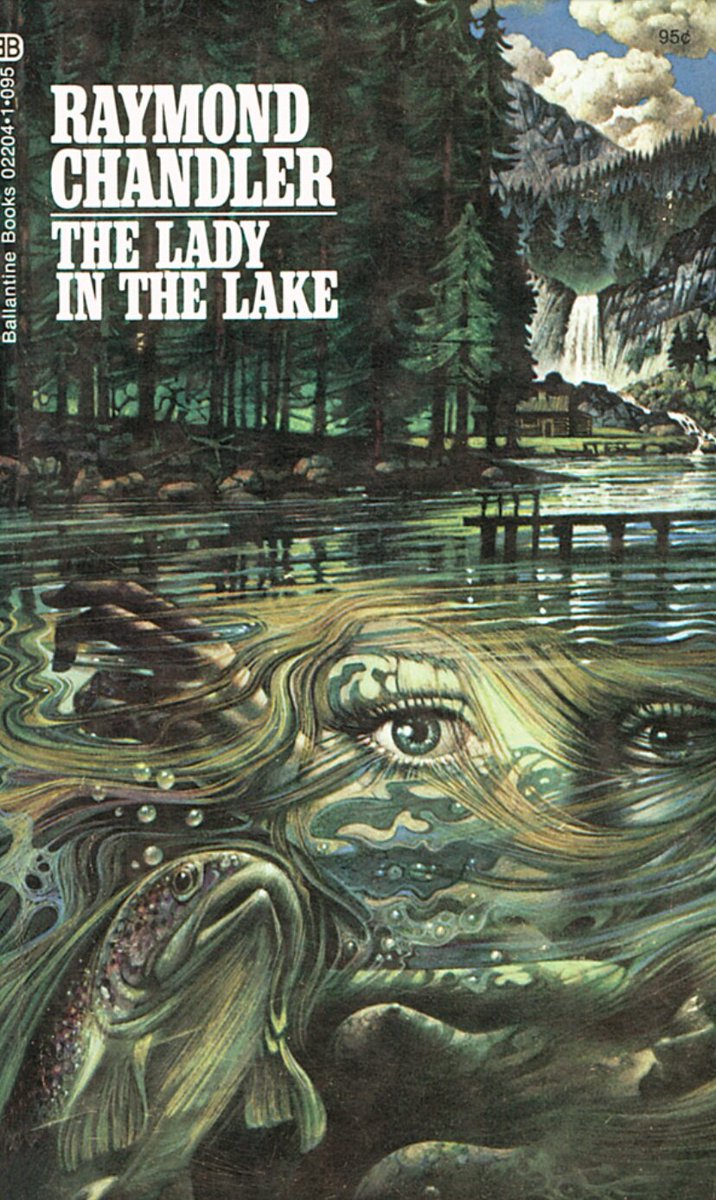
A couple of missing wives—one a rich man's and one a poor man's—become the objects of Marlowe's investigation. One of them may have gotten a Mexican divorce and married a gigolo and the other may be dead. Marlowe's not sure he cares about either one, but he's not paid to care.
Raymond Thornton Chandler was an American-British novelist and screenwriter. In 1932, at the age of forty-four, Chandler became a detective fiction writer after losing his job as an oil company executive during the Great Depression. His first short story, "Blackmailers Don't Shoot", was published in 1933 in Black Mask, a popular pulp magazine. His first novel, The Big Sleep, was published in 1939. In addition to his short stories, Chandler published seven novels during his lifetime (an eighth, in progress at the time of his death, was completed by Robert B. Parker). All but Playback have been made into motion pictures, some more than once. In the year before his death, he was elected president of the Mystery Writers of America.
Chandler had an immense stylistic influence on American popular literature. He is a founder of the hardboiled school of detective fiction, along with Dashiell Hammett, James M. Cain and other Black Mask writers. The protagonist of his novels, Philip Marlowe, like Hammett's Sam Spade, is considered by some to be synonymous with "private detective". Both were played in films by Humphrey Bogart, whom many consider to be the quintessential Marlowe.
The Big Sleep placed second on the Crime Writers Association poll of the 100 best crime novels; Farewell, My Lovely (1940), The Lady in the Lake (1943) and The Long Goodbye (1953) also made the list. The latter novel was praised in an anthology of American crime stories as "arguably the first book since Hammett's The Glass Key, published more than twenty years earlier, to qualify as a serious and significant mainstream novel that just happened to possess elements of mystery". Chandler was also a perceptive critic of detective fiction; his "The Simple Art of Murder" is the canonical essay in the field. In it he wrote: "Down these mean streets a man must go who is not himself mean, who is neither tarnished nor afraid. The detective must be a complete man and a common man and yet an unusual man. He must be, to use a rather weathered phrase, a man of honor—by instinct, by inevitability, without thought of it, and certainly without saying it. He must be the best man in his world and a good enough man for any world." Parker wrote that, with Marlowe, "Chandler seems to have created the culminating American hero: wised up, hopeful, thoughtful, adventurous, sentimental, cynical and rebellious—an innocent who knows better, a Romantic who is tough enough to sustain Romanticism in a world that has seen the eternal footman hold its coat and snicker. Living at the end of the Far West, where the American dream ran out of room, no hero has ever been more congruent with his landscape. Chandler had the right hero in the right place, and engaged him in the consideration of good and evil at precisely the time when our central certainty of good no longer held."
Chandler’s fourth full mystery, and one that springs less readily to mind when considering his Philip Marlowe canon. But I’ve always had a sneaking regard for The Lady in The Lake.
It’s the one where you’re made aware that there’s the small matter of the second world war going on elsewhere. The references are sprinkled offhand and obliquely - contemporary readers wouldn’t have needed reminding - but still they’re enough to ground the story right in its period (it was written after Pearl Harbor, published 1944).
Uncharacteristically, it’s also the one that removes a part of its main action to a mountain lake resort some hours’ drive from sweltering LA. But then Chandler is a master at taking you on drives with Marlowe, and just to meet Puma Point’s Sheriff Patton you’d rent a car and drive there yourself.
There’s an unaccountable (to me at least) plot turn that ranks with the legendary So who killed the chauffeur? query wired to Chandler by the screenwriters working on The Big Sleep. But Chandler himself had no idea about the answer to that either, and as the Marlowe novels progress they become increasingly about a sense of time and places and the characters that populate them. The narrative detail becomes token. It simply interests Chandler less, and in the end, generations of his readers have gone along with him on that. They know that the payoff is a take on Los Angeles so vivid, it fires up our image of the metropolis to this day.
Looking down into the deep waters of the small lake there is movement a hand... the murky image is unclear, concealing a secret which gives this book its title, The Lady in the Lake, Marlowe watches, his stomach is... not joyful, however appearances can be deceiving. The brutish husband Bill Chess, the village drunk is arrested for the crime, the victim his mysterious mate an outsider, Muriel has been wet for a month, so well... the difficulty in identification is very unpleasant for the poor local coroner. Little Fawn Lake eighty miles from the bustling metropolis of L.A. is unfamiliar territory for the intrepid shamus , you notice this and the uncomfortable investigator moving about in the quiet area . His client has a vacation cabin here and Marlowe needs to search it. The fat constable Mr. Jim Patton in the mountains of San Bernardino there, is surprisingly competent . Philip Marlowe a private eye has been hired to find the wife of businessman Derace Kingsley, Crystal, a woman whose proclivity for.. extracurricular activity begins the plot. The results murders, Mr. Marlowe is a magnet in this aspect of discovering dead bodies, where ever he roams the unliving are there and stillness prevails. But not for long, others will fall as the detective travels from the mountain lakes outside Los Angeles, that city itself, to a corrupt little town Bay City ( Santa Monica). Al Degarmo the tough cop from Bay City, they do not think kindness a virtue, is snooping around, no gentleman, a crack in the head with a blackjack, a punch in the face, a kick to the shin anything to make you talk, few keep quiet . Mr. Marlowe will experience his unhappiness he is no superman, when hit it hurts, blood flows from him very easily like anyone else. Chris Lavery a playboy the kind that never saw a attractive woman he didn't covet, is the key to the story and revealing the villain or villains from the not so bad . Still lies and liars are easily found here, people who can be believed rare , trust becomes an anomaly. Raymond Chandler the in my opinion the best mystery writer who ever put ink on paper and that includes computers, shows again his mastery of atmosphere and character , you feel the unhealthy air closing in, the breathing becomes hard the thickness all consuming, death is near. For this is much more than another who done it, art if I may be presumptuous ...in writing this, is great literature... a fact.
I have decided to take a break from my usual obsession with history to take a deep plunge into several of the classic noir detective novels by Raymond Chandler, James M. Cain and Dashiell Hammett. A few of these will be re-reads. Why noir? America is evenly divided between two fanatical ideologies so I guess the noir genre suits my cynical nature as an outcast, literary hermit who despises the hypocritical dishonesty and corruption of both political franchises as well as the obedient myrmidons in the media who defend them against the other side without seeing that they are both evil and despicable in and by themselves. Another key ingredient to the noir formula is the hard bitten, cynical private eye working against both the criminal element as well as the corrupt cops. I don't know many criminals besides a few upper-level, corporate fruit flies who will never be brought to justice, but I live in Las Vegas where the police force has worked overtime to tarnish its own image to the best of its ability. In coffee shops around town, I have been completely unsuccessful in trying to engage any one of these morons in an intelligent conversation. It is beyond their meager abilities. It creeps me out that these antisocial goons carry both a badge and a gun. That is another reason I am going noir! No one suits this noir streak better than Raymond Chandler's sarcastic, hard drinking, private dick Philip Marlowe. In "The Lady in the Lake," Marlowe is hired by a perfume company exec to find his estranged wife who had disappeared from their summer home, sending him a very nice dear John letter saying that she was running off to Mexico with another man. That came as no big surprise, but later he runs into his wife'e lover who claims they never ran off together. So where did she go? The wife had some bad habits and the husband is more concerned about some embarrassing publicity that might cost him his cushy job rather than about the missing lady's well-being. No hard feelings, Dear. With Marlowe as our wise-cracking guide, interpreter and body guard, Chandler leads us on a twisting, turning roller coaster ride through a 1940's lookingglass from Hollywood to the lake in the mountains where we stumble upon a lady's body, back down again and then back up to the lake again where, much to our chagrin, we meet both the missing lady and her killer. This is the first time I have read "The Lady in the Lake." It is a 222 page, page- burner that you will not want to put down without a good fight. Whether you are flying transatlantic, across America or taking a meandering, overnight train ride through Europe, may I recommend this novel as an antidote to your temporary captivity. As a warm-up to get you into the proper 1940's mood for this novel, may I also suggest that you go to YouTube and pull up the 3 minute, 1947 trailer to the movie.
5-Stars! WOW! A masterpiece. The very best Marlowe of all.
Great pacing, wonderful progression of events and clues, just enough snappy dialogue, delicious "detective-as-philosopher" quotations, genuine tension and suspense, a sprinkling of red herrings... This is the whole enchilada! Awesome!
I brushed my hair and looked at the grey in it. There was getting to be plenty of grey in it. The face under the hair had a sick look. I didn’t like the face at all. I went back to the desk .... I sat very still and listened to the evening grow quiet outside the open windows. And very slowly I grew quiet with it.
I particularly enjoy how the clues fit together slowly, progressively throughout. You can see the connections, or think you can *winks* and by the end, it's mostly all there for you. I correctly pieced together 4-5 aspects of the plot, but MISSED the very clever big twist! Awesome!
It was a •38 Smith and Wesson on a •44 frame, a wicked weapon with a kick like a •45 and a much greater effective range.
I drove on through the piled masses of granite and down through the meadows of coarse grass where cows grazed. The same gaudy slacks and short shorts and peasant handkerchiefs as yesterday, the same light breeze and golden sun and clear blue sky, the same smell of pine needles, the same cool softness of a mountain summer. But yesterday was a hundred years ago, something crystallized in time, like a fly in amber.
Notes and Quotes:
The upper part of his face meant business. The lower part was just saying good-bye.
12.0% .... it's amazing how modern much of the slang is here. Soap opera, beef, hunk, etc
22.0% .... Behind the right-hand lower corner of the windshield there was a white card printed in block capitals. It read: VOTERS, ATTENTION! KEEP JIM PATTON CONSTABLE. HE IS TOO OLD TO GO TO WORK
25.0% ... She put a firm brown hand out and I shook it. Clamping bobbie pins into fat blondes had given her a grip like a pair of iceman’s tongs.
30% ... The thing rolled over once more and an arm flapped up barely above the skin of the water and the arm ended in a bloated hand that was the hand of a freak. Then the face came. A swollen pulpy gray white mass without features, without eyes, without mouth. A blotch of gray dough, a nightmare with human hair on it.
A heavy necklace of green stone showed on what had been a neck, half imbedded, large rough green stones with something that glittered joining them together.
Bill Chess held the handrail and his knuckles were polished bones.
“Muriel!” his voice said croakingly. “Sweet Christ, it’s Muriel!”
His voice seemed to come to me from a long way off, over a hill, through a thick silent growth of trees.
49.0% .... very good pacing and prose here. A nice rhythm even during the description of rooms, people and clothing. The snappy dialogue is well-balanced. It's the best Marlowe so far imho.
59.0% ... quintessential Chandler ... I brushed my hair and looked at the grey in it. There was getting to be plenty of grey in it. The face under the hair had a sick look. I didn’t like the face at all. I went back to the desk .... I sat very still and listened to the evening grow quiet outside the open windows. And very slowly I grew quiet with it.
63.0% ... this is the kind of detective story I enjoy the most, where the clues come in and slowly fit together, piece by piece throughout the book, building the big picture. There is an info-dump at the end, but it's well-presented.
Raindrops on strippers and crisp apple gunshots Bright copper floozies and warm woolly whatnots, Muscular gentlemen tied up with strings These are a few of my favorite things
Girls in bikinis with breathtaking lipstick Slayed belles on gurneys as fast talking dicks quip Silverwhite cocaine and fabulous bling These are a few of my favourite thing
Finding those corpses with wide ugly gashes And no nose at all and not many eyelashes And Chandler and Marlowe and slightly left wings These are a few of my favourite things
This is one of my favorite of Chandlers. Might be because I was a San Bernardino County Sheriff's deputy for two decades and the story is about Big Bear Lake. (a lot like Phantoms by Dean Koonts that's set in Wrightwood). The voice, the prose in all Raymond Chandler books is what carries the story. That's why he continues to be revered and copied through the ages. Just writing about this book here makes me want to go back and read it again (for the umpteenth time). David Putnam author of the Bruno Johnson series.
As research for a novel I'm writing, I'm reading detective fiction and ripping off everything of value. My story takes place in L.A. of the early '90s, but I'm traveling to all eras and hiring all manner of sleuth to serve as tour guide thorugh the City of Angels. Working my way backwards in time through the Philip Marlowe series, next up is The Lady in the Lake. Published in 1943, I found myself less interested in who shot whom from where and why this time and allowed Chandler's slowly aged and robust prose to intoxicate me. If the best style is that which is invisible, that's Chandleresque.
Philip Marlowe goes to see about a new client, Mr. Derace Kingsley, a big shot businessman who takes to Marlowe's nonchalant backtalk. Mr. Kingsley is also desperate to locate his wife Crystal, missing for a month. Last seen at their in the mountain town of "Puma Point," Crystal's disappearance hadn't raised much concern from her husband due to a telegram she sent announcing her intention to obtain a divorce in Mexico and to marry a fop named Chris Lavery. The playboy has assured Kingsley that this is untrue, which Kingsley believes.
Asking Kingsley's bewitching secretary Miss Adrienne Fromsett for Lavery's address, Marlowe detects poison in her attitude. Knocking on the fop's door at his home in "Bay City," Marlowe is assured, for the time being, that Lavery did not run off with, marry or has any notion of Crystal Kingsley's whereabouts. Watching the house, Marlowe attracts the attention of a neighbor, Dr. Albert Almore, who becomes so agitated by the presence of the private dick that he calls a cop, Det. Lt. Degarmo, who assumes Marlowe has been hired by the family of Almore's deceased wife to watch the doc. He gets told to beat it. Next stop: Puma Lake.
San Bernardino baked and shimmered in the afternoon heat. The air was hot enough to blister my tongue. I drove through it gasping, stopped long enough to buy a pint of liquor in case I fainted before I got to the mountains, and started up the long grade to Crestline. In fifteen miles the road climbed five thousand feet, but even then it was far from cool. Thirty miles of mountain driving brought me to the tall pines and a place called Bubbling Springs. It had a clapboard store and a gas pump, but it felt like paradise. From there on it was cool all the way.
The Puma Lake dam had an armed sentry at each end and one in the middle. The first one I came to had me close all the windows of the car before crossing the dam. About a hundred yards away from the dam a rope with cork floats barred the pleasure boats from coming any closer. Beyond these details the war did not seem to have done anything much to Puma Lake.
Marlowe is shown around the lakeside cabin by Kingsley's neighbor Bill Chess, a temperamental sod who maintains that Mrs. Kinglsey was here a few weeks ago, but went down the hill and hasn't been back. Marlowe works it out that Chess's wife Muriel caught him in a compromising position with Crystal Kingsley and left him the same day that Mrs. Kingsley was last seen. Walking near the lake, Chess gets even more reason to become mopey when he spots something in the water, the badly decomposed corpse of Muriel Chess. Marlowe goes to fetch the local law, Sheriff Jim Patton.
While Bill Chess produces an undated letter from his wife that could be construed as a suicide note, suspicion falls on him for murdering Muriel. Marlowe learns through the local gossip queen that a few weeks back, a man claiming to be a Los Angeles copper named DeSoto came around asking rude questions about someone named Mildred Haviland. No one cooperated with him, but the photo he flashed looked like Muriel Chess. Marlowe phones the copper switchboard but can find no detective named De Soto. He breaks into the Chess cabin for a look-see and is caught by the sheriff. Marlowe shares his theory that Muriel wasn't killed my her husband, but someone out of her past.
Confirming that Lavery was seen at the San Bernardino hotel where Crystal Kingsley's car was located with a woman who looked just like Crystal Kingsley, Marlowe returns to Bay City to confront the fop. Snooping around the place, he's confronted by Lavery's landlord Mrs. Fallbrook, who holds a pistol on him she found on the stairs. Marlowe manages to avoid getting shot and after getting rid of the nosy woman, finds Lavery shot dead in the bathtub. It looks as if a woman surprised Lavery shaving and emptied the pistol that Marlowe just had pointed at him. He finds a handkerchief on the bed with Adrienne Fromsett's initials.
Updating his client, Marlowe goes on the theory that Lavery got killed over whatever business happened with Dr. Almore, whose wife officially died of carbon monoxide poisoning and was discovered by Lavery. Her parents suspect foul play and visiting them, Marlowe discovers the private eye they hired was set up by the Bay City cops and sent to get his mind right in jail. That's exactly where Marlowe ends up, with Lt. Det. Degarmo hoping the private dick starts feeling unwelcome in Bay City. Interrogated by a sympathetic police captain, Marlowe learns that Degarmo was once married to Dr. Almore's nurse, Mildred Haviland.
"Is it your line that you can tie this Almore business a year and a half ago to the shooting in Lavery's place today? Or is it just a smoke screen you're laying down because you know damn well Kingsley's wife shot Lavery?"
I said: "It was tied to Lavery before he was shot. In a rough sort of way, perhaps only with a granny knot. But enough to make a man think."
"I've been into this matter a little more thoroughly than you might think," Webber said coldly. "Although I never had anything personally to do with the death of Almore's wife and I wasn't chief of detectives at that time. If you didn't even know Almore yesterday morning, you must have heard a lot about him since."
I told him exactly what I had heard both from Miss Fromsett and from the Graysons.
"Then it's your theory that Lavery may have blackmailed Dr. Almore?" he asked at the end. "And that that may have something to do with the murder?"
"It's not a theory. It's no more than a possibility. I wouldn't be doing a job if I ignored it. The relations, if any, between Lavery and Almore might have been deep and dangerous or just the merest acquaintance, or not even that. For all I positively know they may never even have spoken to each other. But if there was nothing funny about the Almore case, why get so tough with anybody who shows an interest in it? It could be coincidence that George Talley was hooked for drunk driving just when he was working on it. It could be coincidence that Almore called a cop because I stared at his house, and that Lavery was shot before I could talk to him a second time. But it's no coincidence that two of your men were watching Talley's home tonight, ready, willing and able to make trouble for me, if I went there."
If there's an aspect of Raymond Chandler's books that stand out most for me, its discipline. Philip Marlowe is a man with no past (his lack of military service isn't explained, not in this book) and dubious future. He has no friends, no exes, no pets. We don't know where he grew up or what made him want to become a private dick. We learn about Marlowe by watching in action, how he gets information from lowlifes and liars, or how he responds to pressure from those in authority. That's Marlowe, not where he went to college or what happened to him to make him like he is. And yet there is a lot to him.
"Let me see your identification."
I handed him my wallet and he rooted in it. Degarmo sat in a chair and crossed his legs and stared up blankly at the ceiling. He got a match out of his pocket and chewed the end of it. Webber gave me back my wallet. I put it away.
"People in your line make a lot of trouble," he said.
"Not necessarily,' I said.
He raised his voice. It had been sharp enough before. "I said they make a lot of trouble, and a lot of trouble is what I meant. But get this straight. You're not going to make any in Bay City."
I didn't answer him. He jabbed a forefinger at me.
"You're from the big town," he said. "You think you're tough and you think you're wise. Don't worry. We can handle you. We're a small place, but we're very compact. We don't have any political tug-of-war down here. We work on the straight line and we work fast. Don't worry about us, mister."
"I'm not worrying," I said. "I don't have anything to worry about. I'm just trying to make a nice clean dollar."
"And don't give me any of the flip talk," Webber said, "I don't like it."
My only complaint with The Lady in the Lake is how Marlowe seemed to fade into the background by the climax. He's not so much driven by a mystery he has to solve as sort of going through the motions, and Chandler introduces so many characters that they end up doing almost as much detecting or scene stealing as Marlowe. I could feel Chandler sort of give up toward the end, let Marlowe take note of what other characters were doing and end the book. He became more of a passive hero as far as the story went, but Chandler gets away with it by writing such smooth and unadorned prose.
Raymond Chandler's fourth novel to feature Los Angeles P.I. Philip Marlowe involves two missing wives. One is the independently wealthy spouse of Derace Kingsley, an executive in a large firm. His wife, Crystal, who disappeared a month ago after sending him a telegram from Texas announcing that she was divorcing him and marrying her boyfriend, Chris Lavery, who has a reputation as a Don Juan.
Kingsley isn't particularly concerned about that. He doesn't really love his wife; he knows that she plays around, and he also knows that Lavery is one of her conquests. But then he happens to run into Lavery who tells him that he hasn't seen Crystal in a month and certainly didn't run off to Texas or anywhere else with her. Now worried, Kingsley hires Marlowe to find her.
Inevitably, of course, this will lead Marlowe into a complex series of events that's hugely convoluted, even for a Raymond Chandler novel. Several people will be murdered; some will be blackmailed. Almost everybody will lie to Marlowe, making his job even more difficult, and corrupt cops will keep beating him up and threatening to frame him for all sorts of crimes. But, as always, Marlowe will soldier on, irrespective of the odds, determined to root out the truth, even though he really doesn't like his client or virtually anyone else with whom he will come into contact on this case. It's his job, damnit, and he's going to do it the best he can.
As with practically any novel by Raymond Chandler, the plot is almost impossible to follow, but then nobody reads Chandler for his plots. Like the best of his books, this one is beautifully written in the spare, lean tone that set the early standard for hard boiled crime novels. This is not my favorite of Chandler's novels by any means, but it's still a very good read.
A rich man hires Phillip Marlowe to find his wife. The trail leads to a resort town and another dead woman. Where is Crystal Kingsley? And who killed Muriel Chess? And what did Chris Lavery or Dr. Almore have to do with it?
The Lady in the Lake is a tale of lies, double crosses, cheating woman, murder, and a shop-soiled Galahad named Phillip Marlowe caught in the middle of it. Chander and Marlowe set the standards for slick-talking detectives for generations to come and Marlowe is in fine form in this outing, following the serpentine twists of the plot as best he can. Chandler's similes are in fine form, as is Marlowe's banter.
Since Raymond Chandler is my favorite of the noir pioneers, I feel guilty for saying this but this thing is so convoluted I stopped caring about the plot about a third of the way in and just stuck around for the Scotch-smooth prose. Seriously, this has to be the most convoluted plot from the master of overly convoluted plots. I had an idea of the connection between the two women but it took forever for everything to come together. Marlowe couldn't be blamed for not cracking the case early on since it read like Raymond Chandler was making it up as he went in between weekend-long benders.
To sum it up, the prose is up to par but the plot is a meandering mess. It's barely a 3 and my least favorite Chandler book I've read so far.
So, I have decided to finish my reading of all of Raymond Chandler’s Philip Marlowe detective novels, and this is the fourth in the series, my first reading of this one. It’s remarkable for me for two reasons; 1) I also began reading Maj Sjöwall and Per Wahlöö’s Martin Beck detective novels, set in Sweden, and they couldn’t be more different in tone, so I think about that all the time as I read, and 2) Chandler is known for writing about Los Angeles, but this book takes Marlowe into rural areas of California. So that’s unusual. You get some aw-shucks back country talk. But this is regardless of location a terrific novel, characteristically Chandler with cleverly humorous dialogue.
The other thing Chandler is known for is (almost?) convoluted plots. You may recall The Big Sleep--right, a work of genius, and though no one can precisely say everything that happens, no one really cares.
Part of the reason for the fuzziness is that Chandler wrote many of his novels by a process he called the “cannibalizing” of his earlier short stories, previously published in pulp magazines. He’d rewrite them and mash them together to make them work as a whole, focusing mostly, it seems on Marlowe and dialogue. This novel reworks things from three different stories into one messy? (brilliantly conceived?) tale.
Indulge me on the contrast between Marlowe and Beck a minute. Marlowe’s novel, published in 1943, is theatrical, noir melodrama, focused on language, very “literary” in descriptions, calling attention to the writing. Like Sam Spade in Maltese Falcon faces danger competently while wisecracking his way through the landmines; here’s some examples:
“She looked playful and eager, but not quite sure of herself, like a new kitten in a house where they don't care much about kittens.”
“I decided I could lose nothing by the soft approach. If that didn't produce for me—and I didn't think it would—nature could take its course and we could bust up the furniture.”
“A nice enough fellow, in an ingenuous sort of way.”
“I smelled of gin. Not just casually, as if I had taken four or five drinks of a winter morning to get out of bed on, but as if the Pacific Ocean was pure gin and I had nosedived off the boat deck. The gin was in my hair and eyebrows, on my chin and under my chin. It was on my shirt. I smelled like dead toads.”
“I don't like your manner," Kingsley said in a voice you could have crack a Brazil nut on. "That's all right," I said. "I'm not selling it.”
Marlowe’s character is mainly revealed through dialogue and action. No deep reflection (of course).
In the Beck novels, Martin Beck is tight-lipped, with almost no sense of humor, very little description of setting and again, no deep reflection, character revealed through action and his very serious, minimal dialogue. The Beck novels, written a quarter of a century after the Marlowe books, are like the anti-Marlowe. Both guys drink, but Beck is not happy and Marlowe always seems to be having fun, even when he gets beat up! The police procedurals in the Beck novels are clear and deliberate, with no kidding around. Almost grimly realistic--this is how cops actually work and live--while the Marlowe books are theatrically entertaining.
Marlowe is hired to find a missing wife and heads into the country to find her. He finds shifting, ambiguous ground to the extent few novels can claim.
SPOILER ALERT on some cool/confusing things that happen in the resolution, which I admit I had to consult sources to help me figure out: The murdered woman in the lake, assumed to be Crystal Kingsley, was actually Mildred Haviland, killed in a jealous rage by Al Degarmo, who was her former husband. Another murdered woman, supposed to be Muriel Chess, was actually Crystal Kingsley, killed by Mildred Haviland, who then assumed her identity. (!!??)
If you find that kind of thing maddening, read Beck, as Maj Sjöwall and Per Wahlöö would never write anything that crazy. That doesn’t happen in real life, they'd say! But it’s way fun to me. I like both Beck and Marlowe, by the way, though there is a reason Marlowe is still seen as one of the top three detective writers ever, with Dashiell Hammett and Jim Thompson. (Or is that third guy in the detective trinity James Cain?)
07/2011 Wonderful. This was my third time reading The Lady in the Lake. I find it engaging and effective, more than some of the other Philip Marlowe books even. The mystery seems convoluted then simple and it gets me every time (though it's fairly easy to guess, I suppose). I never try to guess the solution, and memory is funny - the way I'll remember so much of the story but not the end.
The Last Croak [Apologies to Raymond Chandler, Bob Dylan and the Goons] (For Ray and Cissy)
The office of the Gillerlain Company was located in the Treloar Building on Oliver Street, near Sixth, on the west side. It was on the seventh floor. When you arrived and walked out of the elevator, you were greeted by swinging double plate glass doors edged in platinum. Even before you had passed through them, you could smell Gillerlain Regal, the Champagne of Perfumes.
There were two women on the other side of the doors. The first one I noticed sat at reception. She wasn't so much a woman as a teenaged girl pretending to be a woman. I suppose that she was the type of girl who appealed to some men, a reet petite neat little blonde whose blouse revealed that she was pretty well constructed for her age, and otherwise left very little to the imagination, even the vivid imagination of a private investigator, but, me, I couldn't help thinking that she was somebody's daughter and that she should still be in school. Getting an education.
What appealed to me the least was that she seemed to be wearing as much make-up as an Instagram influencer. Plus I realised that she was the source of the perfume that greeted me outside the elevator. Maybe she was paid in perfume, or she received a fairly substantial staff discount. It didn't smell any better for her youth.
Of more interest to me was a tall, lean, light-haired lovely. I should call her a lady. She was wearing a midnight black business suit, a pressed white shirt and a black tie with tiny white ants crawling over it. She didn't show much flesh, but I could tell she was pretty muscular where it counted. I suspected she could beat me in a hundred yard dash, even if she gave me a head start. Her name plaque said she was Ms Adrienne Fromsett, Personal Assistant, in a language I could already understand, but was keen to master. She smiled delicately, almost involuntarily, when she looked up and saw me walk up to the receptionist. I could learn to trust and appreciate an involuntary smile.
"You must be Mister Philip Marlowe," she said. "Three minutes early for your appointment. We value punctuality here."
The dolly girl receptionist looked around at her, as if she had been elbowed out of her job.
Ms Fromsett went into the office that belonged to Mr Derace Kingsley. When she returned, she held the door open for me and said "Mr Kingsley will see you now."
I mouthed thank you, almost imperceptibly, and smiled. She smiled back at me. I could get used to this.
Derace Kingsley was of middling height, muddling weight and equally average looks. He had gone way too soft in his sixty years of infrequent exercise. The flesh on his face was smooth and plump as a ripened plum. His neck struggled with the collar of his tightly buttoned shirt. If his skin had been green, he might have looked like something out of "The Wind in the Willows", a frog, perhaps, if not quite a toad.
As I had suspected (for I had read the novel), he wanted to engage my services to find and return his wife, Crystal, who had disappeared a month before.
We discussed the circumstances as best he could recall. They had been arguing over her socialising alone, by which he meant without him, although he suspected that there might be other men implicated as well. She had sent him a note demanding a divorce, which he had laughed off, not believing that any other man would put up with her misbehaviour, or could keep her in the manner to which she had become accustomed.
The note revealed that she was then at their cabin on a private lake, Little Fawn Lake, near Puma Point. She was going to stay there for a few weeks, to get her head together, before going down to El Paso. The two weeks had already expired.
Kingsley asked me if I was familiar with the San Bernardino Mountains inland from Los Angeles. I knew they were there, but had never inspected them up close.
"Never mind," he said. "Miss Fromsett will take you up there, won't you dear?" She had just tapped softly at the office door, and was waiting for permission to enter. And then, more for my benefit than hers, Kingsley said, "She knows her way around." She wore a grimace on her face that reminded me of a feminist reaction to being called "Miss". Nevertheless, at his desk, he opened the drawer and handed her a set of keys, which I assumed were for the cabin and the gate to the property.
She winked at me on her way out to her desk behind reception, and I smiled, perceptibly, to her but not to her boss, the third time that day. So far.
I assumed that we would take separate cars to the cabin, hers in the lead, and mine following it, but her coupe was being serviced. We agreed that she would give me directions from the passenger's seat of the Chrysler.
Our conversation was short and sweet. If I hadn't been sitting, it would have swept me off my feet.
From time to time, I enquired what it was like working for Derace Kingsley. She never went into any detail, always replying that it was OK and that she couldn't complain. Not that there was nothing about which to complain, more that she wasn't the sort to complain about it, if there was.
It started to rain as soon as we reached the foothills. Then we started up the long grade to Crestline. In fifteen miles the road climbed five thousand feet, but even then it was far from cool. It wasn't exactly hot, but it was humid, even inside the car. The air conditioning wasn't working, and I hadn't had the funds to get it repaired.
A mile out of Puma Lake, Ms Fromsett pointed to a sign under the highway sign that said "Little Fawn Lake 1 3/4 miles". Down the side road to which it pointed, we drove another five miles, until we spotted a rough wood sign that said, "Little Fawn Lake. Private Road. No Trespassing."
By now the road had converted into a track. We soon came to a gate, which Ms Fromsett got out of the car and unlocked. It had stopped raining.
Beyond the gate, the road wound around for a couple of hundred yards through trees, and then suddenly below us there was a small oval lake surrounded by pine trees and granite rocks and wild reeds. Across the lake, on the other side of the dirt road which ran over a dam, we could see a large redwood cabin. We crossed the dam towards the cabin. It was shut up and quiet. There was no sign of any cars or bikes. The curtains were drawn, not real.
By this time, the sun had gone down behind the range, and visibility was reduced. We couldn't see any lights in the cabin. We assumed there was nobody inside, it being close enough to the time when somebody inside would have turned the lights on.
Ms Fromsett had packed a hamper of food for us to eat on our stay overnight. When I stopped the car, I opened the boot and lifted it out. I noticed that she had also packed two bottles of burgundy. I assumed that they were expensive, but I wouldn't know for sure. Maybe, she had taken them from Kingsley's cellar. Maybe he had given them to her.
Just as I closed the boot, it started to rain again. Ms Fromsett took hold of my left hand and dragged me, both of us running, until we could climb up the stairs of the cabin porch. Under cover of the porch roof, she opened the cabin door, smiling. It was the first time I had seen her smile since we left the office. I had kept my eyes on the road, like a good investigator, well a safe and attentive driver.
Before I could take the hamper inside, she put her arms around my chest and kissed me on the lips. They were long lips. I like long lips, and I liked kissing hers. I couldn't wait to get inside and start practising.
"That was a pleasant surprise," I said, trying to display my 43 year old gratitude.
She responded, reassuringly for someone like me, not used to these things, "I've been dying to kiss you the whole trip."
We did go inside, but before we started kissing practice, we unpacked the hamper and set the table with crockery and cutlery we found in the kitchen. I walked around the outside of the cabin, just to get my bearings. A full moon worked its lunar way through the clouds.
It was a lot cooler than the car had been, but we didn't need to light the fire. We both seemed to hope there'd be other ways to generate heat.
I looked into the main bedroom and saw that there was a Queen-sized bed. I grinned, and Ms Fromsett, Adrienne, noticed and responded in kind. I was starting to feel confident she would also respond in kindness.
We didn't eat dinner at the table. We sat on the davenport. There was a coffee table in front of it, on which we placed our plates and wine glasses. As soon as we finished our meal, Adrienne put her right arm around my shoulders, and dragged me towards her long wet lips. Her biceps were athletic, firm and persuasive. On the other hand, her lips were moist, soft and inviting. Either way, without undue regard to cause and effect, I was compliant in her arms.
We left the front door open, so that we could see the moonlit lake. It was then that, for the first time, we heard the frogs croaking. I assumed that they were down by the lake, although earlier in the night I had noticed that there was a water tank at the side of the cabin. Now it seemed to be surrounded by a chorus of croaks.
Between the side of the cabin and the water tank, there was a yard or two of lawn, which meant that the tank was totally exposed to the sky. There was a rusted hole in the roof guttering opposite the tank. When I had looked around, I had noticed that the rainwater poured through the hole and seemed to have made a little depression in the grass.
There's only so much kissing a man and a woman can do before they have to get into bed. We left the davenport and went into the bedroom. We removed each other's clothes and placed them neatly on the chair next to the french doors on my side of the bed, which opened onto the grass between the cabin and the water tank.
Adrienne got under the sheets and beckoned me to follow her, which I did. I was determined to be obedient that night.
I forget how long we cuddled for, but it felt good, darned good. I had spent a long time waiting for a moment like this. Years.
I didn't hear Kingsley enter the property or the cabin. He must have left his car some distance from the cabin and walked the rest of the way, so he didn't alert us to his presence.
Kingsley could see us from the front door, and queried, "Crystal?"
Adrienne froze in my arms, and edged out from beneath me.
I did what any red-blooded American male would do. I ran.
I ran out the French doors, in the opposite direction to where Kingsley stood, holding something metallic in his hand.
I ran as naked and erect as the first Olympian.
In fact, it was more of a triple jump - a hop, a skip and a jump.
As soon as I landed on the lawn, I felt something cold, wet, soft and squishy under foot. It was in the depression in the grass.
It was a frog. Past tense. It was now more horizontal than vertical. This particular frog had croaked its last croak.
I resumed running as best I could, until I got to the other side of the tank from the house, near where I had parked the Chrysler, out of sight from the track. Then I heard two gunshots.
It went silent equally suddenly. There were no screams or moans. I couldn't tell whether anybody was alive or whether they were both dead.
I started to sob. It's not something I've ever done before, nor is it something a private detective should get into the habit of doing. It's darned embarrassing, and bad for business.
Then I heard a woman's voice. I was sure it belonged to Adrienne.
"Marlowe, you gutless wonder. Get in here and finish what you started."
When I got inside, the bedside lamp was on, there was a pistol under it, and the wooden headboard was splintered just above where Adrienne's head had been mid-cuddle.
In the lounge room, I could see the body of a man lying headfirst on the timber floor. He still had a gun in his hand. There was a pool of blood around his head. It was definitely Kingsley. He, too, had croaked it.
I went in and rolled him over on his back. There was a single bullet wound in the middle of his forehead, right between the eyes. Subsequent police inquiries would establish that it wasn't self-inflicted. I rolled him back face-down.
When Adrienne and I got married, I believed what she had told me that first night together, that she was eight years my senior (which made her 51 at the time). Only when she eventually died, many years of happy marriage later, did I discover that she was actually 18 years older than me. She was in fantastic condition for a 61 year old. And she remained in this condition, until cancer finally took her from me.
I honestly like these better than Christie when it comes to the old-time mysteries. Maybe it's the Noir, but that isn't really the case for this book. We're in the boondocks, surrounded by charming small-town deputies and some more charmingly corrupt officials. Well, okay, so we're not in the city. The corruption, murder, and mystery are the same.
As always, Chandler's prose is seriously amazing. The voice is everything, the interactions always amusing and often surprising, and the rest is plainly evocative.
It's everything I expect in a grand Noir and it rocks harder than the body bobbing in the water.
Crystal, Muriel, Mildred, Adrienne and Florence are the women displayed in Chandler's Hall of Mirrors, which begins with the simple case of a missing wife and quickly develops into four murders, plus a Dr Feelgood who feeds his patients drugs; and corrupt cops in Bay City, or Santa Monica, Ca., that Chandler knew all too well. I think he invented the cliche of a coshed character who wakes up with a dead body in the same room. Here it's a stiff femme fatale on the bed and she's only wearing nylons -- a saucy image for the author in 1943 (when nylons were scarce), but it produces visual piquancy. "The minutes went by on tiptoe," Ray avers, "with their fingers to their lips."
I understand what's going on -- well, up to a point -- but I couldnt deliver a synopsis that makes sense and it doesnt really matter. The murders have a connective twist in an absurdist plot. Please remember that when Howard Hawks filmed "The Big Sleep," he and his writers had no idea who killed a chauffeur found in a car off Lido pier. Hawks sent Ray a telegram asking whodunit. Ray went through his novel, reflected for some hours, and wired back, "I don't know." Ray and Hawks and readers agree the plot doesnt have to make sense if it's fun. How modern can you get? Plot is just a way of telling a story. The sillier, the better.
Lauded by Brit toffs Edith Sitwell and Cyril Connolly, among others, Chandler knew that overseas he was considered an Author while in the US he was merely a "mystery writer." His language and sentence structure, uniquely his own, have an hypnotic effect on the nervous system: there's a rhythmic tension. Chandler aimed for an emotional quality. It's not the plot, he argued, "it's the richness of texture." And: "The most durable thing in writing is style. Style is a projection of personality and you have to have a personality before you can project it. My kind of writing demands a certain amount of dash and high spirits -- the word is gusto, a quality lacking in modern writing."
He wasn't interested in adapting his novels for the screen. He did write one original screenplay, "The Blue Dahlia," but his ending was censored. (The killer could not be a serviceman. So he became the apartment house dick). Yet the noir was a hit. He was pleased. "Good original screenplays are almost as rare in Hollywood as virgins," he said.
Arthur: The Lady of the Lake, her arm clad in the purest shimmering silmite held aloft Excalibur from the bosom of the water, signifying by divine providence that I, Arthur, was to carry Excalibur. THAT is why I am your king!
Dennis: Listen, strange women lyin' in ponds distributin' swords is no basis for a system of government! Supreme executive power derives from a mandate from the masses, not from some farcical aquatic ceremony!
The fact that I can't resist a Monty Python quote aside, the titular lady in the lake in Chandler's book is distinctly non-Arthurian. Rather, she is a lovely, rotting corpse who rises up from the depths to make Philip Marlow's day more interesting.
This is yet another classic noir gumshoe tale that will delight fans of the hard boiled genre. This has my favourite ending of any of the Marlow books so far. I finished reading this with a big, cheesey grin on my face.
To be honest, I hadn't thought I'd finish this book today but a two-and-a-half hour traffic jam had other ideas. Thank goodness for audiobooks...
Chandler is such a giant in the mystery genre that sometimes you forget how limited his output was, just seven full novels in his lifetime, a manuscript completed by another writer decades later, and a slew of short stories. Of course, it pretty much all revolves around his Private eye, Philip Marlowe. Lady in the Lake is the fourth novel in the Marlowe canon.
Marlowe seems to always get hired by rich folks with rich folks’ problems. And that’s maybe cause as someone once said about banks, that’s where the money is. Kingsley hasn’t seen his wife in over a month and doesn’t worry that she’s run off and possibly married a new Lothario. Something’s not right and Kingsley wants it resolved without any press or notoriety. Without much to go on, Marlowe heads up to the mountains, to where Crystal was last seen, and starts poking around. And what pops up from underneath the sunken pier isn’t something that’s going to make his life any easier with the local law.
The plot does get a bit convoluted what With bodies popping up here and there, but hold your breath cause Marlowe is going to sort it all out in the end with a spellbound audience.
Marlowe sets the stage for many later private eyes, poking around beyond what might be expected for the dollars he’s paid. He believes in getting it right even though not much might make sense for a while. While he holds things tight, he’s not normally as at odds with the law as other private eyes tended to be. In fact, he seems to work hand and hand with the law quite often, although he didn’t necessarily have just one homicide detective or lieutenant that he was chums with. This one has Marlowe a bit more at odds with the Bay City Police than in the earlier novels for reasons not made clear at first.
The writing is tight. The descriptions give the reader a great sense of the types that Marlowe deals with. There’s often a sparseness to the prose that goes with the atmosphere, which always feels a bit dark and claustrophobic.
After publishing this novel in 1943, Chandler took six years before publishing the next novel in the series, The Littke Sister.
I hate people hard, but I don't hate them very long.
This was my July birthday selection for the Dead Writers Society and what an excellent choice it turned out to be. Raymond Chandler was a heavenly wordsmith and I always find myself inspired by his novels. He writes Philip Marlowe with such a laconic style. Not a word wasted, but we feel we know the man despite the complete lack of personal details. Do we know anything about the guy? We meet no family members, no friends, no past history. Yet, we feel he's a somewhat decent man, wanting to collar the correct criminal and know what really went down.
Whether he's describing a hand shake that “feels like a towel rack" or a climb that “a well-nourished mountain goat” could make, Chandler makes me smile. The mystery is there so Chandler allows Marlowe to solve it, but I always get the impression that describing the setting and establishing the atmosphere was more important to him. He seems to have a concern with police conduct, something familiar to twenty first century people. Sadly, some things never change.
The ending of this novel is weak, with Marlowe’s part of small significance, but I can't bring myself to dock a star. The vocabulary, the dialogue, and the writing are just too delicious.
„— Нали няма да се държите нагло, мистър Марлоу? — Можете да определите думите ми както искате. Ще говоря по работа, няма да се упражнявам в международна дипломация.“
„Дамата от езерото“ е превъзходно заплетено криминале! Филип Марлоу е нает от бизнесмен, за да открие изчезналата му съпруга, но случаят постепенно се оказва далеч по-сложен и мрачен. Частният детектив се забърква в сериозни неприятности, разследвайки свързани помежду си престъпления...
„— Все още не съм ви наел, но ако това стане, да знаете — работата е абсолютно поверителна. Да не седнете да я раздувате с познатите си полицаи. Ясно ли е? — Каква е по-точно работата, мистър Кингзли? — Че за вас има ли значение? Нали вършите всякакви разследвания? — Не всякакви. Само относително почтени.“
„— Не си спомням. Решихме, че от само себе си се разбира — заради думите му. Във всеки случай наистина се държеше като градски полицай, на когото не минават никакви номера. — А за мен това е признак, че може да няма нищо общо с полицията.“
„— Единствената причина, поради която те попитах, беше да проверя дали не прекаляваш в наблюдателността си. Онези, които запомнят прекалено много подробности, са точно толкова ненадеждни като свидетели, както и другите, които нищо не забелязват. В повечето случаи си измислят половината. А ти издържаш на пробата ��а достоверност, предвид обстоятелствата.“
„ — Вижте, мис Фромсет, и на мен много ми се иска да се отнасям към тази история безучастно, небрежно и изискано. С удоволствие бих изиграл тази игра поне веднъж така, както допада на хора като вас. Но няма кой да ми го позволи — нито клиентите, нито полицията, нито онези, срещу които заставам. Колкото и да се опитвам да бъда благовъзпитан, в крайна сметка носът ми се оказва заврян в прахта, а самият аз се опитвам да бръкна някому в окото.“
„— Полицейската работа — каза почти нежно — е огромен проблем. Също като политиката. За нея са необходими хора от висше качество, а няма с какво да ги привлечем. Затова работим с онези, които се навият — и ето го резултата.“
„— Сега пък какво става? — изръмжа. — Почакай и ще видиш. — Кой дава тук нарежданията? — Фактът, че питаш, означава колко е излишен отговорът.“
This was okay. The ideal way to read this is on one of those weekends in early spring when an ice storm has caused a five-day power outage, and since your beloved had endured enough of your bullshit and left a few weeks back, you are now cold, lonely, surviving on frozen celery and potatoes that were out in the garage, and sitting on the couch with nothing but your sad thoughts to distract you.
I, on the other hand, tried to read it in ten- and twenty-minute bursts between Zoom meetings, hot meals, exercise sessions and potential evacuations due to encroaching wildfires. I ended up having to back up and re-read many lengthy passages just to establish what was going on, because few people in this book are honest, and even fewer feel a commitment to doing the right thing.
What always surprises me in books of this era is how readily women hop into bed with their bosses, their husband's friends, their husband's enemies, the mailman, the bartender, whomever crosses their path that day. Contraceptives were somewhat less reliable in those days, and consequences considerably more severe. But then I have to remind myself that this is just fiction, and Raymond Chandler was probably huddled in the cold in a lonely kitchen, chasing flights of fantasy between bouts of questioning the arc of his miserable life.
My fifth book read thanks to a Goodreads suggestion, this one from Alan Firestone. I'd never read any Chandler before, and I loved this, especially how tight and smart and stylized it all is. High marks from start to finish.
الرواية الرابعة لشخصية المحقق الخاص "فيليب مارلو", إحدى قصص الكاتب البوليسي الأمريكي الكبير "رايموند تشاندلر", والذي مازالت رواياته ذات بريق رغم مرور حوالي ثلاثة أرباع القرن عليها
تبدأ عندما يستدعي أحد الرجال الأثرياء المحقق "مارلو" للتحقيق في اختفاء زوجته منذ شهر تقريباً, وتتوالى الجرائم عليه.
لا شرح للقصة حتى لا أحرق الأحداث, ولكن دعوني أشرح لكم نوعية الحبكة. يقوم تشاندلر ببداية لحادثة بسيطة, ثم تتعقد الحادثة. يضع خيوط الجريمة أمامنا لكي نحاول استنتاج الحل, ولكن هيهات؛ فهناك دائما المزيد من التفاصيل التي يخفيها عنّا حتى النهاية ليكون حل اللغز حصري لبطله "مارلو" نفس طريقة حبكة مسلسل "المحقق كونان" تماما.
وهذا الغموض يزعجني, فأنا أريد دائماً من الكاتب أن يرفع خيوط الجريمة كلها عاليا ويعالجها أمام عيني, مثل مسلسل "Death Note"
*** الرواية غير مترجمة, ولا يوجد أي كتب مترجمة للكاتب, لا يوجد له بالعربي سوى صفحته على الويكيبيديا
قرأت نسخة مختصرة من القصة, لأن العمر أقصر من أن أحيط بكل الروايات الكلاسيكية السابقة التي فاتتني. وأنا أريد فعلاً أن ألم بهم.
I should probably slow down on calling Raymond Chander a god. Novelists who write so damn well (and there are few of those) must sometimes tire of both hyperbole and the undersell too. Look. This isn't my favorite Chandler or my favorite Marlowe, and the Great and Glorious Chandler doesn't deviate too far from his script (Rich, difficult clients >> wise-cracking PI >> dame >> cops >> drinks >> California >> dead bodies >> Marlowe close to the line >> Marlowe over the line >> Marlowe wraps it all up and still fills like crap about it). But he does it so well. This is a formula that gets tried again and again by almost every new detective or Noir writer on the planet and 99 percent don't even get close. But Chander owns it. His counterrotated prose is like a literary quadruple lutz that he lands again and again and again. He is predictable, pretty and dear GOD nearly perfect every single time.
5 Stars. Many things in life start simply. Then they get complicated. That includes 'Lady ..' Raymond Chandler was one of his era's writers of record for atmosphere, police corruption, and the darker side of big cities (L.A. in this case). He doesn't disappoint. Our favourite shamus, Philip Marlowe, meets with Derace Kingsley whose wife has been missing for a month. He wants to "Make sure she's OK." He has received a cable from her; has she gone to Mexico for a quick divorce? Crystal is young and wild; one never knows! After negotiations settle Marlowe's fee at $25 a day with $.08 a mile for expenses, this is 1944 remember, he sets out in pursuit of boy friends, hideouts, and acquaintances. It leads to a summer cabin, another missing woman, and a body in the lake. I listened to the BBC's radio play adaptation. Magnificent. They added an Ian Fleming interview of Raymond Chandler on thrillers, writing styles, the difference between American and British crime novels, and their favourite authors. The interview appears to be from 1958 just before the publication of Fleming's 'Goldfinger' featuring James Bond. Enjoy - I did! (Oc2019/May2025)
Call me stupid, but I'm not quite as much of a fan of Chandler as everyone tells me I should be. After I peaked with The Big Sleep, I seem t0 be on a downward slope. I still love the laconic style and the noir atmosphere of the deliciously cynical and jaded Marlowe, but the convoluted plots are becoming an irritant - I know everyone says you don't read Chandler for the plot but is it too much to ask for a storyline that is coherent and comprehensible?
Taking Marlowe out of LA is a bit yawny (though the local sheriff is a great character) and there are various dames to be traced and castigated with Marlowe's usual sense of ethics. This feels particularly dark with that ending but the 'twist' has become cheapened over time so that this one feels more retro than the earlier books.
“Police business is a hell of a problem. It’s a good deal like politics. It asks for the highest type of men, and there’s nothing in it to attract the highest type of men. So we have to work with what we get...”
In this the fourth book in series, Philip Marlowe is hired by Degrace Kingsley, a perfume company executive, to track down a piece of lost property, his missing wife. What Marlowe discovers is a web of murder, extortion, and police corruption that extends beyond the borders of Bay City, a fictional suburb of Los Angeles.
As with the other books in the series Marlowe at times resorts to means that, while effective, are morally questionable, (feeding liquor to an alcoholic for information, breaking and entering, and not contacting the police after discovering a body immediately etc), but generally he does his best to act with integrity in a world where greed, corruption, and apathy seems prevalent. Marlowe manages to deport himself with class and wit despite being constantly warned off, bribery attempts, and police brutality. In each case, Marlowe doesn’t rattle under the pressure. Chandler presents a world in which good and evil—black and white—are inseparably mixed, meaning that Marlowe's grey areas appear significantly less dark than those around him.
As per usual Chandler writes the story from a first person point of view meaning that everything is filtered through Marlowe’s perspective, yet the readers learn little about the man directly. This can be both intriguing and frustrating at times.
'The Lady in the Lake' is a thrilling hard-boiled detective novel that reads at a fast pace but Chandler plays it straight and doesn't try and use any unnecessary gimmicks. I was a little underwhelmed by the last book (The High Window) but here Chandler is back on top form and proves himself to be one of the best of the genre.
رمانهای چندلر پیش از آنکه داستانهای پلیسی باشند آثار ادبی هستند . او می گفت : رنگ مایه داستان ، به غیر از عامل معما ، باید از کشش دراماتیک و محتوای غنی انسانی برخوردار باشد. چندلر ، در عین حال که خشونت و حادثه را به فضای داستانهایش راه می دهد ، از تشریح محیط اجتماعی و توصیف تحولات روانی شخصیت هایش نیز غافل نمی شود. داستانهای او برخوردار از روایت پردازی ساده و بی پیرایه ، همراه با تصاویری شاعرانه و طنزی غافلگیر کننده است . بانوی دریاچه چهارمین رمان بلند چندلر است و از بهترین آثار او به شمار می آید . مضمون این داستان برای چندلر جذابیتی خاص داشت : او ابتدا ، در 1939 ، آن را به صورت داستانی کوتاه به چاپ رساند . در 1943 ، با بسط دادن هسته اصلی داستان ، رمان بانوی دریاچه را به شکل کنونی اش پدید آورد. استقبال خوانندگان از این رمان سبب شد که در 1946 کمپانی مترو گلدوین مایر فیلمی از روی آن بسازد . کارگردان و بازیگر نقش اصلی فیلم رابرت مونتگمری بود.
ماجرای این داستان پلیسی مربوط به خانواده((دریس کینگسلی)) است .شخصی به نام ((مارلو)) از طرف ستوان((مک گی)) و به سفارش آقای((دریس کینگسلی)) مامور میشود تا همسر((دریس)) را که به تازگی ناپدید شده بیابد .((دریس)) تلگرافی را به((مارلو)) نشان میدهد که همسرش هنگام رفتن برای او فرستاده بود .متن تلگراف چنین بود از راه مرز میروم مکزیک طلاق بگیرم .با((گریس)) ازدواج خواهم کرد .خوشبخت باشی .کریستال)) بدین ترتیب مارلو تحقیقاتش را آغاز میکند و .....
This well may be Chandler at his very best! He not only does everything he usually does so incredibly well - the hard hitting, gritty and wisecracking Marlowe, the wonderfully sharp and evocative prose, the superb pacing - but the plot, a missing person case / murder mystery, is perhaps the most sophisticated and suspenseful of all the Marlowe tales. Full of twists and turns, and the largest and best developed cast of conniving, shifty and treacherous characters I've seen from Chandler. Outstanding. This is like *the* gold standard for detective fiction!
When Philip Marlowe gets the job to trace a lady who has left her husband, he does not want her back but wants to know she is safe anyhow, he gets more than he was counting on. When he visits their house in the country he and the caretaker find the caretakers' wife, who disappeared at the same time as Marlowe quarry, drowned in the lake which starts a series of new questions. When a man supposedly getting married with the runaway wife also dies of a severe case of lead poisoning Marlowe has some real detecting to do. The story does flow like a calm brook lovely along with some nasty killings, some corrupt policemen and some really smart and likable policeman. And along comes Marlowe being a wise guy.
The story and its conclusion are not that exciting, and the solution seems to fit most questions. It is however with Chandler the journey that is the most fascinating and Philips small descriptions that are really fun and I will not give any in this review since they make far more sense being in their natural environment as Raymond Chandler created. It is a quite brilliant book mostly because of the prose by its reader which feels casual and laidback, sadly Chandler only wrote 6 Marlowe novels but they all are well worth your time reading them and than preferably in English (or American as some would say) . It has been a while since I revisited this novel but it is better than I remembered.