Perhaps no other battle or campaign of the American Civil War equalled the siege of Petersburg, Virginia. For 292 days, the war's final drama was played out over the fate of this once gracious Southern town, "the last bulwark of the Confederacy". The book covers the 11-month siege of Petersburg.
American Civil War historian. He has won the Civil War Round Table of New York's Fletcher Pratt Award and the Jerry Coffey Memorial Book Prize. A former executive producer at National Public Radio, he lives in Washington, DC.
The Last Citadel gets a solid 4 Stars for a complete, detailed tour through the 9 month siege of Petersburg. Each major battle or movement is clearly mapped, a big plus as there are few dramatic events but a long series of feints, attacks, and extended periods of little action. Trudeau uses the words of the participants to the max extent possible, split equally between Union and Confederate. The Battle of the Crater was one of the famous battles early in the siege. A bold plan poorly executed, the attack failed amidst great slaughter. Like that battle, many other efforts to break the defensive lines around Petersburg falter because of poor Union leadership. Trudeau also points out that the best Union soldiers had been killed earlier during the Overland campaign, especially at Cold Harbor, and the remaining troops weren’t the aggressive soldiers needed. The Confederate forces are outnumbered and poorly supplied but have the leadership to hold a stronger Union at bay for many months. Towards the end, Lee was desperate for a success. One of the most interesting battles took place as the Confederates attack Ft Steadman and adjacent fortifications. A “Battle of the Bulge” takes place, but only lasting a few hours, as the effort to breakthrough Union lines fails.
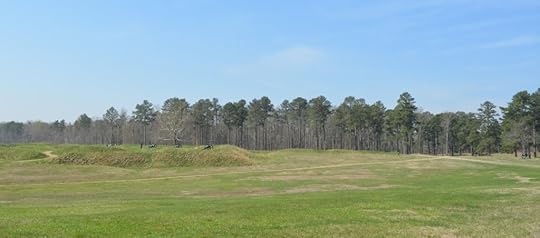
Here is the current site of Ft Steadman. The Confederate attack came from the right. The Petersburg National Battlefield is one of the best Civil War sites to visit.
Here is a representation of a strongpoint, just imagine sharpened stakes in place of the boards in front of the ditch:
Inevitably the Union wears down the defenders. After the Battle of Five Forks, the Confederacy is so weakened that Grant orders all his forces to attack along the entire line. The line is broken in several places and the retreat to Appomattox begins. This is a good book to understand the last year of the war in the East. The Army of Northern Virginia, best employed in mobile attacks, is tied down defending Petersburg and Richmond. The Union armies bang their heads against the frustrating forerunners of WWI’s trench defenses. Recommended.
I was moved to read this book by a recent visit to the Petersburg National Battlefield in Virginia. I spent the better part of a weekend touring various parts of the Battlefield with Park Rangers, but I still came away confused. The siege lines are lengthy and the key locations of the battle are separated and distant from each other. (I got lost several times driving.)
For some battlefields I have seen, such as Gettysburg, Antietam, Shiloh, or Vicksburg, a vist can illuminate and can be more informative than a casual reading of several books. For Petersburg, the reverse is true. I think this is due to the length of the siege (from June 1864-April 1865), to the complexity of the military operations, and to the interrelationship of the Petersburg siege with activites elswhere, particularly Sheridan's raids in the Shenendoah Valley and Sherman's taking of Atlanta and March to the sea. I found I needed to hold these events in mind in understanding the siege, rather than simply view the battlefield. Trudeau's book, which I found during my visit to Petersburg, helped me to do this.
Noah Andre Trudeau's "The Last Citadel" explains the Petersburg Siege and places it in its context in ending the Civil War. Perhaps most importantly for me, he explains how the decisive event of the siege occurred before it even began: Grant's brilliant move following the Union disaster at Cold Harbor, in which he stole a march on General Lee, crossed the James River, (a risky and audacious move) and attacked Petersburg from the South. Lee had forseen this move. He told Confederate General Jubal Early at Cold Harbor that: "we must destroy this army of Grant's before he gets to the James River. If he gets there it will become a siege, and then it will be a mere question of time."
These were prophetic words but Lee was unable to react quickly enough when Grant moved his army from its trenches at Cold Harbor and crossed the James River. The object of the siege was to capture the City of Petersburg and then move on the Confederate capitol of Richmond from the South. The siege itself was combined, as Trudeau shows, with operations directly on Richmond, staged from an area slightly north of Petersburg called the Bermuda Hundred. When Petersburg fell at last, the Union moved immediately into Richmond. General Lee surrendered at Appatomatox only one week later.
Trudeau's book is divided into four large Parts, together with a Prologue and an Epilogue. The book covers the early days of the siege (Petersburg probably could have been taken immediately after Grant crossed the James River with more aggressive efforts from the Union commanders), the famous incident of the Crater, operations against the southern railroads providing supplies to Petersburg, southern attempts to break the siege, the long, weary winter of the siege, and much else. Each part of the book begins with a short quotation from General Grant's "Final Report of Operations, March 1864 -- May, 1865". The four parts are each divided into short chapters which are, in turn, subdivided by short bold-faced headings each highlighting a critical moment or event. Thus the scene shifts rapidly from the Union lines to those of the South, from General Grant's deliberations to those of General Lee, from the battles to the trenches. It is, on the whole, an effective means of presenting the story. It held my attention and helped me understand the sometimes confusing sequences of events.
There are excellent discussions of the famous Battle of the Crater and of General Lee's numerous attempts to take the initiative and break the siege. I found the best and most poignant writing in Part IV of the book which details the breaking of the Confederate lines in April, 1865. Trudeau explains how Lee's lines were simply stretched too thin and how Grant after laboring to create this situation, was able to exploit it with an all-out assault. There is a good treatment of the battle of Five Forks, which led to the break -- this discussion occurs at the end of the chapter rather than at the beginning. I viewed and heard a discussion of the Five Forks site during my visit to Petersburg -- Five Forks is some distance from most of the rest of the Battlefield -- But I didn't really understand the significance of the site until I read Trudeau's book.
There are eloquent accounts of the evacuation of Petersburg and of visits during the siege by President Lincoln. Trudeau's Epilogue is thoughtful and a good summation of the book and the siege. The maps in the book were helpful. And I particularly enjoyed the many drawings and illustrations in the book. These illustrations were made contemporaneously with the events they describe and have not often been reproduced. "The Last Citadel" is a good account of a critical but sometimes underestimated battle in our country's Civil War.
Hard book to rate. Covering the campaign in one volume is a hard road to travel but not impossible. The problem with this book is the coverage is uneven. Passages on Burgess Mill and Fort Stedman are top notch. Peebles Farm, though, is done in two pages. Five Forks and the battles leading to it are absent. The writing is at times lively and lucid and at others muddled. All in all, a frustrating book because one feels it could have, with more care, been a true classic of conciseness.
I didn't plan it, nor did it enter my mind as I was choosing to read the Last Citadel, but I ended up reading about the fall of Petersburg and the Army of Northern Virginia's retreat and surrender almost 150 years to the days that it happened, which definitely made me think a little bit more about what I was reading.
If you've read and enjoyed any of Noah Andre Trudeau's previous Civil War books, The Last Citadel: Petersburg, June 1864 - April 1865 is a book that you'll want to add to your reading list. As with Trudeau's other books, The Last Citadel is a compelling and detailed read, taking from both primary and secondary sources to tell the story of the campaign from the perspective of the combatants and the civilians the battles took place around and among. He also goes beyond a narrative of the battle, getting into the heads of the generals and decision makers to explain why things happened, not just when, where, and how they happened.
In The Last Citadel, Trudeau uses General Grant's official report on the campaign as a common thread. He begins chapters with excerpts from the report, using them as a framework around which he builds the story of the long month long campaign. The story of the campaign is told chronologically, detailing first the actions of one side and then the other. Detailing is the right word; Trudeau tells what happened from the Corps level right down to the regimental level and below. He doesn't simply settle for describing what happened; he tells the story from the perspective of the participants - from the generals down to the common soldier. The Petersburg campaign was a siege, so you can't tell the story without mentioning the townspeople; Trudeau does this the same way, using their remembrances to tell the story from the civilian viewpoint and elaborate on what the townspeople endured.
Some readers may become bored with the details and the length of the book, but I thoroughly enjoyed The Last Citadel. I found it very readable and compelling, particularly the stories of the common soldier and what they experienced both in the trenches around Petersburg and the more conventional battles that took place and the stories of the civilians about what was happening inside the city as the siege tightened. This book may not be the best read for someone looking for a casual read on the subject, but if you're a student of military history or the American Civil War I highly recommend it.
Afterthought: The centenary of World War I is another good reason for reading this book. A lot of parallels can be drawn between the beginning of trench warfare in World War I and the Petersburg Campaign. I've been reading a lot about World War I lately and the experiences of the soldiers in the trenches around Petersburg sound similar; you can get a feel while reading The Last Citadel of how warfare was developing in 1864 and 1865 into what it would be in 1914-1918.
Noah Andre Trudeau wrote about Grant's overland campaign in an earlier book, and about Lee's surrender at Appomattox Courthouse and the end of the war in a later book.
"The Siege of Petersburg" is a handy label we casually use to signify everything that happened in the vicinity of Petersburg and Richmond in the interim between those two more active, and seemingly more dramatic, bookends. Petersburg remains little understood by the public because it's such an enormous story, complex in geography and back-and-forth chronology and peopled with less-familiar personalities. If you visit the national battlefield in Petersburg, you're likely to come away with a distorted understanding of what happened if for no other reason than that the park covers such a very small fraction of the true battlefield. The terrain has to be visited, from the rebel fieldworks east of Richmond all the way south and west to Five Forks, and all the works that still are to be found over all that ground. But even so the evolution of all those fieldworks is not easily discerned from tramping over that hallowed ground.
So I will say this about The Last Citadel: for me, Trudeau's book has put all that thicket of geography and chronology and personalities into proper context. That is a great service, and I am grateful to the author for having done so. This is as easy a read about a Civil War study as you'll ever find. At times the tone comes close to feeling chatty. Trudeau seems to have sought to pour as much of the Siege of Petersburg into a single volume as possible. He has largely succeeded, but . . . And here's where I have to say what's problematic about this book.
The informality of the tone itself makes me uneasy, although once I got used to Trudeau's style it bothered me less. His structuring of his text is also a little disturbing, as his approach to story-telling can change from chapter to chapter in a manner more akin to a novel than a history. But again this is more a matter of my concern with style than with content.
The included maps are somewhat puzzling at first until you start to understand how they're being used. Again, the geography and terrain is so extensive as to make the inclusion of illustrative maps for a story like this one a flummoxing venture. I'd give the maps a letter grade of B: some of the other reviews I've seen here single them out unfairly, in my opinion.
I was very disappointed that almost the entire story of General Sheridan's arrival on the battlefield and the action at Five Forks was summarized in the space of a few short pages. I understand why this was done: telling the full story would have added a few hundred more pages to the book. Still, this story is far too central to the greater Petersburg story to be given such short shrift.
Although I often found this book hard to put down, and it does provide much-needed context for the events it covers, my assessment of The Last Citadel is, regrettably, mixed.
In The Last Citadel: Petersburg, June 1864-April 1865, Noah Andre Trudeau charts Union General Ulysses S. Grant’s Petersburg Campaign, from June 9, 1864, when General Benjamin Butler first attacked defenses around the city, to April 3, 1865, when Federal troops at last captured this vital Virginia railroad hub south of Richmond. The ten-month Siege of Petersburg was the longest and most costly to ever take place on North American soil.
Within this non-traditional history, Trudeau brings to life these dramatic events through the words of men and women who were there, including officers, common soldiers, and the residents of Petersburg. What emerges is an epic account rich in human incident and adventure, told through various chapters covering all aspects of the campaign. This revised Sesquicentennial edition includes updated text, redrawn maps, and new material.
The Last Citadel is divided into six parts, including a prologue and epilogue. The chapters are arranged into a rough chronology, but this is not strictly a chronological account of the siege. Each chapter uses a different subject to frame the narrative, from the effect of artillery bombardment on soldiers and civilians, the role of newspapers and the press, and even fraternization between opposing armies.
This is a unique and interesting way to look at the battle, drawing from a multitude of primary sources including military orders and dispatches, regimental histories, civilian diaries and letters, newspapers, and more. Trudeau organizes his book well, so that various perspectives never become jumbled or distracting. This keeps each chapter fresh and interesting, like reading a collection of articles rather than a weighty historical text.
Two incidents stand out: the Beefsteak Raid and Confederate sabotage at City Point. Grant was never able to completely seal off Petersburg or Richmond, and the Confederates looked for ways to exploit that failure. Supplying an army of over 100,000 men required a huge supply of food, including beef. Confederate cavalrymen led by Maj. Gen. Wade Hampton pulled off a daring raid Sept. 14-17, 1864 in which they rode behind Grant’s lines and rustled 2,486 head of cattle, bringing it back over 50 miles to supply their own army.
Grant’s headquarters was at City Point, Virginia on the James River. On August 9, 1864, a large explosion ripped apart an ammunition barge, sending wood, cannonballs, bullets, and shell fragments flying. 43 Union soldiers were killed instantly and another 126 wounded. At the time, it was ruled an accident, but after the war it became known as an act of sabotage by Confederate Secret Service agent John Maxwell using a timed explosive (he called it a Horological Torpedo) smuggled aboard the barge. Incidents such as these make the Siege of Petersburg a truly unique event in the annals of the American Civil War.
Noah Andre Trudeau (born February 23, 1949) is a former executive producer at National Public Radio who lives in Washington, D.C. He is a history graduate of the State University of New York at Albany. His other books include Like Men of War: Black Troops in the Civil War, 1862-1865 (1998), Gettysburg: A Testing of Courage (2002), and Southern Storm: Sherman’s March to the Sea (2008).
Really liked this book a lot. It goes into some considerable detail even though it the campaign lasted almost a year. Moreover it is crystal clear about the strategical and tactical aspects of the campaign without getting dull for a moment. Filled to the brim with personal accounts and very good maps to accompany the text I would recommend this book to anyone interested in the ACW and wanting to read about the Petersburg campaign (not that there's much to choose from though).
Interesting is the storytelling technique the writer uses. Almost every chapter has a different structrue. Day-by-day in one and jumping from general to general in the next and then a short chapter about a single event followed by a series of battles which are treated in detail in one chapter.
I've had trouble deciding how to rate this book. It's very well researched and some parts (such as the account of the assault on Fort Stedman) are extremely well-written. But I have many criticisms. Much of the book is poorly organized and relies too heavily on first person accounts not woven into an engaging narrative. I don't like way the author did his section headings. The maps aren't sufficiently detailed. The illustrations (all contemporary sketches by a single artist) aren't sufficient. There isn't enough tactical detail. The notes aren't presented in a way to enable a reader to easily find a reference. There is no description of the Battle of Five Forks (?!). Etc. And yet, because the siege of Petersburg has been so neglected by historians, until very recently this has been its definitive history For that reason alone (what would we have had without it?) the author deserves a lot of credit. Thankfully Wilson Greene is now starting to publish his 3-volume work that should become the go-to history of the siege and associated battles. In any event, I settled on four stars because the parts of this book that are good are really good, and because I'm an easy grader.
Kind of like the siege of Petersburg itself, this book has a few moments of action surrounded by long moments where nothing is achieved. There are some things in here that are definitely worth reading about (the Crater especially) but there's not much of a feeling for the stakes here. Even Lee admitted that if it came down to a siege, he was probably done for. Maybe the monotony of a siege doesn't lend itself to a gripping tale but I have to think this could have been told in a more engaging way.
Finally I finished this book! It is quite long and highly detailed. It is extremely well researched, which is what I think took me so long to read it. Unless you are a student of the Civil War and know all the respective players on both sides, it is hard sometimes to know who is who and for what side they are fighting on. But one thing is for certain, this long siege showed very well the futility of the strategy for fighting on both sides. This would later be repeated in the carnage of World War One’s trench warfare.
Although it is considered to be the most comprehensive coverage of the siege of and battles around Petersburg between June 1864 and April 1865, Trudeau's chronological (sometimes day-by-day) approach might not be attractive to the casual Civil War reader. I also did not like the absence of footnotes or endnotes within the text.
Trudeau provides a nice overview of each phase of the Petersburg Campaign - with one exception. He summarizes the movement of the armies towards the city, early attempts by the Union to overtake the defenses, and subsequent full scale assaults culminating with the Crater. Later Union movements south of the city as the lines extend area also each detailed, culminating with the breakthrough that forced the evacuation.
The exception - as mentioned by others - completely overlooking Five Forks. I literally stopped reading and went back, thinking I missed a chapter or my copy was misprinted. Nope. How such an otherwise complete account of the entire campaign can misfire that badly makes me shake my head. I think Trudeau did cover Five Forks in one of his other books about this time period... but still would have been logical to include it here.
This is, to my knowledge, the only single volume history of the Petersburg Campaign and it just received an updated & revised edition in late 2014 (originally published 1991). It covers the entire campaign from the first attacks on Petersburg in June 1864 until Grant's breakthrough in April 1865.
Having not read the original version I cannot compare, although there is a preface giving a brief overview. Most notably the maps have been reworked. Some things still slipped through the cracks, particularly an early mention of the 7000 men lost in a half hour at Cold Harbor (Gordon Rhea shot that old myth down since this book was first published).
Maybe I am just burned out from reading Rhea's entire Overland Campaign series back-to-back during the preceding two months (and a bit distracted by moving), but this book fell rather flat with me. It's not terrible and parts of it are quite good; the events leading to AP Hill's death build quite nicely. It doesn't neglect events north of the James River either. Alas, this book is frustratingly inconsistent. Trudeau is prone to quoting at too great a length and sometimes eschews a narrative of some raid or battle, providing a quote from an official report instead. (Trudeau also sometimes overuses parentheses.) This is particularly frustrating on two occasions - a cavalry raid by Wilson early in the campaign and Five Forks. Five Forks is reduced to a map and a paragraph from Grant's official report, which I found a maddening oversight.
There is a feeling of disconnect and lack of smooth transition between chapters, most of them focused on a particular offensive. Oddly, the offensives seem commonly referred to by number these days ("Grant's Nth Offensive"), but almost never as such in the book; I don't know if that simply wasn't common terminology for the campaign in 1991?
I found the maps too few, too small, and poorly placed.
Given what this book does right in places and the scarcity of alternatives (and aforementioned concerns about personal bias), I'm giving this 3 stars of 5 (ideally I'd give 2.5). It has its merits, but is a seriously flawed work.
The Last Citadel, Noah Trudeau's second Civil War history book, is generally regarded as the single volume history of the Petersburg campaign, and for good reason. The book is meticulously researched and draws from a sea of primary sources on both sides. Trudeau does a magnificent job working with these primary sources and allowing them to drive the narrative and provide most of the color to the story. His own writing is not overly flowery, or terribly artistic, but it is easily digestible and well organized (mostly).
I've read many reviews of this book that complain that it's too dry. I disagree, but I can understand where some of that sentiment probably comes from. The narrative of the book is very structured, almost like a journal or a diary. The historical action is covered chronologically, then by location, and divided into segments that cover the perspective of each of the competing sides. This can get to be a bit repetitive, and the nature of the siege campaign can also add to that feeling. Trudeau also occasionally gets literally repetitive, as he does in the last chapter of the book. Each subsection of the last chapter starts with the same vignette of General Grant ordering the final offensive against Petersburg. It's a great scene, but we don't need to read it several times over.
Another factor that probably leads some readers to find this book dry, is that it is very detail oriented. Added to the previous comments about repetitive elements, the endless listing of military units, officers, and where they were and where they moved can be overwhelming to those unfamiliar with serious military history reading. That's not really a fault of the material, in fact it's a strength for the serious student of Civil War history, but you might not enjoy this book if you're not a military/Civil War history enthusiast.
This is a very nice rendering of the Battle of Petersburg. Many Civil War buffs recall General Robert E. Lee's words: "We must destroy this Army of Grant's before he gets to the James River. If he gets there it will become a siege, and then it will be a mere question of time."
This book provides in great detail the battle for Petersburg. It provides insights into General Beauregard's wise disposition of forces at the start of the battle, and his weak opponent, General "Baldy" Smith, who was quite tentative at that time. And the usually reliable Winfield Scott Hancock did not have one of his finer days at the outset.
There follow the tales: the well conceived breaking off of the engagement at Cold Harbor and Grant's subsequent movement across the James River to Petersburg; the pendulum swings, as Grant lengthened the Confederate trenches by attacking and lengthening his own trenches; the Battle of the Crater, a great lost opportunity (the final act of incompetence by General Ambrose Burnside, as he was relieved after his ineffectual generalship here); the Confederate raid on the Union's "beefsteak" by Wade Hampton; Gordon's desperate effort to break out; Sheridan's crushing defeat of Pickett at Five Forks; Grant's subsequent statement that "I have ordered a general assault along the lines."
Then, the race to Appomattox Station began. . . .
Sometimes, the tale becomes a bit stale. Overall, though, this is a very useful volume on the key siege at Petersburg.
Good single volume history of the Petersburg Campaign; however, there were some things which prevented it from getting four stars. Several sections in the beginning of the book quotes extensively from the Official Records and (for the Crater) testimony for the Joint Committee on the war, rather than using the author's own words; this tended to make the flow of the book a bit jerky. Some of the changes in the structure of the armies or the changes in command of certain units are passed over quickly (such as the return of James Longstreet to the Army of Northern Virginia) or omitted entirely (like the formation of the Army of Northern Virginia's Fourth Corps, or the replacement of Wade Hampton with W.H.F. Lee as commander of the Cavalry Corps).
Another classic Civil War story from Trudeau this time about the strangulation of Petersburg, and the how that led to the fall of Richmond. It is amazing how close the South came to winning this battle even though Atlanta, Savannah and Charleston were falling under the march of Sherman. Confederate General Robert E. Lee comes across as a true hero and a wonderful person. The war would have been over a lot more quickly, had he led the North. Trudeau explains the battle but also puts the battles into context.
Trudeau continues the story he started with "Bloody Roads South", and in the same style: A day-by-day account of the Civil War's 9-month Siege of Petersburg, VA. While filling in the bigger picture with excerpts from Ulysses S. Grant's final report of U.S. military operations in the final year of the war, Trudeau presents an excellent, concise narrative of the major and minor actions that took place in the Petersburg vicinity in 1864-65. As a Civil War buff who has sometimes felt confused about certain aspects of the siege, this book helped to clear up several questions for me.
A very thorough and easily read account of the Petersburg campaign although the author strangely omits the Five Forks battle. It does provide a good understanding of the trench warfare fought there and the struggle of the Confederates to hold on to the city's defenses despite their inferior numbers.
Found to be very interesting from start to finish. Would recommend this book to those who are serious about learning the facts about what happened in an around Petersburg area prior to the end of the war.
The heartbreaking story of the Siege of Petersburg. Trudeau draws upon considerable research into first person accounts of this sad saga in our history.