

What do you think?

A Ride to Remember: A Civil Rights Story
The true story of how a ride on a carousel made a powerful Civil Rights statement
A Ride to Remember tells how a community came together—both black and white—to make a change. When Sharon Langley was born in the early 1960s, many amusement parks were segregated, and African-American families were not allowed entry. This book reveals how in the summer of 1963, due to demonstrations and public protests, the Gwynn Oak Amusement Park in Maryland became desegregated and opened to all for the first time. Co-author Sharon Langley was the first African-American child to ride the carousel. This was on the same day of Martin Luther King Jr.’s March on Washington for Jobs and Freedom. Langley’s ride to remember demonstrated the possibilities of King’s dream. This book includes photos of Sharon on the carousel, authors’ notes, a timeline, and a bibliography.
A Ride to Remember tells how a community came together—both black and white—to make a change. When Sharon Langley was born in the early 1960s, many amusement parks were segregated, and African-American families were not allowed entry. This book reveals how in the summer of 1963, due to demonstrations and public protests, the Gwynn Oak Amusement Park in Maryland became desegregated and opened to all for the first time. Co-author Sharon Langley was the first African-American child to ride the carousel. This was on the same day of Martin Luther King Jr.’s March on Washington for Jobs and Freedom. Langley’s ride to remember demonstrated the possibilities of King’s dream. This book includes photos of Sharon on the carousel, authors’ notes, a timeline, and a bibliography.
40 pages, Hardcover
First published January 7, 2020
Ratings & Reviews
Friends & Following
Create a free account to discover what your friends think of this book!
Community Reviews
Displaying 1 - 30 of 90 reviews

March 18, 2021
On the same day as Dr. Martin Luther King, Jr delivered his 'I Have a Dream' speech, a little girl named Sharon Langley was the first black child to ride a formerly segregated carousel in a Baltimore amusement park. That first ride was the result of years of work by civil rights activists and a series of concentrated peaceful protests at the Gwynn Oak Park over the 4th of July that same year. This picture book bio provides a civil rights story that is very readable for groups and extra facts to drill down on in the back of the book. I love the fact that Sharon Langley herself contributed to this book highlighting this historic achievement. Her family lived by the Golden Rule and she as continued to honor her parents and their legacy. If you want to see the carousel, it was moved to Washington, D.C. in 1981. Mrs. Langley visited the carousel with family to commemorate the 50th anniversary of her first ride. Highly recommended!

March 12, 2020
A Ride to Remember is a lovely picture-book memoir recounting the story of the first African American child to ride a previously segregated carousel in Baltimore.
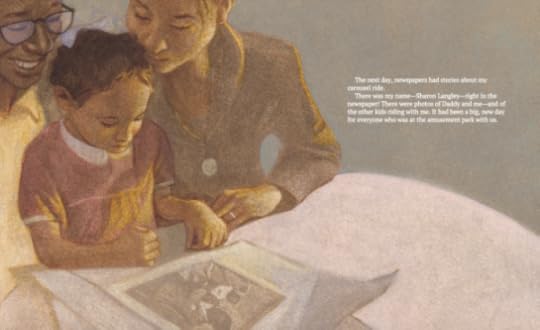
The main narrative features strong writing. While there is a lot of text, it's uncomplicated and tells the story clearly, in such a way that even young listeners will understand what's going on. The soft illustrations are a beautiful complement to the story. At the back are some pages with facts, a timeline, and a bibliography.
Overall, this is quite strong. I would definitely recommend it to those interested in the Civil Rights movement, as well as those who enjoy historical picture books about real events.
Quotable moment:
The main narrative features strong writing. While there is a lot of text, it's uncomplicated and tells the story clearly, in such a way that even young listeners will understand what's going on. The soft illustrations are a beautiful complement to the story. At the back are some pages with facts, a timeline, and a bibliography.
Overall, this is quite strong. I would definitely recommend it to those interested in the Civil Rights movement, as well as those who enjoy historical picture books about real events.
Quotable moment:

June 11, 2020
"I love carousels. The horses come in so many colors---black, white, brown, gray, a honey shade of tan, sunny yellow, fire engine red, or even a soft baby blue. But no matter their colors, the horses all go at the same speed as they circle round and round. They start together. They finish together, too. Nobody is first and nobody is last. Everyone is equal when you ride a carousel."
If you are allowed to ride a carousel....
Sharon Langley tells the story of the peaceful protests of her parents and many others that led to the opening of an amusement park in Baltimore to African Americans in 1963.
It's a powerful story, well told, and beautifully illustrated by Coretta Scott Award winner Floyd Cooper.
If you are allowed to ride a carousel....
Sharon Langley tells the story of the peaceful protests of her parents and many others that led to the opening of an amusement park in Baltimore to African Americans in 1963.
It's a powerful story, well told, and beautifully illustrated by Coretta Scott Award winner Floyd Cooper.

March 3, 2020
It's difficult for me to know that in my young years, blacks were treated terribly. Not only were there segregated bathrooms, water fountains, and schools, but children were forbidden to enjoy rides at parks. The sixties were a time of unrest, and a time of facing the fact that all these things denied to people of color were incredibly unfair.
This book is based on a true story. The Gwynn Oak Amusement Park in Baltimore, Md, denied access to the carousel, and any of the rides in the park. Written by Sharon Langley, the first black child who rode the horse on this particular carousel, the book tells the importance of rebellion and the sheer stupidity and racism that many, not all, whites held against those of color.
Children who were raised to learn the golden rule of doing unto others what you would want to be treated, asked parents why whites did not adhere to this basic biblical tenant.
In 1963, people peacefully went to Gwynn Oak Amusement Park and protested peacefully. Singing songs of "We Shall Overcome," and carrying signs that demanded equal treatment, people were taken by bus to jail.
On August 28th, 1963, Sharon's mother and father entered the park. It was open to all. Marching to an ornately decorated horse, Sharon's father placed her on the carousel. Reporters and photographers were there to witness this story.
Today, on the Mall in Washington, DC, the carousel stands as a testimony to a time when people made a difference. This famous carousel ride represented the fact that the horses on the carousel all went around at the same time. No one was before, and no one was after!
This book is based on a true story. The Gwynn Oak Amusement Park in Baltimore, Md, denied access to the carousel, and any of the rides in the park. Written by Sharon Langley, the first black child who rode the horse on this particular carousel, the book tells the importance of rebellion and the sheer stupidity and racism that many, not all, whites held against those of color.
Children who were raised to learn the golden rule of doing unto others what you would want to be treated, asked parents why whites did not adhere to this basic biblical tenant.
In 1963, people peacefully went to Gwynn Oak Amusement Park and protested peacefully. Singing songs of "We Shall Overcome," and carrying signs that demanded equal treatment, people were taken by bus to jail.
On August 28th, 1963, Sharon's mother and father entered the park. It was open to all. Marching to an ornately decorated horse, Sharon's father placed her on the carousel. Reporters and photographers were there to witness this story.
Today, on the Mall in Washington, DC, the carousel stands as a testimony to a time when people made a difference. This famous carousel ride represented the fact that the horses on the carousel all went around at the same time. No one was before, and no one was after!

January 21, 2020
This account of a significant Civil Rights achievement, celebrate on the same August day as the Freedom March on Washington, is a previously untold story that merits the attention of everyone, every age.

October 9, 2019
A personal story of the Civil Rights Movement about how a carousel ride made a powerful statement on equality.

November 2, 2019
Sometimes it is the simplest acts that herald larger changes. This picture book provides a personal account of how the author, Sharon Langley, rode a carousel in a Baltimore amusement park in 1963 following protests to integrate the park. She wasn't even a year old yet. While it's clear that adults were at the forefront of efforts to make changes in the way things were done during this pivotal summer--it was also the summer of the March on Washington and Dr. Martin Luther King, Jr.'s famous speech--the account of these events makes it clear that children were also involved in the movement, briefly highlighting the arrest of three white brothers, who were arrested, along with their parents, for trying to integrate the park. Readers will love having such a personal account and perspective on history as well as seeing photographs of Sharon then and now and the horse she rode on as the carousel went around. Back matter includes more information about the events and both authors. The oil erasure illustrations lend a sentimental and historical note to the account, which make them the perfect choice to accompany this lesser-known story of the civil rights movements. Young readers will appreciate the acknowledgement of the contributions of youngsters in that movement, making this a solid addition to any classroom library devoted to civil rights, social justice, change or the impact of one person on the world around him/her. I will certainly seek out Amy Nathan's book for older readers on this very topic.

December 12, 2022
"Everyone is equal when you ride a carousel... Nobody first and nobody last, everyone equal, having fun together."
This book broke my heart reading about how Sharon's mom and dad had to explain segregation, with Sharon asking her parents, "But what about the Golden Rule?" and her mom stating that some people either forgot the Golden Rule or they did not believe it applies to "people like them."
Great resource.
This book broke my heart reading about how Sharon's mom and dad had to explain segregation, with Sharon asking her parents, "But what about the Golden Rule?" and her mom stating that some people either forgot the Golden Rule or they did not believe it applies to "people like them."
Great resource.

February 21, 2020
Back in the 1960’s, African-Americans were not allowed to enter the Gwynn Oak Amusement Park in Baltimore. They were not allowed to sit on the grass, share treats or ride on the carousel. As the world around them began to change and become less segregated, Gwynn Oak continued its policies. They became the center of protests where hundreds were arrested. A mother and child who were African American and light skinned covertly entered the park and were allowed to enjoy themselves for hours. They shared their story with the press. As the pressure built, the park’s owners agreed to allow everyone into the park and to drop any charges from the protests. The first day the park was open was August 28, 1963. That day, a little girl named Sharon Langley, was the first African-American to ride the carousel with her father holding onto her. A photo of the ride made the papers as did the other major news story of the day, when Martin Luther King, Jr. made his iconic “I Have a Dream” speech. The carousel was moved to Washington, D. C. where Sharon took a ride on the fiftieth anniversary of her first ride in Baltimore.
The authors make a point of framing the tumultuous 1960’s for young readers. They have a child ask questions about why African-Americans were not allowed to enter the park. This is such an important moment in the book, giving modern children a lens into the inherent societal racism of the time, racism that is not erased in our modern society either, of course. They then turn to the protests about the park, showing the bravery of the people who protested, who went to jail, and who insisted on staying overnight to make a point. The body of the book does a great job offering historical perspective as well as details about the protests and efforts to desegregate the park. More information is also shared in the final pages, including more details of the events in the book, a bibliography and a timeline.
Cooper’s art is done with a lush softness to the lines. He used oil erasure on illustration board to capture an almost sepia-toned historical feel. The faces he shows of the people involved are tremendously moving, showing that this was about people insisting on change.
In a single story, children will deeply understand what the civil rights struggle was about. Appropriate for ages 5-9.
The authors make a point of framing the tumultuous 1960’s for young readers. They have a child ask questions about why African-Americans were not allowed to enter the park. This is such an important moment in the book, giving modern children a lens into the inherent societal racism of the time, racism that is not erased in our modern society either, of course. They then turn to the protests about the park, showing the bravery of the people who protested, who went to jail, and who insisted on staying overnight to make a point. The body of the book does a great job offering historical perspective as well as details about the protests and efforts to desegregate the park. More information is also shared in the final pages, including more details of the events in the book, a bibliography and a timeline.
Cooper’s art is done with a lush softness to the lines. He used oil erasure on illustration board to capture an almost sepia-toned historical feel. The faces he shows of the people involved are tremendously moving, showing that this was about people insisting on change.
In a single story, children will deeply understand what the civil rights struggle was about. Appropriate for ages 5-9.

March 22, 2021
An important and beautifully told story.
I appreciated the information at the back about the real people who were in the story and the timeline that helped to illustrate the events.
I appreciated the information at the back about the real people who were in the story and the timeline that helped to illustrate the events.

March 8, 2020
Sharon Langley tells the story of desegregating Gwynn Oak Amusement Park in Baltimore. She was the first Black child to ride the carousel on the day the parke opened to everyone. Interesting timing as it was the same day that Martin Luther King, Jr. gave his "I Have a Dream" speech in Washington, DC. Part of history written at an elementary reader's level. Lovely illustrations bring the scenes to life. Information text at the end provides background.

November 10, 2022
I would rate, "A Ride to Remember: A Civil Rights Story," 5 out of 5 stars. This nonfiction book, written by Sharon Langley, describes her story of being the first African American to ride on the carousel at Gwynn Oak Amusement Park in 1963. Langley's true story is told through the perspective of her parents, explaining to her how many people came together to protest to end segregation that was still active at the Baltimore Amusement park although many "unfair laws" had changed when by the time she was born. Langley describes what her parents told her of the many things that individuals did to stand up and peacefully protest against the amusement park and even mentioning that the special day of August 28th, 1963, was the day that her family was the first African Americans to step foot into the Gwynn Oak Amusement Park, and the day that Reverend Dr.Martin Luther King Junior let the biggest protest, March on Washington for Jobs and Freedom. I would utilize this book as a whole-class read-aloud and provide it as an independent reading for my students. When using this book for a whole-class read-aloud, I would lead a lesson/discussion on the topic of segregation and peaceful protests. I would ask students how would they stand-up/advocate for something that they know is wrong and wanting to make change for. I would also provide students with a "virtual experience" of riding the carousel, which can deepen the intention for my lesson and build a personal connection to students. (https://www.youtube.com/watch?v=qyK10...)
I very much enjoyed reading this book as it provides students with a sense of motivation and confidence, knowing they are able to make a difference in the world by coming together and standing up for what is right.
I very much enjoyed reading this book as it provides students with a sense of motivation and confidence, knowing they are able to make a difference in the world by coming together and standing up for what is right.

March 6, 2020
This story of a Civil Rights Era protest, as told to a young girl by her parents, helps reveal life under segregation in a way accessible for young readers. Floyd Cooper's illustrations bring the story to life.

March 5, 2020
Interesting story of a child and her family living near an amusement park that they were forbidden from riding the carousel because they were black. And the changes that came about when people stood up for justice and one little girl got to ride and tells her story.

February 28, 2020
Gwynn Oak Amusement Park was segregated. Even after many other establishments integrated, Gwynn Oak stubbornly refused to comply. So families and community figures protested--and eventually the park gave in. Sharon Langley was the first African American child to ride the carousel the day integration took place, and she shares the details of her historic first ride in this beautiful book.

June 29, 2020
An excellent tool to talk with very young kids about protest and their place in the past and present. Lovely illustrations.

June 8, 2020
I liked this fascinating memoir of an incident in Civil Rights history. But I loved Cooper's soft, fuzzy illustrations, described as oil erasure on illustration board, that I thought were a perfect accompaniment to the story. His illustrations are realistic, his people almost photo-realistic, and the large size of the book gave him scope to add a lot of detail to the illustrations.
February 18, 2020
I had never heard this story of the carousel on the mall. My seven-year-old loved reading a civil rights story that felt local to our neighborhood.
February 14, 2020
An unexpectedly POWERFUL story.

February 10, 2020
Beautiful, life-like pictures. Very clear, age-appropriate retelling of desegregating Gwynn Oak Amusement Park.

January 31, 2020
Written from the viewpoint of a young child having a conversation with her parents, this book is easily accessible and relevant to children today. Most of whom would agree that the Golden Rule and fairness means that the color of one's skin should not prevent a child's ride on a carousel.
Using a gentle and kind conversational tone, the child and her parents discuss the discrimination, months of protests by the community, and the media's role in raising awareness of this unfair rule Gwynn Oak Amusement Park.
The carousel becomes a symbol of the larger, nation-wide civil rights movement. Tying together Sharon's historic ride as the first African American child on the very day that Dr. Martin Luther King gave his "I Have A Dream" speech, with the fact that this carousel now sits on the National Mall, very close to the Lincoln Memorial where Dr King spoke. It is an excellent book for children, and teachers, on equality and the power of community; and how each of us can change the world.
Using a gentle and kind conversational tone, the child and her parents discuss the discrimination, months of protests by the community, and the media's role in raising awareness of this unfair rule Gwynn Oak Amusement Park.
The carousel becomes a symbol of the larger, nation-wide civil rights movement. Tying together Sharon's historic ride as the first African American child on the very day that Dr. Martin Luther King gave his "I Have A Dream" speech, with the fact that this carousel now sits on the National Mall, very close to the Lincoln Memorial where Dr King spoke. It is an excellent book for children, and teachers, on equality and the power of community; and how each of us can change the world.
February 6, 2020
A touching and inspiring story with beautiful illustrations, and definitely a story I have never heard before. However, this is very text heavy for a picture book, and I would be interested to see what age range the author had in mind for this one.

January 24, 2020
This awesome nonfiction picture book shares with young readers a personal story of the civil rights movement. The events of this story take place over fifty years ago, but kids will be fascinated by the author's family's role in ending discrimination in one of Baltimore's amusement parks. Before 1963, African Americans were not allowed to visit the Gwynn Oak Amusement Park. In the summer of 1963, mass protests took place and hundreds of people were arrested. When the park's owners relented and welcomed all families, young Sharon Langley and her parents were the first African American family to enter the park and ride the carousel. The day was also famous because Dr. Martin Luther King, Jr. gave his famous "I Have a Dream" speech in our nation's capital. With fascinating first-person narration and gorgeous illustrations, young readers will learn so much about the civil rights movement. Author's notes, a time line, and a list of books and articles at the back of the book make this a terrific nonfiction resource to have on the shelf.
December 7, 2019
This moving tale of a civil-rights landmark event is told for children through the eyes of a young girl. Sharon Langley WAS the first black child to ride the carousel at the previously segregated Gwynn Oak Amusement Park in Baltimore. In the story, Sharon is the now 5 or 6 year old asking her parents questions about the event and the exclusion of families of color. "Why, she asks, were there no rides for children like me?" Her parents' answers to that simple but huge question are tender, straight-forward and perfectly written for a young audience.
The story of the protest and civil rights victory celebrates a victory in the civil rights movement that may be little known to many readers and it is an ideal way to discuss the enormous issues that produced it.
Floyd Cooper's soft and beautiful illustrations extend the text perfectly and add layers and layers of emotional understanding to the reading experience.
Excellent back matter includes a Note from Sharon Langley that provides much additional information, photographs, a Timeline, Bibliography and many sources. This book is a quiet gem!
The story of the protest and civil rights victory celebrates a victory in the civil rights movement that may be little known to many readers and it is an ideal way to discuss the enormous issues that produced it.
Floyd Cooper's soft and beautiful illustrations extend the text perfectly and add layers and layers of emotional understanding to the reading experience.
Excellent back matter includes a Note from Sharon Langley that provides much additional information, photographs, a Timeline, Bibliography and many sources. This book is a quiet gem!
January 21, 2020
Shows a child's confusion about segregation and people not knowing about the "Golden Rule:" "What about treating other people the way you want to be treated?"
"Many people - both blacks and whites - knew that segregation was unfair and just plain wrong."
The story of protests to make an amusement park in Baltimore open to everyone. The first day everyone was welcome was also the day of MLK's speech during the March on Washington. The carousel in the story is the one on the National Mall. (I'll have to look for the sign that tells about Langley's ride and her name on the saddle and horse shoe.)
"Many people - both blacks and whites - knew that segregation was unfair and just plain wrong."
The story of protests to make an amusement park in Baltimore open to everyone. The first day everyone was welcome was also the day of MLK's speech during the March on Washington. The carousel in the story is the one on the National Mall. (I'll have to look for the sign that tells about Langley's ride and her name on the saddle and horse shoe.)

January 23, 2020
Story of a carousel ride at Baltimore's Gwynn Oak Park that was once segregated. The carousel survived a storm and is now located on the National Mall in Washington, D.C.

Read
December 5, 2020While the author was too young to know it, she was the first person of color to ride a carousel in Maryland after Civil Rights protestors marched on July 4, 1963. Floyd Cooper's illustrations are lovely.

December 4, 2019
Moved me to tears.
November 22, 2021
A Ride to Remember, a Civil Rights Story by Sharon Langley and Amy Nathan is a memoir written about Langley’s experience as the first African American child to legally ride the carousel at Gwynn Oak Amusement Park in Baltimore, Maryland, just before her first birthday in 1963.
“Everyone is equal when you ride a carousel.” The text describes a place that is bright, cheery, and engaging. The horses on the carousel all go the same pace...no one is ahead and no one is behind. Yet, the reader learns that all this fun is not for everyone, but just for the lucky children with white skin. While the curious child asks her Mama questions about the intriguing park, sadly she learns about segregation. In response to her question about the Golden Rule, her Mama says, “I guess that some people forgot that the Golden Rule is supposed to include everyone.” In the time preceding Sharon’s birth, some of the laws segregating blacks and whites had already started to change, but the law at the amusement park had not. People got so tired of the unfairness of segregation that on July 4th that year, they organized and led a peaceful protest at the park. There were hundreds of people there, and all kinds of people, too. Almost three hundred protestors were arrested that day! Some spent the night in jail. They all vowed to return so that white and black children could go to the amusement park together. So many stories about the protests in the newspapers made the park owners decide that it was time to end segregation at the park. On August 28, 1963, Sharon and her parents walked into the park a little bit nervous to see angry protestors, but only smiles greeted them. Smiles and reporters, while Sharon became the first black girl to ride the carousel.
This book is filled with historical facts including an entire spread at the end of the book with photographs and notes from Sharon Langley, a timeline, and updates about some of the people mentioned in the story. There are many references to articles proving that much additional research was done to authenticate the facts for this story.
Floyd Cooper’s illustrations are layered with sepia and golden tones in watercolors, and seem to employ Seurat’s pointillism to create the effect of applying small dots of color throughout. The bright bursts of color give the scenes a “dreamy and nostalgic quality” notes Kirkus Reviews.
This book was recommended to me by a colleague in my school. She teaches third grade, and since Epic Reading (where I read the book) notes that this book is for ages 6-9 with a Guided Reading Level R, that would make sense. Unfortunately, I was unable to find this book in Lexile or Scholastic Book Wizard. Written in narrative form, this book tells the story of a young girl learning about inequality. THe authors use the features of fiction to convey factual information, carefully pacing the vents, and using the plot to bring a rise in action (using the protests and jailing of blacks and whites). This combination of narrative and expository structure is evident while delivering a sensitive message about treating each other with kindness and equality from the turning of the first page. In a third grade classroom, I would connect this to the standard RI.3.3 to describe the relationship between a series of historical events in a text, using language that pertains to time, sequence, and cause and effect.
This story is compelling because children this age are interested in amusement parks and inherently seek to be fair. Readers would empathize with the children that are getting turned away from being unable to ride and play at the park. This team of authors and illustrator have delivered an engaging story packed with historical facts. Plus, readers can actually go see the horse that Sharon rode since it is on display in Washington D.C.
“Everyone is equal when you ride a carousel.” The text describes a place that is bright, cheery, and engaging. The horses on the carousel all go the same pace...no one is ahead and no one is behind. Yet, the reader learns that all this fun is not for everyone, but just for the lucky children with white skin. While the curious child asks her Mama questions about the intriguing park, sadly she learns about segregation. In response to her question about the Golden Rule, her Mama says, “I guess that some people forgot that the Golden Rule is supposed to include everyone.” In the time preceding Sharon’s birth, some of the laws segregating blacks and whites had already started to change, but the law at the amusement park had not. People got so tired of the unfairness of segregation that on July 4th that year, they organized and led a peaceful protest at the park. There were hundreds of people there, and all kinds of people, too. Almost three hundred protestors were arrested that day! Some spent the night in jail. They all vowed to return so that white and black children could go to the amusement park together. So many stories about the protests in the newspapers made the park owners decide that it was time to end segregation at the park. On August 28, 1963, Sharon and her parents walked into the park a little bit nervous to see angry protestors, but only smiles greeted them. Smiles and reporters, while Sharon became the first black girl to ride the carousel.
This book is filled with historical facts including an entire spread at the end of the book with photographs and notes from Sharon Langley, a timeline, and updates about some of the people mentioned in the story. There are many references to articles proving that much additional research was done to authenticate the facts for this story.
Floyd Cooper’s illustrations are layered with sepia and golden tones in watercolors, and seem to employ Seurat’s pointillism to create the effect of applying small dots of color throughout. The bright bursts of color give the scenes a “dreamy and nostalgic quality” notes Kirkus Reviews.
This book was recommended to me by a colleague in my school. She teaches third grade, and since Epic Reading (where I read the book) notes that this book is for ages 6-9 with a Guided Reading Level R, that would make sense. Unfortunately, I was unable to find this book in Lexile or Scholastic Book Wizard. Written in narrative form, this book tells the story of a young girl learning about inequality. THe authors use the features of fiction to convey factual information, carefully pacing the vents, and using the plot to bring a rise in action (using the protests and jailing of blacks and whites). This combination of narrative and expository structure is evident while delivering a sensitive message about treating each other with kindness and equality from the turning of the first page. In a third grade classroom, I would connect this to the standard RI.3.3 to describe the relationship between a series of historical events in a text, using language that pertains to time, sequence, and cause and effect.
This story is compelling because children this age are interested in amusement parks and inherently seek to be fair. Readers would empathize with the children that are getting turned away from being unable to ride and play at the park. This team of authors and illustrator have delivered an engaging story packed with historical facts. Plus, readers can actually go see the horse that Sharon rode since it is on display in Washington D.C.
August 20, 2020
A Ride to Remember: A Civil Rights Story is an autobiographical children's picture book written by the team of Sharon Langley and Amy Nathan and illustrated by Floyd Cooper. It center on Sharon Langley became the first African American child to legally ride the carousel at Gwynn Oak Amusement Park in Baltimore, Maryland, one month before her first birthday, in 1963.
Sharon Langley is a Baltimore native who became known as the first African American child to enjoy Gwynn Oak Amusement Park when it opened to the public without segregation.
Langley-Nathan's text is rather simplistic, straightforward, and informative. Framed as a conversation between Langley and her parents, the story recalls the sustained efforts of people working together that made Langley's ride possible. Backmatter includes supplemental information includes a bibliography, timeline, a note from Langley, and information about the carousel, which is now situated at the National Mall in Washington, D.C. Cooper’s richly textured illustrations, made using oil erasure on illustration board, evoke sepia photographs’ dreamlike combination of distance and immediacy, complementing the aura of reminiscence that permeates Langley and Nathan;s narrative.
The premise of the book is rather straightforward. Like many children, Sharon Langley took her first carousel ride supported by a parent’s steadying hand. However, Langley's August 1963 ride, a month before her first birthday, was also a landmark: the culmination of a sustained civil rights struggle to integrate the Gwynn Oak Amusement Park in Baltimore.
All in all, A Ride to Remember: A Civil Rights Story is a wonderful autobiographical story that delivers a beautiful and tender message about equality from the very first page.
Sharon Langley is a Baltimore native who became known as the first African American child to enjoy Gwynn Oak Amusement Park when it opened to the public without segregation.
Langley-Nathan's text is rather simplistic, straightforward, and informative. Framed as a conversation between Langley and her parents, the story recalls the sustained efforts of people working together that made Langley's ride possible. Backmatter includes supplemental information includes a bibliography, timeline, a note from Langley, and information about the carousel, which is now situated at the National Mall in Washington, D.C. Cooper’s richly textured illustrations, made using oil erasure on illustration board, evoke sepia photographs’ dreamlike combination of distance and immediacy, complementing the aura of reminiscence that permeates Langley and Nathan;s narrative.
The premise of the book is rather straightforward. Like many children, Sharon Langley took her first carousel ride supported by a parent’s steadying hand. However, Langley's August 1963 ride, a month before her first birthday, was also a landmark: the culmination of a sustained civil rights struggle to integrate the Gwynn Oak Amusement Park in Baltimore.
All in all, A Ride to Remember: A Civil Rights Story is a wonderful autobiographical story that delivers a beautiful and tender message about equality from the very first page.
Displaying 1 - 30 of 90 reviews