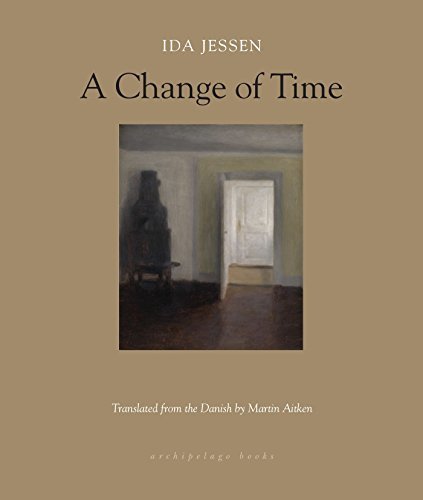
I found this book odd in some ways and quietly refreshing in others. The story follows the entries in Lilly Høy's diary covering a period of her life from January 3 1904 to November 1 1932. Although this in itself causes the first of the oddities - she only keeps this diary for just over a year when she first moves to Thyregod as a new teacher in the folk school. Many years later, in fact 22 years later as her husband is in hospital dying, she finds the diary and starts to keep new entries which end some 5 years later with the close of the book - in 1932
Part of the difficulty with this author is that there are no explanations - as a reader you have to do a bit of juggling and work things out for yourself, and this also applies to her plot, such as it is. For example we're introduced to Peter Carlson, but it's only later he reappears as an emotionally significant other to Lilly or as Fru Bagge, which is how she refers to herself.
The book opens with our narrator's husband Vigand Bagge, the parish doctor, dying in the hospital in Give, which is a town, some distance from their home in the village of Thyregod. And this is the other slight difficulty I encountered. I had to keep looking up all these Danish names and places on Google Maps. It wasn't a big deal, but they are all real places, and as I know practically nothing about Denmark apart from the usual - its capital is Copenhagen, there is a statue of the Little Mermaid in the harbour in remembrance of Hans Christiaan Anderson etc. - and so this turned into a real geography lesson for me.
I checked out Ryslinge, which is on the island of Fyn, in the sheltered east of the country - this is where Lilly grows up and then she goes to the teacher training college in Strib - also on Fyn. On a day trip to see her old "college" friends, she crosses to the island from the ferry at Fredericia. Books are ordered from Vejle, the main city in the area. When she first arrives in the hinterland, the train only goes as far as Give, and then she travels for another two hours in Peter's "cart" to Thyregod.
The geography and history of Denmark, however, is part of this book. One of Ms Jessen's interests is an investigation into the changes occurring in this tiny real-life village of Thyregod and the surrounding area. Our narrator, Fru Bagge documents her own observations of the changes in this village over her life span and in deed as the village school teacher, she is instrumental in a number of its developments - the parents's evening for example is to provide the adults with a forum, and place for lectures, and later, she takes on the role of librarian and brings to life the town's Book Collection.
Peder Møllergaard, the town's self-declared leader and organiser speaks to Lilly, after her husband's death.
"For we are indeed happy that you chose to stay, Fru Bagge."
I have no idea what would make him say such a thing.
He told me the parish book collection, housed at the Young Men's and Women's Christian Association, is at present without supervision, and asked if the position would interest me.
"I don't think there's much of a salary," he said, with his back half turned."
I made no comment.
"It would please me," he said, "if you would take it on."
It is in this simple conversation that we understand Lilly is being given a life-line, and at the same time being asked to shoulder her civic duty, even if it is only in a very small way, and yet this is how the town grows and develops and improves - through the hands and goodwill of its inhabitants. I liked the lack of explanation here and the overall use of understatement.
Our author's interests, include local history and land development; which is important as the town and its hinterland is regarded as possibly the poorest area of the whole country. Fru Bagge recounts "that as late as 1870, as much as 90% of the district was heathland", which means it was very poor for agriculture and without other resources. And our narrator gives us detailed and often beautiful descriptions of the weather, the land, the use of peat to keep the cold at bay, how people managed, the children's responses to their first school ever in such a small village in this backwater of the country.
I think quite a few readers will balk at this packing in of a lot of local lore and history, not expecting the plot to be diversified in this way, but it makes sense - lives are always intermingled with a community and how that community develops affects directly the personal development of each individual and this is essential to what this very personal tale boils down to.
Also there is some difficulty in following the narrative; our narrator flicks forwards and back a lot with her memories both personal and wider, and it's not always immediately apparent that there are links and connections between one path and the other. For instance Fru Bagge is given a short "story" written by one of her husband's patients who was treated for tuberculosis. The village pastor gives it to her as a sort of compensation for her husband's refusal to have any kind of funeral, but as it turns out the story documents the relationship between Peter Carlson, and his wife Henriette, - the Peter of whom Lilly had formed a brief, but intense relation. When Lilly reads the story, its effects are not immediately apparent and they are certainly not revealed to us the reader, but later we understand it is connected to her decision not to pursue her long lost interest in Peter Carlson. Peter who has in fact re-initiated the relationship after the death of Lilly's husband. Meanwhile, we are informed somewhere in the middle of these bits of memory, that Peter's wife succumbed to the Spanish influenza of 1918. It's just a brief line and told with more relevance to the effect it has on Carl and his sisters, who are Peter's children.
So the book does not present a particularly easy read - as it does not flow and follow neatly. It is not the case that the reader has nothing to do but turn the pages etc. No: I flipped back and forwards multiple times in my Kindle, trying to pin down various bits of information.
And the ending - well I could hardly believe the ending first time round, I had to go back and re-read all the little snippets of information about Peter and then this other man - all over again, but the feelings strike true, and ultimately the book seems to have done a sound job of representing the messiness of life.
I read someone's review recently who said - you have to get to the end of your life before you can make sense of it, and so novelists start at the end, with all their plans laid out neat and straight - not so with this novelist and for this I particularly like her.
Some of the shifts are quite jarring - so be warned. I don't want to gloss over some of my personal irritations. I want my reviews to be as honest as possible.
On the other hand, however, I would like to include this gorgeous description of Lilly's hens that she kept at Rose Cottage, just to demonstrate how wonderful Ida Jessen's writing can be:
April 19 1929
I find much pleasure in the hens. When I have been down to open the hatch in the mornings, they dash to the fence and watch me wistfully as I go back to the house. After lunch I let them out of the run, and shortly afterwards they are clucking and scraping all over the garden, except the kitchen garden, which Carl has fenced off. Most have particular friends whose company they prefer. One encounters them unexpectedly in some snug little hiding place or enjoying a dust-bath down by the pond. They love the spring and sunshine. They tidy their feathers as if they were shaking sand from a towel, settle themselves more comfortably and cluck softly to each other. ... In the summer, when the french doors were left open, they would often venture into the dining room to see me. They were the politest of visitors, calling out to ask if they were welcome, and whenever I appeared too abruptly from another room they would scatter and fall over themselves in a rush to be gone.
I think a lot of readers will complain about the abrupt ending, but I think it complies with the diary format. She kept the diary through the painful lonely years after her husband's death and then when she meets an old friend at the age of 50 and falls in love once more, she no longer needs the diary and so it breaks off, quite suddenly - but true to life.
Ms Jessen is certainly pushing against the parameters of what a novel is, and this experimentation will unsettle quite a few readers. On the whole, however, I think this is good. This is what Virginia Woolf did, she didn't bother with Her Following, or her sales and income etc. Ms Jessen like Ms Woolf wants to see what can be done with this tried and tested format - let's push it somewhere new. And I say - Good for her.
Thank you to Netgalley for an ARC.