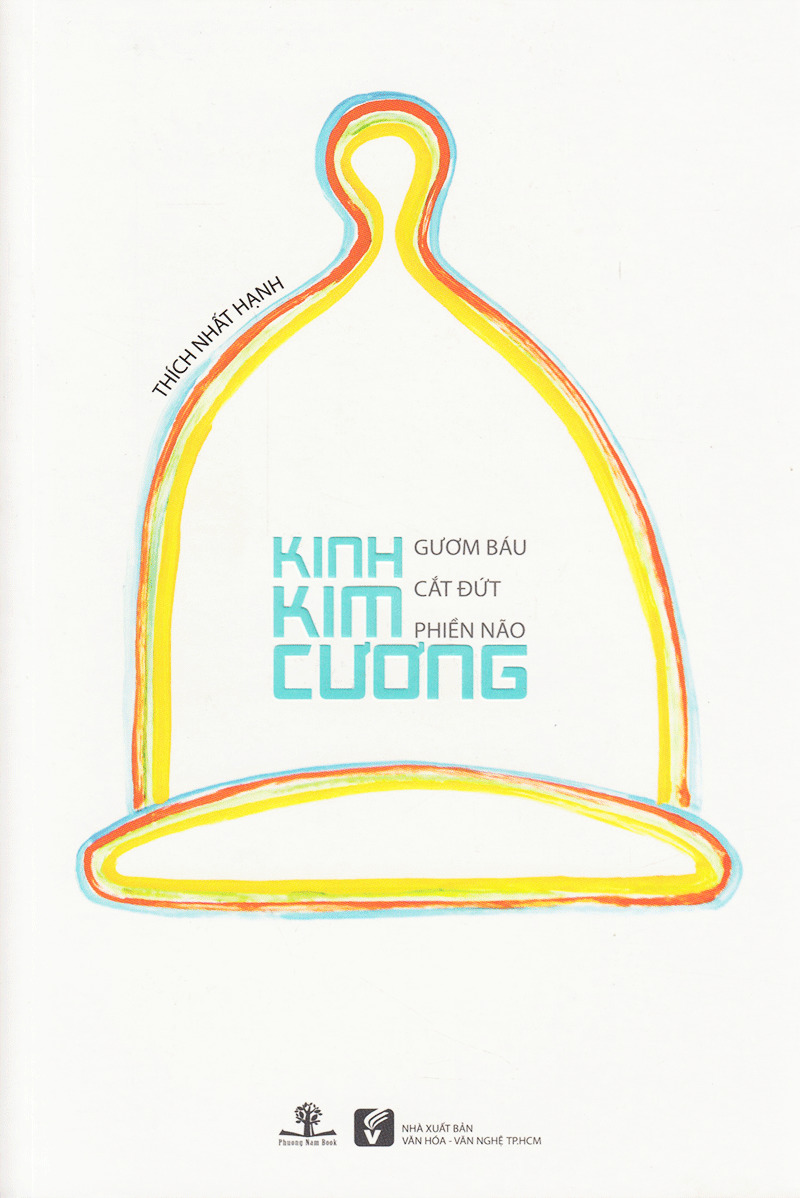
I'm not equipped to really review this book.
I'll do my best.
The book is a commentary on the Buddhs's teaching called "The Diamond that Cuts Through Illusion." Thich Nhãt Hanh (Thay, for those in the know) is a Vietnamese monk who now lives at a retreat in France called Plum Village Famously, Martin Luther King nominated him for the Nobel Peace Prize, although he has not won. He has written many books and a lot of poetry. He was actively involved in attempts to protest the Vietnam War, including as a confidante of those monks and nuns who self-immolated.
The DTCTI is one of the key sutras given by the Buddha, although it does not always seem . . . clear . . . to modern readers. Hence, these commentaries. But note, these are not scholarly. I expected a little bit more historical context and explanation (why does the disciple approach the Buddha by baring his right shoulder? Who knows!) and maybe a little more engagement with its intellectual history--uh, what's up with past lives? Thay cites a few sources but it is never clear how these help to make sense of the sutra. (For example: "According to such-and-such school of Buddhism . . ." But why should I listen to that school as compared to another.)
Like many of the most prominent interpreters of Buddhism to the West--Pema Chodron, Trungpa Chogyam--Thay is interested in translating seemingly abstract ideas into practical advice for everyday life. Still, while he is better at this than explaining the historically-situated meaning of these ideas, there is still a disconnect, and it never is quite clear how ideas of non-self and non-attachment can be translated into political or social action.
Enough of the troubles. The book is still worth a perusal. It's short, and, at the best of times, can flip perspective enough to make everything seem a little different.
According to Thay, the key sentence in the sutra is, "When innumerable, immeasurable infinite beings become liberated, we do not think that a single being has been liberated." This seems like a paradox, but it is not. One must understand it according tot he peculiar dialectical rules of the genre. (That's my inner scholar translating Thay.) Beings to become liberated--but the advanced Buddhist practitioner does not think of tit that way--because he or she already knows that individuals are not things. Everything is composed of everything else. In Thay's favored analogy, a rose is not a rose, but is made up of soil and water and sun. When we see a rose as a rose, we are trapped by perceptions. When we see it as composed of other things, we are letting those perceptions go. So although we should act to make everything liberated, we should not force the issue, not praise ourselves for doing so (there is no ourselveS: we are all interconnected).
But there can be problems with this way of thinking too, some of which Thay himself seems to slip into: superciliousness and pity. If we look at a jerky person and try to forgive him because of his, say, bad upbringing, we are reducing him, and also risk slipping from compassion into pity: poor bugger, if he only had it better, like me, he'd be better, like me. I'm not sure how to solve this problem, at least not from the text here.
There is also more to the dialectic. After one realizes that a thing is not a thing, but is composed of other things, the next step is then to treat it, again, like a thing. Non-self and non-attachment should not get int he way of communication, but should make it richer. First there was a mountain, then there was no mountain, then there was a mountain. The ideas are rafts for getting through difficult thought problems, but once on the other side, should be abandoned (96, 117).
There is also the difficulty--threat--(on page 134) that in running too fast from one set of concepts--self and attachment--we will reify its opposite, nonself and nonattachment, ironically making those the core of ourselves, becoming attached to them.
Much of the rest of the sutra is spent congratulating itself--if only people could see the world this way, everything would be better, even moresoe than if everyone were rich.