

What do you think?

The Finders
Who Are The Finders?
The average person lives with an experience of the world that is rooted in fear, worry, and anxiety. The most common way this manifests is in a persistent sense of discontentment. Something just doesn't feel quite right.
That something is usually hard to put a finger on. It's often just a feeling that haunts us in the background, one that leads to endless soul searching and goal striving. Although it can disappear when a desire is achieved, or a piece of our life that was believed to be missing falls into place, ultimately the relief is only temporary. Before long, the background feeling that something is not okay returns and the search begins anew.
You may be surprised to learn that life doesn't have to be this way. Since 2006, our global scientific research project has been on the trail of the tiny fraction of the population that seems to have escaped this fate. We found thousands of them, and what we learned has been nothing short of astonishing. It will revolutionize your life for the better, if you'll let it.
The average person lives with an experience of the world that is rooted in fear, worry, and anxiety. The most common way this manifests is in a persistent sense of discontentment. Something just doesn't feel quite right.
That something is usually hard to put a finger on. It's often just a feeling that haunts us in the background, one that leads to endless soul searching and goal striving. Although it can disappear when a desire is achieved, or a piece of our life that was believed to be missing falls into place, ultimately the relief is only temporary. Before long, the background feeling that something is not okay returns and the search begins anew.
You may be surprised to learn that life doesn't have to be this way. Since 2006, our global scientific research project has been on the trail of the tiny fraction of the population that seems to have escaped this fate. We found thousands of them, and what we learned has been nothing short of astonishing. It will revolutionize your life for the better, if you'll let it.
240 pages, Hardcover
Published March 31, 2019
Ratings & Reviews
Friends & Following
Create a free account to discover what your friends think of this book!
Community Reviews
Displaying 1 - 30 of 38 reviews

May 5, 2020
According to Jeffery Martin, ordinary human life is centered in a highly individualized self, which is separate from the rest of the world. This self observes events, takes action, and has an inner voice that is forever telling a story about one's personal past and what should happen next. Because that voice is perpetually oriented toward obtaining validation and finding new problems to solve, it's difficult for anyone to be truly satisfied for any length of time.
I think most of us probably agree with this observation.
Finders, according to this book, are people who have lost that "core discontentment." They have discovered stages of mental development (referred to here as Locations) in which the mind grows progressively more serene due to a weakening of the Narrative-Self's chatter.
For example, someone who has attained Location 1 can "look within to a deeper level that somehow seems okay." There is a sense that everything is unfolding as it should, and negative emotions are less frequent, regardless of outer circumstances. Further movement may occur with an effort to bring this form of consciousness to the forefront. In Location 2, the boundary between the self and the rest of the world begins to disintegrate. I suppose that's what is meant by unity. Location 3 brings a heightened awareness of the present moment, including increased awareness of any remaining intrusions of the Narrative-Self's voice.
Each Location is a new way of experiencing life. Martin writes primarily about Locations 1 through 4 and theorizes that many more Locations exist (at least through 20). But he has no data on those. The fact that he talks about them anyway prompts a little skepticism on my part. (Examples: "Locations 6 through 9 typically bring dramatically increased reports of accurate premonitions, intuition, and related experiences" and "The closer a Finder gets to Location 9, the more reports of mind-matter interaction also appear. ... Beyond Location 9, Finders report these types of experience becoming more routine.")
I too am aware of "reports" of mind-matter interaction, e.g., in the memoir Walking Through Walls. I'm not inclined to dispute their accuracy or honesty. But this remains a subject with zero bearing on life as I've always known it. Martin's talk of such things brings to mind another book, Gary Zukav's The Seat of the Soul, which must have been meant for readers who're more credulous than I'm able to be.
Martin's explanation for the shortage of data rests largely on the unwillingness of people in these higher locations to cooperate in research. They have no motivation to do so.
It sounds like the jury is still out on whether Finders are an asset to society overall. Finders may be more productive, more creative, and more capable of coping with difficulties. But they may also be less flexible and less socially integrated into the community.
But to back up, what is it like to be a Finder? Martin says they still have thoughts, but their thoughts lack the power to pull them into "long thought streams and internal narratives." Of course, thoughts are useful in solving problems, but for non-Finders they're cluttered with needless self-referential connections (e.g., fearing how embarrassed I'll be if I don't know the answer). Finders have no interest in the narrative that inner voice wants to impose on them. Thus, if cut off by a rude motorist in traffic, they might feel a temporary diminishment of inner peace but they don't seize upon the event as yet another example of the world's injustice. For them there is "no sense of agency," no reason for personal involvement.
At the end, Martin acknowledges that his book has focused only on what it's like to be a Finder, not on how to become one. There's a brief questionnaire, which I completed and which says I am probably not a Finder. (Per Martin, that could be explained by the fact that I've spent my adult life engrossed in one intense project after another. For me, the problems I intended to solve were far more urgent than self-improvement, and until they were solved I had no patience for suggestions that everything was unfolding as it should.) He says there are different ways of making the transition. Some people doggedly pursue it, perhaps via a technique like meditation or via some kind of surrender such as accepting Jesus. For others it's an accidental "awakening." In any event, the state they arrive at may already be present in everyone, and just not recognized.
According to the back cover, this information "will revolutionize your life for the better." But that's somewhat misleading because the book makes little to no attempt to explain how to achieve Finder status. Martin says at the outset that he had to decide what kind of book to write. This is not a how-to, it's not hard data that might be of use to other researchers, and it has no anecdotes illustrating the way Finders live. Anecdotes, he says, would not be helpful because every Finder has a different story. Data would be dry and would limit his audience. And there are other resources for a reader wanting to become a Finder (starting with online addresses of another book by Martin and a course). So in its own terms, this book boils down to three words: Enlightened people exist.
Oops, was that a spoiler?
I think most of us probably agree with this observation.
Finders, according to this book, are people who have lost that "core discontentment." They have discovered stages of mental development (referred to here as Locations) in which the mind grows progressively more serene due to a weakening of the Narrative-Self's chatter.
For example, someone who has attained Location 1 can "look within to a deeper level that somehow seems okay." There is a sense that everything is unfolding as it should, and negative emotions are less frequent, regardless of outer circumstances. Further movement may occur with an effort to bring this form of consciousness to the forefront. In Location 2, the boundary between the self and the rest of the world begins to disintegrate. I suppose that's what is meant by unity. Location 3 brings a heightened awareness of the present moment, including increased awareness of any remaining intrusions of the Narrative-Self's voice.
Each Location is a new way of experiencing life. Martin writes primarily about Locations 1 through 4 and theorizes that many more Locations exist (at least through 20). But he has no data on those. The fact that he talks about them anyway prompts a little skepticism on my part. (Examples: "Locations 6 through 9 typically bring dramatically increased reports of accurate premonitions, intuition, and related experiences" and "The closer a Finder gets to Location 9, the more reports of mind-matter interaction also appear. ... Beyond Location 9, Finders report these types of experience becoming more routine.")
I too am aware of "reports" of mind-matter interaction, e.g., in the memoir Walking Through Walls. I'm not inclined to dispute their accuracy or honesty. But this remains a subject with zero bearing on life as I've always known it. Martin's talk of such things brings to mind another book, Gary Zukav's The Seat of the Soul, which must have been meant for readers who're more credulous than I'm able to be.
Martin's explanation for the shortage of data rests largely on the unwillingness of people in these higher locations to cooperate in research. They have no motivation to do so.
It sounds like the jury is still out on whether Finders are an asset to society overall. Finders may be more productive, more creative, and more capable of coping with difficulties. But they may also be less flexible and less socially integrated into the community.
But to back up, what is it like to be a Finder? Martin says they still have thoughts, but their thoughts lack the power to pull them into "long thought streams and internal narratives." Of course, thoughts are useful in solving problems, but for non-Finders they're cluttered with needless self-referential connections (e.g., fearing how embarrassed I'll be if I don't know the answer). Finders have no interest in the narrative that inner voice wants to impose on them. Thus, if cut off by a rude motorist in traffic, they might feel a temporary diminishment of inner peace but they don't seize upon the event as yet another example of the world's injustice. For them there is "no sense of agency," no reason for personal involvement.
At the end, Martin acknowledges that his book has focused only on what it's like to be a Finder, not on how to become one. There's a brief questionnaire, which I completed and which says I am probably not a Finder. (Per Martin, that could be explained by the fact that I've spent my adult life engrossed in one intense project after another. For me, the problems I intended to solve were far more urgent than self-improvement, and until they were solved I had no patience for suggestions that everything was unfolding as it should.) He says there are different ways of making the transition. Some people doggedly pursue it, perhaps via a technique like meditation or via some kind of surrender such as accepting Jesus. For others it's an accidental "awakening." In any event, the state they arrive at may already be present in everyone, and just not recognized.
According to the back cover, this information "will revolutionize your life for the better." But that's somewhat misleading because the book makes little to no attempt to explain how to achieve Finder status. Martin says at the outset that he had to decide what kind of book to write. This is not a how-to, it's not hard data that might be of use to other researchers, and it has no anecdotes illustrating the way Finders live. Anecdotes, he says, would not be helpful because every Finder has a different story. Data would be dry and would limit his audience. And there are other resources for a reader wanting to become a Finder (starting with online addresses of another book by Martin and a course). So in its own terms, this book boils down to three words: Enlightened people exist.
Oops, was that a spoiler?

February 12, 2019
Every so often someone comes along that re-writes the narrative on a certain topic and Jeffery has done just that. As an entrepreneur and engineer by background, I deeply appreciate people who do real research and base their work on that. This research based book provides a comprehensive, relatable prospective on what it is like to be a Finder and experience fundamental wellbeing on a persistent basis.
If you are a Seeker this book will show you what life is like when you become a Finder and awaken. And whether or not you are a member any particular religion or spiritual tradition, after reading this book you'll have a deeper understanding of the historical texts.
If you are a Finder and have already experienced an awakening, you will find yourself reading this book and repeatedly going "This is me", "I experience life just like this", and on and on like I did. It is a beautiful experience when you can so deeply relate to something like you will with this book.
If you are a Finder already, this will likely become the book that you get in the hands of all of the people closest to you. It will give them a glimpse of how you experience reality (and do it in a way that doesn't make you seem crazy to them). And it may just encourage them to join you in becoming a Finder.
If you are a Seeker this book will show you what life is like when you become a Finder and awaken. And whether or not you are a member any particular religion or spiritual tradition, after reading this book you'll have a deeper understanding of the historical texts.
If you are a Finder and have already experienced an awakening, you will find yourself reading this book and repeatedly going "This is me", "I experience life just like this", and on and on like I did. It is a beautiful experience when you can so deeply relate to something like you will with this book.
If you are a Finder already, this will likely become the book that you get in the hands of all of the people closest to you. It will give them a glimpse of how you experience reality (and do it in a way that doesn't make you seem crazy to them). And it may just encourage them to join you in becoming a Finder.
February 11, 2019
The Finders is the only book of its kind. Not only does it provide a real-world, grounded narrative for higher-states of consciousness and how they are accessed, but it also is the only book of its kind to provide insight into how these states can be experienced as a persistent way of being (and the different sorts of issues one faces from a baseline of persistent and fundamental wellbeing.)
Is it possible to achieve persistent fundamental wellbeing?
Do people who live in this state still experience stress, or suffering?
What does life look like beyond this transition? What methods are proven to take one there? And is it one-size fits all?
These questions and more are addressed in this book and its accompanying resources (I highly recommend taking the time to go through the free mini-course on the subject shared in the book).
And while this book is written for people who find themselves in these states of being and desire more context for their own experiences, it will also be an illuminating text for those who are seeking these higher states of consciousness—and who are frustrated with methods that have fallen short.
I am confident in time this book will be seen as the go-to text in the fields of spirituality, meditation, non-duality, and enlightenment equal to none. I personally enjoyed the matter-of-fact nature of discussing these phenomena and the reality of awakening, which is such a welcomed contrast to the other books I've read in this field.
Thank you Dr. Jeffery Martin for documenting your research, and taking the time to share it publicly so it may benefit the lives of others. I can say with confidence it has made a difference in mine.
Is it possible to achieve persistent fundamental wellbeing?
Do people who live in this state still experience stress, or suffering?
What does life look like beyond this transition? What methods are proven to take one there? And is it one-size fits all?
These questions and more are addressed in this book and its accompanying resources (I highly recommend taking the time to go through the free mini-course on the subject shared in the book).
And while this book is written for people who find themselves in these states of being and desire more context for their own experiences, it will also be an illuminating text for those who are seeking these higher states of consciousness—and who are frustrated with methods that have fallen short.
I am confident in time this book will be seen as the go-to text in the fields of spirituality, meditation, non-duality, and enlightenment equal to none. I personally enjoyed the matter-of-fact nature of discussing these phenomena and the reality of awakening, which is such a welcomed contrast to the other books I've read in this field.
Thank you Dr. Jeffery Martin for documenting your research, and taking the time to share it publicly so it may benefit the lives of others. I can say with confidence it has made a difference in mine.

April 14, 2019
The book is somewhat interesting but it’s a way to sell you something (who doesn’t want Fundamental Wellbeing, amiright?) while hiding behind “years of research and thousands of interviews”.
The target audience is unclear (per the author, the Finders don’t really care, the Seekers will only get a glimpse through the author’s musings).
If you know about and/or have read/experienced ego-death it’s basically that, but in a conscious, on-going basis. This supposedly is a form of transcendence and it’s really cool and brings you peace. Maybe.
Also let’s build a super-confusing terminology about “locations” and to keep the “.chapters” to a maximum of 3 pages.
Honestly, the author/the book may be onto something but the way it’s packed + next steps makes it basically look like a scam. Would not recommend.
The target audience is unclear (per the author, the Finders don’t really care, the Seekers will only get a glimpse through the author’s musings).
If you know about and/or have read/experienced ego-death it’s basically that, but in a conscious, on-going basis. This supposedly is a form of transcendence and it’s really cool and brings you peace. Maybe.
Also let’s build a super-confusing terminology about “locations” and to keep the “.chapters” to a maximum of 3 pages.
Honestly, the author/the book may be onto something but the way it’s packed + next steps makes it basically look like a scam. Would not recommend.

April 24, 2019
Great book summarizing extensive research on various individuals in PNSE (persistent non-symbolic experience), which encompasses Eastern mystics, Christians who took Jesus into their heart, various normal people, and more :)
The choice to use the term "non-symbolic experience" instead of "awakened", "Christ-consciousness", or something else is to both be spiritual-practice agnostic and a pragmatic stab at a term most could agree on. "Persistent" indicates the state is ongoing for months (onto years), not just accessed here and there (as many of us can, say in flow states or when quite relaxed or with psychedelics).
An interesting point in the research is that there's a great diversity of ways to experience PNSE (as are there so many different ways to experience "normal life" or "normal conscious experience" (non-PNSE)). This point is easily lost in the book, which focuses largely on the higher-level commonalities among "Finders" who experience PNSE (or "Fundamental Wellbeing").
At the start Jeffery uses a good analogy that, while there appears to be a continuum of experience (as the "narrative self" and its self-talk diminishes) with various Locations of conscious experience, these Locations are more like diverse countries. "Location 1" is not one set type of conscious experience for all Finders there, but more like the USA for Americans: being an American in Wyoming, Alabama, or New York City are quite different (despite the fact there are still common American traits among them).
As an example, in Location 4, some individuals have "loss of sex drive" whereas other individuals have "ecstatically heightened sex drive and experience". The Locations are ordered on a continuum roughly corresponding to the strength of "the narrative self, however curiously "nonduality" (oneness with environment/surroundings) is experienced at Locations 2 and 4 (not 3 and 1).
Anyway, despite all this variety, have a glance at the Locations:
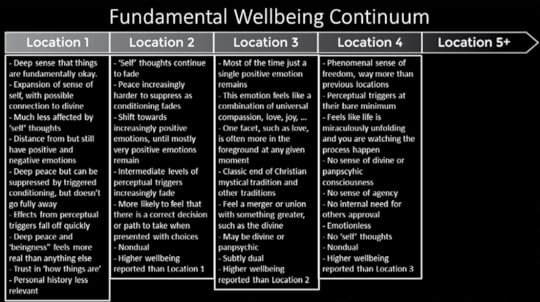
The book does a good job of introducing what they found to be the core aspect of PNSE (or awakening): the narrative self shows up less in one's experience. That voice talking about situations, about you, judging you, planning storylines to be good for you, etc: you stop taking it so seriously. You generally care less about stories as a tool to explain the world and yourself. Thus the "silence" described by Yogis. And when the voice lessens its role (or vanishes 'completely'), BOOM, the experience of life changes. Senses get more visceral and lush, fear of death diminishes, and a strange, almost ineffable peace wells up within. You 'live in the moment'.
That restless discontentment with life, with your story, mostly vanishes.
At some Locations, negative emotions (especially serious ones) can still bother you, but the baseline state in now a silent inner-peace (ok, a small minority seems to have abundance of non-narrative thoughts!). Thus the name "Fundamental Wellbeing".
Next there's a good summary of the different Locations. Loc 1 is the closest to normal.
Generally Finders find a preferred Location of conscious experience (and some are 'fluid' and can move around between them). Loc 2, 3, and 4 seem to be more common favorites than Loc 1 (once someone goes beyond Loc 1 to the others). Loc 4 is the most often rejected (yes, the brain considers and rejects the Location even though there's no "sense of agency" at that state. Loc 5+ seem pretty cool, but unfortunately "we don't want to share too much speculation until we have more data" (and there aren't that many Finders there).
The descriptions in the book are often distanced and objective. As if an indifferent alien is reading a study of a certain variety of humans and their experience of life. And it's quite interesting and weird the way it "makes sense" to talk about the experience of people with "no sense of agency". For example, "There are decision processes unfolding in your brain that take into account the information read in this book".
The core psychological and physiological aspects are discussed.
Curiously, some forms of self-awareness seem enhanced, and some forms seem reduced.
Perhaps in part because self-reflection is rare (as they just don't see/feel the need/importance), and it is to some degree useful. Although clearly not as useful as those not in PNSE seem to think! (At least not for most of life.)
The most pertinent example is how a few Finders fell out of PNSE due to immense stress in their lives. They showed physiological signs of stress, yet internally felt that "everything is fine".
The final interesting chapter covers how Finders handle various aspects of life: work, sex, family, etc.
Ultimately, the book is highly recommended for anyone interesting in cultivating one's Subjective experience of life.
I personally am put off by Loc 4 (however it seems emotions can come back in Loc 5+, as if it's a transition). I am also a bit disturbed by the apparent lack of self-reflection (however, humans are quite commonly unaware of issues with their body or life -- and Finders appear to ignore recurrent social/emotional stress to a far lesser degree than normal).
As with pain, dampened pain seems possibly preferable to no pain.
There seem to be subtle motivational paradoxes as well to "taking action yet also feeling everything is perfect as it is".
Yet maybe the journey is gradual and one sees that what is an apparent paradox to us is quite clear to them. Ayyo, the challenges of self-modification.
As one chapter is entitled "you get what you optimize for".
Lastly, Jeffrey Martin often sounds like a salesperson. This can be a bit off-putting.
I found he kept off that fairly well in this book :)
Edit [Mar 18, 2025]:
On the third re-read, I really wished that scare quotes were used for much of discussions of the "narrative self"! Ego is simply "self model". There ary many ways that one can be in "not PNSE". Blurring pathological cases with states whose wellbeing is more contingent on circumstances seems confusing.
The choice to use the term "non-symbolic experience" instead of "awakened", "Christ-consciousness", or something else is to both be spiritual-practice agnostic and a pragmatic stab at a term most could agree on. "Persistent" indicates the state is ongoing for months (onto years), not just accessed here and there (as many of us can, say in flow states or when quite relaxed or with psychedelics).
An interesting point in the research is that there's a great diversity of ways to experience PNSE (as are there so many different ways to experience "normal life" or "normal conscious experience" (non-PNSE)). This point is easily lost in the book, which focuses largely on the higher-level commonalities among "Finders" who experience PNSE (or "Fundamental Wellbeing").
At the start Jeffery uses a good analogy that, while there appears to be a continuum of experience (as the "narrative self" and its self-talk diminishes) with various Locations of conscious experience, these Locations are more like diverse countries. "Location 1" is not one set type of conscious experience for all Finders there, but more like the USA for Americans: being an American in Wyoming, Alabama, or New York City are quite different (despite the fact there are still common American traits among them).
As an example, in Location 4, some individuals have "loss of sex drive" whereas other individuals have "ecstatically heightened sex drive and experience". The Locations are ordered on a continuum roughly corresponding to the strength of "the narrative self, however curiously "nonduality" (oneness with environment/surroundings) is experienced at Locations 2 and 4 (not 3 and 1).
Anyway, despite all this variety, have a glance at the Locations:
The book does a good job of introducing what they found to be the core aspect of PNSE (or awakening): the narrative self shows up less in one's experience. That voice talking about situations, about you, judging you, planning storylines to be good for you, etc: you stop taking it so seriously. You generally care less about stories as a tool to explain the world and yourself. Thus the "silence" described by Yogis. And when the voice lessens its role (or vanishes 'completely'), BOOM, the experience of life changes. Senses get more visceral and lush, fear of death diminishes, and a strange, almost ineffable peace wells up within. You 'live in the moment'.
That restless discontentment with life, with your story, mostly vanishes.
At some Locations, negative emotions (especially serious ones) can still bother you, but the baseline state in now a silent inner-peace (ok, a small minority seems to have abundance of non-narrative thoughts!). Thus the name "Fundamental Wellbeing".
Next there's a good summary of the different Locations. Loc 1 is the closest to normal.
Generally Finders find a preferred Location of conscious experience (and some are 'fluid' and can move around between them). Loc 2, 3, and 4 seem to be more common favorites than Loc 1 (once someone goes beyond Loc 1 to the others). Loc 4 is the most often rejected (yes, the brain considers and rejects the Location even though there's no "sense of agency" at that state. Loc 5+ seem pretty cool, but unfortunately "we don't want to share too much speculation until we have more data" (and there aren't that many Finders there).
The descriptions in the book are often distanced and objective. As if an indifferent alien is reading a study of a certain variety of humans and their experience of life. And it's quite interesting and weird the way it "makes sense" to talk about the experience of people with "no sense of agency". For example, "There are decision processes unfolding in your brain that take into account the information read in this book".
The core psychological and physiological aspects are discussed.
Curiously, some forms of self-awareness seem enhanced, and some forms seem reduced.
Perhaps in part because self-reflection is rare (as they just don't see/feel the need/importance), and it is to some degree useful. Although clearly not as useful as those not in PNSE seem to think! (At least not for most of life.)
The most pertinent example is how a few Finders fell out of PNSE due to immense stress in their lives. They showed physiological signs of stress, yet internally felt that "everything is fine".
The final interesting chapter covers how Finders handle various aspects of life: work, sex, family, etc.
Ultimately, the book is highly recommended for anyone interesting in cultivating one's Subjective experience of life.
I personally am put off by Loc 4 (however it seems emotions can come back in Loc 5+, as if it's a transition). I am also a bit disturbed by the apparent lack of self-reflection (however, humans are quite commonly unaware of issues with their body or life -- and Finders appear to ignore recurrent social/emotional stress to a far lesser degree than normal).
As with pain, dampened pain seems possibly preferable to no pain.
There seem to be subtle motivational paradoxes as well to "taking action yet also feeling everything is perfect as it is".
Yet maybe the journey is gradual and one sees that what is an apparent paradox to us is quite clear to them. Ayyo, the challenges of self-modification.
As one chapter is entitled "you get what you optimize for".
Lastly, Jeffrey Martin often sounds like a salesperson. This can be a bit off-putting.
I found he kept off that fairly well in this book :)
Edit [Mar 18, 2025]:
On the third re-read, I really wished that scare quotes were used for much of discussions of the "narrative self"! Ego is simply "self model". There ary many ways that one can be in "not PNSE". Blurring pathological cases with states whose wellbeing is more contingent on circumstances seems confusing.

June 10, 2019
A book about an extremely interesting research: a scientific, evidence-based, ethnography-like study of "Finders" (in opposition to "Seekers"): people experiencing "Persistent Well-being", a.k.a. "Persistent Non-Symbolic Experience", a state where the narrative self (your "inner voice") is strongly suppressed and consequently the person experiments a continuous feeling of happiness/bliss, sometimes associated with the sensations of non-duality, mindfulness, and/or lack of agency (among others).
Traditionally this state is associated to what we call in religious contexts "mystic state", "Union with God", "Awakening" or "Enlightenment" but it is reported even by atheists and persons without a religious background, of many ages and socioeconomic profiles. Based on interviews and tests with thousands of individuals the author describes what these people have in common, proposes a taxonomy of different types of experiences ("locations") and the fluidity between them, and even describes the real-life consequences and challenges of transitioning to Persistent Well-Being (e.g. how to keep your job or your marriage during the process). The research team doesn't try to explain the phenomenon or how to achieve it; the book is more about describing it in detail, without any preconceptions or prejudices.
The only thing I didn't like in the book is the tone used by the author, something between a self-help book and an elaborated advertisement. This doesn't mean that the research presented shouldn't be reviewed seriously, though.
Traditionally this state is associated to what we call in religious contexts "mystic state", "Union with God", "Awakening" or "Enlightenment" but it is reported even by atheists and persons without a religious background, of many ages and socioeconomic profiles. Based on interviews and tests with thousands of individuals the author describes what these people have in common, proposes a taxonomy of different types of experiences ("locations") and the fluidity between them, and even describes the real-life consequences and challenges of transitioning to Persistent Well-Being (e.g. how to keep your job or your marriage during the process). The research team doesn't try to explain the phenomenon or how to achieve it; the book is more about describing it in detail, without any preconceptions or prejudices.
The only thing I didn't like in the book is the tone used by the author, something between a self-help book and an elaborated advertisement. This doesn't mean that the research presented shouldn't be reviewed seriously, though.

May 22, 2019
Neat research, but not my cup of tea
~~~~~~~~~~~~~~~~~~~~~~~~~~
What I found interesting about the book is:
(a) The description of the way the average person’s life is dominated by the narrative-self and its associated self-referential thoughts, largely feeding on a diet of fear, worry, and anxiety (Search also for “nafs” and “commanding self”).
(b) The way the narrative-self gives the constant switching of our many mini selves the appearance of unity (Search for “ornstein multimind”).
(c) The possibility – as the narrative-self recedes and becomes diminished – of going beyond that to become a finder experiencing higher levels of awareness and consciousness and the deep and abiding peace that lay hidden behind the veils of the narrative-self.
And (d) the mention of the dark night of the soul and the possibility for the finder’s narrative-self to “die before you die”.
The author’s long and extensive research led to a smart model which enables such finders to be sorted along a continuum into buckets or, as he prefers, locations; and he goes on at great length to describe his findings on the characteristics and other details of these locations.
What left me feeling a little flat was that the locations are merely numbered rather than carrying memorable descriptive names; and numbered buckets simply cannot contain or do justice to the wonderful and unique individual seekers, nor to the rich and varied culture, knowledge, and wisdom of mystical paths such as Sufism (be it Islamic, Universal, or Western). I would suggest that many mystical teachers and guides actually do know how to deal with the intermediate location 4, its difficulties, the paths of freedom and of humanity, and locations beyond 4 which the author feels are areas of ongoing research and beyond the scope of the book.
Also, the book doesn’t provide more detailed context about the sort of tried-and-tested paths that might lead the seeker to become a finder, such as Zen, Buddhism and the Sufi Way (as projected in the West). Nor does the author provide much detail about exemplary individuals who have become finders, to whom readers might be able to relate. I guess that had the author gone into more detail in some cases, then he would have filled a fat volume or two with details of the many other examples, in order to maintain an overall balance.
Nor is The Finders a cookbook – ie something of practical application. The book certainly provides a detailed description of the kitchen environment, the utensils to be used, the ingredients, the menu, adverts, and testimonials. But as for the recipe, the first course (seeker to finder), and dessert (finder to explorer), there is a link to a web page (unpromisingly titled “Email Capture”) to download a free how-to book, and that in turn leads you to visit two more of the author’s web sites, sign up to one or both courses, and pay rather more. It may, however, help set would-be seekers off on their search, or take more seasoned seekers off in new directions.
Full marks for the many years of dedicated, painstaking, thoughtful, and outstanding scientific research. However, unlike many mystical texts, teaching stories, humour, poetry, musical pieces, and often indirect teaching methods, reading The Finders is unlikely – in itself – to impart baraka (grace, “gifts”, or “honey”) or bring about lasting and transformative change by design.
Having said that, with a 70% success rate advertised for the finders course, and given the unarguable benefits that becoming a finder has to offer, that may well prove to be of inestimable value.
Slight niggles: In the Kindle edition, the image of the locations does not display correctly and is unviewable.
~~~~~~~~~~~~~~~~~~~~~~~~~~
What I found interesting about the book is:
(a) The description of the way the average person’s life is dominated by the narrative-self and its associated self-referential thoughts, largely feeding on a diet of fear, worry, and anxiety (Search also for “nafs” and “commanding self”).
(b) The way the narrative-self gives the constant switching of our many mini selves the appearance of unity (Search for “ornstein multimind”).
(c) The possibility – as the narrative-self recedes and becomes diminished – of going beyond that to become a finder experiencing higher levels of awareness and consciousness and the deep and abiding peace that lay hidden behind the veils of the narrative-self.
And (d) the mention of the dark night of the soul and the possibility for the finder’s narrative-self to “die before you die”.
The author’s long and extensive research led to a smart model which enables such finders to be sorted along a continuum into buckets or, as he prefers, locations; and he goes on at great length to describe his findings on the characteristics and other details of these locations.
What left me feeling a little flat was that the locations are merely numbered rather than carrying memorable descriptive names; and numbered buckets simply cannot contain or do justice to the wonderful and unique individual seekers, nor to the rich and varied culture, knowledge, and wisdom of mystical paths such as Sufism (be it Islamic, Universal, or Western). I would suggest that many mystical teachers and guides actually do know how to deal with the intermediate location 4, its difficulties, the paths of freedom and of humanity, and locations beyond 4 which the author feels are areas of ongoing research and beyond the scope of the book.
Also, the book doesn’t provide more detailed context about the sort of tried-and-tested paths that might lead the seeker to become a finder, such as Zen, Buddhism and the Sufi Way (as projected in the West). Nor does the author provide much detail about exemplary individuals who have become finders, to whom readers might be able to relate. I guess that had the author gone into more detail in some cases, then he would have filled a fat volume or two with details of the many other examples, in order to maintain an overall balance.
Nor is The Finders a cookbook – ie something of practical application. The book certainly provides a detailed description of the kitchen environment, the utensils to be used, the ingredients, the menu, adverts, and testimonials. But as for the recipe, the first course (seeker to finder), and dessert (finder to explorer), there is a link to a web page (unpromisingly titled “Email Capture”) to download a free how-to book, and that in turn leads you to visit two more of the author’s web sites, sign up to one or both courses, and pay rather more. It may, however, help set would-be seekers off on their search, or take more seasoned seekers off in new directions.
Full marks for the many years of dedicated, painstaking, thoughtful, and outstanding scientific research. However, unlike many mystical texts, teaching stories, humour, poetry, musical pieces, and often indirect teaching methods, reading The Finders is unlikely – in itself – to impart baraka (grace, “gifts”, or “honey”) or bring about lasting and transformative change by design.
Having said that, with a 70% success rate advertised for the finders course, and given the unarguable benefits that becoming a finder has to offer, that may well prove to be of inestimable value.
Slight niggles: In the Kindle edition, the image of the locations does not display correctly and is unviewable.
April 14, 2019
The book is somewhat interesting but it’s a way to sell you something (who doesn’t want Fundamental Wellbeing, amiright?) while hiding behind “years of research and thousands of interviews”.
The target audience is unclear (per the author, the Finders don’t really care, the Seekers will only get a glimpse through the author’s musings).
If you know about and/or have read/experienced ego-death it’s basically that, but in a conscious, on-going basis. This supposedly is a form of transcendence and it’s really cool and brings you peace. Maybe.
Also let’s build a super-confusing terminology about “locations” and to keep the “.chapters” to a maximum of 3 pages.
Honestly, the author/the book may be onto something but the way it’s packed + next steps makes it basically look like a scam. Would not recommend.
The target audience is unclear (per the author, the Finders don’t really care, the Seekers will only get a glimpse through the author’s musings).
If you know about and/or have read/experienced ego-death it’s basically that, but in a conscious, on-going basis. This supposedly is a form of transcendence and it’s really cool and brings you peace. Maybe.
Also let’s build a super-confusing terminology about “locations” and to keep the “.chapters” to a maximum of 3 pages.
Honestly, the author/the book may be onto something but the way it’s packed + next steps makes it basically look like a scam. Would not recommend.

July 31, 2020
Achievement Unlocked!
Jesus was "born this way" (Son of God) but the Buddha had to earn it. At least that's one way the story goes though some (mainly in the East) think any seeker can potentially upgrade their state of consciousness to "enlightened" though vanishingly few manage to actually do so. In the old days, it was not uncommon for Americans to travel to the East seeking spiritual achievement just like foreigners came to the USA looking for material achievement. The Beatles traveled to India and came back with Maharishi. Was he a finder? Several gurus soon came to America to save us the trip and teach us how to transform our consciousnesses, though many suspected these spiritual teachers really came here for material achievement.
What does the technology of the East offer us that we couldn't, with our American know how, figure out how to do even better? We've turned mindfulness into a way to reduce stress, getting rid of those pesky religious trappings. Couldn't science engineer a superior spiritual path? The goal would need a more sciency name though. How about "fundamental wellbeing"?
When Dr. Martin began his research in 2006, he wanted to study those who had succeeded at reaching a superior consciousness in hopes of doing so himself and though it doesn't become clear until the last chapter, "A Personal Note," he was successful. He designed a protocol so that others could do so too (for $2997 according to a recent marketing email).
The Tao that can be written about in a book isn't the real one and non-symbolic consciousness, which is what Dr. Martin originally called his goal, by its very nature resists being symbolized. But that never stops folks from trying. Still, we symbolizers must always keep in mind that what we end up with will be a very different animal than what we set out to trap in our cages.
Take, for example Mastering the Core Teachings of the Buddha: An Unusually Hardcore Dharma Book. This is a how-to book for specific goals ("The Finders" does not say much about technique)--a sort of walk-through for the video game of Buddhism. Enlightenment in this context means the ability to do the tricks Gautama could do.
"The Finders" characterizes enlightenment (now called "Fundamental Wellbeing") by its cognitive, emotional, sense-of-self, memory, and perceptive effects. One wants to achieve this because one's life becomes subjectively better. The proof of betterness is that hardly any finders report a wish to return to their previous unenlightened condition. Yet, some do! Jed McKenna in his Spiritual Enlightenment: The Damnedest Thing warns that enlightenment isn't what you should seek as it will ruin your life. Eckhart Tolle (is he a finder?) doesn't indicate that there are any downsides to his teachings. Are these people all talking about the same thing? If we are being "non-symbolic", does it even make sense to ask that question?
You have to wonder to what extent those who "mastered the core techniques" would qualify as finders. It's obvious, however that few who complete the finders course are skilled in those core techniques. So, destinations differ. At the same time, there are those who will tell you there is no destination, or, worse perhaps, that you are already "there" if you only realized it. Even this book distinguishes between different flavors of finder--that there are perhaps as many as 20 separate "locations" along a continuum where one could end up (though hardly anything is said about any of those other than the first four.)
How then can we characterize a finder? Dr. Martin says it is the absence of a narative self. Becoming a finder, known in this book as "transitioning" (it was written before the gender revolution), is then often experienced as the extinguishing of this self. What is a "narative self?" Early on, Dr. Martin claims that the vast majority of people have this internal construct that keeps a running commentary, often critically, on their life. (Do you have one, dear reader?) Why call that absence "non-symbolic?"
Another reviewer, rating the book one star says it was "not what I was seeking" adding that it "sounded like someone who just doesn't care!" Indeed, some of Jeffery's finders don't seem to care about all that much. Jeffery considers that a problem and specifically warns his students about how bad it will turn out if they lose all their motivation. Jed McKenna seems to be a non-carer and makes fun of those on the path who make a big deal about compassion. "I don't do heart," he says, but he also says ""I don't eat human eyeballs or shoot Disney characters. I'm a nice guy." So he does care--it's just not part of his enlightenment. Contrast this with Daniel Ingram (who wrote Mastering the Core Teachings of the Buddha) who makes a point of teaching Buddhist ethics as an essential part of the enlightenment process. Compassion is by no means optional for him.
I actually finished this book (the audiobook--which goodreads doesn't list among editions) almost two months ago and started my review then but it's taken until now to figure out what I wanted to say. In the sense of being "food for thought," this was an excellent book for me, but I think that's actually more of an accident so I can't really give the book credit, but let me explain what I've figured out.
The term "enlightenment" seen as the end of a journey is misleading. It is a feeling one has after certain realizations. There are many such realization experiences and the order one has these differs for each person "on the path." I never felt enlightened because I lacked a "narrative self." I could qualify as a "finder" in Dr. Martin's sense but that wasn't what I'd been seeking. I'd been seeking something I called "understanding"--I wanted life to make sense to me-- and when I had the clear realization that there could be no such actual understanding outside of the subjective feeling of it, that's when I felt enlightened. I stopped seeking because I now knew that what I was looking for didn't exist in the form I required. It was like looking for a rational number whose square is two and then understanding the proof that the square root of two is irrational. There were many other realizations I still needed, perhaps an infinite number of them.
Dr. Martin's finders aren't all enlightened. They have (at best) just had some basic realizations which they now understand intellectually. Many have incorporated their realizations into their (still mostly intact) egos. Instead of "enlightened" we'd be better calling these people "awakened" though many have likely fallen back asleep and merely remember having been awake.
Still, having 70% of your students reach an awakening experience is impressive. But perhaps that figure, based on what students have reported, isn't all that accurate. I had an intellectual understanding of a lot of these concepts before I had enough experiences to integrate any of it into who I was. It makes sense that many spiritual traditions discourage people from comparing their experiences and understandings with each other because it is the opposite of helpful.
If you do koan study as a zen practitioner, after solving a koan, you get another one to work with. You don't graduate--it's not an "achievement unlocked" situation. The sound of one hand clapping, the non-duality koan, teaches you something different than "If you say this is not a stick, I will hit you with it" which basically teaches the limits of language and conceptual understanding and how it can trap you. These are separate experiences and not things that you can get from their intellectual discussion.
Dr. Martin thinks like an academic psychologist and does his research accordingly. It's interesting research and I'm glad to have read this summary of some of it's results, but I also think it's basically wrongheaded, even just as research, and I don't trust his conclusions. For that reason, I'm giving it 2 stars because the reader should be warned it can be misleading.
Jesus was "born this way" (Son of God) but the Buddha had to earn it. At least that's one way the story goes though some (mainly in the East) think any seeker can potentially upgrade their state of consciousness to "enlightened" though vanishingly few manage to actually do so. In the old days, it was not uncommon for Americans to travel to the East seeking spiritual achievement just like foreigners came to the USA looking for material achievement. The Beatles traveled to India and came back with Maharishi. Was he a finder? Several gurus soon came to America to save us the trip and teach us how to transform our consciousnesses, though many suspected these spiritual teachers really came here for material achievement.
What does the technology of the East offer us that we couldn't, with our American know how, figure out how to do even better? We've turned mindfulness into a way to reduce stress, getting rid of those pesky religious trappings. Couldn't science engineer a superior spiritual path? The goal would need a more sciency name though. How about "fundamental wellbeing"?
When Dr. Martin began his research in 2006, he wanted to study those who had succeeded at reaching a superior consciousness in hopes of doing so himself and though it doesn't become clear until the last chapter, "A Personal Note," he was successful. He designed a protocol so that others could do so too (for $2997 according to a recent marketing email).
The Tao that can be written about in a book isn't the real one and non-symbolic consciousness, which is what Dr. Martin originally called his goal, by its very nature resists being symbolized. But that never stops folks from trying. Still, we symbolizers must always keep in mind that what we end up with will be a very different animal than what we set out to trap in our cages.
Take, for example Mastering the Core Teachings of the Buddha: An Unusually Hardcore Dharma Book. This is a how-to book for specific goals ("The Finders" does not say much about technique)--a sort of walk-through for the video game of Buddhism. Enlightenment in this context means the ability to do the tricks Gautama could do.
"The Finders" characterizes enlightenment (now called "Fundamental Wellbeing") by its cognitive, emotional, sense-of-self, memory, and perceptive effects. One wants to achieve this because one's life becomes subjectively better. The proof of betterness is that hardly any finders report a wish to return to their previous unenlightened condition. Yet, some do! Jed McKenna in his Spiritual Enlightenment: The Damnedest Thing warns that enlightenment isn't what you should seek as it will ruin your life. Eckhart Tolle (is he a finder?) doesn't indicate that there are any downsides to his teachings. Are these people all talking about the same thing? If we are being "non-symbolic", does it even make sense to ask that question?
You have to wonder to what extent those who "mastered the core techniques" would qualify as finders. It's obvious, however that few who complete the finders course are skilled in those core techniques. So, destinations differ. At the same time, there are those who will tell you there is no destination, or, worse perhaps, that you are already "there" if you only realized it. Even this book distinguishes between different flavors of finder--that there are perhaps as many as 20 separate "locations" along a continuum where one could end up (though hardly anything is said about any of those other than the first four.)
How then can we characterize a finder? Dr. Martin says it is the absence of a narative self. Becoming a finder, known in this book as "transitioning" (it was written before the gender revolution), is then often experienced as the extinguishing of this self. What is a "narative self?" Early on, Dr. Martin claims that the vast majority of people have this internal construct that keeps a running commentary, often critically, on their life. (Do you have one, dear reader?) Why call that absence "non-symbolic?"
Another reviewer, rating the book one star says it was "not what I was seeking" adding that it "sounded like someone who just doesn't care!" Indeed, some of Jeffery's finders don't seem to care about all that much. Jeffery considers that a problem and specifically warns his students about how bad it will turn out if they lose all their motivation. Jed McKenna seems to be a non-carer and makes fun of those on the path who make a big deal about compassion. "I don't do heart," he says, but he also says ""I don't eat human eyeballs or shoot Disney characters. I'm a nice guy." So he does care--it's just not part of his enlightenment. Contrast this with Daniel Ingram (who wrote Mastering the Core Teachings of the Buddha) who makes a point of teaching Buddhist ethics as an essential part of the enlightenment process. Compassion is by no means optional for him.
I actually finished this book (the audiobook--which goodreads doesn't list among editions) almost two months ago and started my review then but it's taken until now to figure out what I wanted to say. In the sense of being "food for thought," this was an excellent book for me, but I think that's actually more of an accident so I can't really give the book credit, but let me explain what I've figured out.
The term "enlightenment" seen as the end of a journey is misleading. It is a feeling one has after certain realizations. There are many such realization experiences and the order one has these differs for each person "on the path." I never felt enlightened because I lacked a "narrative self." I could qualify as a "finder" in Dr. Martin's sense but that wasn't what I'd been seeking. I'd been seeking something I called "understanding"--I wanted life to make sense to me-- and when I had the clear realization that there could be no such actual understanding outside of the subjective feeling of it, that's when I felt enlightened. I stopped seeking because I now knew that what I was looking for didn't exist in the form I required. It was like looking for a rational number whose square is two and then understanding the proof that the square root of two is irrational. There were many other realizations I still needed, perhaps an infinite number of them.
Dr. Martin's finders aren't all enlightened. They have (at best) just had some basic realizations which they now understand intellectually. Many have incorporated their realizations into their (still mostly intact) egos. Instead of "enlightened" we'd be better calling these people "awakened" though many have likely fallen back asleep and merely remember having been awake.
Still, having 70% of your students reach an awakening experience is impressive. But perhaps that figure, based on what students have reported, isn't all that accurate. I had an intellectual understanding of a lot of these concepts before I had enough experiences to integrate any of it into who I was. It makes sense that many spiritual traditions discourage people from comparing their experiences and understandings with each other because it is the opposite of helpful.
If you do koan study as a zen practitioner, after solving a koan, you get another one to work with. You don't graduate--it's not an "achievement unlocked" situation. The sound of one hand clapping, the non-duality koan, teaches you something different than "If you say this is not a stick, I will hit you with it" which basically teaches the limits of language and conceptual understanding and how it can trap you. These are separate experiences and not things that you can get from their intellectual discussion.
Dr. Martin thinks like an academic psychologist and does his research accordingly. It's interesting research and I'm glad to have read this summary of some of it's results, but I also think it's basically wrongheaded, even just as research, and I don't trust his conclusions. For that reason, I'm giving it 2 stars because the reader should be warned it can be misleading.
April 21, 2019
Terms like "Unity Consciousness" or "Enlightenment" are cloaked in mystery and dogma. "The Finders" does an excellent job of stripping this away. Jeff's well-written summary of his research helps normalize the elusive state of "non-symbolic awareness."
The research revealed there is no set pattern in how people arrive at a cessation of their inner narrative and thought patterns. There are common stages, or locations, and these can come and go. And, they evolve. Overall, the research validated Ken Wilber's work on integral stages of development, particularly the notion that there is distinct and separate work in the processes of "waking up, growing up, cleaning up, and showing up." The research also showed that "waking up" is culturally bounded, and beliefs shape the experience and the interpretation of the experience.
I enjoyed the probing questions and interesting insights. There are some people who experience a "witnessing awareness" even during sleep. Anesthesia during surgery turns off this awareness in those who normally experience it 24/7. Topics such as sex, memory, functioning in daily life, effect on relationships, and "unspiritual" behavior are explored.
A caveat I would add is that describing and summarizing interviews with "Finders" does not automatically mean that Jeffery Martin has unlocked a sure path to arriving at these states. He has done some interesting work with technology such as transcranial focused ultrasound. He has many good suggestions. However, before signing up for an expensive and time-consuming course with his group, read reviews on Reddit. One reviewer went to great lengths to write about the Finders course, and went so far as to use the word "duped." If you consider taking the Finder's course, which could be fine for you, trust your instincts and your own heart, do your own research, consider many teachers, and don't succumb to spiritual salesmanship.
The research revealed there is no set pattern in how people arrive at a cessation of their inner narrative and thought patterns. There are common stages, or locations, and these can come and go. And, they evolve. Overall, the research validated Ken Wilber's work on integral stages of development, particularly the notion that there is distinct and separate work in the processes of "waking up, growing up, cleaning up, and showing up." The research also showed that "waking up" is culturally bounded, and beliefs shape the experience and the interpretation of the experience.
I enjoyed the probing questions and interesting insights. There are some people who experience a "witnessing awareness" even during sleep. Anesthesia during surgery turns off this awareness in those who normally experience it 24/7. Topics such as sex, memory, functioning in daily life, effect on relationships, and "unspiritual" behavior are explored.
A caveat I would add is that describing and summarizing interviews with "Finders" does not automatically mean that Jeffery Martin has unlocked a sure path to arriving at these states. He has done some interesting work with technology such as transcranial focused ultrasound. He has many good suggestions. However, before signing up for an expensive and time-consuming course with his group, read reviews on Reddit. One reviewer went to great lengths to write about the Finders course, and went so far as to use the word "duped." If you consider taking the Finder's course, which could be fine for you, trust your instincts and your own heart, do your own research, consider many teachers, and don't succumb to spiritual salesmanship.
February 12, 2019
I eagerly pre-ordered this book, having followed Dr. Martin's research on non-ordinary states of consciousness for a few years, and participated in one of the Finders Course experiments on which this book was based.
I thought I had a pretty solid grasp of these concepts, but the Finders far surpassed my expectations with detailed, accurate maps of consciousness beyond anything I have seen elsewhere, including Dr. Martin's own research papers.
Critically, unlike 'ancient wisdom' that all too often presupposes we live in 'ancient times', Dr. Martin provides context and guidance of how these different locations of consciousness integrate, and do not integrate, with the reality of modern life.
As we develop the ability to manipulate states of consciousness at will, and measure them with increased precision, Dr. Martin's book serves as a pioneering work on successfully navigating this exciting new field of psychology.
I thought I had a pretty solid grasp of these concepts, but the Finders far surpassed my expectations with detailed, accurate maps of consciousness beyond anything I have seen elsewhere, including Dr. Martin's own research papers.
Critically, unlike 'ancient wisdom' that all too often presupposes we live in 'ancient times', Dr. Martin provides context and guidance of how these different locations of consciousness integrate, and do not integrate, with the reality of modern life.
As we develop the ability to manipulate states of consciousness at will, and measure them with increased precision, Dr. Martin's book serves as a pioneering work on successfully navigating this exciting new field of psychology.
May 29, 2019
Intriguing
Interesting to learn that peaceful people exist who may not be categorized as mystics. Even more interesting that some get there by coincidence, accidentally, and some try for decades without success.
Another example of a “lifestyle” with as many variations as any other way of life. God surely enjoys abundance and variety. This book has wet my appetite for more.
Interesting to learn that peaceful people exist who may not be categorized as mystics. Even more interesting that some get there by coincidence, accidentally, and some try for decades without success.
Another example of a “lifestyle” with as many variations as any other way of life. God surely enjoys abundance and variety. This book has wet my appetite for more.
August 26, 2019
This book is about the states of mind that Martin labels Fundamental Wellbeing.
These seem to be what people seek through meditation, but Martin carefully avoids focusing on Buddhism, and says that other spiritual approaches produce similar states of mind.
Martin approaches the subject as if he were an anthropologist. I expect that's about as rigorous as we should hope for on many of the phenomena that he studies.
The most important change associated with Fundamental Wellbeing involves the weakening or disappearance of the Narrative-Self (i.e. the voice that seems to be the center of attention in most human minds).
I've experienced a weak version of that. Through a combination of meditation and CFAR ideas (and maybe The Mating Mind, which helped me think of the Narrative-Self as more of a press secretary than as a leader), I've substantially reduced the importance that my brain attaches to my Narrative-Self, and that has significantly reduced how much I'm bothered by negative stimuli.
Some more "advanced" versions of Fundamental Wellbeing also involve a loss of "self" - something along the lines of being one with the universe, or having no central locus or vantage point from which to observe the world. I don't understand this very well. Martin suggests an analogy which describes this feeling as "zoomed-out", i.e. the opposite extreme from Hyperfocus or a state of Flow. I guess that gives me enough hints to say that I haven't experienced anything that's very close to it.
I'm tempted to rephrase this as turning off what Dennett calls the Cartesian Theater. Many of the people that Martin studied seem to have discarded this illusion.
Alas, the book says little about how to achieve Fundamental Wellbeing. The people who he studied tend to have achieved it via some spiritual path, but it sounds like there was typically a good deal of luck involved. Martin has developed an allegedly more reliable path, available at FindersCourse.com, but that requires a rather inflexible commitment to a time-consuming schedule, and a fair amount of money.
Should I want to experience Fundamental Wellbeing?
Most people who experience it show a clear preference for remaining in that state. That's a clear medium strength reason to suspect that I should want it, and it's hard to see any counter to that argument.
The weak version of Fundamental Wellbeing that I've experienced tends to confirm that conclusion, although I see signs that some aspects require continuing attention to maintain, and the time required to do so sometimes seems large compared to the benefits.
Martin briefly discusses people who experienced Fundamental Wellbeing, and then rejected it. It reminds me of my reaction to an SSRI - it felt like I got a nice vacation, but vacation wasn't what I wanted, since it conflicted with some of my goals for achieving life satisfaction. Those who reject Fundamental Wellbeing disliked the lack of agency and emotion (I think this refers only to some of the harder-to-achieve versions of Fundamental Wellbeing). That sounds like it overlaps a fair amount with what I experienced on the SSRI.
Martin reports that some of the people he studied have unusual reactions to pain, feeling bliss under circumstances that appear to involve lots of pain. I can sort of see how this is a plausible extreme of the effects that I understand, but it still sounds pretty odd.
Will the world be better if more people achieve Fundamental Wellbeing?
The world would probably be somewhat better. Some people become more willing and able to help others when they reduce their own suffering. But that's partly offset by people with Fundamental Wellbeing feeling less need to improve themselves, and feeling less bothered by the suffering of others. So the net effect is likely just a minor benefit.
I expect that even in the absence of people treating each other better, the reduced suffering that's associated with Fundamental Wellbeing would mean that the world is a better place.
However, it's tricky to determine how important that is. Martin mentions a clear case of a person who said he felt no stress, but exhibited many physical signs of being highly stressed. Is that better or worse than being conscious of stress? I think my answer is very context-dependent.
If it's so great, why doesn't everyone learn how to do it?
* Achieving Fundamental Wellbeing often causes people to have diminished interest in interacting with other people. Only a modest fraction of people who experience it attempt to get others to do so.
* I presume it has been somewhat hard to understand how to achieve Fundamental Wellbeing, and why we should think it's valuable.
* The benefits are somewhat difficult to observe, and there are sometimes visible drawbacks. E.g. one anecdote of a manager who became more generous with his company's resources - that was likely good for some people, but likely at some cost to the company and/or his career.
Conclusion
The ideas in this book deserve to be more widely known.
I'm unsure whether that means lots of people should read this book. Maybe it's more important just to repeat simple summaries of the book, and to practice more meditation.
[Note: I read a pre-publication copy that was distributed at the Transformative Technology conference.]
These seem to be what people seek through meditation, but Martin carefully avoids focusing on Buddhism, and says that other spiritual approaches produce similar states of mind.
Martin approaches the subject as if he were an anthropologist. I expect that's about as rigorous as we should hope for on many of the phenomena that he studies.
The most important change associated with Fundamental Wellbeing involves the weakening or disappearance of the Narrative-Self (i.e. the voice that seems to be the center of attention in most human minds).
I've experienced a weak version of that. Through a combination of meditation and CFAR ideas (and maybe The Mating Mind, which helped me think of the Narrative-Self as more of a press secretary than as a leader), I've substantially reduced the importance that my brain attaches to my Narrative-Self, and that has significantly reduced how much I'm bothered by negative stimuli.
Some more "advanced" versions of Fundamental Wellbeing also involve a loss of "self" - something along the lines of being one with the universe, or having no central locus or vantage point from which to observe the world. I don't understand this very well. Martin suggests an analogy which describes this feeling as "zoomed-out", i.e. the opposite extreme from Hyperfocus or a state of Flow. I guess that gives me enough hints to say that I haven't experienced anything that's very close to it.
I'm tempted to rephrase this as turning off what Dennett calls the Cartesian Theater. Many of the people that Martin studied seem to have discarded this illusion.
Alas, the book says little about how to achieve Fundamental Wellbeing. The people who he studied tend to have achieved it via some spiritual path, but it sounds like there was typically a good deal of luck involved. Martin has developed an allegedly more reliable path, available at FindersCourse.com, but that requires a rather inflexible commitment to a time-consuming schedule, and a fair amount of money.
Should I want to experience Fundamental Wellbeing?
Most people who experience it show a clear preference for remaining in that state. That's a clear medium strength reason to suspect that I should want it, and it's hard to see any counter to that argument.
The weak version of Fundamental Wellbeing that I've experienced tends to confirm that conclusion, although I see signs that some aspects require continuing attention to maintain, and the time required to do so sometimes seems large compared to the benefits.
Martin briefly discusses people who experienced Fundamental Wellbeing, and then rejected it. It reminds me of my reaction to an SSRI - it felt like I got a nice vacation, but vacation wasn't what I wanted, since it conflicted with some of my goals for achieving life satisfaction. Those who reject Fundamental Wellbeing disliked the lack of agency and emotion (I think this refers only to some of the harder-to-achieve versions of Fundamental Wellbeing). That sounds like it overlaps a fair amount with what I experienced on the SSRI.
Martin reports that some of the people he studied have unusual reactions to pain, feeling bliss under circumstances that appear to involve lots of pain. I can sort of see how this is a plausible extreme of the effects that I understand, but it still sounds pretty odd.
Will the world be better if more people achieve Fundamental Wellbeing?
The world would probably be somewhat better. Some people become more willing and able to help others when they reduce their own suffering. But that's partly offset by people with Fundamental Wellbeing feeling less need to improve themselves, and feeling less bothered by the suffering of others. So the net effect is likely just a minor benefit.
I expect that even in the absence of people treating each other better, the reduced suffering that's associated with Fundamental Wellbeing would mean that the world is a better place.
However, it's tricky to determine how important that is. Martin mentions a clear case of a person who said he felt no stress, but exhibited many physical signs of being highly stressed. Is that better or worse than being conscious of stress? I think my answer is very context-dependent.
If it's so great, why doesn't everyone learn how to do it?
* Achieving Fundamental Wellbeing often causes people to have diminished interest in interacting with other people. Only a modest fraction of people who experience it attempt to get others to do so.
* I presume it has been somewhat hard to understand how to achieve Fundamental Wellbeing, and why we should think it's valuable.
* The benefits are somewhat difficult to observe, and there are sometimes visible drawbacks. E.g. one anecdote of a manager who became more generous with his company's resources - that was likely good for some people, but likely at some cost to the company and/or his career.
Conclusion
The ideas in this book deserve to be more widely known.
I'm unsure whether that means lots of people should read this book. Maybe it's more important just to repeat simple summaries of the book, and to practice more meditation.
[Note: I read a pre-publication copy that was distributed at the Transformative Technology conference.]
July 31, 2021
Just imagine silencing our internal chatterbox; the critical voice of the Narrative Self which provides us with incessant commentary about all our actions and integrates them into stories, which it constantly revises in which we are the protagonist. Imagine erasing the big question mark of doubt about our purpose and path in life, and all our fears(e.g fears of failure and death). Most people make incessant tradeoffs to try and alleviate this discontent, but the "Finders' in this book described their transition to a feeling of fundamental peace, the great joy of knowing that they are ok just as they are. This book is basically the result of interviews with thousands of "Finders" who have made this breakthrough to awareness or enlightenment by means of the Finder's course, religion, meditation, or even spontaneous peak experiences.
This is probably the first serious psychological study of the enlightened, which seeks to investigate and understand the process outside the context of a particular religion like Buddhism or Christianity and without the terminology of mysticism.
We learn of a path of "Fundamental Wellbeing with about 20 locations, in which only the first 4 have been described in detail. From location 1 where we feel that everything is fine to location 4 where this awareness is always in the foreground of our thinking, there is an ever-increasing reduction in the quantity, emotional strength and persistence of self-critical thoughts and we become more and more positively focused on the present moment. We also become less reactive to emotional triggers and less and less dependent on approval from others.
So far so good, but the problem is that not all transitions between locations (particularly the higher) are smooth and not all higher locations are functional for working day-to-day existence. For example the absence of personal emotion of those in location 4 and their disdain for social approval may cause them relationship difficulties, while their focus on the present may entail problems with memory and also a lack of motivation..
It is also difficult to understand the path through locations as linear because in locations one and three there is an increased feeling of connections to the divine or to nature (a duality) whereas in locations 2 and 4 " there is a sense that everything is truly just one thing" (non-duality). Why the oscillation? We have no idea. Unsurprisingly, different people have affinities for different locations and may prefer to return to previous locations.
This is a path-breaking book about enlightenment by Jeffrey Martin but it is not a How To Book – it doesn't disclose the methods or protocols used in the finder's courses.
Moreover, and most disappointing for me it lacks any philosophical or metaphysical framework for understanding the path it describes. We are as perplexed as Alice down the rabbit-hole because when we finish this book we know no more about the nature of human consciousness or why it should develop, than when we started.
How do we know that there are 20 locations? What happens at locations 10 to 20? There are no answers in this book.
The book would have been a lot more interesting to read, if the dry analysis of the aspects of the locations had been supplemented by at least one case study at each location. In the end it falls between two stools of nether telling human stories nor trying to get a handle on the bigger picture of the development of human consciousness.
I can't give it an unqualified recommendation.
This is probably the first serious psychological study of the enlightened, which seeks to investigate and understand the process outside the context of a particular religion like Buddhism or Christianity and without the terminology of mysticism.
We learn of a path of "Fundamental Wellbeing with about 20 locations, in which only the first 4 have been described in detail. From location 1 where we feel that everything is fine to location 4 where this awareness is always in the foreground of our thinking, there is an ever-increasing reduction in the quantity, emotional strength and persistence of self-critical thoughts and we become more and more positively focused on the present moment. We also become less reactive to emotional triggers and less and less dependent on approval from others.
So far so good, but the problem is that not all transitions between locations (particularly the higher) are smooth and not all higher locations are functional for working day-to-day existence. For example the absence of personal emotion of those in location 4 and their disdain for social approval may cause them relationship difficulties, while their focus on the present may entail problems with memory and also a lack of motivation..
It is also difficult to understand the path through locations as linear because in locations one and three there is an increased feeling of connections to the divine or to nature (a duality) whereas in locations 2 and 4 " there is a sense that everything is truly just one thing" (non-duality). Why the oscillation? We have no idea. Unsurprisingly, different people have affinities for different locations and may prefer to return to previous locations.
This is a path-breaking book about enlightenment by Jeffrey Martin but it is not a How To Book – it doesn't disclose the methods or protocols used in the finder's courses.
Moreover, and most disappointing for me it lacks any philosophical or metaphysical framework for understanding the path it describes. We are as perplexed as Alice down the rabbit-hole because when we finish this book we know no more about the nature of human consciousness or why it should develop, than when we started.
How do we know that there are 20 locations? What happens at locations 10 to 20? There are no answers in this book.
The book would have been a lot more interesting to read, if the dry analysis of the aspects of the locations had been supplemented by at least one case study at each location. In the end it falls between two stools of nether telling human stories nor trying to get a handle on the bigger picture of the development of human consciousness.
I can't give it an unqualified recommendation.

February 27, 2023
Intriguing research and insights into awakened beings.
Martin is probably being a tad lenient when giving out the awakened title to individuals.
But the research has unique offering when it comes to understanding what is going on inside their experience.
Such as a steep drop in the amount of self-referential thought, great distance from personal emotions, and not at all guaranteed improved qualities of moral fibre or empathy.
Martin states that fundamental wellbeing (the awakening) is attainable and desirable for most people.
Simultaneously most people do not change their lives - they end up doing the same thing as before.
Something to think about for sure.
There is something off about my perspective toward Dr. Jeffrey Martin - I feel like there is some criticism I haven't found about them.
While the book is good and insightful, it is always clearly designed to sell Martin's courses that supposedly lead to a 70 % chance of awakening yourself.
Big promise if you ask me.
Having said that, if you are a "Seeker" - I can recommend the book.
Martin is probably being a tad lenient when giving out the awakened title to individuals.
But the research has unique offering when it comes to understanding what is going on inside their experience.
Such as a steep drop in the amount of self-referential thought, great distance from personal emotions, and not at all guaranteed improved qualities of moral fibre or empathy.
Martin states that fundamental wellbeing (the awakening) is attainable and desirable for most people.
Simultaneously most people do not change their lives - they end up doing the same thing as before.
Something to think about for sure.
There is something off about my perspective toward Dr. Jeffrey Martin - I feel like there is some criticism I haven't found about them.
While the book is good and insightful, it is always clearly designed to sell Martin's courses that supposedly lead to a 70 % chance of awakening yourself.
Big promise if you ask me.
Having said that, if you are a "Seeker" - I can recommend the book.

May 16, 2021
Revolutionary and evolutionary. Science catching up to religion...
This book will change the way you see the world of personal development in the most fundamental ways. The Finders are the people who managed to reach some level of enlightenment. But there are so many different types, stages, and degrees of enlightenment that it's hard to define just what it is. This book really breaks such a tricky subject down in a very down to Earth and easy to understand way. Phenomenal and inspiring. A whole lot of work went into this, and it certainly paid off. Now readers can get a glimpse of what their minds are capable of; if they'd only put in the work to wake up... It's well worth any amount of effort it may take to get there. Awakening to a much higher state of consciousness is possible. The Finders can help. 😁 Highly recommend for awakened souls and regular people alike. A must read!!!
This book will change the way you see the world of personal development in the most fundamental ways. The Finders are the people who managed to reach some level of enlightenment. But there are so many different types, stages, and degrees of enlightenment that it's hard to define just what it is. This book really breaks such a tricky subject down in a very down to Earth and easy to understand way. Phenomenal and inspiring. A whole lot of work went into this, and it certainly paid off. Now readers can get a glimpse of what their minds are capable of; if they'd only put in the work to wake up... It's well worth any amount of effort it may take to get there. Awakening to a much higher state of consciousness is possible. The Finders can help. 😁 Highly recommend for awakened souls and regular people alike. A must read!!!

April 6, 2019
Not what I was seeking
Unless I completely misunderstood the book, what was described as a finder sounded like someone who just doesn't care! That may be nice for some, but, I want a change where compassion and love actually is tangible. I see very little in these Finders. I am sure that all of these finders, the researchers and others did not intend for the book to come off the way it's presented. Oh yeah, in case you still want to become one of these finders, they direct you to a website....I didn't notice if there was a fee to join.
Unless I completely misunderstood the book, what was described as a finder sounded like someone who just doesn't care! That may be nice for some, but, I want a change where compassion and love actually is tangible. I see very little in these Finders. I am sure that all of these finders, the researchers and others did not intend for the book to come off the way it's presented. Oh yeah, in case you still want to become one of these finders, they direct you to a website....I didn't notice if there was a fee to join.
Want to Read
August 6, 2022wondering if this book will provide anything new. We all know about the negative bias and mindfulness also expressing real emotions and the motivation that adversity gives us. Anxiety is a part of us and there is a reason for it. We can't be happy all the time, we accept the mood swings and we all have an aunt who is totally positive 24/7 and we can take a leaf out of her book.
Sounds like this book does have something to offer but just give it to us, GIVE us the generosity and kindness and compassion, when it's commercialised for profit then it's dumb.
Sounds like this book does have something to offer but just give it to us, GIVE us the generosity and kindness and compassion, when it's commercialised for profit then it's dumb.
September 16, 2020
Very helpful book
This book is very helpful. I read it in conjunction with doing the “45 Days to Awakening Course”
I highly recommend both reading the book and taking the course.
I am definitely in what he calls, fundamental well-being”.
I am in a space where I feel peace and well- being in the background, no matter what is going on. And it is more and more in the foreground of my experience
This book is very helpful. I read it in conjunction with doing the “45 Days to Awakening Course”
I highly recommend both reading the book and taking the course.
I am definitely in what he calls, fundamental well-being”.
I am in a space where I feel peace and well- being in the background, no matter what is going on. And it is more and more in the foreground of my experience

September 22, 2024
Hands down one of the best books I’ve ever read on my spiritual path. I’m taking the free online Explorer’s course and enjoying a beautiful community on the Perfectly Okay website that offer mutuality without asking for money - refreshing - what a gift to the Seekers, the Finders and the Explorers. Highly recommend this book to anyone who continues to wrestle with that persistent feeling of unlocalized discontent (nearly everyone?)! Even if you are in a peaceful place, this book will help you deepen into your wellbeing. Oceans of gratitude to this author.
June 18, 2021
A modern, secular look at the further reaches of human well-being. Jeffery and his team have picked up where the great psychologist Abraham Maslow left off in the 1970's. The book is a rigorous and research-backed study of the states of mind commonly known as enlightenment. There is much to learn in this book!

Read
September 3, 2023He's a great idea for a book. Title it something, talk about the subject ad nauseam, give it supernatural powers and abilities, then NEVER clearly define what you are talking about. Bonus points, make sure the subject is not definable, measurable, or understandable so you can pretty much give it any magical powers and say anything you want.
November 19, 2023
WOW.
Wow! Just Wow! Thank you very much for your work and for putting the book together! I loved reading it, and it changed my frame on FW completely.
Now, I see it really a state of mind, almost like there are people who use amphetamine for work, or antidepressants for their mood; and here you can abide in a certain location to be more effective and happy about your life
Wow! Just Wow! Thank you very much for your work and for putting the book together! I loved reading it, and it changed my frame on FW completely.
Now, I see it really a state of mind, almost like there are people who use amphetamine for work, or antidepressants for their mood; and here you can abide in a certain location to be more effective and happy about your life

February 8, 2026
Wanted to read this, but will skip given Jeffery's despicable contact with Epstein...
Small selection:
Jeffery: "Along these lines...a few (legal age) slave girls of my own choosing, in the event that at least some of your press coverage is accurate... ; )”
Document: https://www.justice.gov/epstein/files...
Small selection:
Jeffery: "Along these lines...a few (legal age) slave girls of my own choosing, in the event that at least some of your press coverage is accurate... ; )”
Document: https://www.justice.gov/epstein/files...
July 3, 2019
Fascinatingly novel examination of what might otherwise be called non-dual awareness
I have signed up for the Finders Course and look forward to it. Unexpected insights as a result of this book.
I have signed up for the Finders Course and look forward to it. Unexpected insights as a result of this book.
November 1, 2020
Fascinating insight into the range of things people experience after spiritual awakening or enlightenment. This research based on interviews with people across all spiritual traditions as well as those who had spontaneous awakenings is a great help in navigating the spiritual jungle.

June 11, 2022
Unique about enlightend people and what enlightenment really means in daily life. Not the only source and doesn't cover everything, but it adds it's own perspective which I haven't seen in any other source. Recommended.

July 25, 2019
Well, for those of us who can relate to The Finders, it's a good book because it gives you information on how other Finders feel and think about their lives and their transformations.

December 27, 2019
Любопытно, но не более того. Исследования реального следов не обнаружил. Наверное чтобы поверить автору стоит его знать лично. Пока выглядит как желаемое за действительное

April 24, 2020
Did not finish.
I found this sort of interesting, but not absorbing enough to listen to the audio book without my attention wandering, so I'm taking it off the shelf for now.
I found this sort of interesting, but not absorbing enough to listen to the audio book without my attention wandering, so I'm taking it off the shelf for now.
Displaying 1 - 30 of 38 reviews