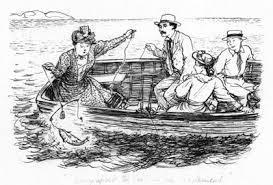
'The drawing’s all right but don’t worry about going over the edges,’ offers Florence Chaplin to the 17-year-old Ernest Shepard in his first term at the Royal Academy Schools. Sound advice for the artist who would later draw the world of Winnie-the-Pooh (and Mole, Ratty and Toad), and become an illustrator beloved by children everywhere.
In these two volumes of memoirs, we find a portrait of a childhood in two parts. Drawn from Memory (1957) covers 1887, the Golden Jubilee year in which Ernest turned 8. It is an account of a happy, loving child gazing up at the adult world, capturing the naïvety and enthusiasm of that age, when the heart races at the sight of a fire engine or a gunship on the Thames. He lives a sweet-tempered domestic life, extremely close to his brother Cyril (a companion on almost all adventures), with plenty of outings: to the pantomime, the music hall and the seaside. Both his parents – his father an architect, his mother musical – encourage his drawing, and his early sketches reveal ‘a somewhat lively imagination, mostly concerned with battle scenes’.
But the untroubled bliss of Ernest’s childhood ends in tragedy. Drawn from Life (1961) opens with the death of his adored mother, when he is 10. The children, sent away to the care of aunts, are devastated. The aunts become a steady presence from here on:Aunt Alicia, his godmother; Aunt Annie, an invalid; Aunt Fanny, ‘by far the most energetic’; Aunt Emily, ‘stout and short of breath’. They are the sort of aunts with whom things do not agree: trains, the cold, London.
The loss of his mother casts a long shadow over the years of prep school, but Ernest presses on, eventually getting to St Paul’s and from there to the Royal Academy Schools. Throughout all this he is always drawing, studying the people around him, watching for those moments of expression that come to characterize his style. One of the many joys of these delightful memoirs are the sketches and their captions – Ernest was a true master of capturing the vitality of a scene, and the emotional depths of his subjects.
Ernest Howard Shepard was an English artist and book illustrator. He was known especially for his human-like animals in illustrations for The Wind in the Willows by Kenneth Grahame and Winnie-the-Pooh by A. A. Milne.
This was a pleasant follow up to Drawn From Memory, and like its predecessor, was made charming by the plentiful illustrations. The very fact that it's pleasant is a bit of a surprise, since it starts with the death of Shepard's mother, and he'd explicitly said in the first book that his childhood was unhappy following that. You wouldn't know it from this book, the opening chapters of which chronicle not noticeably unhappy succeeding years of schooling and summer holidays with his aunts. I did enjoy it more once he became an art student and met his future wife, but still, the writing style was curiously flat. I didn't mind that quite as much in the first book because it suited the voice of his child-self better.
I loved this so much. It’s such a comforting, funny, delightful little book. There is no pretense to fancy writing in this but Shepard tells a great story and there are so many fun details. Shepard tells of his teenage and young adult years and ends the story with his wedding day. I loved reading about his aunts, the various schools and art schools he goes to ending at the Royal Academy, setting up his own studio, the friends he makes at art school, his family holidays abroad and in England, and how he takes on responsibility as he prepares to be married. His fiancé sounds like a delightful person. I love reading about a young couple who seem genuinely well matched even though they’re young and inexperienced.
I love Shepard’s relationship with his father and siblings, Cyril and Ethel, too. I also love reading about siblings who are friends. Ethel seemed like quite a fun and interesting person. I want a story about her! Also, I want book three: Drawn from Experience about his young married life and his early career and his wartime experiences and his children. Pretty please! Alas, since that doesn’t exist, I am content with this delightful book and will certainly be revisiting it in the future.
Another enjoyable read. I appreciated the credit he gave his wife, a fellow artist and better painter than Shepard. But the fact that she was still expected to cook for them...does not surprise, though it does annoy. I enjoyed his mention of meeting the artist Abbey who was working on the murals for the BPL in London and how Abbey got him an intro to an editor at Punch. I like the Abbey room at Boston's library very much. I'd have liked to read about his drawing Pooh and Ratty and Mole and all the others, but I guess I'll have to look for another memoir--or biography for that.
Having so loved the first volume of E H Shepard’s memoires recently I had to quickly acquire the second volume, and once it arrived I wanted to read it. Drawn from Memory; carries on the story of the young Ernest’s life from the time of his mother’s death, when he was a young boy, until he marries. Illustrated by author – the man famous for his illustrations of children’s literary classics like The Wind in the Willows and Winnie the Pooh – this book is every bit as lovely as the first volume. “Mother always encouraged my drawing and, although she had little talent herself, would show me how to use my paints. We made plans together for when I grew up and became an artist myself. She, almost more than Father, inspired me to persevere. After her death I missed her companionship terribly and determined to justify her faith in my talent.” A young Ernest accompanied his elder brother Cyril to St. Johns Wood preparatory school ‘Oliver’s’ for a while before transferring his education to St. Pauls public school where Ernest’s Uncle Willie was a schoolmaster. Here Ernest tries hard to not stand out too much, enjoys playing rugger, and seems to have not really encountered many problems, at St. Paul’s Ernest was unsurprisingly already doing well in the drawing class. By the time he was fifteen Ernest education was focussed mainly on his artist studies; when he began, while technically still a schoolboy, to spend some of his time at Heatherley’s art school. Later he became a student at the Royal Academy art schools. During these years Ernest meets Florence Chaplin herself a gifted art student – who he is later to marry – while making lifelong friends among his other fellow students. “The prize distribution at the Academy Schools that winter was really happy event for me. I had won a medal for a painted figure and ten pounds for a set of life drawings. But what pleased me even more was that Florence Chaplin had won the £40 prize for a mural. The subject was ‘The Procession of the Hours’ and she treated it by showing the Horae as female figures. It was lovely both in colour and design and the award was a most popular one, all agreeing that it was by far the best. She was later commissioned to carry out the design for the nurses’ dining-room at Guy’s Hospital. It was a big undertaking, measuring twenty-five feet in length, and took her over a year to paint. Many years later I was able to buy back the original drawing, and it hangs in my drawing room today” Ernest’s relationship with his family, his brother Cyril, sister Ethel, his father and a collection of aunts, is close, and described with quite obvious affection. Ernest’s architect father is supportive of his youngest son’s artistic ambitions and despite not having an awful lot of money – gives his children some wonderfully memorable holidays in Devon, Wales and Germany. In Kingswear, Devon, Ernest and his siblings are re-introduced to Gussie Rogers, an old friend of their mother’s; spending some very happy times with Gussie and her husband Groby to whom Ernest particularly took to. Shepard’s writing style is a fairly simple one, there’s a definite nostalgia about his recollections without any unnecessary sentimentality. Set against a backdrop of late Victorian life, remembering Queen Victoria’s diamond jubilee, and her death a few years later which plunged the entire country into silent mourning, ‘Drawn from Life’ is a wonderful evocation of a time long gone. I think so often we think of people living in late Victorian society as being really rather dour, and unlike ourselves. Yet the people in E H Shepard’s memoires certainly don’t come across like that. Whether it’s playing hockey among the antique school’s statuary casts or attempting to cycle from London to Bristol, Ernest’s memories of fun, friendship family and love are enormously engaging, and the people we meet in his company are portrayed with real warmth and are every bit as likeable as Ernest himself. As we bid a fond farewell to young Ernest at the end of this volume, he is just twenty four years old, has just sold a painting in the Royal Academy summer exhibition. On his wedding day as he moves into a small country cottage with his dear Pie (Florence), has seventy pounds in the bank and is looking forward to the future with optimism.
A continuation of Drawn from Memory, this book takes Shepard from the point when his mother dies to the time he marries. I really cannot say enough about how wonderful these memoirs are - Shepard's writing style is simple and clear, truthful without being either sentimental or negative. He tells of such interesting details (bike trips, holidays with family, school bullies, his difficulty painting, his first studio - just to name a few), and his drawings are pure delight.
I highly recommend it for anyone interested in Victorian times, artists, or childhood memoirs.
I read it with pleasure. I also read it because I had liked the first one so much. I still prefer the first one, by far, as I have little interest in Shepard himself, as it were. The first volume was superb for its theme of memory, its evocation of a certain time, its desperate desire to be there again, safe, innocent; this one is more of a regular autobiography, and so less interesting. Fine enough, but nothing really special.
a lovely portrait of family life in the late Victorian era- beautifully rendered through words and line drawings. Captures perfectly the excitement of the world as seen through the eyes of the young Earnest Shepard. Childhood adventures, sites, sounds, smells and people are well remembered and conveyed. Some awareness of class differences from the POV of the young as well as the demands of and relationships with extended family. A pleasure to read.
A charming memoir set in Victorian and Edwardian London. Beautifully illustrated as you'd expect from E. H. Shepard. I found this to be a good companion to his other memoir "Drawn from Memory" and together they give a more complete picture of his early life and young adulthood.
The most darling little book! Shepard's writing is beautifully evocative and filled with affection, as are the drawings peppered throughout. What a treat to have access to these snapshots of time, and to be able to experience events such as the Diamond Jubilee or exhibitions at the Royal academy from the view of young Shepard. Especially if you know some of the mentioned areas of London this will warm your heart.