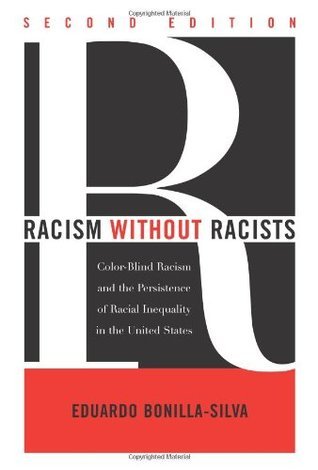
Very conflicted about this book: I'd say it was a 4 for the value of its core concepts but a 1 for the distorting effects that EBS's personal politics and ideology had on the argument. I found myself agreeing with a good deal of the core text, but the later essays tacked on to updated versions of the text were abysmal.
Let's start with the argument and its value. EBS argues that a new racial ideology has emerged in the post-Civil Rights era to justify continuing racial inequality and white domination: colorblind racism. I wish EBS had given a one or two sentence definition of this term, but here's what I think it is: white people using a variety of techniques (race-blind liberalism, claiming to have black friends, generalizing about minorities but with caveats, ascribing racist beliefs to others, purposeful vagueness, etc) to A. deny that racism continues today and seriously affects the life quality/opportunity/rights of people of color v. whites B. Come up with alternative, often POC-blaming explanations (usually cultural rather than biologically racial) for continued inequality and C. deny that they have any role to play either in creating the problem, benefitting from future/past racism and white privilege, or solving the problem.
EBS main research method is to convincingly lay out the data on continued racial inequality and then do extended qualitative interviews with white college students and white adults of various backgrounds on their views on race. While I sometimes thinks EBS spins these interviews to fit his own argument, the interviews do suggest a strong plausibility for his thesis. The interviewees show a tremendous ignorance about history and ongoing racial discrimination; they justify inequities with reliance on stereotypes; they use statements like "let the past be the past" or "let's treat everyone equally" to blithely deny the continuing relevance of racism; they exaggerate their contacts with black people; and they utterly fail to critically examine why, if they were raised in a mostly white environment, that was the case (other than pointing to the circular logic that 'people just like to live with their own). I was disturbed to find out how many people expressed concern with interracial marriage by pointing to the problems the kids will face; as if that's the problem of those parents or kids and not the problem of continued intolerance in society.
If I were EBS, here's how I would have framed my argument; this is sort of a toned-down version of his case. Overall, these interviews show that white Americans too often use colorblind frames and language to act as if we as a country had transcended race when we have not. It is the substitution of wish for inconvenient reality, and it colors a great deal of our politics and culture. It is, in short, a powerful denial mechanism. This belief can then be A. a way of justifying ongoing racial inequality B. A way of eschewing any responsibility C. A de facto defense of the racial status quo. This book shows how this mindset acts to undercut movements for racial progress given how many people simply don't think critically about race, our history, and their own lives/roles in these wider stories. Even though racism as a whole has declined and PoC have made significant progress in many ways, colorblind racism remains a major obstacle to change.
I think this is an argument that everyone should hear, and it is more or less a moderated version of what EBS says. Why did I moderate his argument? Because the actual book is way more flawed, ideological, and oversimplified than what I've presented above. Let's get to the problems in this book.
The root of this book's problems is the failure to distinguish scholarship from politics and ideology. Scholarship should entail minimizing one's ideological/political commitments as much as possible in the pursuit of truth; full objectivity is possible, but we strive for it nonetheless, in large part so we can have a chance of convincing people who don't already agree with us. EBS, however, openly roots his book in ideological/political commitments rather than trying to minimize them.
Here's one example: this book takes a sort of crude Marxist/Gramscian frame on colorblind racism. For EBS, ideology is exclusively a tool that dominant groups use to justify their dominance and to inculcate in the dominated a sense that their subordination is just. That's certainly part of what ideas/ideologies do. Through that lens, everything a white interviewee says that could be taken as justifying the racial hierarchy must be taken as such, and only as such. For example, opposition to affirmative action or busing or concerns about certain cultural trends that might be part of the problems holding back progress for PoC must be interpreted as wanting to preserve white racial domination or making excuses for continued racial inequalities. However, ideas/ideologies are not just about preserving domination. They are about situating oneself in society, envisioning a just society in which we can all live, locating oneself in a variety of traditions (cultural, faith-based, intellectual, etc), creating a moral code and identity for oneself, and so on.
EBS has only one frame to look at these interviews through, so naturally almost every answer fits his frame unless the speaker embraces a fully progressive politics. However, these interviewees (or many of them) are engaged in a more complex set of thought processes. They largely don't have a pre-existing commitment to the racial hierarchy; rather, they explain ongoing inequality through lazy thinking, assumptions, biases, and stereotypes. They generally want a society that is integrated and racially egalitarian, but they don't want to do anything to reach that point. They might desire these ends but have other moral commitments (equality under the law, meritocracy, for instance) that move them to oppose affirmative action, which you can plausibly argues violates those principles. They might have a conservative worldview in which top-down gov't solutions are seen as ineffective, backfiring, or producing unexpected outcomes. None of these positions, which are all over the interviews, is evidence of a white commitment to using colorblind racism to maintain racial inequality. Rather, what emerges from these interviews is ignorance, moral lassitude, and simplistic thinking that are the product of living in racially isolated environments and not making the effort to learn about race in our society. EBS, again because of this narrow ideological frame, can only see the power dynamic here. This dynamic exists, but to say it is the only thing at work is highly reductionist.
Another problem: EBS falls into what Bill Maher calls "progressophobia," or the downplaying or denial that any progress has been made for fear of being seen as justifying ongoing injustice. Colorblind ideology, as I said before, pretends we live in a world we don't live in; in that sense it is bad. But it is much, much better than the biological racism of Jim Crow, in which whites all over the country viewed PoC as essentially inferior to themselves and as inherently second-class citizens. This was the dominant way of looking at race 100 years ago; it was challenged here and there in the 20th century, but in the last 50 years or so we have seen dramatic changes in people's beliefs on race on everything from equal citizenship, intermarriage, intelligence, culture, and so on. The vast majority of Americans do not want to return to anything resembling Jim Crow or overt racism, although the ongoing denial of the continuing significance of race can be an excuse for embracing pretty racist politicians like Trump. I am not saying we are done; we are far from it, and in many ways we have been backsliding in recent years toward the return of overt racism and white nationalism. But in order to know how we made progress in the past we have to admit that some progress happened; this process is crucial for making progress now, but EBS seems committed to simply moving the goalposts on racism while not spelling out what a racially egalitarian society would look like (critical race theorists never seem to do this for some reason).
And this is where the mixing of politics and research particularly hampers this book: EBS measures progress solely by his own highly progressive political metric. If you aren't reaching EBS' standards (sort of social democratic Sanders type stuff plus CRT worldview), then you aren't making progress, thus allowing him to deny that progress had been made; instead, racism has simply morphed, Terminator style. This is how he can deny that the election of Obama signaled any progress on race at all, even though basically no one in 1961 when he was born would have considered this to be possible in their lifetimes. EBS argues in absurd fashion that Obama was "center right," that he played to white audiences and corporate overlords while ignoring PoC, and that he failed to achieve meaningful change. Of course, this ignores that if Obama had come out as a fire-breathing radical, he wouldn't have been elected dog catcher, much less president. It ignores the political limitations on "revolutionary action" imposed by the separation of powers, factions in his own party, the need to fundraise, and the resistance of an utterly obstructionist GOP.
EBS can't seem to credit that Obama just has a different worldview than he does (a similar problem for his interpretations of the interview subjects); he believes in working through the system, building coalitions with those who don't share all of your worldview, respecting and listening to opponents, and taking half a loaf. Obama didn't leave community organizing because he got tired of it or wanted more fame; he realized that there was a larger power structure that inhibited change at the local level and that people like him needed to be in that structure to push for change. This doesn't always work, but EBS thinks that the only way to achieve real change is through extra-systemic social protest movements. For example, EBS mentions only the social movements of the Civil Rights Era, failing to acknowledge the crucial role of politics: LBJ's alliance, the media, legislation, etc. It took both of these elements to achieve that massive success, but participation in electoral politics doesn't seem to satisfy EBS' desire for authenticity and revolutionary change (a fantasy, largely). As usual, King was much smarter and more strategic than most of those who claim his legacy today. All of Obama's accomplishments are dismissed for having not achieved systemic change, totally ignoring the context and the limitations on what political actors can achieve.
So for EBS, how do you become an antiracist and help address these problems? Essentially, as he says in his narrow-minded conclusion, you must become a progressive like him. In other words, his big plan for change is for everyone to go through antiracist therapy and emerge on the other side as a progressive activist. This kind of thinking will only lead to further stagnation for this incredibly important cause. Rather, scholars, activists, and others need to think of a way to build a big-tent antiracism that can encompass many worldviews and ideologies. For example, I am waiting for someone to spell out a modern, liberal anti-racism that is willing to work within and outside of electoral politics, that accepts multiple worldviews within an alliance for progress, that doesn't simply pathologize or dismiss those who disagree, and that doesn't think you can dismiss notions like civility, responsibility, and objectivity in the pursuit of justice. There have to be ways of building coalitions toward anti-racism that encompass liberals, centrists, progressives, and yes, even conservatives, as well as people who interpret the world primarily through a religious lens. Not everyone can be included in this, and at some point too much inclusion dilutes energy and action. But EBS' path is a path to marginalization and failure; it undermines both scholarship and action.
This is not a bad book; it is mixed. White Fragility is a bad book. After having read/listened to a number of these texts, here's what I think the big problem is: these scholars are not willing to listen to and converse with those who disagree with them. Accepting their ideology is the precondition for acceptance and action; if you disagree they seek to explain your disagreement as a product of power, privilege, ignorance, what-have-you. These factors may matter, but the world and issues like race are incredibly complex and even people of good faith are not going to converge on the same perspectives. So I think that's why so many people find this kind of scholarship and activism to be condescending, frustrating, and alienating. For me, a liberal anti-racism starts with listening to each other and trying to see the world as others see it. For all of this book's strengths, it fails in that essential task, and while its core concept may be part of the puzzle, this book is not a strong basis for building an anti-racism that would have any chance of integrating the very interviewees it is based on, the proxies for a country that needs to reexamine its commitment to simplistic colorblindness.