We have a copy of this book from when my sister, Jenny, was little. It is straight up from the early 70s. Grover is going through the "everything in the world" museum. It teaches kids how to categorize things, how to identify things, and then, of course, how to look around the world they live in with the perspective that they are, in fact, always in the everything in the world museum.
Not to get all philosophical, but when you read this book as often as I do, that is inevitable. I've searched for this book on Amazon to give it as a gift and it appears to be out of print. It is so cute. If you find it somewhere, snap it up and keep it.
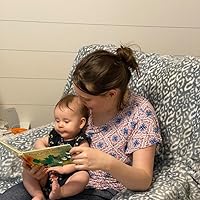
This is an awesome book that I read to Lauryn. We get to explore everything in the whole wide world! We discover things on the ground, things in the sky, things on the wall, things that grow from the ground, things that you can trip over, small things, heavy things, and all sorts of exciting new things for little toddlers to learn.
Lauryn loves to see Grover trip and fall through this entire book. She laughs when he and her gets tickled, and when she gets cuddled just like he does.
This book is super interactive in just learning about everything she can discover.
I definitely recommend this book to parent of toddlers.
It gets 4 stars, rather than 5, only because it's not The Monster at the End of this Book. But, then, what is? La Comédie humaine? The Ars Amatoria? Bob, Son of Battle? I don't think so.
Great book. One of my favs as a child. This book is a good way to teach us, kids, how some things are different and others are the same. It shows the similarities between objects as well as the differences. I loved this and I enjoyed reading it, I'd recommend this book.
Discounted from Thriftbooks. | For my money, the best Sesame Street book out there. Such a good read-aloud, with things to notice on every re-read, and lots of opportunities to point at a labeled item and ask the child to identify it (button! Fish! Balloon!). Every gentle, curious Grover fan will love it.
This book is an example of the mania I possess for the idea of "infinity". I would lay awake in bed saying, "The Earth was created day day day day day day day day day day . . . "
. . . because when I was little we used to say, "Oh, that was the day before yesterday. And THAT was the day-day before yesterday."
So every few days I'd "check in" and continue to mentally sound out, ". . . day day day day day day day day day . . ." saving up that finishing phrase for years and years later.
I'd even think of milestones I must have passed, like 1492, or the birth of Christ.
Okay, anyway, this book is like that. Or like those dreams where I'm tumbling in space and no direction is up and my foot can barely tap upon the surface of a planet with unknown coordinates and I don't ever think I'll reach another tangible place, or back where I started, home.
It's kind of akin to those other children's books like the one of the snail and the largest house in the world, or the illustrated version of The Fisherman and His Wife. You know, things go on and on, and reach a pinnacle.
Long story short, this is the story of Grover going through a museum that holds every object in the world. Everything that can be categorized as something or existing in a certain state. I'm gonna go home and read it right now.
This Little Golden Book, written by Norman Stiles & Daniel Wilcox and illustrated by Joe Mathieu (1974), is a Sesame Street comic-style picture book. While it can't compete with the all-time bestselling The Monster at the End of This Book (1971), it's still thought-provoking. (There's a read-through of the book in a Grover voice here.)
Lovably clumsy monster Grover visits the Everything in the Whole Wide World Museum, and stumbles through on his own (no visitors or museum staff are visible). Most of the rooms contain, on pedestals, several things that fit into a category, such as "The Things That Make So Much Noise You Can't Think Room" and "The Long Thin Things You Can Write with Room." (In the latter, Grover finds a carrot, realizes that it's misplaced, and succeeds in restoring it to its proper place – in the otherwise empty Carrot Room. Pretty surreal.) If the reader notices that these categories are somewhat arbitrary and not the way that things are usually categorized, they might start thinking about how we do categorize things and why.
To be honest, in between readings of this book, I usually forget the specifics of the museum rooms. What I remember most is the ending: Grover ponders, "You know, I have seen many things in this museum. But I have still not seen everything in the whole wide world. Where did they put everything else? Aha!" He finds two enormous doors labeled "Everything Else." On the last page, having opened the doors, Grover finds himself outside. He exclaims, "Look at this! Buildings! Bushes! Windows! Mountains..." The end. I think the message is that it's worth looking at things in the world with a sense of awe, wonder, and radical amazement, as if they were things on display in a museum.
Outstanding! Hilarious! I genuinely laughed out loud. First of all, I love Grover, he's probably close to my favourite Muppet - and I love museums and taxonomy and things of that ilk - but this was so funny on top of that, and has a good point at the end too. It's not the easiest to find, but I think every kid I know should have this.
Fantastically detailed illustrations, will keep minds occupied- both young and old! Glad the Kindle edition is available since it seems to be out of print.
This is a pleasant gem among Sesame Street branded books. The almost comic book style illustrations manage to remain interesting, yet unobtrusive. The text reads well at face value, and provides the lovable sense of humor many children associate with Sesame Street. Older children will be exposed to a higher level of knowledge by delving deeper into the ancillary material. The detailed illustrations provide a good level of involvement and open multiple opportunities for learning across a breadth of topics.
A very important book in my childhood and my relationship with my paternal grandmother. I still love the concept of an everything in the world museum... and how all inherent issues in that concept werent necessarily lost on the authors of this book, which makes sense as it is a sesame street book and prior to the mid nineties sesame street failed to make many mistakes as an organization, and I doubt they make too many nowadays. Plus grover is fantastic, way better than elmo
One of my all-time favorite books from childhood. The illustrations are incredibly engaging, and the story is simple, yet entertaining, even for very, very young kids, as Grover goes on a crazy journey to a museum that holds, well, everything in the whole wide world. My mom and I read this book so much, it was too tattered to save. This book brings back great memories.
In this book, readers travel with Grover to the Everything in the Whole Wide World Museum and they take a look around. There are rooms with soft things, hard things, and things that can tickle you. The book is a fun way to learn vocabulary while making it fun for readers with jokes and silly characters in the background.
Great book. I'm pretty sure Sandra Dodd referred to this book in her writings on unschooling. Why explore the Everything in the Whole Wide World Museum when you can explore the whole wide world? Why get kids ready for the real world by going to school, when they can live in the real world instead? Love it.
I loved this book when I was a kid, and now my children love it too. So much fun as Grover visits the museum that has everything in the whole wide world in it. Doesn't seem possible, but with a little inventiveness and a child's imagination, it's amazing the places this book will take you. Highly recommended.
This is an amazing book. I read it over and over as a child. The animations are fun and creative, with each page holding your attention with all the things to look at. Always a great choice for those with kids that are just old enough to handle paperback books by themselves. You can learn new sounds and basic words, as well as more complex things like weight and object placement. 5 stars.